Page 161 of 440
161
2-4. Using other
driving systems
2
When driving
CAUTION
■When VSC is activated
The slip indicator light flashes and a warning buzzer sounds. Always drive
carefully. Reckless driving may cause an accident. Exercise particular care
when the indicator light flashes and a buzzer sounds.
■ Replacing tires
Make sure that all tires are of the same size, brand, tread pattern and total
load capacity. In addition, make sure that the tires are inflated to the recom-
mended tire pressure level.
The ABS and VSC system will not function correctly if different tires are fitted
on the vehicle.
Contact your Toyota dealer for further information when replacing tires or
wheels.
■ Handling of tires and suspension
Using tires with any kind of problem or modifying the suspension will affect
the driving assist systems, and may cause the system to malfunction.
Page 162 of 440
162
2-5. Driving information
Cargo and luggage
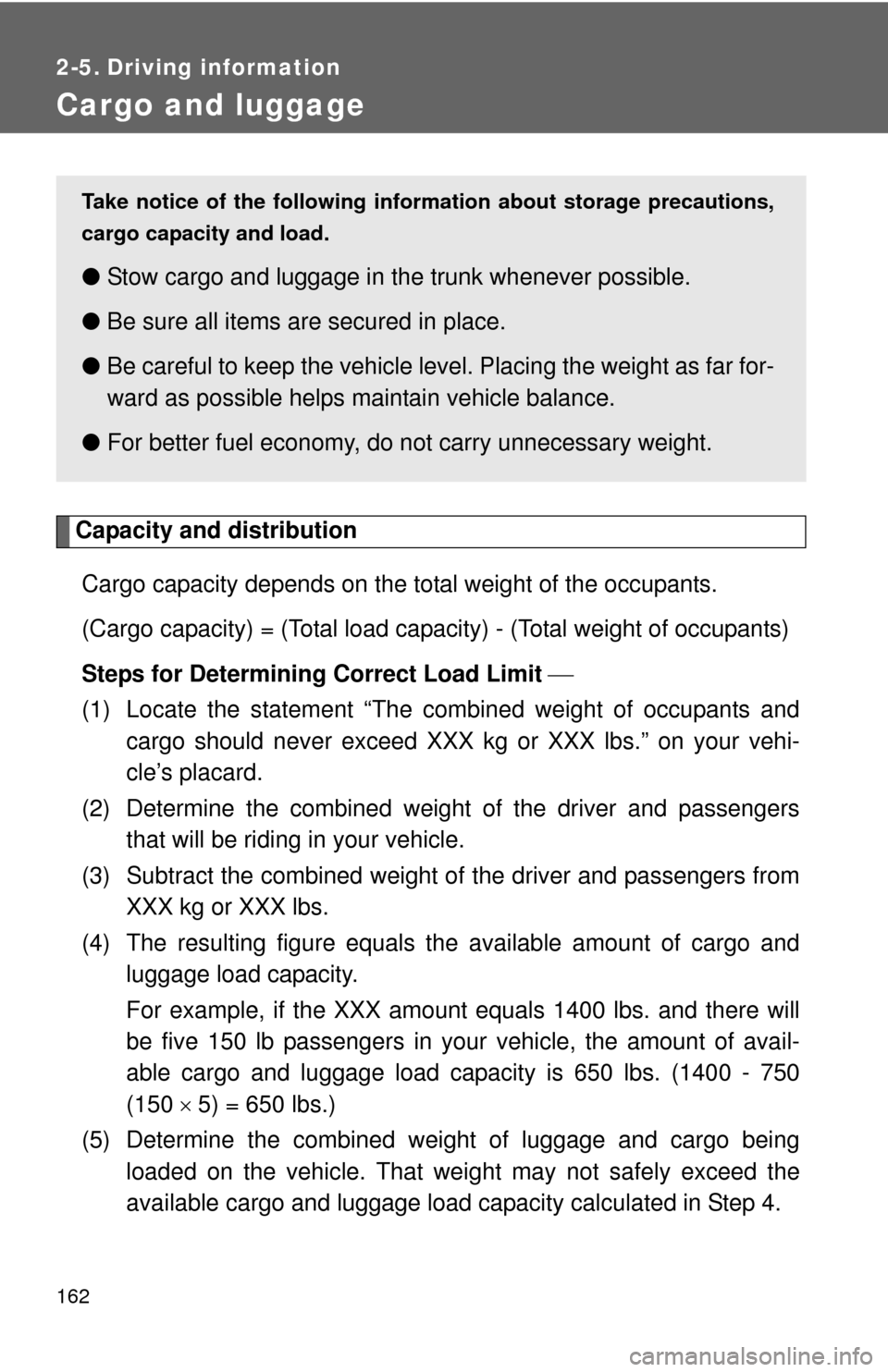
Capacity and distributionCargo capacity depends on the total weight of the occupants.
(Cargo capacity) = (Total load capacity) - (Total weight of occupants)
Steps for Determining Correct Load Limit
(1) Locate the statement “The co mbined weight of occupants and
cargo should never exceed XXX kg or XXX lbs.” on your vehi-
cle’s placard.
(2) Determine the combined weight of the driver and passengers that will be riding in your vehicle.
(3) Subtract the combined weight of the driver and passengers from XXX kg or XXX lbs.
(4) The resulting figure equals the available amount of cargo and luggage load capacity.
For example, if the XXX amount equals 1400 lbs. and there will
be five 150 lb passengers in your vehicle, the amount of avail-
able cargo and luggage load capacity is 650 lbs. (1400 - 750
(150 5) = 650 lbs.)
(5) Determine the combined wei ght of luggage and cargo being
loaded on the vehicle. That weig ht may not safely exceed the
available cargo and luggage load capacity calculated in Step 4.
Take notice of the following info rmation about storage precautions,
cargo capacity and load.
● Stow cargo and luggage in the trunk whenever possible.
● Be sure all items are secured in place.
● Be careful to keep the vehicle level. Placing the weight as far for-
ward as possible helps maintain vehicle balance.
● For better fuel economy, do no t carry unnecessary weight.
Page 163 of 440
163
2-5. Driving information
2
When driving
(6) If your vehicle will be towing a trailer, load from your trailer will be
transferred to your vehicle. Cons ult this manual to determine how
this reduces the available ca rgo and luggage load capacity of
your vehicle.
Toyota does not recommend towing a trailer with your vehicle. Your
vehicle is not designed for trailer towing.
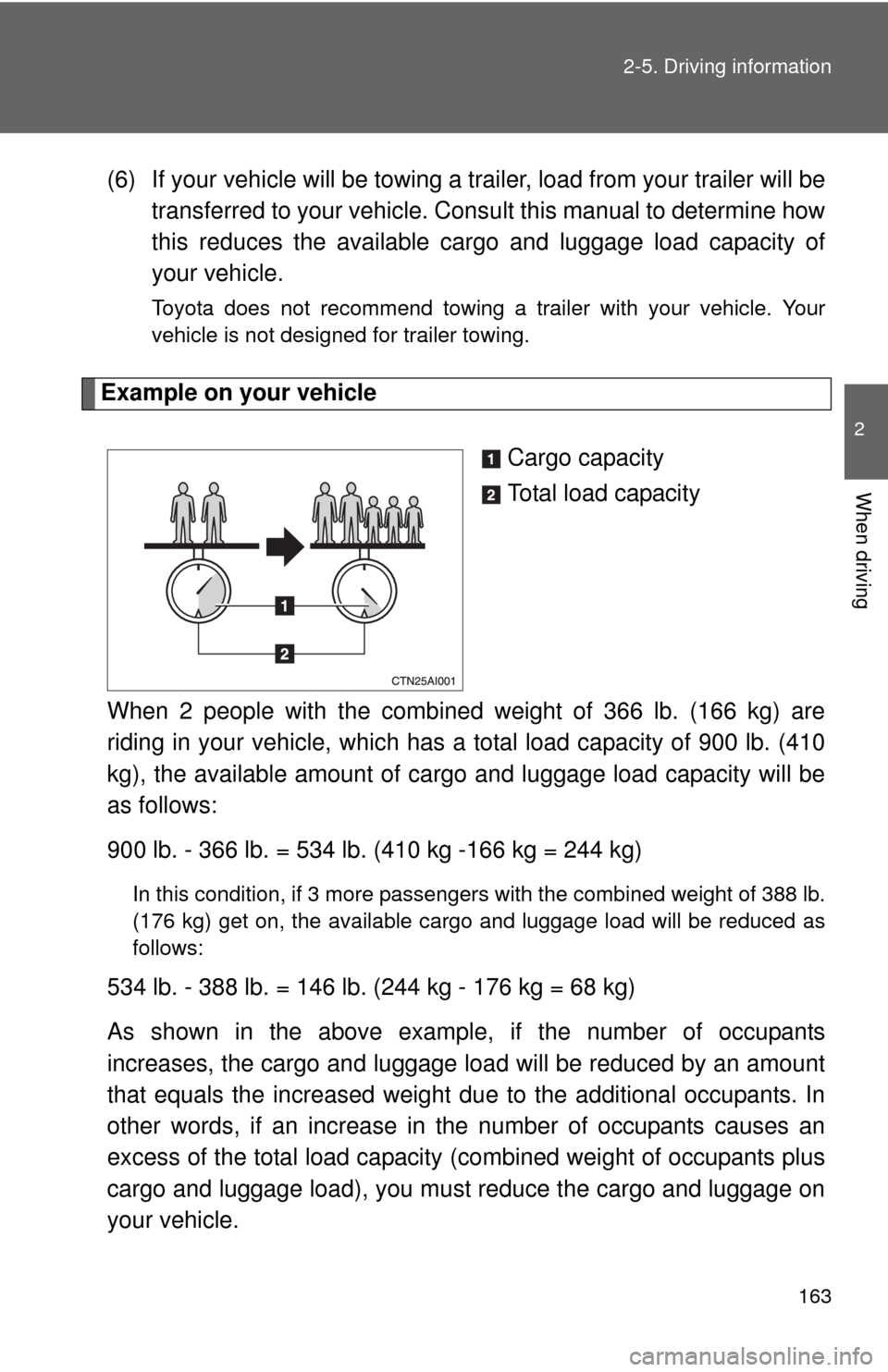
Example on your vehicle
Cargo capacity
Total load capacity
When 2 people with the combined weight of 366 lb. (166 kg) are
riding in your vehicle, which has a total load capacity of 900 lb. (410
kg), the available amount of cargo and luggage load capacity will be
as follows:
900 lb. - 366 lb. = 534 lb. (410 kg -166 kg = 244 kg)
In this condition, if 3 more passengers with the combined weight of 388 lb.
(176 kg) get on, the available cargo and luggage load will be reduced as
follows:
534 lb. - 388 lb. = 146 lb. (244 kg - 176 kg = 68 kg)
As shown in the above example, if the number of occupants
increases, the cargo and luggage load will be reduced by an amount
that equals the increased weight du e to the additional occupants. In
other words, if an increase in th e number of occupants causes an
excess of the total load capacity (combined weight of occupants plus
cargo and luggage load), you must reduce the cargo and luggage on
your vehicle.
Page 164 of 440
164 2-5. Driving information
CAUTION
■Storage precautions
●Do not place anything on the package tray behind the rear seatback.
Such items may be thrown about and possibly injure people in the vehicle
during sudden braking or in an accident.
● Do not drive with objects on top of the instrument panel.
They may interfere with the driver’s field of view or move during sharp
acceleration or turning, thus impairing the driver’s control of the vehicle. In
an accident they may injure the vehicle occupants.
● Secure all items in the occupant compartment, as they may shift and injure
someone during an accident or sudden braking.
■ Capacity and distribution
●Do not exceed the maximum axle weight rating or the total vehicle weight
rating.
● Even if the total load of occupant's weight and the cargo load is less than
the total load capacity, do not apply the load unevenly.
Improper loading may cause deteriorati on of steering or braking control
which may cause death or serious injury.
Page 165 of 440
165
2-5. Driving information
2
When driving
Vehicle load limits
■Total load capacity and seating capacity
These details are also described on the tire and loading information label.
(P. 313)
CAUTION
■ Overloading the vehicle
Do not overload the vehicle.
It may not only cause damage to the tires, but also degrade steering and
braking ability, resulting in an accident.
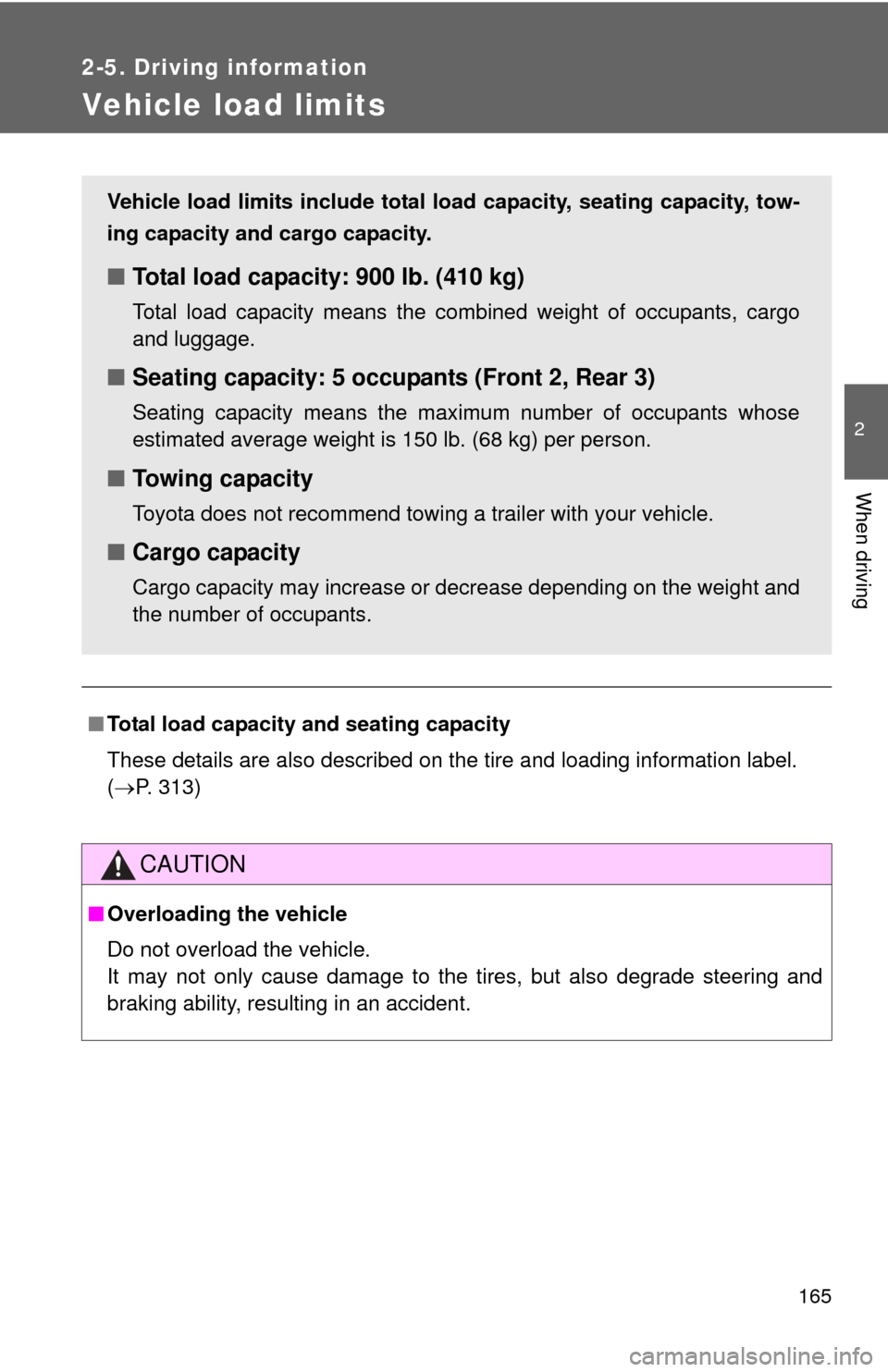
Vehicle load limits include total load capacity, seating capacity, tow-
ing capacity and cargo capacity.
■ Total load capacity: 900 lb. (410 kg)
Total load capacity means the combined weight of occupants, cargo
and luggage.
■Seating capacity: 5 occupants (Front 2, Rear 3)
Seating capacity means the maximum number of occupants whose
estimated average weight is 150 lb. (68 kg) per person.
■Towing capacity
Toyota does not recommend towing a trailer with your vehicle.
■Cargo capacity
Cargo capacity may increase or decrease depending on the weight and
the number of occupants.
Page 309 of 440

309
4-3. Do-it-yourself maintenance
4
Maintenance and care
■
Tire types
1 Summer tires
Summer tires are high-speed performance tires best suited to highway
driving under dry conditions. Since summer tires do not have the same
traction performance as snow tires, summer tires are inadequate for driv-
ing on snow-covered or icy roads. Fo r driving on snow-covered roads or
icy roads, the use of snow tires is recommended. When installing snow
tires, be sure to replace all four tires.
2 All season tires All season tires are designed to provide better traction in snow and to be
adequate for driving in most winter conditions, as well as for use year
round. All season tires, however, do not have adequate traction perfor-
mance compared with snow tires in heavy or loose snow. Also, all season
tires fall short in acceleration and handling performance compared with
summer tires in highway driving.
3 Snow tires
For driving on snow-covered roads or icy roads, we recommend using
snow tires. If you need snow tires, select tires of the same size, construc-
tion and load capacity as the originally installed tires. Since your vehicle
has radial tires as original equipment, make sure your snow tires also
have radial construction. Do not install studded tires without first checking
local regulations for possible restrictions. Snow tires should be installed on
all wheels. ( P. 166)
■ Initializing the tire pressure warning system
Initialize the tires with the tire inflation pressure adjusted to the specified
level.
Page 317 of 440
317
4-3. Do-it-yourself maintenance
4
Maintenance and care
Wheels
■When replacing wheels
The wheels of your Toyota are equipped with tire pressure warning valves
and transmitters that allow the tire pressure warning system to provide
advanced warning in the event of a loss in tire inflation pressure. Whenever
wheels are replaced, the tire pressure warning valves and transmitters must
be switched over from the old wheels. (P. 305)
If a wheel is bent, cracked or heavily corroded, it should be replaced.
Otherwise, the tire may separat e from the wheel or cause loss of
handling control.
■ Wheel selection
When replacing wheels, care should be taken to ensure that
they are equivalent to those removed in load capacity, diameter,
rim width, and offset.
Replacement wheels are available at your Toyota dealer.
Toyota does not recommend using:
●Wheels of different sizes or types
● Used wheels
● Bent wheel that have been straightened
■ Aluminum wheel precautions
●Use only Toyota wheel nuts and wrenches designed for use
with your aluminum wheels.
● When rotating, repairing or changing your tires, check that the
wheel nuts are still tight after driving 1000 miles (1600 km).
● Be careful not to damage the aluminum wheels when using
tire chains.
● Use only Toyota genuine bal ance weights or equivalent and
use a plastic or rubber hammer when balancing your wheels.
Page 400 of 440
400 6-1. Specifications
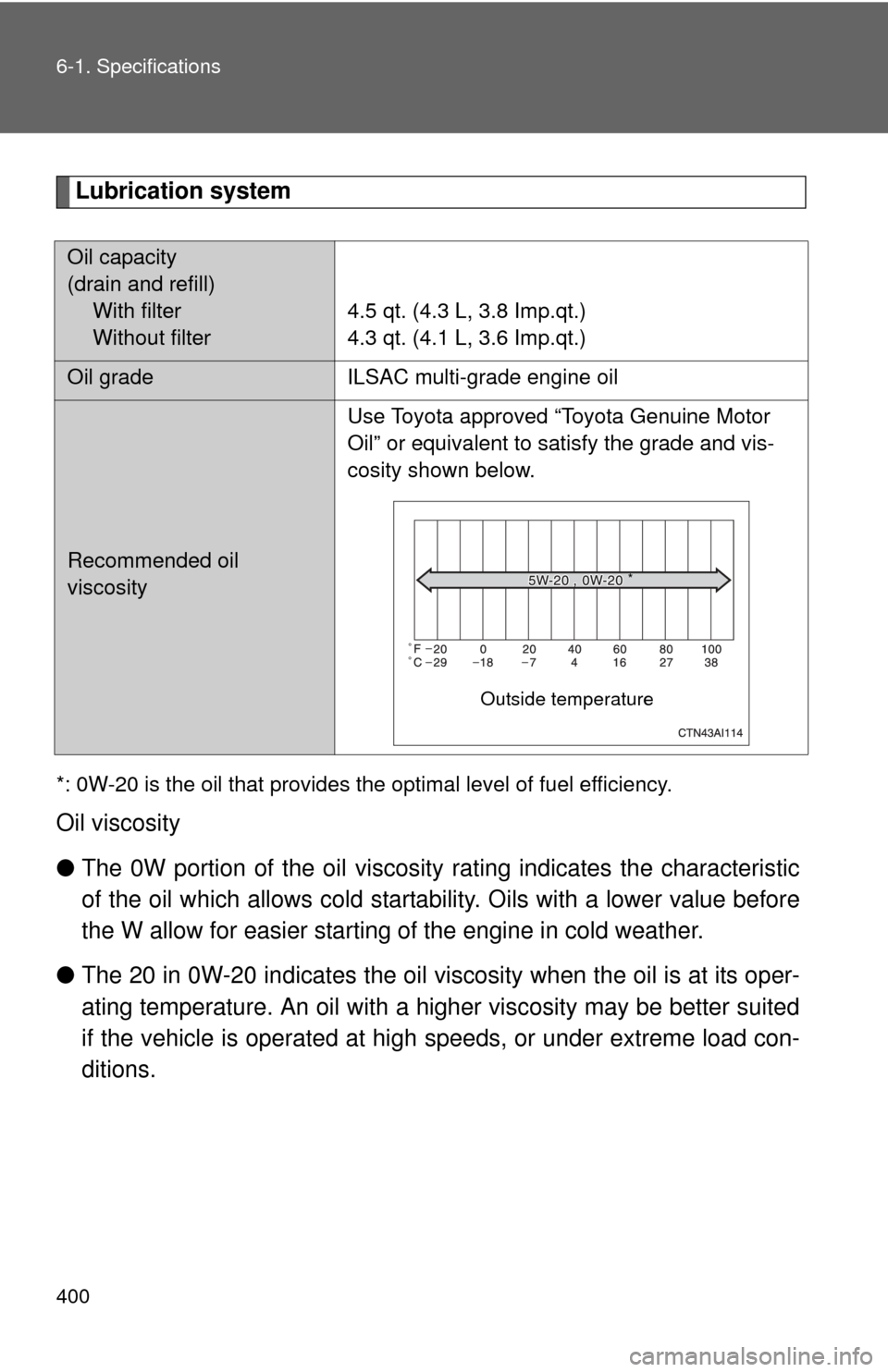
Lubrication system
*: 0W-20 is the oil that provides the optimal level of fuel efficiency.
Oil viscosity
●The 0W portion of the oil viscosity rating indicates the characteristic
of the oil which allows cold startab ility. Oils with a lower value before
the W allow for easier starting of the engine in cold weather.
● The 20 in 0W-20 indicates the oil viscosity when the oil is at its oper-
ating temperature. An oil with a higher viscosity may be better suited
if the vehicle is operated at high speeds, or under extreme load con-
ditions.
Oil capacity
(drain and refill) With filter
Without filter 4.5 qt. (4.3 L, 3.8 Imp.qt.)
4.3 qt. (4.1 L, 3.6 Imp.qt.)
Oil grade
ILSAC multi-grade engine oil
Recommended oil
viscosity Use Toyota approved “Toyota Genuine Motor
Oil” or equivalent to satisfy the grade and vis-
cosity shown below.
Outside temperature
*