Page 88 of 452

88 1-7. Safety information
AVALON_U_(L/O_0802)
CAUTION
■SRS airbag precautions
Observe the following precautions regarding the airbags. Failure to do so
may cause death or serious injury.
● The driver and all passengers in the vehicle must wear their seat belts
properly.
The SRS airbags are supplemental devices to be used with the seat belts.
● The SRS driver airbag deploys with considerable force, and can cause
death or serious injury especially if the driver is very close to the airbag.
The National Highway Traffic Safety Administration (“NHTSA”) advises:
Since the risk zone for driver airbag is the first 2 - 3 in. (50 - 75 mm) of
inflation, placing yourself 10 in. (250 mm) from your driver airbag provides
you with a clear margin of safety. This distance is measured from the cen-
ter of the steering wheel to your breastbone. If you sit less than 10 in. (250
mm) away now, you can change your driving position in several ways:
• Move your seat to the rear as far as you can while still reaching the pedals comfortably.
• Slightly recline the back of the seat. Although vehicle designs vary, many drivers can achieve the 10 in. (250 mm) distance, even with the
driver seat all the way forward, simply by reclining the back of the seat
somewhat. If reclining the back of your seat makes it hard to see the
road, raise yourself by using a firm, non-slippery cushion, or raise the
seat if your vehicle has that feature.
• If your steering wheel is adjustable, tilt it downward. This points the air- bag toward your chest instead of your head and neck.
The seat should be adjusted as recommended by NHTSA above, while still
maintaining control of the foot pedals, steering wheel, and your view of the
instrument panel controls.
Page 90 of 452
90 1-7. Safety information
AVALON_U_(L/O_0802)
CAUTION
■SRS airbag precautions
● Do not sit on the edge of the seat or
lean against the dashboard.
● Do not allow a child to sit on the knees
of a front passenger while the vehicle is
moving.
● Do not drive the vehicle while the driver
or passenger have items resting on
their knees.
● Do not lean against the door, the roof
side rail or the front, side and rear pil-
lars.
● Do not allow anyone to kneel on the
passenger seat toward the door or put
their head or hands outside the vehicle.
Page 113 of 452

When driving2
113
AVALON_U_(L/O_0802)
2-1. Driving procedures ........ 114Driving the vehicle............ 114
Engine (ignition) switch
(with smart key
system) .......................... 122
Engine (ignition) switch
(without smart key
system) .......................... 126
Automatic transmission .... 129
Turn signal lever .............. 133
Parking brake ................... 134 2-2. Instrument cluster.......... 135
Gauges and meters ......... 135
Indicators and warning
lights .............................. 138
Center display .................. 141
2-3. Operating the lights and
windshield wipers ........ 143
Headlight switch ............... 143
Fog light switch ................ 145
Windshield wipers and
washer ........................... 146
2-4. Using other driving
systems ........................ 149
Cruise control ................... 149
Dynamic laser cruise
control ............................ 152
Driving assist systems ..... 163
2-5. Driving information ........ 166 Cargo and luggage .......... 166
Vehicle load limits ............ 169
Winter driving tips ............ 170
Trailer towing ................... 175
Dinghy towing .................. 176
Page 143 of 452
143
2
When driving
AVALON_U_(L/O_0802)
2-3. Operating the lights and windshield wipers
Headlight switch
Turning on the high beam headlightsWith the headlights on, push
the lever forward to turn on the
high beams.
Pull the lever back to the center
position to turn the high beams
off.
Pull the lever toward you to
turn on the high beams.
Release to turn them off. You can
flash the high beams with the
headlights on or off.
The headlights can be operated manually or automatically.
The side marker, parking, tail, license plate and instrument
panel lights turn on.
The headlights and all lights listed above turn on.
The headlights and all the lights listed above turn on and off
automatically. (When the “ENGINE START STOP” switch or
the engine switch is in ON mode.)
Turn off the daytime running light system.
U.S.A. Canada
(if equipped)
Page 148 of 452
148 2-3. Operating the lights and windshield wipers
AVALON_U_(L/O_0802)
■In extremely hot or cold weather
The system will turn off if the windshield gets extremely hot (at more than
176°F [80°C]) or cold (at less than 14°F [-10°C]).
■ Customization that can be co nfigured at Toyota dealer
Settings (e.g. drip prevention function) can be changed.
(Customizable features P. 432)
CAUTION
■Caution regarding the use of windshield wipers in “AUTO” mode
The windshield wipers may operate unexpect edly if the sensor is touched or
the windshield is subject to vibration in “AUTO” mode. Take care that your
fingers or anything else do not become caught in the windshield wipers.
NOTICE
■ When the windshield is dry
Do not use the wipers, as they may damage the windshield.
■ When there is no washer fluid spray from the nozzle
Damage to the washer fluid pump may be caused if the lever is pulled
toward you and held continually.
Page 150 of 452
150 2-4. Using other driving systems
AVALON_U_(L/O_0802)
■Cruise control can be set when
● The shift lever is in the “D” or “4”, “5”, or “6” range of “S” mode.
● Vehicle speed is between approximately 25 mph (40 km/h) and 125 mph
(200 km/h).
■ Accelerating
The vehicle can be accelerated normally. After acceleration, the set speed
resumes.
■ Automatic cruise control cancelation
The set speed is automatically canceled in any of the following situations.
● Actual vehicle speed falls more than 10 mph (16 km/h) below the preset
vehicle speed
At this time, the memorized set speed is not retained.
● Actual vehicle speed is below 25 mph (40 km/h)
● VSC is activated
■ If the cruise control indicator light flashes
Turn the “ON-OFF” button off once, and then reactivate the system.
If the cruise control speed cannot be set or if the cruise control cancels
immediately after being activated, there may be a malfunction in the cruise
control system. Have the vehicle inspected by your Toyota dealer.
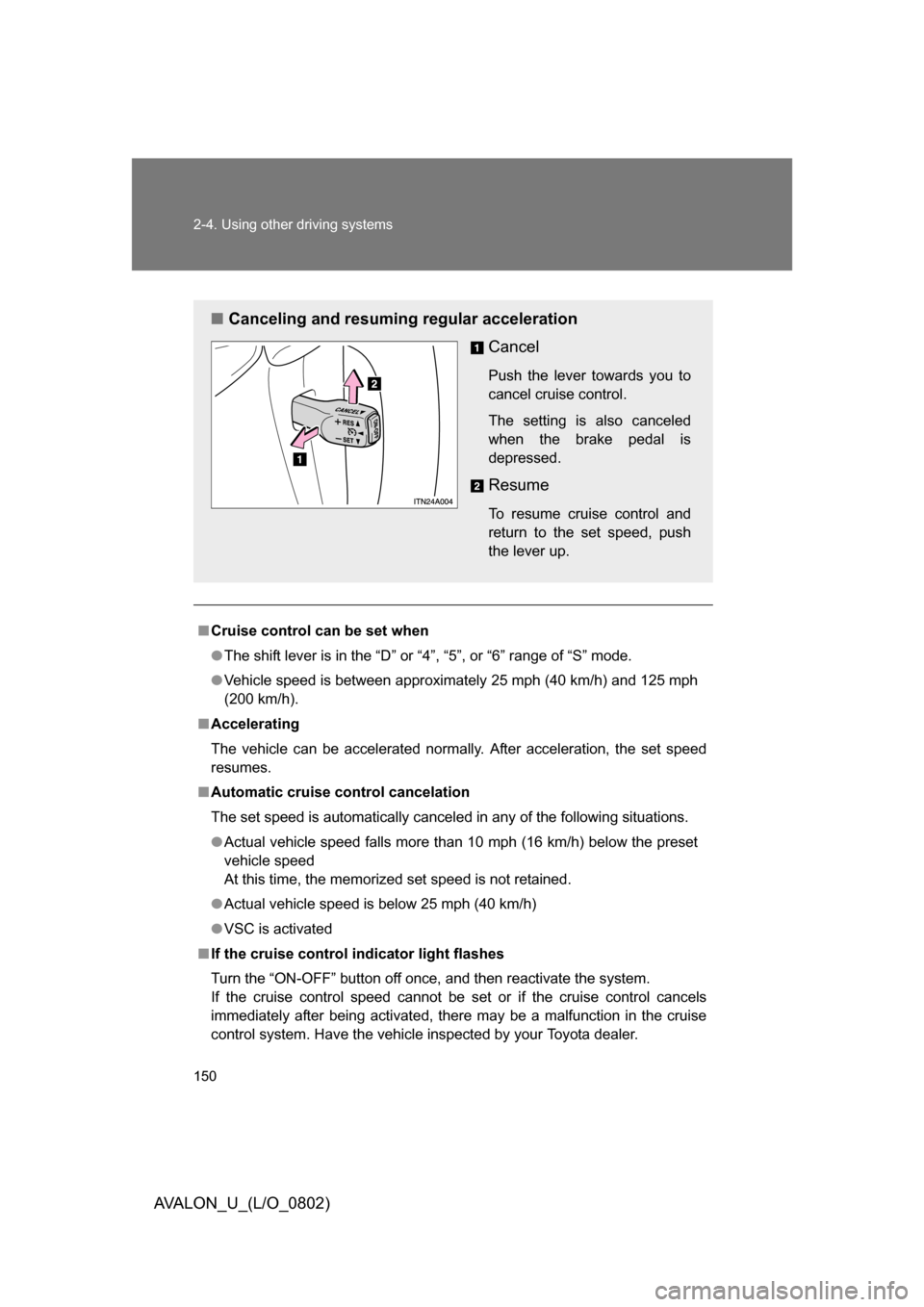
■ Canceling and resuming regular acceleration
Cancel
Push the lever towards you to
cancel cruise control.
The setting is also canceled
when the brake pedal is
depressed.
Resume
To resume cruise control and
return to the set speed, push
the lever up.
Page 154 of 452
154 2-4. Using other driving systems
AVALON_U_(L/O_0802)
■Canceling and resuming the speed setting
Cancel
Push the lever towards you to
cancel cruise control.
The setting is also canceled
when depressing the brake
pedal.
Resume
To resume cruise control and
return to the set speed, push
the lever up.
■Changing the vehicle -to-vehicle distance
Each push of the switch
changes the vehi cle-to-vehicle
distance
Long
Medium
Short
The vehicle-to-vehicle distance
is automatically set to the long
mode when the “ENGINE
START STOP” switch or the
engine switch is set to the ON
mode.
A vehicle mark is displayed
ahead if one is detected. Preceding vehicle mark
Page 166 of 452
166
AVALON_U_(L/O_0802)
2-5. Driving information
Cargo and luggage
Capacity and distributionCargo capacity depends on the total weight of the occupants.
(Cargo capacity) = (Total load capacity) – (Total weight of occupants)
Steps for Determining Correct Load Limit—
(1) Locate the statement “The comb ined weight of occupants and
cargo should never exceed XXX kg or XXX lbs.” on your vehi-
cle’s placard.
(2) Determine the combined weight of the driver and passengers that will be riding in your vehicle.
(3) Subtract the combined weight of the driver and passengers from
XXX kg or XXX lbs.
(4) The resulting figure equals the available amount of cargo and luggage load capacity.
For example, if the “XXX” amount equals 1400 lbs. and there will
be five 150 lb passengers in your vehicle, the amount of avail-
able cargo and luggage load capacity is 650 lbs. (1400 – 750 (5
150) = 650 lbs.)
(5) Determine the combined weight of luggage and cargo being loaded on the vehicle.
That weight may not safely exceed the available cargo and lug-
gage load capacity calculated in Step 4.
Take notice of the following information about storage precau-
tions, cargo capacity and load.
●Stow cargo and luggage in the trunk whenever possible. Be
sure all items are secured in place.
● Be careful to keep the vehicle le vel. Placing the weight as far
forward as possible helps maintain vehicle balance.
● For better fuel economy, do no t carry unnecessary weight.


![TOYOTA AVALON 2008 XX30 / 3.G Owners Manual 148 2-3. Operating the lights and windshield wipers
AVALON_U_(L/O_0802)
■In extremely hot or cold weather
The system will turn off if the windshield gets extremely hot (at more than
176°F [80°C])](/manual-img/14/6155/w960_6155-147.png "TOYOTA AVALON 2008 XX30 / 3.G Owners Manual 148 2-3. Operating the lights and windshield wipers
AVALON_U_(L/O_0802)
■In extremely hot or cold weather
The system will turn off if the windshield gets extremely hot (at more than
176°F [80°C])")
