Page 146 of 496
134
CY14016
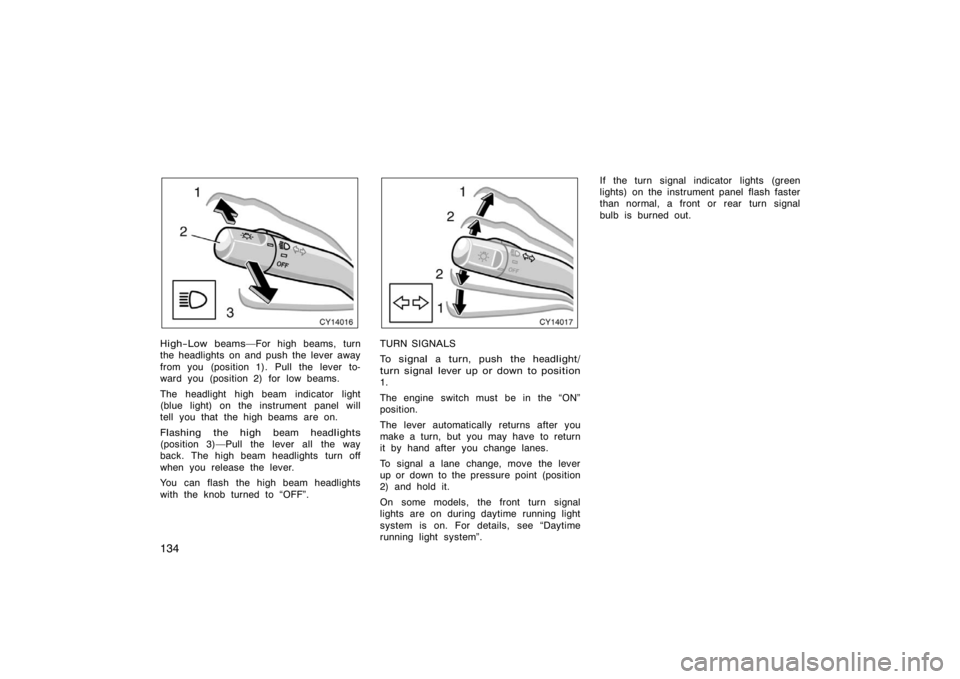
High−Low beams�For high beams, turn
the headlights on and push the lever away
from you (position 1). Pull the lever to-
ward you (position 2) for low beams.
The headlight high beam indicator light
(blue light) on the instrument panel will
tell you that the high beams are on.
Flashing the high beam headlights
(position 3)�Pull the lever all the way
back. The high beam headlights turn off
when you release the lever.
You can flash the high beam headlights
with the knob turned to �OFF".
CY14017
TURN SIGNALS
To signal a turn, push the headlight/
turn signal lever up or down to position
1.
The engine switch must be in the �ON"
position.
The lever automatically returns after you
make a turn, but you may have to return
it by hand after you change lanes.
To signal a lane change, move the lever
up or down to the pressure point (position
2) and hold it.
On some models, the front turn signal
lights are on during daytime running light
system is on. For details, see �Daytime
running light system". If the turn signal indicator lights (green
lights) on the instrument panel flash faster
than normal, a front or rear turn signal
bulb is burned out.
Page 148 of 496
136
CY14044
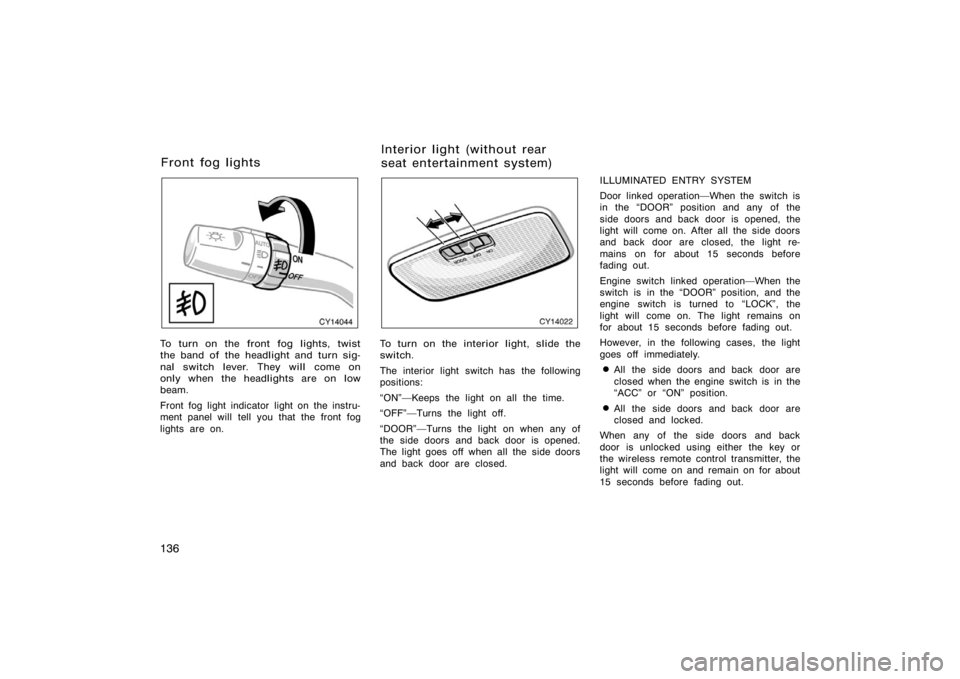
To turn on the front fog lights, twist
the band of the headlight and turn sig-
nal switch lever. They will come on
only when the headlights are on low
beam.
Front fog light indicator light on the instru-
ment panel will tell you that the front fog
lights are on.
CY14022
To turn on the interior light, slide the
switch.
The interior light switch has the following
positions:
�ON"�Keeps the light on all the time.
�OFF"�Turns the light off.
�DOOR"�Turns the light on when any of
the side doors and back door is opened.
The light goes off when all the side doors
and back door are closed.ILLUMINATED ENTRY SYSTEM
Door linked operation�When the switch is
in the �DOOR" position and any of the
side doors and back door is opened, the
light will come on. After all the side doors
and back door are closed, the light re-
mains on for about 15 seconds before
fading out.
Engine switch linked operation�When the
switch is in the �DOOR" position, and the
engine switch is turned to �LOCK", the
light will come on. The light remains on
for about 15 seconds before fading out.
However, in the following cases, the light
goes off immediately.
�All the side doors and back door are
closed when the engine switch is in the
�ACC" or �ON" position.
�All the side doors and back door are
closed and locked.
When any of the side doors and back
door is unlocked using either the key or
the wireless remote control transmitter, the
light will come on and remain on for about
15 seconds before fading out.
Front fog lights Interior light (without rear
seat entertainment system)
Page 436 of 496

424
Power steering fluid level
Check the level through the reservoir. The
level should be in the �HOT" or �COLD"
range depending on the fluid temperature.
See page 440 in Section 7−2 for addition-
al information.
Exhaust system
If you notice any change in the sound of
the exhaust or smell exhaust fumes, have
the cause located and corrected immedi-
ately. (See �Engine exhaust cautions" on
page 343 in Section 2.)
INSIDE THE VEHICLE
Items listed below should be checked
regularly, e.g. while performing periodic
services, cleaning the vehicle, etc.
Lights
Make sure the headlights, stop lights, tail
lights, turn signal lights, and other lights
are all working. Check headlight aim.
Service reminder indicators and warning
buzzers
Check that all service reminder indicators
and warning buzzers function properly.
Steering wheel
Check that it has the specified free play.
Be alert for changes in steering condition,
such as hard steering or strange noise.Seats
Check that all front seat controls such as
seat adjusters, seatback recliner, etc. op-
erate smoothly and that all latches lock
securely in any position. Check that the
head restraint move up and down smooth-
ly and that the locks hold securely in any
latched position. For folding−down rear
seatbacks and swing−up rear seat cush-
ions (vehicles without third seats), tum-
bling second seats (vehicles with third
seats), folding−up third seats and detach-
able third seats, check that the latches
lock securely.
Seat belts
Check that the seat belt system such as
buckles, retractors and anchors operate
properly and smoothly. Make sure that the
belt webbing is not cut, frayed, worn or
damaged.
Accelerator pedal
Check the pedal for smooth operation and
uneven pedal effort or catching.
Brake pedal
Check the pedal for smooth operation and
that the pedal has the proper clearance.
Check the brake booster function.
Brakes
In a safe place, check that the brakes do
not pull to one side when applied.
Parking brake
Check that the pedal has the proper travel
and that, on a safe incline, your vehicle
is held securely with only the parking
brake applied.
Automatic transmission �Park" mecha-
nism
On a safe incline, check that your vehicle
is held securely with the selector lever in
�P" position and all brakes released.
OUTSIDE THE VEHICLE
Items listed below should be performed
from time to time, unless otherwise
specified.
Fluid leaks
Check underneath for leaking fuel, oil, wa-
ter or other fluid after the vehicle has
been parked for a while. If you smell fuel
fumes or notice any leak, have the cause
found and corrected immediately.
Page 464 of 496

452
CY73023
Ty p e A
Ty p e B
Ty p e C Good
Good
Good Blown
Blown
Blown
CY73033
If the headlights or other electrical
components do not work, check the
fuses. If any of the fuses are blown,
they must be replaced.
See �Fuse locations" on page 430 in Sec-
tion 7−1 for locations of the fuses.
Turn the engine switch and inoperative
component off. Pull the suspected fuse
straight out and check it.
Determine which fuse may be causing the
problem. The lid of the fuse box shows
the name of the circuit for each fuse. See
page 468 in Section 8 for the functions
controlled by each circuit. Type A fuses can be pulled out by using
the pull−out tool. The location of the pull−
out tool is shown in the illustration.
If you are not sure whether the fuse has
blown, try replacing the suspected fuse
with one that you know is good.
If the fuse has blown, push a new fuse
into the clip.
Only install a fuse with the amperage rat-
ing designated on the fuse box lid.
If you do not have a spare fuse, in an
emergency you can pull out the �PWR
OUTLET" or �HEATER NO.2" fuse, which
may be dispensable for normal driving,
and use it if its amperage rating is the
same.
If you cannot use one of the same amper-
age, use one that is lower, but as close
to the rating as possible. If the amperage
is lower than that specified, the fuse
might blow out again but this does not
indicate anything wrong. Be sure to get
the correct fuse as soon as possible and
return the substitute to its original clip.
It is a good idea to purchase a set of
spare fuses and keep them in your ve-
hicle for emergencies.
Checking and replacing fuses
Page 466 of 496
454
The following illustrations show how to
gain access to the bulbs. When replacing
a bulb, make sure the engine switch and
light switch are off. Use bulbs with the
wattage ratings given in the table.
The stop/tail and rear side marker lights
consist of a number of LEDs. If any of
the LEDs burn out, take your vehicle to
your Toyota dealer to have the light re-
placed.
CAUTION
�To prevent burning yourself, do not
replace the light bulbs while they
are hot.
�Halogen bulbs have pressurized gas
inside and require special handling.
They can burst or shatter if
scratched or dropped. Hold a bulb
only by its plastic or metal case.
Do not touch the glass part of a
bulb with bare hands.
NOTICE
Only use a bulb of the listed type.
The inside of the lens of exterior lights
such as headlights may temporarily fog up
when the lens becomes wet in the rain or
in a car wash. This is not a problem
because the fogging is caused by the
temperature difference between the outside
and inside of the lens, just like the
windshield fogs up in the rain. However, if
there is a large drop of water on the
inside of the lens, or if there is water
pooled inside the light, contact your
Toyota dealer.
Replacing light bulbs�
Page 467 of 496
455
A: HB3 halogen bulbs
B: H11 halogen bulbs
C: HB4 halogen bulbs
D: Wedge base bulbs (amber)
E: Single end bulbs
F: Wedge base bulbs (clear)
G: Double end bulbs
9005
Ty p e
WBulb No.Light bulbs
Headlights (high beam)
Headlights (low beam)
Front fog lights
Parking and front side marker lights
Front turn signal lights
Rear turn signal lights
Back−up lights
License plate lights
High mounted stoplight
Interior light
Personal lights
Vanity lights
Door courtesy lights
Glove box light
Luggage compartment light
Running board lights �
9006 168
�
�
�
�
921
�
�
� �
921
168
1156NA 60
55
51
5
27
21
18 5
18 8
5
3
3.8
1.2 8
3.8 A
B
C
D E
D F
F
F
G F
G
F
F
G F
Page 468 of 496
456
CY73039
High beam
(inside)
Low beam
(outside)
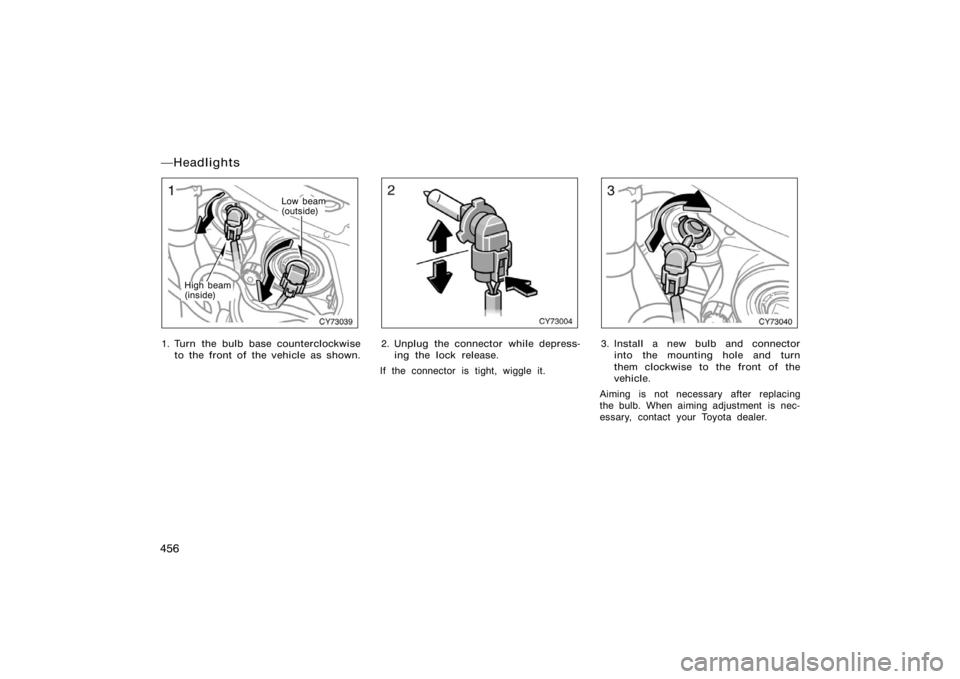
1. Turn the bulb base counterclockwiseto the front of the vehicle as shown.
CY73004
2. Unplug the connector while depress-ing the lock release.
If the connector is tight, wiggle it.
CY73040
3. Install a new bulb and connector into the mounting hole and turn
them clockwise to the front of the
vehicle.
Aiming is not necessary after replacing
the bulb. When aiming adjustment is nec-
essary, contact your Toyota dealer.
�Headlights