Page 36 of 496
24
The power door lock switch can be reset
in the following ways.
�Turn the engine switch to �ON".
�Unlock all the side doors and back
door with the key or wireless remote
control transmitter.
�Unlock the driver’s door or front pas-
senger ’s door with the inside lock
knob, and then unlock all the side
doors and back door with the power
door lock switch.
This unlocking protection with the power
door lock switch can be disabled. For de-
tails, contact your Toyota dealer.CY12004
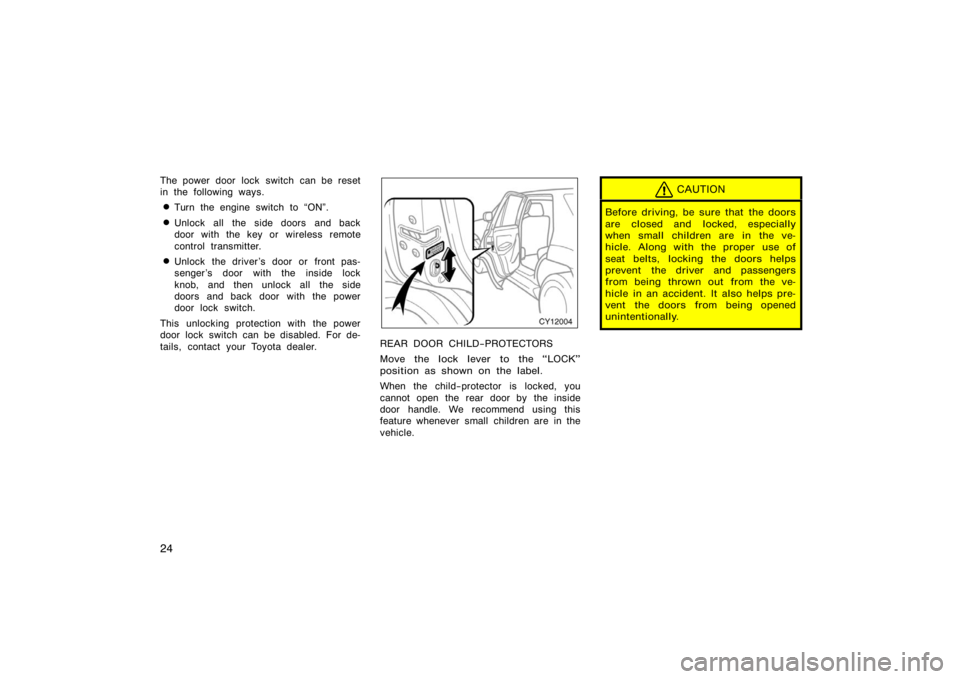
REAR DOOR CHILD−PROTECTORS
Move the lock lever to the �LOCK"
position as shown on the label.
When the child−protector is locked, you
cannot open the rear door by the inside
door handle. We recommend using this
feature whenever small children are in the
vehicle.
CAUTION
Before driving, be sure that the doors
are closed and locked, especially
when small children are in the ve-
hicle. Along with the proper use of
seat belts, locking the doors helps
prevent the driver and passengers
from being thrown out from the ve-
hicle in an accident. It also helps pre-
vent the doors from being opened
unintentionally.
Page 53 of 496

41
OPERATION OF INSTRUMENTS AND
CONTROLS
Occupant restraint systems
Seats42
. . . . . . . . . . . . . . . . . . . . . . . . . . . . . . . . . . . . .\
. . . . . . . . . . . . . . . . .
Front seats 42
. . . . . . . . . . . . . . . . . . . . . . . . . . . . . . . . . . . . \
. . . . . . . . . . . . .
Driving position memory system 48
. . . . . . . . . . . . . . . . . . . . . . . . . . . . . . .
Rear seats 50
. . . . . . . . . . . . . . . . . . . . . . . . . . . . . . . . . . . . \
. . . . . . . . . . . . . .
Head restraints 62
. . . . . . . . . . . . . . . . . . . . . . . . . . . . . . . . . . . . \
. . . . . . . . . .
Armrest 63
. . . . . . . . . . . . . . . . . . . . . . . . . . . . . . . . . . . . \
. . . . . . . . . . . . . . . . .
Seat heaters 63
. . . . . . . . . . . . . . . . . . . . . . . . . . . . . . . . . . . . \
. . . . . . . . . . . .
Seat belts 64
. . . . . . . . . . . . . . . . . . . . . . . . . . . . . . . . . . . . \
. . . . . . . . . . . . . . .
SRS airbags 74
. . . . . . . . . . . . . . . . . . . . . . . . . . . . . . . . . . . . \
. . . . . . . . . . . .
Roll sensing of curtain shield airbags off switch 95
. . . . . . . . . . . . . . . . .
Child restraint 96
. . . . . . . . . . . . . . . . . . . . . . . . . . . . . . . . . . . . \
. . . . . . . . . . .
SECTION 1− 3
Page 54 of 496
42
While the vehicle is being driven, all ve-
hicle occupants should have the seatback
upright, sit well back in the seat and prop-
erly wear the seat belts provided.
CAUTION
�Do not drive the vehicle unless the
occupants are properly seated. Do
not allow any passengers to sit on
top of a folded−down seatback, or
in the luggage compartment or car-
go area. Persons not properly
seated and/or not properly re-
strained by seat belts can be killed
or severely injured in the event of
emergency braking or a collision.
�During driving, do not allow any
passengers to stand up or move
around between seats. Otherwise,
death or severe injuries can occur
in the event of emergency braking
or a collision.
Driver seat
CAUTION
The SRS driver airbag deploys with
considerable force, and can cause
death or serious injury especially if
the driver is very close to the airbag.
The National Highway Traffic Safety
Administration (�NHTSA") advises:
Since the risk zone for driver airbag
is the first 50�75 mm (2�3 in.) of
inflation, placing yourself 250 mm (10
in.) from your driver airbag provides
you with a clear margin of safety.
This distance is measured from the
center of the steering wheel to your
breastbone. If you sit less than 250
mm (10 in.) away now, you can
change your driving position in sever-
al ways:
�Move your seat to the rear as far
as you can while still reaching the
pedals comfortably.
�Slightly recline the back of the
seat. Although vehicle designs vary,
many drivers can achieve the 250
mm (10 in.) distance, even with the
driver seat all the way forward, sim-
ply by reclining the back of the
seat somewhat. If reclining the back
of your seat makes it hard to see
the road, raise yourself by using a
firm, non−slippery cushion, or raise
the seat if your vehicle has that
feature.
�If your steering wheel is adjustable,
tilt it downward. This points the air-
bag toward your chest instead of
your head and neck.
The seat should be adjusted as rec-
ommended by NHTSA above, while
still maintaining control of the foot
pedals, steering wheel, and your view
of the instrument panel controls.
Seats Front seats�
�Front seat precautions
Page 57 of 496
45
CAUTION
Avoid reclining the seatback any
more than needed. The seat belts pro-
vide maximum protection in a frontal
or rear collision when the driver and
the front passenger are sitting up
straight and well back in the seats. If
you are reclined, the lap belt may
slide past your hips and apply re-
straint forces directly to the abdomen
or your neck may contact the shoul-
der belt. In the event of a frontal
collision, the more the seat is re-
clined, the greater the risk of death
or serious injury.
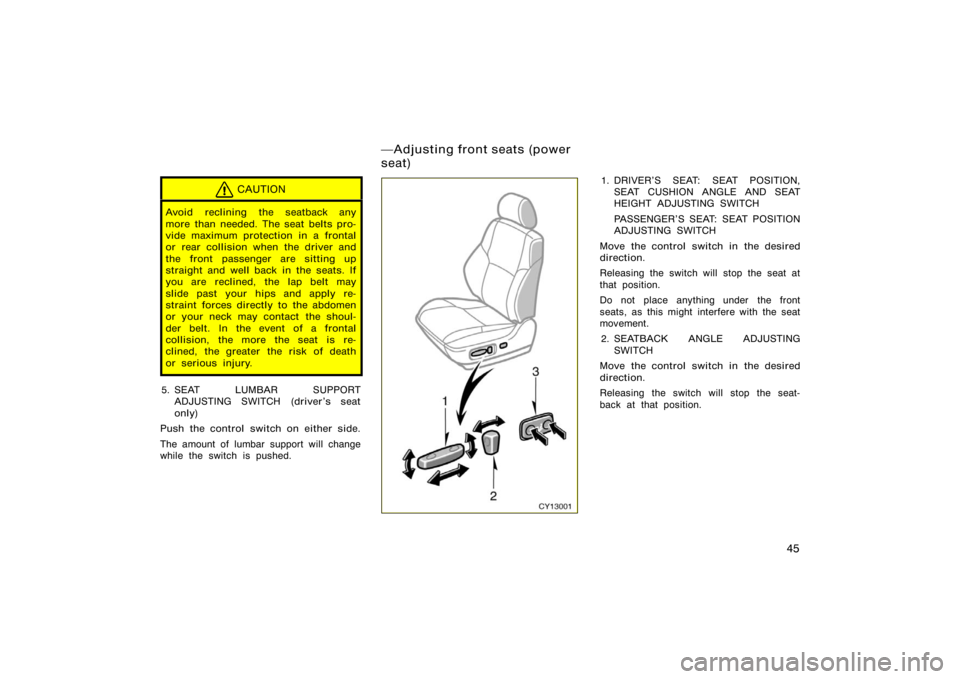
5. SEAT LUMBAR SUPPORTADJUSTING SWITCH (driver’s seat
only)
Push the control switch on either side.
The amount of lumbar support will change
while the switch is pushed.
CY13001
1. DRIVER’S SEAT: SEAT POSITION, SEAT CUSHION ANGLE AND SEAT
HEIGHT ADJUSTING SWITCH
PASSENGER’S SEAT: SEAT POSITION
ADJUSTING SWITCH
Move the control switch in the desired
direction.
Releasing the switch will stop the seat at
that position.
Do not place anything under the front
seats, as this might interfere with the seat
movement. 2. SEATBACK ANGLE ADJUSTING SWITCH
Move the control switch in the desired
direction.
Releasing the switch will stop the seat-
back at that position.
�Adjusting front seats (power
seat)
Page 58 of 496
46
CAUTION
Avoid reclining the seatback any
more than needed. The seat belts pro-
vide maximum protection in a frontal
or rear collision when the driver and
the front passenger are sitting up
straight and well back in the seats. If
you are reclined, the lap belt may
slide past your hips and apply re-
straint forces directly to the abdomen
or your neck may contact the shoul-
der belt. In the event of a frontal
collision, the more the seat is re-
clined, the greater the risk of death
or serious injury.
3. SEAT LUMBAR SUPPORTADJUSTING SWITCH (driver’s seat
only)
Push the control switch on either side.
The amount of lumbar support will change
while the switch is pushed.
CY13282
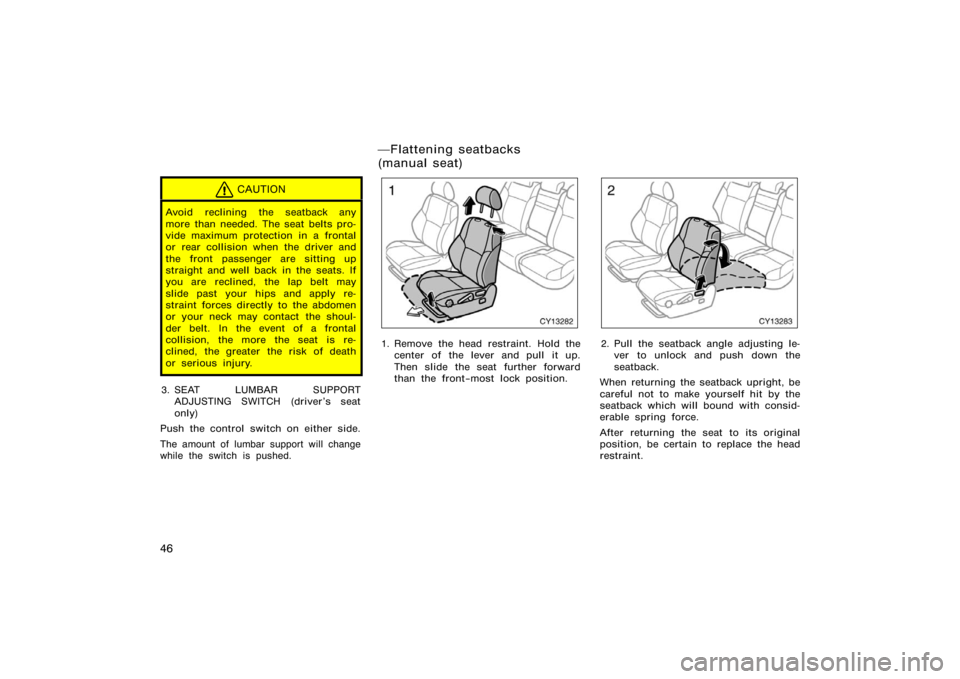
1. Remove the head restraint. Hold the center of the lever and pull it up.
Then slide the seat further forward
than the front−most lock position.
CY13283
2. Pull the seatback angle adjusting le-ver to unlock and push down the
seatback.
When returning the seatback upright, be
careful not to make yourself hit by the
seatback which will bound with consid-
erable spring force.
After returning the seat to its original
position, be certain to replace the head
restraint.
�Flattening seatbacks
(manual seat)
Page 62 of 496
50
CY13107
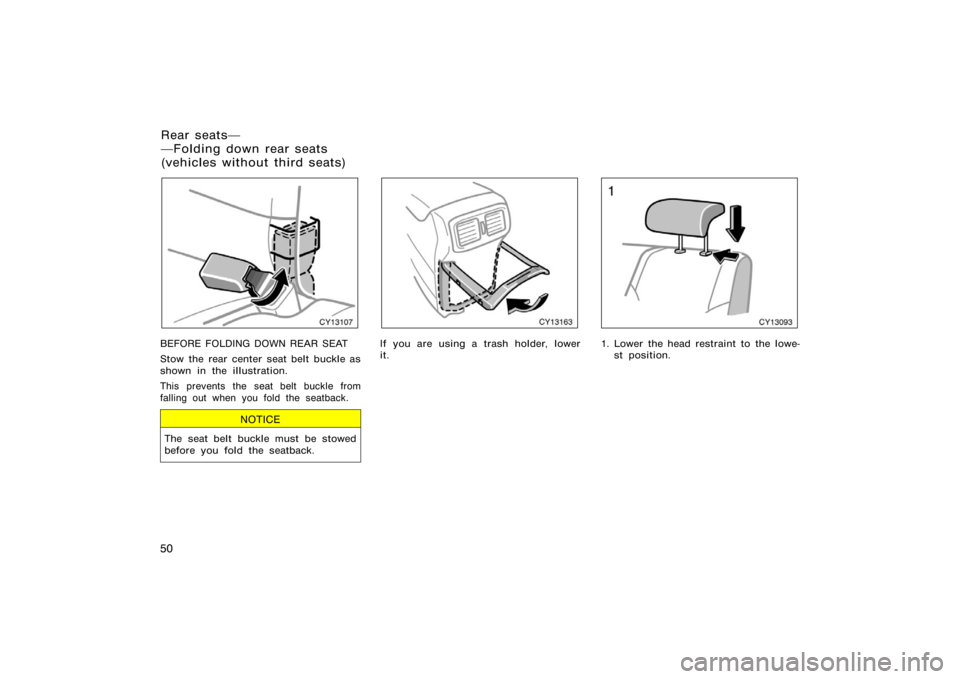
BEFORE FOLDING DOWN REAR SEAT
Stow the rear center seat belt buckle as
shown in the illustration.
This prevents the seat belt buckle from
falling out when you fold the seatback.
NOTICE
The seat belt buckle must be stowed
before you fold the seatback.
CY13163
If you are using a trash holder, lower
it.
CY13093
1. Lower the head restraint to the lowe-st position.
Rear seats�
�Folding down rear seats
(vehicles without third seats)
Page 63 of 496
51
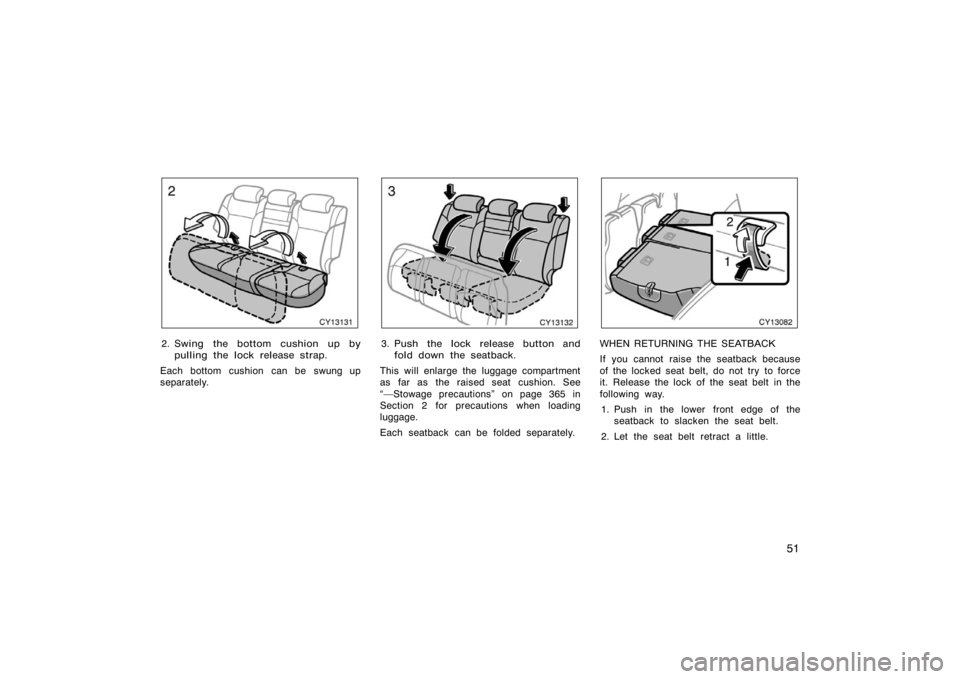
CY13131
2. Swing the bottom cushion up bypulling the lock release strap.
Each bottom cushion can be swung up
separately.
CY13132
3. Push the lock release button and fold down the seatback.
This will enlarge the luggage compartment
as far as the raised seat cushion. See
��Stowage precautions" on page 365 in
Section 2 for precautions when loading
luggage.
Each seatback can be folded separately.
CY13082
WHEN RETURNING THE SEATBACK
If you cannot raise the seatback because
of the locked seat belt, do not try to force
it. Release the lock of the seat belt in the
following way. 1. Push in the lower front edge of the seatback to slacken the seat belt.
2. Let the seat belt retract a little.
Page 64 of 496
52
CAUTION
When returning seats to their original
position, observe the following pre-
cautions in order to prevent death or
serious injury in a collision or sud-
den stop:
�Make sure the seatback is securely
locked by pushing forward and rear-
ward on the top of the seatback.
Failure to do so will prevent the
seat belt from operating properly.
�Make sure the seat belts are not
twisted or caught in the seatback
and are arranged in their proper
position and are ready to use.
�Make sure the bottom cushion is
securely locked by trying to pull up
the edge of the cushion near the
lock release straps.
�Make sure to arrange the buckles of
the seat belts in their proper posi-
tion and be ready to use.
CAUTION
�Adjustment should not be made
while the vehicle is moving.
�When adjusting the seat, be careful
not to hit the seat against a pas-
senger or luggage.
�After adjusting the seatback, push
back your body to make sure it is
locked in position.
�When returning seats to their origi-
nal position, observe the following
precautions in order to prevent
death or serious injury in a colli-
sion or sudden stop:
Make sure the seat is securely
locked by pushing forward and rear-
ward on the top of the seatback or
by trying to pull up the edge of the
bottom cushion. Failure to do so
will prevent the seat belt from oper-
ating properly.
Make sure the seat belts are not
twisted or caught under the seat
and are arranged in their proper
position and are ready to use.
�The third seats have a maximum
capacity of two belted occupants
who do not exceed 150 cm (59 in.)
in height. Exceeding these limits
can result in increased risk of seri-
ous injuries or death.
Folding the seats up will enlarge the
luggage compartment. See ��Stowage
precautions" on page 365 in Section 2 for
precautions when loading luggage.
�Rear seat precautions
(vehicles with third seats)