2008 SUZUKI GRAND VITARA TPMS
[x] Cancel search: TPMSPage 183 of 290

6-24
OPERATING YOUR VEHICLE
66J22-03E
When you turn off the engine, however, the
malfunction indicator resets. It takes about
ten minutes after restarting the engine for
the malfunction to be detected again and
for the light to start flashing.
TPMS LimitationsThe tire pressure monitoring system may
not function properly under certain circum-
stances. In the following situations, the low
tire pressure warning light may come on
and remain on or may blink.
When you replace a flat tire with the
spare tire.
When you include the spare tire during a
tire rotation.
When the TPMS sensor is damaged dur-
ing a tire replacement or liquid sealants
are used to repair a flat tire. When the TPMS sensor’s electronic sig-
nal is disturbed in one of the following
ways:
– Electric devices or facilities using simi-
lar radio wave frequencies are nearby.
– A lot of snow or ice covers the vehicle,
in particular, around the wheels or
wheel housings.
– Snow tires or tire chains are used.
When you use non-genuine SUZUKI
wheels or tires.
Replacing Tires and/or WheelsIf you get a flat tire, Suzuki recommends
that you have an authorized SUZUKI
dealer mount a new tire on the wheel that
had the flat tire, and reinstall this tire on the
vehicle in place of the spare. The TPMS is
already set up to recognize the ID code of
the original wheel, and normal TPMS oper-
ation will be restored.
If you wish to operate your vehicle with the
spare tire installed, you must have an
authorized SUZUKI dealer set up the
TPMS to recognize the ID code of the
spare tire TPMS sensor.
If you need to replace any wheels on your
vehicle, your dealer must make sure that
TPMS sensors are installed in the new
wheels and must set up the TPMS to rec-
ognize the new sensors.
WARNING
The TPMS malfunction indicator is
combined with the low tire pressure
telltale. When the system detects a
malfunction, the telltale will flash for
approximately one minute and then
remain continuously illuminated.
This sequence will continue upon
subsequent vehicle start-ups as long
as the malfunction exists.
WARNING
When the malfunction indicator is
illuminated, the system may not be
able to detect or signal low tire pres-
sure as intended. TPMS malfunctions
may occur for a variety of reasons,
including the installation of replace-
ment or alternate tires or wheels on
the vehicle that prevent the TPMS
from functioning properly. Always
check the TPMS malfunction telltale
after replacing one or more tires or
wheels on your vehicle to ensure that
the replacement or alternate tires and
wheels allow the TPMS to continue to
function properly.
CAUTION
The tire pressure sensors can be
damaged by the installation or
removal of tires. When tires must
be repaired or replaced, we highly
recommend that you have them
repaired or replaced by an autho-
rized SUZUKI dealer.
Do not use liquid sealants for a flat
tire as air pressure sensors can be
damaged.
If the low tire pressure warning
light comes on frequently, there
may be something wrong with one
of the tires or with the monitoring
system. Have your vehicle
inspected by an authorized SUZUKI
dealer.
Page 184 of 290
6-25OPERATING YOUR VEHICLE
66J22-03E
For Vehicles Sold in U.S.A.This device complies with Part 15 of the
FCC Rules.
Operation is subject to the following two
conditions:
1) This device may not cause harmful
interference.
2) This device must accept any interfer-
ence received, including interference
that may cause undesired operation.
NOTE:
Changes or modifications not expressly
approved by the party responsible for com-
pliance could void the user’s authority to
operate the equipment.Traveling to CANADAPlease note that service for the tire pres-
sure monitoring system may not be avail-
able in CANADA should there be any
problems or malfunctions in the system.
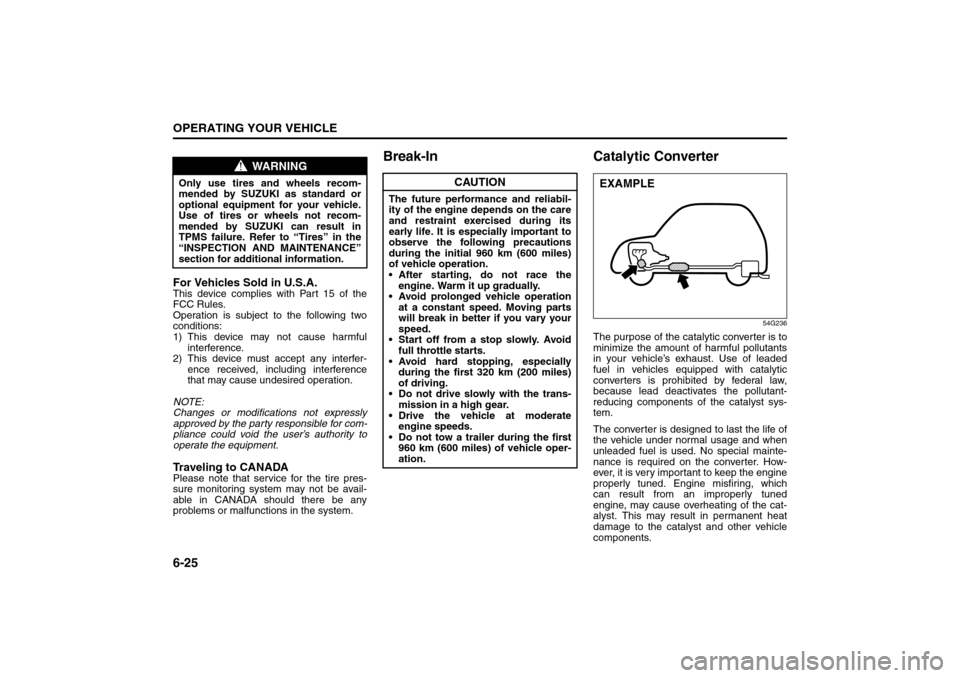
Break-In Catalytic Converter
54G236
The purpose of the catalytic converter is to
minimize the amount of harmful pollutants
in your vehicle’s exhaust. Use of leaded
fuel in vehicles equipped with catalytic
converters is prohibited by federal law,
because lead deactivates the pollutant-
reducing components of the catalyst sys-
tem.
The converter is designed to last the life of
the vehicle under normal usage and when
unleaded fuel is used. No special mainte-
nance is required on the converter. How-
ever, it is very important to keep the engine
properly tuned. Engine misfiring, which
can result from an improperly tuned
engine, may cause overheating of the cat-
alyst. This may result in permanent heat
damage to the catalyst and other vehicle
components.
WARNING
Only use tires and wheels recom-
mended by SUZUKI as standard or
optional equipment for your vehicle.
Use of tires or wheels not recom-
mended by SUZUKI can result in
TPMS failure. Refer to “Tires” in the
“INSPECTION AND MAINTENANCE”
section for additional information.
CAUTION
The future performance and reliabil-
ity of the engine depends on the care
and restraint exercised during its
early life. It is especially important to
observe the following precautions
during the initial 960 km (600 miles)
of vehicle operation.
After starting, do not race the
engine. Warm it up gradually.
Avoid prolonged vehicle operation
at a constant speed. Moving parts
will break in better if you vary your
speed.
Start off from a stop slowly. Avoid
full throttle starts.
Avoid hard stopping, especially
during the first 320 km (200 miles)
of driving.
Do not drive slowly with the trans-
mission in a high gear.
Drive the vehicle at moderate
engine speeds.
Do not tow a trailer during the first
960 km (600 miles) of vehicle oper-
ation.
EXAMPLE
Page 286 of 290

15-4INDEX
66J22-03E
PParking Brake Lever
.................................................... 5-1
, 9-23
Pedals
...................................................................................5-1
Periodic Maintenance Schedule
.........................................9-3
Power Assisted Brakes
.......................................................6-16
Power Door Locking System
..............................................2-2
Power Mirror Control
...........................................................2-17
Power Steering
....................................................................9-24
Power Steering Fluid
...........................................................9-24
Power Window Controls
.....................................................2-14
RRadio Antenna
.....................................................................4-35
Rear Window Defroster and Outside Rearview Mirrors
Defroster Switch ..................................................................4-15
Rear Window Wiper/Washer Switch
..................................3-9
Refill with Oil and Check for Leaks ....................................9-12
Remote Audio Controls
............................................ 3-12
, 4-49
Replace the Oil Filter
...........................................................9-11
Replacing Tires and/or Wheels
..........................................6-24
Reporting Safety Defects
....................................................12-4
Roof Rails or Roof Rack Anchors
......................................5-23
SSafety Certification Label
...................................................12-2
Seat Adjustment
..................................................................2-17
Seat Belt Extender ...............................................................2-35
Seat Belt Inspection ............................................................2-27
Seat Belt Pretensioner System
..........................................2-36
Seat Belt Reminder
..............................................................2-24
Seat Belts and Child Restraint Systems
...........................2-20
Selection of Coolant
............................................................9-17
Shopping Hook
....................................................................5-19Shoulder anchor height adjuster
....................................... 2-26
Side Air Bags and Side Curtain Air Bags
......................... 2-40
Side Door Locks
.................................................................. 2-2
SLIP Indicator Light
.....................................................4-6
, 6-19
Snow Tires
........................................................................... 9-32
Spare Tire Nut Lock
............................................................ 2-1
Spark Plugs
......................................................................... 9-20
SPECIFICATIONS
................................................................ 14-1
Specified Fluid
.................................................................... 9-15
Specified Gear Oil ............................................................... 9-13
Specified Oil
........................................................................ 9-9
Speedometer ....................................................................... 4-11
Spot Light
............................................................................ 5-8
Stability Control System
.................................................... 6-18
Starting the Engine
............................................................. 6-2
Steering Wheel
.................................................................... 9-23
Sun Visor
............................................................................. 5-7
Sunroof
................................................................................ 5-11
Supplemental Restraint System (air bags)
....................... 2-37
TTachometer
.......................................................................... 4-13
Tailgate
................................................................................ 2-14
Temperature Gauge
............................................................ 4-14
Theft Deterrent Light .......................................................... 4-21
Thermometer
....................................................................... 4-18
Tilt Steering Lock Lever
..................................................... 3-10
Tire Chains
.......................................................................... 7-5
Tire Changing Tool
............................................................. 5-18
Tire Inflation Pressure ........................................................ 9-26
Tire Inspection
.................................................................... 9-27
Tire Pressure Monitoring System (TPMS)
........................ 6-21