2008 SUBARU OUTBACK wheel
[x] Cancel search: wheelPage 386 of 444
11-40Maintenance and service
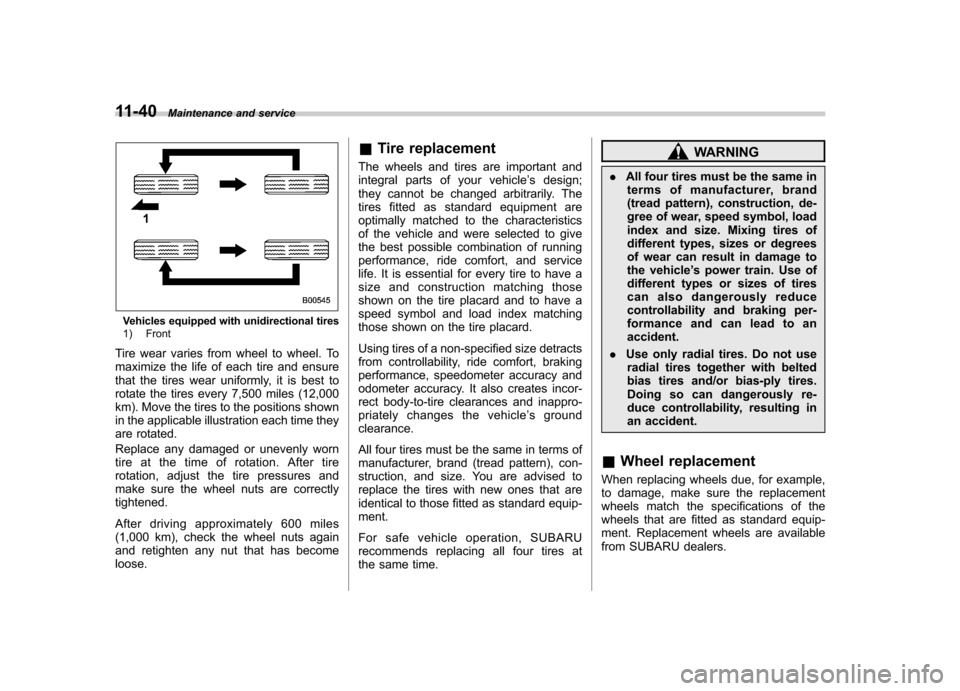
Vehicles equipped with unidirectional tires
1) Front
Tire wear varies from wheel to wheel. To
maximize the life of each tire and ensure
that the tires wear uniformly, it is best to
rotate the tires every 7,500 miles (12,000
km). Move the tires to the positions shown
in the applicable illustration each time they
are rotated.
Replace any damaged or unevenly worn
tire at the time of rotation. After tire
rotation, adjust the tire pressures and
make sure the wheel nuts are correctlytightened.
After driving approximately 600 miles
(1,000 km), check the wheel nuts again
and retighten any nut that has become loose. &
Tire replacement
The wheels and tires are important and
integral parts of your vehicle ’s design;
they cannot be changed arbitrarily. The
tires fitted as standard equipment are
optimally matched to the characteristics
of the vehicle and were selected to give
the best possible combination of running
performance, ride comfort, and service
life. It is essential for every tire to have a
size and construction matching those
shown on the tire placard and to have a
speed symbol and load index matching
those shown on the tire placard.
Using tires of a non-specified size detracts
from controllability, ride comfort, braking
performance, speedometer accuracy and
odometer accuracy. It also creates incor-
rect body-to-tire clearances and inappro-
priately changes the vehicle ’s ground
clearance.
All four tires must be the same in terms of
manufacturer, brand (tread pattern), con-
struction, and size. You are advised to
replace the tires with new ones that are
identical to those fitted as standard equip-ment.
For safe vehicle operation, SUBARU
recommends replacing all four tires at
the same time.
WARNING
. All four tires must be the same in
terms of manufacturer, brand
(tread pattern), construction, de-
gree of wear, speed symbol, load
index and size. Mixing tires of
different types, sizes or degrees
of wear can result in damage to
the vehicle ’s power train. Use of
different types or sizes of tires
can also dangerously reduce
controllability and braking per-
formance and can lead to anaccident.
. Use only radial tires. Do not use
radial tires together with belted
bias tires and/or bias-ply tires.
Doing so can dangerously re-
duce controllability, resulting in
an accident.
& Wheel replacement
When replacing wheels due, for example,
to damage, make sure the replacement
wheels match the specifications of the
wheels that are fitted as standard equip-
ment. Replacement wheels are available
from SUBARU dealers.
Page 387 of 444
WARNING
Use only those wheels that are
specified for your vehicle. Wheels
not meeting specifications could
interfere with brake caliper opera-
tion and may cause the tires to rub
against the wheel well housing dur-
ing turns. The resulting loss of
vehicle control could lead to anaccident. Aluminum wheels
Aluminum wheels can be scratched and
damaged easily. Handle them carefully to
maintain their appearance, performance,
and safety. .
When any of the wheels is removed
and replaced for tire rotation or to change
a flat, always check the tightness of the
wheel nuts after driving approximately 600
miles (1,000 km). If any nut is loose,
tighten it to the specified torque. . Never apply oil to the threaded parts,
wheel nuts, or tapered surface of the wheel. . Never let the wheel rub against sharp
protrusions or curbs.. Be sure to fit tire chains on uniformly
and completely around the tire, otherwise
the chains may scratch the wheel. . When wheel nuts, balance weights, or
the center cap is replaced, be sure to
replace them with genuine SUBARU parts
designed for aluminum wheels. Windshield washer fluid
CAUTION
Never use engine coolant as washer
fluid because it could cause paintdamage.
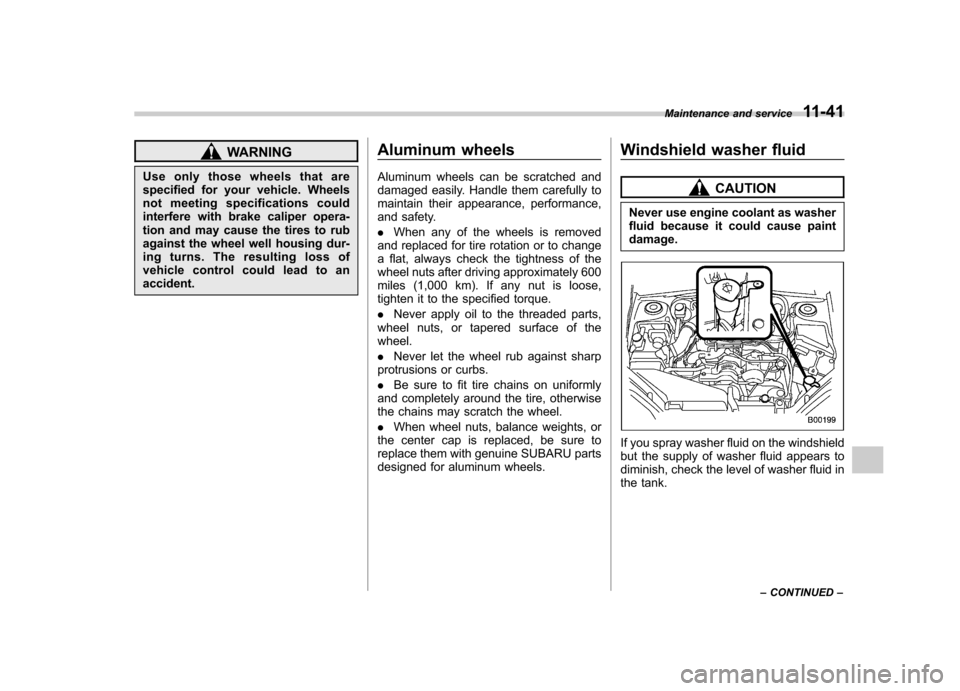
If you spray washer fluid on the windshield
but the supply of washer fluid appears to
diminish, check the level of washer fluid in
the tank. Maintenance and service
11-41
– CONTINUED –
Page 407 of 444

Specifications..................................................... 12-2
Dimensions ........................................................ 12-2
Engine ............................................................... 12-3
Electrical system ................................................ 12-3
Capacities .......................................................... 12-4
Tires .................................................................. 12-5
Wheel alignment ................................................ 12-5 Fuses and circuits
............................................. 12-6
Fuse panel located in the passenger compartment ................................................... 12-6
Fuse panel located in the engine compartment ................................................... 12-8
Bulb chart ........................................................... 12-9
Vehicle identification ....................................... 12-11Specifications
12
Page 408 of 444

12-2Specifications
Specifications
These specifications are subject to change without notice. &Dimensions
in (mm)
Item Legacy OUTBACK
Sedan Station wagon Sedan Station wagon
Non-
turbo Turbo
2.5-liter 2.5-liter 3.0-liter 2.5-liter3.0-liter
Except 2.5GT
spec.B 2.5GT
spec.B Non-
turbo Turbo
Overall length 185.0 (4,700) 188.4 (4,785) 185.0 (4,700) 189.0 (4,800)
Overall width 68.1 (1,730) 68.1 (1,730) 69.7 (1,770) 69.7 (1,770)
Overall height 56.1
(1,425) 56.5
(1,435) 58.1 (1,475) 56.5 (1,435) 63.2 (1,605)
Wheel base 105.1 (2,670) 105.1 (2,670) 105.1 (2,670) 105.1 (2,670)
Tread Front 58.9 (1,495) 58.9 (1,495) 58.9 (1,495) 58.9 (1,495)
Rear 58.5 (1,485) 58.5 (1,485) 58.5 (1,485) 58.7 (1,490)
Ground clearance 5.9 (150)6.3
(160) 5.9
(150) 6.1
(155) 6.3 (160)
8.5
(215) 8.7
(220) 8.5 (215)
Page 411 of 444

&Tires
Tire size P205/55R16
89H P225/60R16
97H P205/50R17
88V 215/45R17
91W P225/55R17
95V 215/45R18
89Y P215/45R18
89W
Wheel size 16 66.5JJ 17 67JJ 18 67JJ
Pressure Front 32 psi
(220 kPa,
2.2 kgf/cm
2) 32 psi
(220 kPa,
2.2 kgf/cm2) 33 psi
(230 kPa,
2.3 kgf/cm2) 35 psi
(240 kPa,
2.4 kgf/cm2) 32 psi
(220 kPa,
2.2 kgf/cm2) 33 psi
(230 kPa,
2.3 kgf/cm2)
Rear 30 psi
(210 kPa,
2.1 kgf/cm
2) 30 psi
(210 kPa,
2.1 kgf/cm2) 32 psi
(220 kPa,
2.2 kgf/cm2) 33 psi
(230 kPa,
2.3 kgf/cm2) 30 psi
(210 kPa,
2.1 kgf/cm2) 32 psi
(220 kPa,
2.2 kgf/cm2)
Rear at
trailer tow- ing –
32 psi
(220 kPa,
2.2 kgf/cm
2) –
32 psi
(220 kPa,
2.2 kgf/cm2) –
Temporary
spare tire Size T135/80R16 T155/70D17 T135/80R16 T135/70D17 T155/70D17 T155/70D17 Pressure
60 psi (420 kPa, 4.2 kgf/cm
2)
& Wheel alignment
Item Legacy OUTBACK
Sedan Station wagon Station wagon
Toe Front 0 in (0 mm)
Rear 0 in (0 mm)
Camber Front 0815 ’ 0840 ’
Rear 0840 ’ 0830 ’
0810 ’Specifications
12-5
Page 422 of 444

&Recommended tire inflation pressure
! Recommended cold tire inflation pressure
Recommended cold tire inflation pressure for your vehicle ’s tires is as follows,
Tire size P205/
55R16 89H P225/
60R16 97H P205/
50R17 88V 215/45R17
91W P225/
55R17 95V 215/45R18
89Y P215/
45R18 89W
Wheel size 16 66.5JJ 17 67JJ 18 67JJ
Pres- sure Front
32 psi
(220 kPa, 2.2 kgf/
cm
2) 32 psi
(220 kPa, 2.2 kgf/
cm2) 33 psi
(230 kPa, 2.3 kgf/
cm2) 35 psi
(240 kPa, 2.4 kgf/
cm2) 32 psi
(220 kPa, 2.2 kgf/
cm2) 33 psi
(230 kPa,
2.3 kgf/cm2)
Rear 30 psi
(210 kPa,
2.1 kgf/ cm
2) 30 psi
(210 kPa,
2.1 kgf/ cm2) 32 psi
(220 kPa,
2.2 kgf/ cm2) 33 psi
(230 kPa,
2.3 kgf/ cm2) 30 psi
(210 kPa,
2.1 kgf/ cm2) 32 psi
(220 kPa,
2.2 kgf/cm2)
Rear attrailer towing –
32 psi
(220 kPa,
2.2 kgf/
cm
2) –
32 psi
(220 kPa,
2.2 kgf/ cm2) –
Tempor-ary spare tire Size
T135/
80R16 T155/
70D17 T135/
80R16 T135/
70D17 T155/
70D17 T155/70D17
Pres- sure 60 psi (420 kPa, 4.2 kgf/cm
2)
Consumer information and Reporting safety defects
13-5
– CONTINUED –
Page 425 of 444

13-8Consumer information and Reporting safety defects
tires every 7,500 miles (12,000 km).
Rotating the tires involves switch-
ing the front and rear tires on the
right-hand side of the vehicle and
similarly switching the front and
rear tires on the left-hand side of
the vehicle. (Each tire must be kept
on its original side of the vehicle.)
Replace any damaged or unevenly
worn tire at the time of rotation.
After tire rotation, adjust the tire
pressures and make sure the wheel
nuts are correctly tightened. A
tightening torque specification and
a tightening sequence specification
for the wheel nuts can be found“ Flat tires
”section in chapter 9.
& Vehicle load limit –how to
determine
The load capacity of your vehicle is
determined by weight, not by avail-
able cargo space. The load limit of
your vehicle is shown on the
vehicle placard attached to the
driver ’s side B-pillar. Locate the
statement “The combined weight of occupants and cargo should
never exceed XXX kg or XXX lbs
”
on your vehicle ’s placard.
Thevehicleplacardalsoshows
seating capacity of your vehicle.
The total load capacity includes the
total weight of driver and all pas-
sengers and their belongings, any
cargo, any optional equipment such
as a trailer hitch, roof rack or bike
carrier, etc., and the tongue load of
a trailer. Therefore cargo capacity
can be calculated by the followingmethod.
Cargo capacity = Load limit (total
weight of occupants + total weight
of optional equipment + tongue
load of a trailer (if applicable))
For towing capacity information and
weight limits, refer to “Trailer towing
”
section in chapter 8. ! Calculating total and load ca-
pacities varying seating con-
figurations
Calculate the available load capa-
city as shown in the following examples:
Example 1A
Vehicle capacity weight of the
vehicle is 800 lbs (363 kg), which
is indicated on the vehicle placard
with the statement "The combined
weight of occupants and cargo
should never exceed 363 kg or
800 lbs".
For example, if the vehicle has one
occupant weighing 154 lbs (70 kg)
plus cargo weighing 551 lbs (250kg). 1.
Calculate the total weight.
Page 430 of 444
cified government test surfaces of
asphalt and concrete. A tire marked
C may have poor traction perfor- mance.
WARNING
The traction grade assigned to
this tire is based on straight-
ahead braking traction tests,
and does not include accel-
eration, cornering, hydroplan-
ing, or peak traction charac-teristics.
& Temperature A, B, C
The temperature grades are A (the
highest), B, and C, representing thetire ’s resistance to the generation of
heat and its ability to dissipate heat
when tested under controlled con-
ditions on a specified indoor labora-
tory test wheel. Sustained high
temperature can cause the material
of the tire to degenerate and reduce
tire life, and excessive temperature
can lead to sudden tire failure. The grade C corresponds to a level of
performance which all passenger
car tires must meet under the
Federal Motor Vehicle Safety Stan-
dards No. 109. Grades B and A
represent higher levels of perfor-
mance on the laboratory test wheel
than the minimum required by law.
WARNING
The temperature grade for this
tire is established for a tire
that is properly inflated and
not overloaded. Excessive
speed, underinflation, or ex-
cessive loading, either sepa-
rately or in combination, can
cause heat buildup and possi-
ble tire failure. Reporting safety defects (USA)
If you believe that your vehicle has
a defect which could cause a
crash or could cause injury or
death, you should immediately in-
form the National Highway Traffic
Safety Administration (NHTSA) in
addition to notifying Subaru of
America, Inc.
If NHTSA receives similar com-
plaints, it may open an investiga-
tion, and if it finds that a safety
defect exists in a group of vehi-
cles, it may order a recall and
remedy campaign. However,
NHTSA cannot become involved
in individual problems between
you, your dealer, or Subaru of
America, Inc. To contact NHTSA,
you may call the Vehicle Safety
Hotline toll-free at 1-888-327-4236
(TTY: 1-800-424-9153); go to
http://www.safercar.gov; or write
to: Administrator, NHTSA, 400
Seventh Street, SW., Washington,
Consumer information and Reporting safety defects
13-13
– CONTINUED –