2008 SKODA FABIA engine oil
[x] Cancel search: engine oilPage 188 of 252

Inspecting and Replenishing187
Using the systemSafetyDriving TipsGeneral MaintenanceBreakdown assistanceTechnical Data
Loss of coolant
A loss of coolant is first and foremost an indication of a leak in the system. You should not merely top up the coolant in the reservoir. It is also important to have the cooling system inspected without delay by a specialist garage.
Losses can only occur through the pressure relief in the cap of the coolant expan-sion bottle which is completely free of leaks if the coolant boils as a result of over-heating and is forced out of the cooling system.
WARNING
Read and observe the warning notes ⇒page 181, “Working in the engine compartment” before working in the engine compartment.
Caution
One should contact a specialist garage as soon as possible if the source of over-heating itself cannot be determined and removed, since there may be grave damage to the engine.
Replenishing the coolant
– Switch the engine off.
– Allow the engine to cool down.
– Place a cloth over the cap of the coolant expansion reservoir
⇒page 186, fig. 172 and unscrew the cap carefully by turning it to the
left ⇒.
– Top up the coolant.
– Screw the cap tight until it is heard to lock.
The coolant which you use for replenishing the system, must comply with one specific specification ⇒page 186, “Coolant”. Do not use an alternative additive if the coolant additive G12 PLUS is not available in exceptional cases. Just top up the
system with water and as soon as possible arrange adjustment to correct the mixing ratio of water and coolant additive again by a specialist garage.
Only use fresh coolant for topping up the system.
Do not fill up over the “MAX” marking! Excess coolant which is heated up is forced out of the cooling system through the pressure relief valve in the cap of the coolant compensation bottle.
Wait until the engine has cooled down for a system which has suffered a major loss of coolant before pouring in coolant. This is necessary to avoid engine damage.
WARNING
•The cooling system is pressurized! Do not open the cap of the coolant expansion bottle if the engine is still hot - risk of scalding!
•The coolant additive and thus all of the coolant is harmful to your health. Avoid contact with the coolant. Coolant vapours are also harmful to the health. It is important, therefore, to always safely store any coolant additive in its original container out of the reach of children - risk of poisoning!
•If any splashes of coolant get into your eyes, rinse out your eyes immedi-ately with clear water and contact a doctor as soon as possible.
•You should also consult a doctor without delay if you have inadvertently swallowed coolant.
Caution
Do not continue your journey if for some reason it is not possible under the conditions prevailing to top up with coolant. Switch the engine off and obtain professional assistance from a specialist garage, otherwise it could lead to severe engine damage.
For the sake of the environment
Do not re-use coolant if it is necessary to drain the coolant in the system. It should be collected and disposed of in compliance with environmental protection regulations.
NKO A05F 20.book Page 187 Wednesday, April 2, 2008 1:02 PM
Page 189 of 252

Inspecting and Replenishing188
Radiator fan
The radiator fan may switch on suddenly.
The radiator fan is driven by an electric motor and controlled by a thermostat according to the coolant temperature.
The radiator fan may continue running for up to 10 minutes after the engine has been switched off - even if the ignition is also off. It may also switch on suddenly after a certain time, if
•the coolant temperature has risen because of an accumulation of heat or
•the warm engine compartment is heated up additionally by strong sunlight.
WARNING
You must therefore be aware when working in the engine compartment that the fan may switch on suddenly - risk of injury!
Brake fluid
Inspecting the brake fluid level
The brake fluid reservoir is located on the left of the engine compartment.
The brake fluid reservoir on right-hand steering models is positioned on
the other side of the engine compartment.
– Switch the engine off.
– Open the bonnet ⇒ in “Working in the engine compartment” on
page 181.
– Inspect the brake fluid level in the reservoir ⇒fig. 173. The level must
be between the “MIN” and “MAX” markings.
A slight drop in the fluid level results when driving due to normal wear-and-tear and automatic adjustment of the brake pads, and is perfectly normal.
There may be an indication of a leak in the brake system, however, if the fluid level drops significantly within a short time or if it drops below the “MIN” marking. A situ-ation where the brake fluid level is too low is indicated by the warning light lighting up in the instrument cluster ⇒page 28. In this case stop immediately and do not drive any further! Obtain professional assistance.
WARNING
•Read and observe the warning notes ⇒page 181, “Working in the engine compartment” before working in the engine compartment.
•If the fluid level has dropped below the MIN marking, do not drive any further - risk of accident! Contact a Škoda dealer to obtain professional assistance.
Replacing brake fluid
Brake fluid absorbs moisture. This causes the fluid to absorb moisture from the surrounding air over a period of time. Excessive water in the brake fluid may be the cause of corrosion in the brake system. The water content also lowers the boiling point of the brake fluid. This is why brake fluid must be replaced every two years.
Fig. 173 Engine compart-ment: Brake fluid reservoir
NKO A05F 20.book Page 188 Wednesday, April 2, 2008 1:02 PM
Page 212 of 252

Breakdown assistance211
Using the systemSafetyDriving TipsGeneral MaintenanceBreakdown assistanceTechnical Data
Rear towing eye
The rear towing eye is located below the rear bumper on the right ⇒fig. 191.
Tow-starting a vehicle
If the engine does not start, we generally do not recommend to tow-start
your vehicle. One should attempt to start the engine using jump start
cables ⇒page 208 or call on the services of the SERVICE mobile.
If your vehicle has to be towed:
– Engage 2nd or 3rd gear with the vehicle stationary.
– Depress the clutch pedal fully and keep it depressed.
– Switch on the ignition.
– Wait until both vehicles are moving then release the clutch pedal
slowly.
– Depress the clutch pedal fully when the engine fires and take the
vehicle out of gear.
WARNING
There is high risk of having an accident when tow-starting a vehicle, when for example the towed vehicle runs into the towing vehicle.
Caution
Vehicles which are fitted with a catalytic converter should not be tow-started over a distance of more than 50 metres. Unburnt fuel may get into the catalytic converter and damage it.
Towing in a vehicle fitted with a manual gearbox
Please refer to the notes ⇒page 209.
The car can be towed in with a tow bar or a tow rope or with the front or rear wheels raised. The maximum towing speed is 50 km/h.
Towing of a vehicle with an automatic gearbox
Please refer to the notes ⇒page 209.
The car can be towed in with a tow bar or a tow rope. Refer at the same time to the following guidelines:
•Move selector lever into N.
•The maximum towing speed is 50 km/h.
•The maximum permissible towing distance is 50 km. The gear oil pump does not operate when the engine is not running; the gearbox would not be adequately lubricated at higher speeds and over longer towing distance.
Caution
If the vehicle is towed in by a recovery vehicle, it should only be towed in with the front wheels raised. If the vehicle is raised at rear, the automatic gearbox is damaged!
Fig. 191 Rear towing eye
NKO A05F 20.book Page 211 Wednesday, April 2, 2008 1:02 PM
Page 228 of 252

Technical Data227
Using the systemSafetyDriving TipsGeneral MaintenanceBreakdown assistanceTechnical Data
Capacities (in liter)
Weight (in kg)
Fuel tank capacity/of which spare45/7
Reservoir for windscreen washer system/ with headlight cleaning system2/4,5
Engine oila)
a)Oil capacity with oil filter change. Inspect oil level when filling; do not fill up too much. The oil level must be between the markings ⇒page 184.
3,0
Cooling system of the vehicle5,5
FA B I ACOMBI
Permissible gross weight15551580
Unloaden weight ready for work10401065
Loading capacity515515
Loading capacity when using the TLC465465
Permissible front axle load820920
Permissible rear axle load840840
Permissible trailer load, trailer braked/unbraked800/500a)
900/500b)
a)Uphills up to 12%b)Uphills up to 8%
775/450a)
875/450b)
NKO A05F 20.book Page 227 Wednesday, April 2, 2008 1:02 PM
Page 230 of 252

Technical Data229
Using the systemSafetyDriving TipsGeneral MaintenanceBreakdown assistanceTechnical Data
Capacities (in liter)
Weight (in kg)
Fuel tank capacity/of which spare45/7
Reservoir for windscreen washer system/ with headlight cleaning system2/4,5
Engine oila)
a)Oil capacity with oil filter change. Inspect oil level when filling; do not fill up too much. The oil level must be between the markings ⇒page 184.
3,0
Cooling system of the vehicle5,5
FA B I ACOMBI
Permissible gross weight15651585
Unloaden weight ready for work10501070
Loading capacity515515
Loading capacity when using the TLC465465
Permissible front axle load920920
Permissible rear axle load840840
Permissible trailer load, trailer braked/unbraked(800/500)a)
(900/500)b)
a)Uphills up to 12%b)Uphills up to 8%
(800/450)a)
(900/450)b)
NKO A05F 20.book Page 229 Wednesday, April 2, 2008 1:02 PM
Page 232 of 252

Technical Data231
Using the systemSafetyDriving TipsGeneral MaintenanceBreakdown assistanceTechnical Data
Capacities (in liter)
Weight (in kg)
Fuel tank capacity/of which spare45/7
Reservoir for windscreen washer system/ with headlight cleaning system2/4,5
Engine oila)
a)Oil capacity with oil filter change. Inspect oil level when filling; do not fill up too much. The oil level must be between the markings ⇒page 184.
3,2
Cooling system of the vehicle5,5
FA B I ACOMBI
Permissible gross weight15751590
Unloaden weight ready for work10601075
Loading capacity515515
Loading capacity when using the TLC465465
Permissible front axle load920920
Permissible rear axle load840840
Permissible trailer load, trailer braked/unbraked(1000/500)a)
(1200/500)b)
a)Uphills up to 12%b)Uphills up to 8%
(1000/450)a)
(1200/450)b)
NKO A05F 20.book Page 231 Wednesday, April 2, 2008 1:02 PM
Page 234 of 252
Technical Data233
Using the systemSafetyDriving TipsGeneral MaintenanceBreakdown assistanceTechnical Data
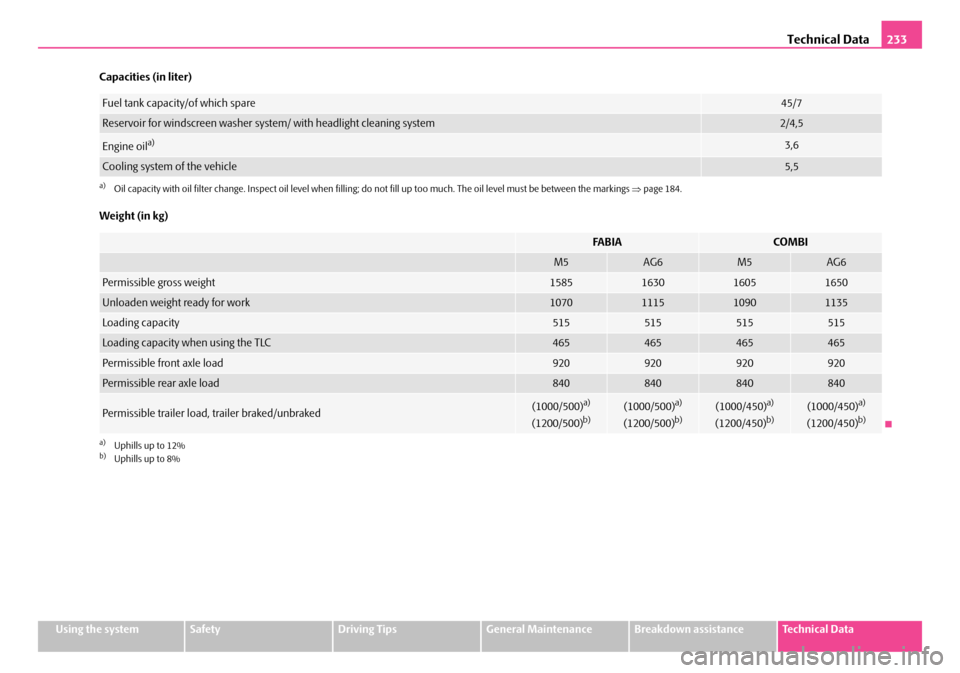
Capacities (in liter)
Weight (in kg)
Fuel tank capacity/of which spare45/7
Reservoir for windscreen washer system/ with headlight cleaning system2/4,5
Engine oila)
a)Oil capacity with oil filter change. Inspect oil level when filling; do not fill up too much. The oil level must be between the markings ⇒page 184.
3,6
Cooling system of the vehicle5,5
FA B I ACOMBI
M5AG6M5AG6
Permissible gross weight1585163016051650
Unloaden weight ready for work1070111510901135
Loading capacity515515515515
Loading capacity when using the TLC465465465465
Permissible front axle load920920920920
Permissible rear axle load840840840840
Permissible trailer load, trailer braked/unbraked(1000/500)a)
(1200/500)b)
a)Uphills up to 12%b)Uphills up to 8%
(1000/500)a)
(1200/500)b)(1000/450)a)
(1200/450)b)(1000/450)a)
(1200/450)b)
NKO A05F 20.book Page 233 Wednesday, April 2, 2008 1:02 PM
Page 236 of 252

Technical Data235
Using the systemSafetyDriving TipsGeneral MaintenanceBreakdown assistanceTechnical Data
Capacities (in liter)
Weight (in kg)
Fuel tank capacity/of which spare45/7
Reservoir for windscreen washer system/ with headlight cleaning system2/4,5
Engine oila)
a)Oil capacity with oil filter change. Inspect oil level when filling; do not fill up too much. The oil level must be between the markings ⇒page 184.
3,8
Cooling system of the vehicle6,2
FA B I ACOMBI
Permissible gross weight16401660
Unloaden weight ready for work11251145
Loading capacity515515
Loading capacity when using the TLC465465
Permissible front axle load920920
Permissible rear axle load840840
Permissible trailer load, trailer braked/unbraked(900/500)a)
(1100/500)b)
a)Uphills up to 12%b)Uphills up to 8%
(900/450)a)
(1100/450)b)
NKO A05F 20.book Page 235 Wednesday, April 2, 2008 1:02 PM