2008 Seat Exeo handbrake
[x] Cancel search: handbrakePage 169 of 303

Driving167
Safety First
Operating instructions
Practical tips
Te c h n i c a l D a t a
If you drive by mistake with the handbrake still applied, you will hear a
warning buzzer and the display will show the message:
Handbrake applied
The handbrake warning is enabled after driving for 3 seconds at a speed
above 5 km/h.
The handbrake warning lamp
lights up when the handbrake is applied
with the ignition on.
WARNING
Please note that the handbrake should be released all the way. If it is only
partially released, this will cause rear brakes overheating, which can
impair the function of the brake system and could lead to an accident.
Caution
After the vehicle has been stopped, always apply the hand brake and engage
a gear.Parking
The following points will ensure there is no risk of the car
rolling away accidentally after it is parked.– Use the foot brake to stop the vehicle.
– Apply handbrake firmly.
– Switch the engine off.
– Engage the first gear ⇒.
When parking on slopes:
Turn the steering wheel so that the, if the vehicle moves, it will do so towards
the curb.
WARNING
•
Do not leave anyone (especially chil dren) in the vehicle when it is
locked. Locked doors could delay assistance in an emergency, potentially
putting lives at risk.
•
Never leave children unsupervised in the vehicle. They could release
e.g. the handbrake or gear lever, moving the vehicle and causing an
accident.
Parking aidGeneral notesVarious systems are available to help you when parking or manoeuvring in
tight spaces, dependi ng on the equipment fitted on your vehicle.
The SEAT parking system gives an acoustic warning if there are any obstacles
behind your car ⇒ page 168.
When you are parking, SEAT parking system plus warns you acoustically and
optically about obstacles in front of and behind the vehicle ⇒ page 168.
Note
To ensure the acoustic parking aid works properly, the sensors must be kept
clean and free of snow and ice.
Exeo_EN.book Seite 167 Freitag, 17. Oktober 2008 11:24 11
Page 199 of 303

Your vehicle maintenance and cleaning197
Safety First
Operating instructions
Practical tips
Te c h n i c a l D a t a
Your vehicle maintenance and cleaningGeneral notesRegular washing and care help maintain the value of your
vehicle.Your vehicle maintenance
Regular care and washing help to maintain the value of the vehicle. This may
also be one of the requirements for acknowledging warranty claims in the
event of bodywork corr osion or paint defects.
The best way to protect your car against the harmful effects of the environ-
ment is through correct maintenance and frequent washing. The longer
substances such as insects remains, bird droppings, resinous tree sap, road
dirt, industrial deposits, tar, soot or road salt and other aggressive materials
remain on the vehicle, the more damage they do to the paintwork. High
temperatures (for instance in strong sunlight) further intensify the corrosive
effect.
After winter, a period when salt is put on the roads, it is important to have the
underside of the vehicle washed thoroughly.
Products for vehicle maintenance
Car care products are available in your Authorised Service Centre. Keep the
product instructions until you have used them up.
WARNING
•
Car care products can be toxic. For this, they must always be kept
closed in their original container. Keep them out of the reach of children.
Failure to comply could result in poisoning.
•
Always read and observe the instructions and warnings on the package
before using car care products. Improper use could damage your health or your vehicle. The use of certain products may produce noxious vapours;
they should be used in well ventilated areas.
•
Never use fuel, turpentine, engine oil, nail varnish remover or other
volatile fluids. These are toxic and highly flammable. Risk of fire and explo-
sion.
•
Before washing your vehicle, or carrying out any maintenance, switch
the engine off, apply your handbrake firmly and remove the key from the
ignition.Caution
Never attempt to remove dirt, mud or dust if the surface of the vehicle is dry.
Never use a dry cloth or sponge for clea ning purposes. This could damage the
paintwork or the windows of your vehicle. Soak dirt, mud or dust with plenty
of water.
For the sake of the environment
•
When purchasing products for your vehicle maintenance, select the ones
which are not harmful to the environment.
•
The leftovers of the car care products should not be disposed of with ordi-
nary household waste. Observe the disposal information on the package.WARNING (continued)
Exeo_EN.book Seite 197 Freitag, 17. Oktober 2008 11:24 11
Page 215 of 303

Checking and refilling levels213
Safety First
Operating instructions
Practical tips
Te c h n i c a l D a t a
WARNING
Never open the bonnet if you see steam or drips of coolant being released
from the engine compartment. Failure to comply could result in burns. Wait
until no steam or coolant can be seen before opening the bonnet.Work in the engine compartment
Extra caution is necessary when working on components in
the engine compartment.Always be aware of the danger of injury and scalding as well as the risk of
accident or even fire when working in the engine compartment (e.g. when
checking and refilling fluids). Therefor e, always observe the warnings listed
below and follow all general safety precautions. The engine compartment of
any motor vehicle is a potentially hazardous area ⇒
WARNING
•
Switch the engine off.
•
Remove the ignition key.
•
Apply handbrake firmly.
•
Place the gear lever into neutral.
•
Wait for the engine to cool down.
•
Children should not be allowed to approach the engine compartment
•
Never spill liquids involved in vehicle operations on the engine
compartment, as these may catch fire (e.g. anti-freeze containing liquid
coolant).
•
Take care not to cause short circuits in the electrical system, especially
when working on the battery.
•
Never touch the radiator fan while the engine is hot, as the fan could
start up suddenly.
•
Never open the expansion tank when the engine is hot. The cooling
system is under pressure.
•
Protect face, hands and arms from any hot steam or hot liquid coolant
released by covering the cap with a large, thick rag when opening the
expansion tank.
•
If any tests have to be performed with the engine running, there is an
extra safety risk from the rotating parts, such as the drive belts, alternator
and radiator fan, etc., and from the high-voltage ignition system.
•
Observe the following additional warnings if work on the fuel system or
the electrical system is necessary:
−Always disconnect the battery.
− Do not smoke.
− Never work near open flames
− Always keep an approved fire extinguisher immediately available.Caution
When topping up fluids, make sure the correct fluid is put into the correct
filler opening. This can otherwise cau se serious malfunctions or engine
damage.
For the sake of the environment
Inspect the ground underneath your vehicle regularly so that any leaks are
detected at an early stage. If you find spots of oil or other fluids, have your
vehicle inspected in the garage.
WARNING (continued)
Exeo_EN.book Seite 213 Freitag, 17. Oktober 2008 11:24 11
Page 240 of 303

If and when
238Your vehicle can be equipped with a steel spare wheel at the factory. The
spare wheel does not usually meet the same performance standards as the
wheels fitted on the vehicle because of the wheel/tyre dimensions, rubber
composition, tread pattern, etc. Theref ore, note the following restrictions:•
The spare steel rim wheel is designed on ly for your vehicle model. Do not
attempt to mount the wheel on any vehicle but your own.
•
Your vehicle will have different driving characteristics when the spare
steel rim wheel is mounted ⇒.
•
The spare wheel is only intended for temporary use after having a flat tyre.
Replace the spare wheel with a normal wheel that has the proper tyre dimen-
sions as soon as possible.
•
If the size of the spare steel rim wheel is different to that of the other
wheels, it is unlikely that snow chains suitable for the other wheels will fit it.
WARNING
•
After mounting the spare steel rim wheel, the tyre pressure must be
checked and corrected as soon as possible. The inflating pressure must
adapt to the vehicle load (consult th e table containing the inflation pres-
sures). Otherwise there is danger of causing an accident. Use the highest
tyre pressure as indicated in the table.
•
Do not drive faster than 80 km/h, as higher speeds can cause an acci-
dent.
•
Avoid heavy acceleration, hard braking and fast cornering, as this could
cause an accident.
Changing a wheelPreparation work
What you must do before changing a wheel.– If you have a flat tyre or puncture, park the car as far away from the flow of traffic as possible. Choose a location that is as level
as possible.
– All passengers should leave the vehicle. They should wait in a
safe place (e.g. behind the roadside crash barrier).
–Apply the handbrake firmly.
– Engage 1st gear.
– When towing a trailer: Unhitch the trailer from your vehicle.
–Take the tools and the spare wheel ⇒ page 236 out of the
luggage compartment.
WARNING
If you have a puncture in heavy traffic, switch on the hazard warning lights
and place the warning triangle in a visible location. This is for your own
safety and also warns other road users.
Caution
If you have to change the tyre on a gradient, block the wheel opposite the
wheel being changed by placing a stone or similar object under it to prevent
the vehicle from rolling away.
Exeo_EN.book Seite 238 Freitag, 17. Oktober 2008 11:24 11
Page 247 of 303

If and when245
Safety First
Operating instructions
Practical tips
Te c h n i c a l D a t a
Repairing a tyrePreparations
– If you have a flat tyre or puncture, park the car as far away from
the flow of traffic as possible.
–Apply the handbrake firmly to prevent the vehicle from moving
accidentally on slopes.
–Engage 1st gear.
– Check whether a repair is possible using the Tyre Mobility System ⇒page 243.
– Ensure that all passengers leave the vehicle and move away from
the danger area ⇒.
– Take the tyre sealant can and the compressor out of the luggage
compartment. – Stick the “max. 80 km/h” adhesive, which is included with the
tyre sealant can, onto the instru ment panel where the driver will
see it.
Filling the tyre
– Shake the tyre sealant can well.
– Screw the enclosed filling hose onto the sealant can as far as it will go. This will automatically pierce the foil sealing the can.
– Take the valve cap off the tyre valve and use the enclosed valve insert tool to unscrew the valve insert ⇒fig. 184.
– Place the valve insert onto a clean surface.
– Remove the sealing plug from the filling hose and insert the hose into the tyre valve.
– Hold the tyre sealant can upside down and fill the complete contents of the can into the tyre.
– Then disconnect the hose and screw the valve insert firmly back into the tyre valve.
Inflating the tyre
– Screw the compressor filling hose onto the tyre valve and plug the connector into the cigarette lighter.
– Pump the tyre up to 2.0 to 2.5 bar and monitor the pressure shown on the pressure gauge.
Fig. 184 Repairing a tyre
Exeo_EN.book Seite 245 Freitag, 17. Oktober 2008 11:24 11
Page 295 of 303
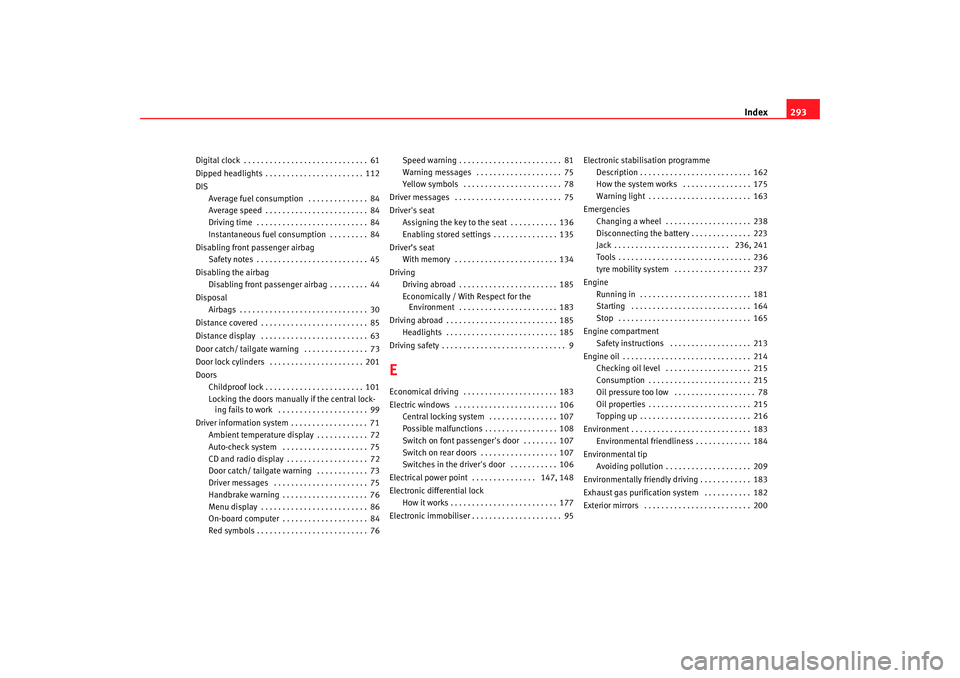
Index293
Digital clock . . . . . . . . . . . . . . . . . . . . . . . . . . . . . 61
Dipped headlights . . . . . . . . . . . . . . . . . . . . . . . 112
DIS
Average fuel consumption . . . . . . . . . . . . . . 84
Average speed . . . . . . . . . . . . . . . . . . . . . . . . 84
Driving time . . . . . . . . . . . . . . . . . . . . . . . . . . 84
Instantaneous fuel consumption . . . . . . . . . 84
Disabling front passenger airbag Safety notes . . . . . . . . . . . . . . . . . . . . . . . . . . 45
Disabling the airbag Disabling front passenger airbag . . . . . . . . . 44
Disposal Airbags . . . . . . . . . . . . . . . . . . . . . . . . . . . . . . 30
Distance covered . . . . . . . . . . . . . . . . . . . . . . . . . 85
Distance display . . . . . . . . . . . . . . . . . . . . . . . . . 63
Door catch/ tailgate warning . . . . . . . . . . . . . . . 73
Door lock cylinders . . . . . . . . . . . . . . . . . . . . . . 201
Doors Childproof lock . . . . . . . . . . . . . . . . . . . . . . . 101
Locking the doors manually if the central lock-ing fails to work . . . . . . . . . . . . . . . . . . . . . 99
Driver information system . . . . . . . . . . . . . . . . . . 71 Ambient temperature display . . . . . . . . . . . . 72
Auto-check system . . . . . . . . . . . . . . . . . . . . 75
CD and radio display . . . . . . . . . . . . . . . . . . . 72
Door catch/ tailgate warning . . . . . . . . . . . . 73
Driver messages . . . . . . . . . . . . . . . . . . . . . . 75
Handbrake warning . . . . . . . . . . . . . . . . . . . . 76
Menu display . . . . . . . . . . . . . . . . . . . . . . . . . 86
On-board computer . . . . . . . . . . . . . . . . . . . . 84
Red symbols . . . . . . . . . . . . . . . . . . . . . . . . . . 76 Speed warning . . . . . . . . . . . . . . . . . . . . . . . . 81
Warning messages . . . . . . . . . . . . . . . . . . . . 75
Yellow symbols . . . . . . . . . . . . . . . . . . . . . . . 78
Driver messages . . . . . . . . . . . . . . . . . . . . . . . . . 75
Driver's seat Assigning the key to the seat . . . . . . . . . . . 136
Enabling stored settings . . . . . . . . . . . . . . . 135
Driver’s seat With memory . . . . . . . . . . . . . . . . . . . . . . . . 134
Driving Driving abroad . . . . . . . . . . . . . . . . . . . . . . . 185
Economically / With Respect for the Environment . . . . . . . . . . . . . . . . . . . . . . . 183
Driving abroad . . . . . . . . . . . . . . . . . . . . . . . . . . 185 Headlights . . . . . . . . . . . . . . . . . . . . . . . . . . 185
Driving safety . . . . . . . . . . . . . . . . . . . . . . . . . . . . . 9
EEconomical driving . . . . . . . . . . . . . . . . . . . . . . 183
Electric windows . . . . . . . . . . . . . . . . . . . . . . . . 106 Central locking system . . . . . . . . . . . . . . . . 107
Possible malfunctions . . . . . . . . . . . . . . . . . 108
Switch on font passenger's door . . . . . . . . 107
Switch on rear doors . . . . . . . . . . . . . . . . . . 107
Switches in the driver's door . . . . . . . . . . . 106
Electrical power point . . . . . . . . . . . . . . . 147, 148
Electronic differential lock How it works . . . . . . . . . . . . . . . . . . . . . . . . . 177
Electronic immobiliser . . . . . . . . . . . . . . . . . . . . . 95 Electronic stabilisation programme
Description . . . . . . . . . . . . . . . . . . . . . . . . . . 162
How the system works . . . . . . . . . . . . . . . . 175
Warning light . . . . . . . . . . . . . . . . . . . . . . . . 163
Emergencies Changing a wheel . . . . . . . . . . . . . . . . . . . . 238
Disconnecting the battery . . . . . . . . . . . . . . 223
Jack . . . . . . . . . . . . . . . . . . . . . . . . . . . 236, 241
Tools . . . . . . . . . . . . . . . . . . . . . . . . . . . . . . . 236
tyre mobility system . . . . . . . . . . . . . . . . . . 237
Engine Running in . . . . . . . . . . . . . . . . . . . . . . . . . . 181
Starting . . . . . . . . . . . . . . . . . . . . . . . . . . . . 164
Stop . . . . . . . . . . . . . . . . . . . . . . . . . . . . . . . 165
Engine compartment Safety instructions . . . . . . . . . . . . . . . . . . . 213
Engine oil . . . . . . . . . . . . . . . . . . . . . . . . . . . . . . 214 Checking oil level . . . . . . . . . . . . . . . . . . . . 215
Consumption . . . . . . . . . . . . . . . . . . . . . . . . 215
Oil pressure too low . . . . . . . . . . . . . . . . . . . 78
Oil properties . . . . . . . . . . . . . . . . . . . . . . . . 215
Topping up . . . . . . . . . . . . . . . . . . . . . . . . . . 216
Environment . . . . . . . . . . . . . . . . . . . . . . . . . . . . 183 Environmental friendliness . . . . . . . . . . . . . 184
Environmental tip Avoiding pollution . . . . . . . . . . . . . . . . . . . . 209
Environmentally friendly driving . . . . . . . . . . . . 183
Exhaust gas purification system . . . . . . . . . . . 182
Exterior mirrors . . . . . . . . . . . . . . . . . . . . . . . . . 200
Exeo_EN.book Seite 293 Freitag, 17. Oktober 2008 11:24 11
Page 296 of 303

Index
294FFabric trim cleaning . . . . . . . . . . . . . . . . . . . . . 204
Fastening rings . . . . . . . . . . . . . . . . . . . . . . . . . . 17
Filling the tank
Releasing the tank flap ma nually . . . . . . . 209
Floor mats . . . . . . . . . . . . . . . . . . . . . . . . . . . . . . 16
Fog lights . . . . . . . . . . . . . . . . . . . . . . . . . . . . . . 114
Front airbags . . . . . . . . . . . . . . . . . . . . . . . . . . . . 32 Description . . . . . . . . . . . . . . . . . . . . . . . . . . 32
Front drink holders . . . . . . . . . . . . . . . . . . . . . . 145
Front passenger airbag deactivation . . . . . . . . . 44
Frontal airbags Operation . . . . . . . . . . . . . . . . . . . . . . . . . . . . 33
safety notes . . . . . . . . . . . . . . . . . . . . . . . . . . 35
Fuel Diesel . . . . . . . . . . . . . . . . . . . . . . . . . . . . . . 210
Fuel gauge . . . . . . . . . . . . . . . . . . . . . . . . . . . 63
Fuel level low . . . . . . . . . . . . . . . . . . . . . . . . . 79
Instantaneous fuel consumption . . . . . . . . . 84
Petrol . . . . . . . . . . . . . . . . . . . . . . . . . . . . . . 210
Fuel range . . . . . . . . . . . . . . . . . . . . . . . . . . . 73, 84
Fuel tank opening the fuel tank flap . . . . . . . . . . . . . 208
Fuel: save . . . . . . . . . . . . . . . . . . . . . . . . . . . . . . 183
Fuse Assignment . . . . . . . . . . . . . . . . . . . . . . . . . 248
Changing . . . . . . . . . . . . . . . . . . . . . . . . . . . 247
GGear shift pattern . . . . . . . . . . . . . . . . . . . . . . . 173
General overview of the engine compartment 282
Glove compartment . . . . . . . . . . . . . . . . . . . . . . 149Cool box . . . . . . . . . . . . . . . . . . . . . . . . . . . . 150
Light . . . . . . . . . . . . . . . . . . . . . . . . . . . . . . . 120HHandbrake . . . . . . . . . . . . . . . . . . . . . . . . . . . . . 166
Hazard warning lights . . . . . . . . . . . . . . . . . . . . 118
Head restraintRear seat . . . . . . . . . . . . . . . . . . . . . . . . . . . 138
Head restraints Front seats . . . . . . . . . . . . . . . . . . . . . . . . . . 136
Rear seats . . . . . . . . . . . . . . . . . . . . . . . . . . 137
Removing and fitting . . . . . . . . . . . . . . . . . 137
head restraints, correct adju stment . . . . . . . . . 13
In-use and non-use positions . . . . . . . . . . . 14
Headlight Automatic headlight control . . . . . . . . . . . . 113
Headlight range control . . . . . . . . . . . . . . . . . . 116 Dynamic . . . . . . . . . . . . . . . . . . . . . . . . . . . . 117
Faulty . . . . . . . . . . . . . . . . . . . . . . . . . . . . . . . 80
Headlights . . . . . . . . . . . . . . . . . . . . . . . . . . . . . 112 Automatic headlight control photosensors 113
Coming home function . . . . . . . . . . . . . . . . 115
Driving abroad . . . . . . . . . . . . . . . . . . . . . . . 185
Front fog lights . . . . . . . . . . . . . . . . . . . . . . 114
Headlight range control . . . . . . . . . . . . . . . 116 Headlight washer system . . . . . . . . . . . . . . 126
Leaving home function . . . . . . . . . . . . . . . . 115
Self-directing headlights . . . . . . . . . . . . . . 118
Heated Seats . . . . . . . . . . . . . . . . . . . . . . . . . . . . . . 161
Heated rear window . . . . . . . . . . . . . . . . . . . . . 123
Heated seat . . . . . . . . . . . . . . . . . . . . . . . . . . . . 161
High pressure cleaners . . . . . . . . . . . . . . . . . . . 199
Horn . . . . . . . . . . . . . . . . . . . . . . . . . . . . . . . . . . . 57
IIdentification number . . . . . . . . . . . . . . . . . . . . 278
Ignition key Safety interlock . . . . . . . . . . . . . . . . . . . . . . 163
Ignition lock . . . . . . . . . . . . . . . . . . . . . . . . . . . . 163
Indicator lamps Cruise control system . . . . . . . . . . . . . . . . . . 67
Glow plug system . . . . . . . . . . . . . . . . . . . . . 70
Hazard warning lights . . . . . . . . . . . . . . . . . . 68
Indicators . . . . . . . . . . . . . . . . . . . . . . . . . . . . 68
Main beam headlights . . . . . . . . . . . . . . . . . 69
Trailer indicators . . . . . . . . . . . . . . . . . . . . . . 67
Indicator lamps - overview . . . . . . . . . . . . . . . . . 65
Indicators . . . . . . . . . . . . . . . . . . . . . . . . . . . . . . 119
Instruments Lighting . . . . . . . . . . . . . . . . . . . . . . . . . 62, 116
Interior lights Background lighting . . . . . . . . . . . . . . . . . . 121
Front . . . . . . . . . . . . . . . . . . . . . . . . . . . . . . . 120
Exeo_EN.book Seite 294 Freitag, 17. Oktober 2008 11:24 11
Page 300 of 303

Index
298Tools . . . . . . . . . . . . . . . . . . . . . . . . . . . . . . . . . . 236
Tow starting
Comments . . . . . . . . . . . . . . . . . . . . . . . . . . 274
Towing . . . . . . . . . . . . . . . . . . . . . . . . . . . . 186, 274 Accessories . . . . . . . . . . . . . . . . . . . . . . . . . 188
Notes on towing . . . . . . . . . . . . . . . . . 186, 187
Removable towing bracket . . . . . . . . . . . . . 189
Technical requirements . . . . . . . . . . . . . . . 186
Towing a trailer . . . . . . . . . . . . . . . . . . . . . . . . . 280
Towing bracket, fitting . . . . . . . . . . . . . . . . . . . 195
Towing eye . . . . . . . . . . . . . . . . . . . . . . . . . . . . . 274
Towing eyes . . . . . . . . . . . . . . . . . . . . . . . . . . . . 275
Tow-starting . . . . . . . . . . . . . . . . . . . . . . . . . . . . 274
Traction control system How the system works . . . . . . . . . . . . . . . . 178
Trailer weights . . . . . . . . . . . . . . . . . . . . . . . . . . 280
Trip recorder . . . . . . . . . . . . . . . . . . . . . . . . . . . . 63
Type plate . . . . . . . . . . . . . . . . . . . . . . . . . . . . . 278
Tyre Mobility System . . . . . . . . . . . . . . . . . . . . . 243
Tyre mobility system . . . . . . . . . . . . . . . . . . . . . 237
Tyre pressure . . . . . . . . . . . . . . . . . . . . 66, 89, 227 Loss . . . . . . . . . . . . . . . . . . . . . . . . . . . . . . . 229
Tyre pressure monitoring . . . . . . . . . . . . . . . . . 228
Tyre pressure monitoring system . . . . . . . . . . . . 88
Tyre pressures . . . . . . . . . . . . . . . . . . . . . . . . . . 280
Tyre repair kit Tyre Mobility System . . . . . . . . . . . . . . . . . . 243
Tyres and wheels Dimensions . . . . . . . . . . . . . . . . . . . . . . . . . 233
Tyres service life . . . . . . . . . . . . . . . . . . . . . . . . 230 Tyres tread depth . . . . . . . . . . . . . . . . . . . . . . . 231
Tyres with directional tread pattern . . . . . . . . . 227
UUnderbody maintenance . . . . . . . . . . . . . . . . . 202VVehicle data . . . . . . . . . . . . . . . . . . . . . . . . . . . . 278
Vehicle identification data . . . . . . . . . . . . . . . . 278
Vehicle identification number . . . . . . . . . . . . . 278
Vehicle Maintenance
Exterior . . . . . . . . . . . . . . . . . . . . . . . . . . . . . 198
Vehicle modifications . . . . . . . . . . . . . . . . . . . . 206
Vehicle paintwork Products for vehicle maintenance . . . . . . . 197
Waxing . . . . . . . . . . . . . . . . . . . . . . . . . . . . . 199
Vehicle washing . . . . . . . . . . . . . . . . . . . . . . . . 198
Ventilation slits . . . . . . . . . . . . . . . . . . . . . . . . . . 17WWarning lamp . . . . . . . . . . . . . . . . . . . . . . . . . . . 29 Alternator . . . . . . . . . . . . . . . . . . . . . . . . . . . . 69
Warning lamps Airbag . . . . . . . . . . . . . . . . . . . . . . . . . . . . . . 66
Anti-lock brake system . . . . . . . . . . . . . . . . . 67
Electronic differential lock . . . . . . . . . . . . . . 67
Electronic stabilisation programme . . . . . . . 68
Engine management (EPC) . . . . . . . . . . . . . . 69
Exhaust emission control system . . . . . . . . 66 Handbrake . . . . . . . . . . . . . . . . . . . . . . . . . . . 70
Red symbols in central display . . . . . . . . . . 76
Seat belt warning lamp . . . . . . . . . . . . . . . . . 68
Yellow symbols in central display . . . . . . . . 78
Warning lamps - overview . . . . . . . . . . . . . . . . . 65
Washer fluid level . . . . . . . . . . . . . . . . . . . . . . . . 80
Washing by hand . . . . . . . . . . . . . . . . . . . . . . . 198
Washing with high pressure cleaners . . . . . . . 199
Wear indicators . . . . . . . . . . . . . . . . . . . . . . . . . 231
Wheel bolts . . . . . . . . . . . . . . . . . . . . . . . . . . . . 281 Torque . . . . . . . . . . . . . . . . . . . . . . . . . . . . . 234
Wheels . . . . . . . . . . . . . . . . . . . . . . . . . . . . 227, 280 Changing a wheel . . . . . . . . . . . . . . . . . . . . 238
Why assume the correct sitting position? . . . . . 28
Why should head restraints be correctly adjusted? 13
Why wear seat belts? . . . . . . . . . . . . . . . . . . 19, 28
Why wear seatbelts? . . . . . . . . . . . . . . . . . . . . . . 18
Windows Defrosting . . . . . . . . . . . . . . . . . . . . . . . . . . 156
Windscreen washer system . . . . . . . . . . . . . . . 220
Windscreen wiper blades Cleaning . . . . . . . . . . . . . . . . . . . . . . . . . . . . 201
Windscreen wipers . . . . . . . . . . . . . . . . . . . . . . 125 Changing blades . . . . . . . . . . . . . . . . . . . . . 221
Rain sensor . . . . . . . . . . . . . . . . . . . . . . . . . 125
Washer jets . . . . . . . . . . . . . . . . . . . . . . . . . 125
Winter Battery . . . . . . . . . . . . . . . . . . . . . . . . . . . . . 223
Winter conditions Defrost function . . . . . . . . . . . . . . . . . . . . . 156
Exeo_EN.book Seite 298 Freitag, 17. Oktober 2008 11:24 11