2008 Seat Altea XL check oil
[x] Cancel search: check oilPage 228 of 317
Checking and refilling levels
226Changing windscreen wiper blades
If the windscreen wiper blades are in perfect condition, you
will benefit from an improv ed visibility. Damaged wiper
blades should be replaced immediately.
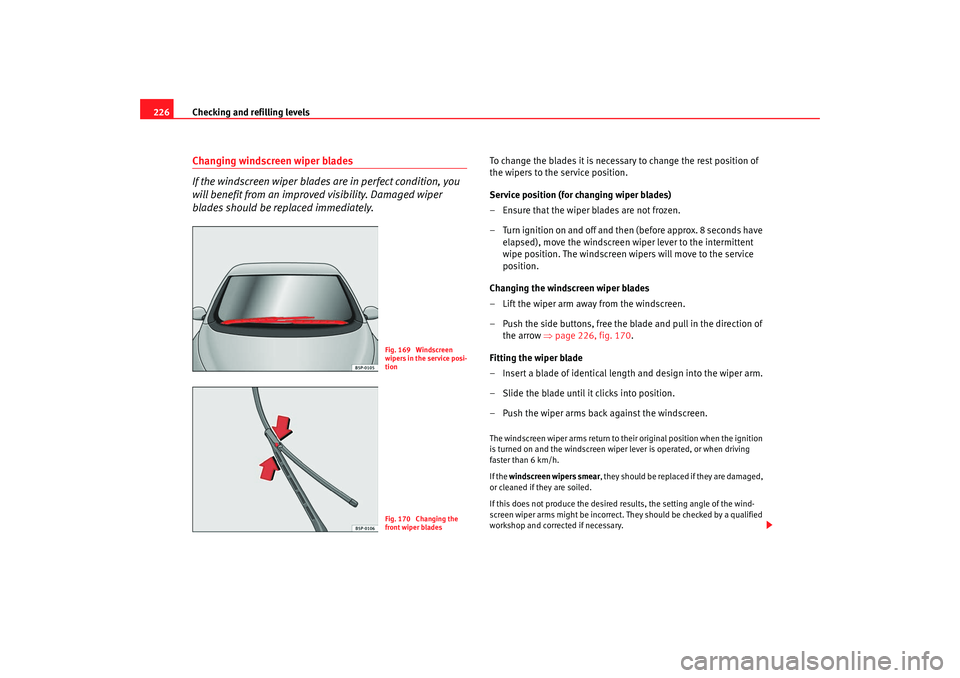
To change the blades it is necessary to change the rest position of
the wipers to the service position.
Service position (for changing wiper blades)
– Ensure that the wiper blades are not frozen.
– Turn ignition on and off and then (before approx. 8 seconds have
elapsed), move the windscreen wi per lever to the intermittent
wipe position. The windscreen wipers will move to the service
position.
Changing the windscreen wiper blades
– Lift the wiper arm away from the windscreen.
– Push the side buttons, free the blade and pull in the direction of the arrow ⇒page 226, fig. 170 .
Fitting the wiper blade
– Insert a blade of identical length and design into the wiper arm.
– Slide the blade until it clicks into position.
– Push the wiper arms back against the windscreen.The windscreen wiper arms return to their original position when the ignition
is turned on and the windscreen wiper lever is operated, or when driving
faster than 6 km/h.
If the windscreen wipers smear , they should be replaced if they are damaged,
or cleaned if they are soiled.
If this does not produce the desired results, the setting angle of the wind-
screen wiper arms might be incorrect. They should be checked by a qualified
workshop and corrected if necessary.
Fig. 169 Windscreen
wipers in the service posi-
tionFig. 170 Changing the
front wiper blades
altea_XL ingles.book Seite 226 Donnerstag, 13. September 2007 10:36 10
Page 229 of 317
Checking and refilling levels227
Safety First
Operating instructions
Tips and Maintenance
Te c h n i c a l D a t a
WARNING
Do not drive unless you have good visibility through all windows!•
Clean the windscreen wiper blades and all windows regularly.
•
The wiper blades should be changed once or twice a year.Caution
•
Damaged or dirty windscreen wipers could scratch the windscreen.
•
Never use fuel, nail varnish remover, paint thinner or similar products to
clean the windows. This could damage the windscreen wiper blades.
•
Never move the windscreen wiper or windscreen wiper arm manually. This
could cause damage.
•
Do not pull the windscreen wipers forward unless they are in the service
position. Otherwise the bonnet could be damaged.Note
•
The wiper arms can be moved to the service position only when the
bonnet is properly closed.
Changing the rear wiper blade
A good rear wiper blade is es sential for clear rear vision.
Damaged wiper blades should be replaced immediately.Removing the wiper blade
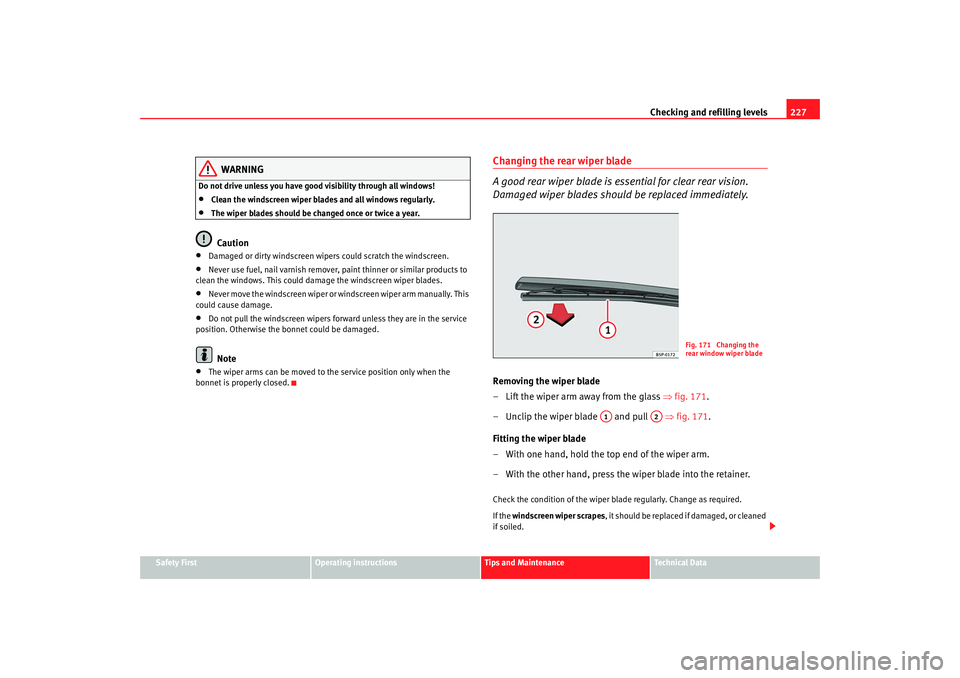
– Lift the wiper arm away from the glass ⇒fig. 171 .
– Unclip the wiper blade and pull ⇒fig. 171.
Fitting the wiper blade
– With one hand, hold the top end of the wiper arm.
– With the other hand, press the wiper blade into the retainer.Check the condition of the wiper blade regularly. Change as required.
If the windscreen wiper scrapes , it should be replaced if damaged, or cleaned
if soiled.
Fig. 171 Changing the
rear window wiper blade
A1
A2
altea_XL ingles.book Seite 227 Donnerstag, 13. September 2007 10:36 10
Page 231 of 317

Checking and refilling levels229
Safety First
Operating instructions
Tips and Maintenance
Te c h n i c a l D a t a
However, if the level goes down noticeably in a short time, or drops below the
“MIN” mark, there may be a leak in the brake system. A display on the instru-
ment panel will warn you if the brake fluid level is too low
⇒page 72.
WARNING
Before opening the bonnet to check the brake fluid level, read and observe
the warnings ⇒page 215.Changing the brake fluid
The Maintenance Program indicates the brake fluid change
intervals.We recommend that you have the brake fluid changed by an Authorised
Service Centre.
Before opening the bonnet, please read and follow the warnings ⇒ in
“Safety instructions on working in the engine compartment” on page 215 in
“Working in the engine compartment”.
Brake fluid absorbs moisture. In the cour se of time, it will absorb water from
the ambient air. If the water content in the brake fluid is too high, the brake
system could corrode. This also considerably reduces the boiling point of the
brake fluid. Heavy use of the brakes may then cause a vapour lock which
could impair the braking effect.
It is important that you use only brake fluid compliant with the US standard
FMVSS 116 DOT 4. We recommend the use of Genuine SEAT brake fluid.
WARNING
Brake fluid is toxic. Old brake fluid impairs the braking effect.
•
Before opening the bonnet to check the brake fluid level, read and
observe the warnings ⇒page 215.
•
Brake fluid should be stored in the closed original container in a safe
place out of reach of children. There is a toxic risk.
•
Complete the brake fluid change according to the Maintenance
Program. Heavy use of the brakes may cause a vapour lock if the brake fluid
is left in the system for too long. This would seriously affect the efficiency
of the brakes and the safety of the vehicle. This may cause an accident.Caution
Brake fluid could damage the paintwork. Wipe off any brake fluid from the
paintwork immediately.
For the sake of the environment
Brake fluid must be drained and disposed of in the proper manner observing
environmental regulations.
WARNING (continued)
altea_XL ingles.book Seite 229 Donnerstag, 13. September 2007 10:36 10
Page 235 of 317

Wheels and tyres233
Safety First
Operating instructions
Tips and Maintenance
Te c h n i c a l D a t a
Wheels and tyresWheelsGeneral notesAvoiding damage
– If you have to drive over a kerb or similar obstacle, drive very
slowly and as near as possible at a right angle to the kerb.
– Keep grease, oil and fuel off the tyres.
– Inspect the tyres regularly for damage (cuts, cracks or blisters, etc.). Remove any foreign objects embedded in the treads.
Storing tyres
– Mark tyres when you remove them to indicate the direction of rotation. This ensures you will be able to install them correctly
when you replace them.
– When removed, the wheels and/or tyres should be stored in a cool, dry and preferably dark location.
– Store tyres in a vertical position if they are not fitted on wheel rims.New tyres
New tyres have to be run in ⇒page 189.
The tread depth of new tyres may vary, according to the type and make of tyre
and the tread pattern. Concealed damage
Damage to tyres and rims is often not readily visible. If you notice unusual
vibrations or the car pulling to one side, this may indicate that one of the tyres
is damaged. The tyres should be checked immediately by an Authorised
Service Centre.
Tyres with directional tread pattern
An arrow on the tyre sidewall indicates the direction of rotation on tyres with
directional tread. Always observe the direction of rotation indicated when
fitting the wheel. This guarantees optimum grip and helps to avoid aqua-
planing, excessive noise and wear.
WARNING
•
New tyres do not have maximum grip in the first 500 km. Drive particu-
larly carefully to avoid risk of accident.
•
Never drive with damaged tyres. This may cause an accident.
•
If you notice unusual vibration or if the vehicle pulls to one side when
driving, stop the vehicle immediately and check the tyres for damage.
Checking tyre pressure
The correct tyre pressure can be seen on the sticker on the
inside of the tank flap.1. Read the required ty re inflation pressure from the sticker. The
values refer to Summer tyres. For Winter tyres, you must add 0.2
bar to the values given on the sticker.
altea_XL ingles.book Seite 233 Donnerstag, 13. September 2007 10:36 10
Page 238 of 317

Wheels and tyres
236Changing wheels around
If the front tyres are worn considerably more than the rear ones it is advisable
to change them around as shown ⇒page 235, fig. 174. All the tyres will then
last for about the same time.
Wheel balance
The wheels on new vehicles are balanced. However, various factors encoun-
tered in normal driving can cause them to become unbalanced, which results
in steering vibration.
Unbalanced wheels should be rebalanced, as they otherwise cause excessive
wear on steering, suspension and tyre s. A wheel must also be rebalanced
when a new tyre is fitted.
Incorrect wheel alignment
Incorrect wheel alignment causes excessiv e tyre wear, impairing the safety of
the vehicle. If tyres show excessive wear, you should have the wheel align-
ment checked by an Authorised Service Centre.
WARNING
There is a serious danger of accidents if a tyre bursts during driving!•
The tyres must be replaced at the latest when the tread is worn down to
the tread wear indicators. Failure to do so could result in an accident. Worn
tyres do not grip well at high speeds on wet roads. There is also a greater
risk of “aquaplaning”.
•
At continuously high speeds, a tyre with insufficient pressure flexes
more. This causes it to overheat. This can cause tread separation and tyre
blow-out. Risk of accident. Always observe the recommended tyre pres-
sures.
•
If tyres show excessive wear, you should have the running gear checked
by an Authorised Service Centre.
•
Keep chemicals such as oil, fuel and brake fluid away from tyres.
•
Damaged wheels and tyres must be replaced immediately!
For the sake of the environment
Under-inflated tyres will increase fuel consumption.Puncture proof tyres
Anti-puncture tyres allow you to continue driving even with a
punctured tyre, in the majority of cases.Vehicles that are factory-fitted with puncture proof tyres
22)
indicate
on the instrument panel when there is a loss of tyre pressure.
Driving with anti-puncture tyres (emergency gear)
– Leave the ESP/TCS (electronic stabilisation programme) switched on, or switch on ⇒page 183.
– Continue driving carefully and slowly (80 km/h maximum).
– Avoid sudden manoeuvres and sharp turns.
– Avoid driving over obstacles (for example kerbs) or potholes.
– Look out for the ESP/TCS intervening often, smoke coming from the tyres or the smell of rubber, the vehicle vibrating or a clat-
tering noise. If any of these occur, stop the vehicle.
The anti-puncture tyres have a tag on the side of the tyre, with the description:
“DSST”, “Eufonia”, “RFT”, “ROF”, “RSC”, “SSR” or “ZP”.
The sides of this type of tyre are reinforced. When the tyres lose air they are
supported on the sides (emergency driving).22)Depending upon version and country.
altea_XL ingles.book Seite 236 Donnerstag, 13. September 2007 10:36 10
Page 241 of 317

Wheels and tyres239
Safety First
Operating instructions
Tips and Maintenance
Te c h n i c a l D a t a
Wheel bolts
Wheel bolts must be tightened to the correct torque.The design of wheel bolts is matched to the rims. If different wheel rims are
fitted, the correct wheel bolts with the right length and correctly shaped bolt
heads must be used. This ensures that wheels are fitted securely and that the
brake system functions correctly.
In certain circumstances, you may not use wheel bolts from a different car -
even if it is the same model ⇒page 210.
After the wheels have been changed, the tightening torque of the wheel bolts
should be checked as soon as possible with a torque wrench ⇒ . The tight-
ening torque for steel and alloy wheels is 120 Nm.
WARNING
If the wheel bolts are not tightened correctly, the wheel could become
loose while driving. Risk of accident.•
The wheel bolts must be clean and turn easily. Never apply grease or oil
to them.
•
Use only wheel bolts which belong to the wheel.
•
If the torque of the wheel bolts is too low, they could loosen whilst the
vehicle is in motion. Risk of accident! If the tightening torque is too high,
the wheel bolts and threads could be damaged.Caution
The prescribed torque for wheel bolts for steel and alloy wheels is 120 Nm.
Winter tyres
Winter tyres will improve the vehicles handling on snow and
ice.In winter conditions winter tyres will considerably improve the vehicles
handling. The design of summer tyre s (width, rubber compound, tread
pattern) gives less grip on ice and snow.
Winter tyres must be inflated to a pressure 0.2 bar higher than the pressures
specified for summer tyres (see sticker on tank flap).
Winter tyres must be fitted on all four wheels.
Information on permitted winter tyre sizes can be found in the vehicle's regis-
tration documents. Use only radial winter tyres. All tyre sizes listed in the
vehicle documentation also apply to winter tyres.
Winter tyres lose their effectiveness when the tread is worn down to a depth
of 4 mm.
The speed rating code ⇒page 237, “New tyres and wheels” determines the
following speed limits: ⇒ ⇒
Q max. 160 km/h
S max. 180 km/h
T max. 190 km/h
H max. 210 km/h
In some countries, vehicles which can exceed the speed rating of the fitted
tyre must have an appropriate sticker in the driver's field of view. These
stickers are available from your Authorised Service Centre. The legal require-
ments of each country must be followed.
Do not have winter tyres fitted for unnecessarily long periods. Vehicles with
summer tyres handle better when the roads are free of snow and ice.
If you have a flat tyre, please refer to the notes on the spare wheel
⇒ page 237, “New tyres and wheels”.
altea_XL ingles.book Seite 239 Donnerstag, 13. September 2007 10:36 10
Page 281 of 317

Technical data279
Safety First
Operating instructions
Tips and Maintenance
Te c h n i c a l D a t a
Te c h n i c a l d a t aChecking fluid levelsFrom time to time, the levels of the different fluids in the
vehicle must be checked. Never fill with incorrect fluids, to do
so may cause serious damage to the engine.
Radiator expansion tank
Windscreen washer fluid reservoir
Engine oil filler cap
Engine oil dipstick
Brake fluid reservoir
Vehicle battery (underneath the cover)
The checking and replenishment of the service fluids are carried out on the
components mentioned above. These operations are described in the
⇒ page 215. Overview
Further explanations, instructions and restrictions on the technical data are
contained as of
⇒page 275.
Fig. 210 Diagram for the
location of the various
elements
A1A2A3A4A5A6
altea_XL ingles.book Seite 279 Donnerstag, 13. September 2007 10:36 10
Page 308 of 317

Index
306Brake system . . . . . . . . . . . . . . . . . . . . . . . . . . . 228
Brake servo . . . . . . . . . . . . . . . . . . . . . . . . . 185
Brakes . . . . . . . . . . . . . . . . . . . . . . . . . . . . . 185
Warning lamp . . . . . . . . . . . . . . . . . . . . . . . . 77
Brakes . . . . . . . . . . . . . . . . . . . . . . . . . . . . . . . . 187
Braking distance . . . . . . . . . . . . . . . . . . . . . . . . 187
Bulb changes general notes . . . . . . . . . . . . . . . . . . . . . . . 259
Bulb defect warning lamp . . . . . . . . . . . . . . . . . . . . . . . . . 77
Buzzer . . . . . . . . . . . . . . . . . . . . . . . . . . . . 117, 163CCar care Exterior . . . . . . . . . . . . . . . . . . . . . . . . . . . . . 202
Car care products . . . . . . . . . . . . . . . . . . . . . . . 201
Catalytic converter . . . . . . . . . . . . . . . . . . . . . . 189
CD changer . . . . . . . . . . . . . . . . . . . . . . . . . . . . 135
Central locking . . . . . . . . . . . . . . . . . . . . . . . . . . 93 Automatic speed dependent locking and un-locking system* . . . . . . . . . . . . . . . . . . . . . 95
Emergency unlocking system . . . . . . . . . . . . 95
Locking system for invo luntary unlocking . . 95
Selective unlocking system* . . . . . . . . . . . . 94
Central locking button Central locking . . . . . . . . . . . . . . . . . . . . . . . 97
unlocking . . . . . . . . . . . . . . . . . . . . . . . . . . . . 97
Central locking system Automatic speed dependent locking and un-locking system* . . . . . . . . . . . . . . . . . . . . . 95 Centre arm rest . . . . . . . . . . . . . . . . . . . . . . . . . 135
Cetane number . . . . . . . . . . . . . . . . . . . . . . . . . 214
Changing gear
See Manual gearbox . . . . . . . . . . . . . . . . . . 167
Changing the lamps Main headlight lamps . . . . . . . . . . . . . . . . . 260
rear lights . . . . . . . . . . . . . . . . . . . . . . . . . . 263
Changing the main headlight lamps dipped beam lights . . . . . . . . . . . . . . . . . . . 261
main beam lights . . . . . . . . . . . . . . . . . . . . 262
Side lights . . . . . . . . . . . . . . . . . . . . . . . . . . 263
turn signal lamps . . . . . . . . . . . . . . . . . . . . 261
Changing the rear light lamps Position light, fog ligh t and rear light on the
tailgate . . . . . . . . . . . . . . . . . . . . . . . . . . . 265
Changing the rear lights Indicator, side and brake lights on the bodywork . . . . . . . . . . . . . . . . . . . . . . . . . 264
luggage compartment lights . . . . . . . . . . . 266
Changing windscreen wiper blades . . . . . . . . . 226
Chassis number . . . . . . . . . . . . . . . . . . . . . . . . 276
Checking . . . . . . . . . . . . . . . . . . . . . . . . . . . . . . 231
Checking battery electrolyte level . . . . . . . . . . 231
Checking engine oil level . . . . . . . . . . . . . . . . . 220
Child safety . . . . . . . . . . . . . . . . . . . . . . . . . . . . . 46
Child seat . . . . . . . . . . . . . . . . . . . . . . . . . . . . . . . 48 Categorisation in groups . . . . . . . . . . . . . . . 48
Group 1 . . . . . . . . . . . . . . . . . . . . . . . . . . . . . 49
Group 2 . . . . . . . . . . . . . . . . . . . . . . . . . . . . . 49
Group 3 . . . . . . . . . . . . . . . . . . . . . . . . . . . . . 49
Groups 0 and 0+ . . . . . . . . . . . . . . . . . . . . . . 48 Safety notes . . . . . . . . . . . . . . . . . . . . . . . . . . 47
Securing . . . . . . . . . . . . . . . . . . . . . . . . . . . . 51
Child seats ISOFIX and Toptether systems . . . . . . . . . . . 52
on the front passenger seat . . . . . . . . . . . . . 31
Cigarette lighter* . . . . . . . . . . . . . . . . . . . . . . . 143
Cleaning alloy wheels . . . . . . . . . . . . . . . . . . . . 206
Cleaning and caring for your vehicle . . . . . . . . 201
Cleaning chrome . . . . . . . . . . . . . . . . . . . . . . . . 205
Cleaning cloth seat covers . . . . . . . . . . . . . . . . 208
Cleaning dash panel . . . . . . . . . . . . . . . . . . . . . 208
Cleaning engine compartment . . . . . . . . . . . . . 207
Cleaning fabric trim . . . . . . . . . . . . . . . . . . . . . 208
Cleaning leather . . . . . . . . . . . . . . . . . . . . . . . . 208
Cleaning plastic parts . . . . . . . . . . . . . . . . . . . . 208
Cleaning seat belts . . . . . . . . . . . . . . . . . . . . . . 209
Cleaning steel wheels . . . . . . . . . . . . . . . . . . . . 206
Cleaning windows . . . . . . . . . . . . . . . . . . . . . . . 204
Cleaning wooden trim . . . . . . . . . . . . . . . . . . . . 208
Climatic* . . . . . . . . . . . . . . . . . . . . . . . . . . . . . . 153
Climatronic General notes . . . . . . . . . . . . . . . . . . . . . . . 160
Clock . . . . . . . . . . . . . . . . . . . . . . . . . . . . . . . . . . 58
Clothes hook . . . . . . . . . . . . . . . . . . . . . . . . . . . 138
Cockpit . . . . . . . . . . . . . . . . . . . . . . . . . . . . . . . . . 55
Control Light switches . . . . . . . . . . . . . . . . . . . . . . . 111
Control lamps . . . . . . . . . . . . . . . . . . . . . . . . . . . 72
Control lighting . . . . . . . . . . . . . . . . . . . . . . . . . . 55
altea_XL ingles.book Seite 306 Donnerstag, 13. September 2007 10:36 10