Page 369 of 426
J-Case Fuses Usage
14 Trailer Stoplamp/Turn Signal
32 Trailer
33 Antilock Brake System
34 Ignition A
35 Driver Side Headlamp
36 Blower Motor
56 Air Pump
58 Passenger Side Headlamp
62Vehicle Stability Enhancement
System (StabiliTrak
®)
Relays Usage
37 Headlamp Washer
38 Rear Windshield Wiper/Washer
39 Fog Lamps
40 Horn
41 Fuel Pump
Relays Usage
42 Windshield Washer
43 High-Beam Headlamp
44 Air Conditioning
45 Cooling Fan
46 Headlamp Driver Module
47 Starter
49 Electric Adjustable Pedals
55 Air Injection Reactor Solenoid
59 Low-Beam Headlamp
60 Ignition 1
61 Powertrain
62Vehicle Stability Enhancement
System (StabiliTrak
®)
Misc. Usage
48 Instrument Panel Battery
5-115
ProCarManuals.com
Page 371 of 426
Fuses Usage
5 Driver Side Headlamp High-Beam
6 Driver Side Headlamp Low-Beam
7 Windshield Wiper
8 Automatic Transfer Case
9 Windshield Washer
10 Powertrain Control Module B
11 Fog Lamps
12 Stoplamp
13 Cigarette Lighter
14 Ignition Coils
15Transmission Control
Module/Canister
16 Ignition B
18 Airbag System
19 Electric BrakeFuses Usage
20 Cooling Fan
21 Horn
22 Ignition E
23 Electronic Throttle Control
24Instrument Panel Cluster/Driver
Information Center
25 Brake Transmission Shift Interlock
26 Engine 1
27 Backup
28 Engine Control Module 1
29 Engine Control Module
30 Air Conditioning
31 Injector Bank A
50 Passenger Side Trailer Turn
51 Driver Side Trailer Turn
5-117
ProCarManuals.com
Page 372 of 426
Fuses Usage
52 Hazard Flashers
53 Transmission
54 Oxygen Sensor B
55 Oxygen Sensor A
56 Injector Bank B
57 Headlamp Driver Module
58 Truck Body Controller 1
59 Electric Adjustable Pedals
61 Ignition A1
66 Regulated Voltage Control
J-Case Fuses Usage
17 Trailer Turn Signal, Stoplamps
32 Trailer
33 Antilock Brake System
J-Case Fuses Usage
34 Ignition A
35 Blower Motor
36 Driver Side Headlamp
62 Passenger Side Headlamp
65Vehicle Stability Enhancement
System (StabiliTrak
®)
Relays Usage
37 Headlamp Washer
38 Rear Wiper
39 Fog Lamps
40 Horn
41 Fuel Pump
42 Windshield Washer
43 High-Beam Headlamp
5-118
ProCarManuals.com
Page 373 of 426
Relays Usage
44 Air Conditioning
45 Cooling Fan
46 Headlamp Driver Module
47 Starter
49 Electric Adjustable Pedals
60 Powertrain
63 Low-Beam Headlamp
64 Ignition 1
Misc. Usage
48 Instrument Panel Battery
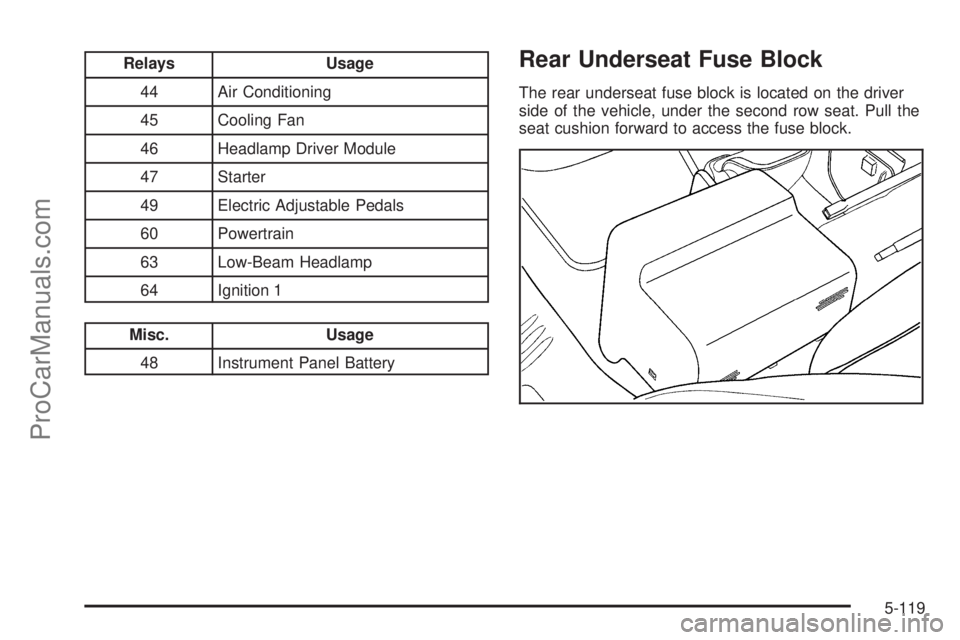
Rear Underseat Fuse Block
The rear underseat fuse block is located on the driver
side of the vehicle, under the second row seat. Pull the
seat cushion forward to access the fuse block.
5-119
ProCarManuals.com
Page 374 of 426
Fuses Usage
01 Passenger Door Control Module
02 Driver Door Control Module
03 Liftgate Module 2
04 Truck Body Controller 3
05 Blank
06 Blank
07 Truck Body Controller 2
08 Power Seats
09 Rear Wiper
10 Driver Door Module
11 Amplier
12 Passenger Door Module
13 Blank
14 Driver Side Rear Parking Lamps
15 Blank
16Vehicle Center High-Mounted
Stoplamp (CHMSL)
17Passenger Side Rear Parking
Lamps
18 Locks
19 Liftgate Module/Driver Seat Module
5-120
ProCarManuals.com
Page 375 of 426
Fuses Usage
20 Blank
21 Locks
23 Blank
24 Unlock
25 Ignition 0
26 Overhead Battery/OnStar
®System
27 Rainsense™ Wipers
28 Sunroof
29 Accessory
30 Parking Lamps
31 Truck Body Controller Accessory
32 Truck Body Controller 5
33 Front Wipers
34 Ignition 3
35 Vehicle Stop
36 Transmission Control Module
37 Heat Ventilation Air Conditioning B
Fuses Usage
38 Front Parking Lamps
39 Rear Left Turn Signal
40 Heat, Ventilation, Air Conditioning 1
41 Front Right Turn Signal
42 Radio
43 Trailer Park
44 Rear Right Turn Signal
45 Blank
46 Auxiliary Power 1
47 Blank
48 Ignition 0
49 Not Used
50 Blank
51 Front Left Turn Signal
52 Brakes
53 Truck Body Controller 4
5-121
ProCarManuals.com
Page 386 of 426

(f)Lubricate all key lock cylinders, hood latch assembly,
secondary latch, pivots, spring anchor, release pawl,
rear compartment hinges, outer liftgate handle pivot
points, rear door detent link, roller mechanism, liftgate
handle pivot points, latch bolt, fuel door hinge, cargo
door hinge, locks, and folding seat hardware. More
frequent lubrication may be required when exposed to
a corrosive environment. Applying silicone grease
on weatherstrips with a clean cloth will make them last
longer, seal better, and not stick or squeak.
(g)Inspect hoses for cracks, chafing, leaks, kinks,
and proper installation.
(h)Change automatic transmission fluid and filter if the
vehicle is mainly driven under one or more of these
conditions:
In heavy city traffic where the outside temperature
regularly reaches 90°F (32°C) or higher.
In hilly or mountainous terrain.
When doing frequent trailer towing.
Uses such as found in taxi, police,
or delivery service.(i)Drain, flush, and refill cooling system. This service
can be complex; you should have your dealer/retailer
perform this service. See Engine Coolant on page 5-28
for what to use. Inspect hoses. Clean radiator,
condenser, pressure cap, and filler neck. Pressure
test the cooling system and pressure cap.
(j)A fluid loss in any vehicle system could indicate a
problem. Have the system inspected and repaired and
the fluid level checked. Add fluid if needed.
(k)If you drive regularly under dusty conditions, inspect
the filter at each engine oil change.
(l)Visually inspect belt for fraying, excessive cracks,
or obvious damage. Replace belt if necessary.
Owner Checks and Services
These owner checks and services should be performed
at the intervals specied to help ensure the safety,
dependability, and emission control performance of your
vehicle. Your dealer/retailer can assist you with these
checks and services.
Be sure any necessary repairs are completed at once.
Whenever any uids or lubricants are added to your
vehicle, make sure they are the proper ones, as shown
inRecommended Fluids and Lubricants on page 6-12.
6-8
ProCarManuals.com
Page 388 of 426

At Least Once a Year
Starter Switch Check
{CAUTION:
When you are doing this inspection, the
vehicle could move suddenly. If the vehicle
moves, you or others could be injured.
1. Before you start, be sure you have enough room
around the vehicle.
2. Firmly apply both the parking brake and the regular
brake. SeeParking Brake on page 2-28.
Do not use the accelerator pedal, and be ready to
turn off the engine immediately if it starts.
3. Try to start the engine in each gear. The vehicle
should start only in PARK (P) or NEUTRAL (N).
If the vehicle starts in any other position, contact
your dealer/retailer for service.
Automatic Transmission Shift Lock
Control System Check
{CAUTION:
When you are doing this inspection, the
vehicle could move suddenly. If the vehicle
moves, you or others could be injured.
1. Before you start, be sure you have enough room
around the vehicle. It should be parked on a level
surface.
2. Firmly apply the parking brake. SeeParking Brake
on page 2-28.
Be ready to apply the regular brake immediately
if the vehicle begins to move.
3. With the engine off, turn the ignition to ON/RUN,
but do not start the engine. Without applying the
regular brake, try to move the shift lever out
of PARK (P) with normal effort. If the shift lever
moves out of PARK (P), contact your dealer/retailer
for service.
6-10
ProCarManuals.com