Page 202 of 320

202 Starting and drivingUsing a battery charger3
33 3/starter
unitTo avoid damaging the car’s electrical
system and electronics, the following rules
must be followed when charging the battery
or jump starting the car.
If the charger or starter unit can be set to
different voltages (6 V/12 V/18 V/24 V),
12V must be selected.
Follow the manufacturer’s instructions
supplied with the charger or starter unit.
No other apparatus that are grounded or
connected to the mains must be
connected to the car during charging or
jump starting.
The charger or starter unit must under no
conditions produce a voltage greater
than:
16 V continuous
18 V for 60 minutes.
If you are unsure about the charge rating of
the unit, disconnect the battery clamp from
the positive terminal before connecting the
unit to the battery.
For long tripsBefore starting off on a long journey, it is
advisable to have your car inspected by
your Saab dealer.
Obtain a few important items to take along
on your journey, such as spare bulbs, wiper
blades, fuses, a drive belt (poly-V-belt) and
the like.
You can check some points yourself before-
hand:
Check that no oil or fuel leaks out of the
engine or gearbox/transmission.
Check the coolant and power steering
fluid levels. Check also for leaks.
Inspect the drive belt (poly-V-belt) and
replace if it shows any signs of wear.
Check the battery charge.
Check the tires for tread pattern and air
pressure, including the compact spare
tire.
Take an extra remote control and keep it
separate.
Check the brakes.
Check all bulbs.
Check for the presence of the tool kit and
jack in the car.
93_US_M08.book Page 202 Friday, May 11, 2007 11:37 AM
ProCarManuals.com
Page 203 of 320

203 Car care
Hood ________________ 204
Engine ______________ 205
Engine bay, 4-cyl engine 208
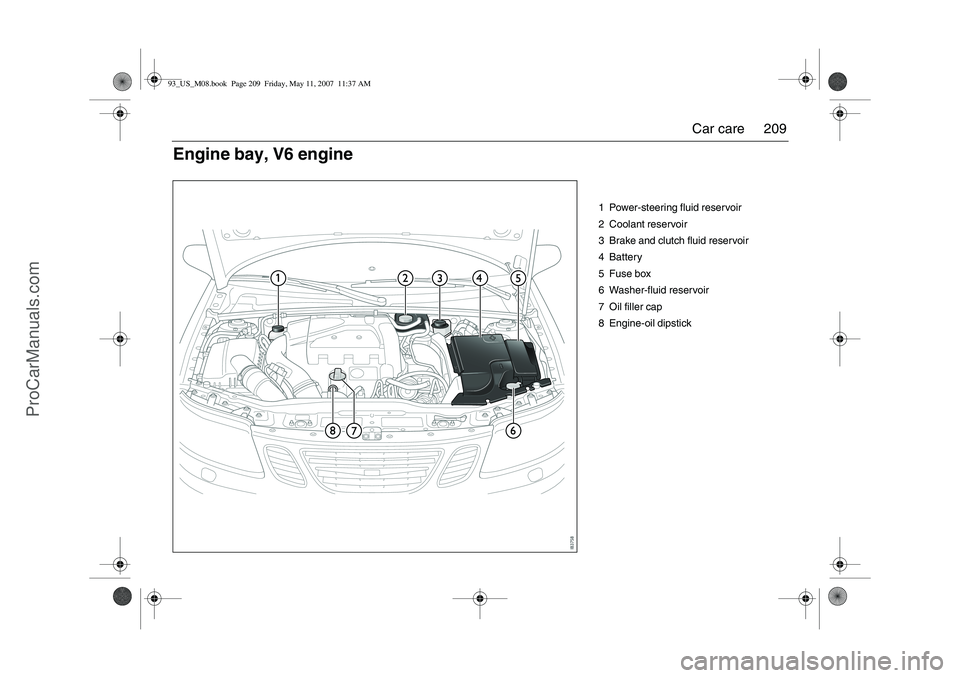
Engine bay, V6 engine _ 209
Engine oil ____________ 210
Air filter______________ 211
Transmission fluid ____ 212
Coolant ______________ 212
Brake/clutch fluid and
brake pads__________ 214
Power steering________ 215
Battery ______________ 216
Drive belt ____________ 219
Wipers and washers ___ 220
Wiper blades _________ 220
Changing bulbs _______ 222
Fuses _______________ 237 Tires _________________ 244
Automatic tire pressure
monitoring system ____ 257
Compact spare ________ 260
Changing a tire ________ 262
Safety belts ___________ 266
Upholstery and trim ____ 266
Textile carpeting _______ 267
Engine bay ____________ 267
Washing ______________ 267
Waxing and polishing ___ 270
Touching up the paint___ 270
Anti-corrosion treatment 271
Recovery and/or
recycling of automotive
materials ____________ 273
Air conditioning (A/C) ___ 274
Car care
3Asterisk means: equipment not fitted in all cars
(can depend on model variant, engine variant,
market specification, options or accessories).93_US_M08.book Page 203 Friday, May 11, 2007 11:37 AM
ProCarManuals.com
Page 208 of 320
208 Car care
1 Oil filler cap
2 Coolant reservoir
3 Brake and clutch fluid reservoir
4Battery
5 Fuse box
6 Washer-fluid reservoir
7 Power-steering fluid reservoir
8 Engine-oil dipstick
Engine bay, 4-cyl engine93_US_M08.book Page 208 Friday, May 11, 2007 11:37 AM
ProCarManuals.com
Page 209 of 320
209 Car care
1 Power-steering fluid reservoir
2 Coolant reservoir
3 Brake and clutch fluid reservoir
4Battery
5 Fuse box
6 Washer-fluid reservoir
7 Oil filler cap
8 Engine-oil dipstick
Engine bay, V6 engine93_US_M08.book Page 209 Friday, May 11, 2007 11:37 AM
ProCarManuals.com
Page 215 of 320

215 Car care
Brake pads should only be changed at a
workshop. We recommend that you con-
tact a Saab dealer.
Power steeringCheck the level of the power steering fluid in
the reservoir regularly, in accordance with
the service program.
The wheels should point directly forwards
during this check.
Clean round the cap before unscrewing it.
Wipe the dipstick. To check the level, screw
down the cap completely and then remove
it again.
The oil level should lie between the MAX
and MIN marks when the oil temperature is
about 68°F (+20°C). If the oil is colder, the
level will be lower, and at a higher tempera-
tures the level will be higher.
Top up with CHF 11S or CHF 202 power
steering fluid.
NOTEAvoid spilling brake fluid onto paintwork,
since it can cause the paint to bubble and
lift. If any brake fluid is spilled, the area
should be flushed with large quantities of
water as quickly as possible.
WARNING
Power steering fluid on hot engine com-
ponents constitutes a fire risk.
Power steering fluid reservoir, 4-cyl
enginePower steering fluid reservoir, V6 engine
93_US_M08.book Page 215 Friday, May 11, 2007 11:37 AM
ProCarManuals.com
Page 239 of 320

239 Car care
Fuse panel in end of fasciaNo. Amp. Function
1 15 Steering wheel lock
2 5 Steering column unit; ignition switch
310Hands-free3
410 Main instrument unit; automatic climate control
(ACC)3
57.5 Control module in front doors; Park Brake Shift Lock
(automatic transmission)
6 7.5 Brake light switch
7 20 Dash fuse panel; fuel filler door
8 30 Control module in passenger front door
9 10 Dash fuse panel
1030 Trailer socket3; electrical socket in storage com-
partment between seats3
11 10 Data link connection (diagnostics)
12 15 Interior lighting incl. glove box
13 10 Accessories
14 20 Amplifier 2, Sound System 3
15 30 Control module in driver’s door
16 5 Passenger Sensing System
17 - -
18 - -
19 - -
20 7.5 Headlight levelling switch3
217.5 Hands-free3; brake light switch; manual climate
control3; clutch pedal switch
22 30 Cigarette lighter3
23 40 Cabin fan
24 7.5 Airbag control module
25 - -
265
Yaw sensor (cars with ESP
® )
27 - -
93_US_M08.book Page 239 Friday, May 11, 2007 11:37 AM
ProCarManuals.com
Page 246 of 320

246 Car carecertain that all wheel nuts are properly tight-
ened. See page 265.
Flat spottingAll tires get hot, especially on long journeys
or when the car is driven hard. After the car
has been parked with hot tires and the tires
have cooled down, a flat spot can form in the
tire, where it is in contact with the ground.
The same can occur if the car has not been
moved for a long time.
Flat spots can cause vibration that can be
felt through the steering wheel, similar to
that experienced when the wheels need bal-
ancing.
Flat spots of this type disappear once the
tires get hot again, usually after 10–15 miles
(20–25 km) of driving at cruising speed. If
the outdoor temperature is low it takes a
longer distance.
When It Is Time for New TiresOne way to tell when it’s time for new tires is
to check the treadwear indicators, which will
appear when your tires have only 1/16 inch
(1.6 mm) or less of tread remaining.
You need a new tire if any of the following
statements are true:
You can see the indicators at three or
more places around the tire.
You can see cord or fabric showing
through the tire’s rubber.
The tread or sidewall is cracked, cut or
snagged deep enough to show cord or
fabric.
The tire has a bump, bulge or split.
The tire has a puncture, cut or other
damage that can’t be repaired well
because of the size or location of the
damage.
WARNING
Rust or dirt on a wheel, or on the parts to
which it is fastened, can make wheel nuts
become loose after a time. The wheel
could come off and cause an accident.
When you change a wheel, remove any
rust or dirt from places where the wheel
attaches to the vehicle. In an emergency,
you can use a cloth or a paper towel to do
this; but be sure to use a scraper or wire
brush later, if you need to, to get all the
rust or dirt off. See “Changing a tire” on
page 262.93_US_M08.book Page 246 Friday, May 11, 2007 11:37 AM
ProCarManuals.com
Page 247 of 320

247 Car care
Treadwear indicatorsThe tires incorporate wear indicators in the
form of smooth, treadless strips across the
width, which become visible when only
2/32" (1.6 mm) of tread remains. As soon as
the indicators become visible, new tires
should be fitted without delay.
Make sure you are familiar with the legal
limit for minimum tread depth in your
country and also any regulations gov-
erning the use of winter (snow) tires.
Buying New TiresTo find out what kind and size of tires you
need, look at the Tire-Loading Information
label.
Before changing to wheels/tires of another
size, we recommend that you contact an
authorized Saab workshop regarding
acceptable options. See also page 294
Wheels/tires combinations that are not
approved by Saab can negatively affect the
car’s directional stability, steering and brak-
ing in both wet and dry conditions.The wheels and tires have been carefully
matched to the characteristics of the car and
play a key role in its outstanding roadhold-
ing and handling.
Do not take it for granted that a wheel/tire
combination will work in the best possible
way, just because it can be fitted to the car.
To ensure that the speedometer is as accu-
rate as possible it should be reprogrammed
if wheels of a different dimension are fitted.
Contact a Saab dealer.
Because of front wheel drive, the front tires
tend to wear faster than the rear ones. New
tires should always be fitted in pairs, so that
tires on the same axle have the same
amount of tread.
Store wheels lying flat or hanging – never
standing upright.
Treadwear indicator93_US_M08.book Page 247 Friday, May 11, 2007 11:37 AM
ProCarManuals.com