2008 SAAB 9-3 light
[x] Cancel search: lightPage 269 of 320

269 Car care
When the soft top is only slightly soiled,
follow the directions on the cleaning agent
packaging. No brushing is necessary.
Check the soft top for water penetration
from time to time by spraying a small
amount of water on it. If water does not form
droplets but disappear into the material, it is
recommended to wash normally and then
waterproof.
If the soft top is heavily soiled and normal
recommended cleaning does not produce a
noticeable improvement, carry out the fol-
lowing.
The following cleaning method must be only
used if the soft top is heavily soiled and must
not be carried out more than twice a year.
1 Stop normal cleaning.
2 Rinse off the thick dirt thoroughly with
water.
3 Spray the newly rinsed soft top with the
recommended cleaning agent and allow
it to work in for 15-20 minutes.4 Move the washing brush backwards and
forwards, not diagonally, from side to
side or in circles. Use a soft brush, like a
clothes brush or a micro fibre cloth so
that the cleaning agent foams. Never
use a wire brush.
5 Then rinse the soft top with warm water
and brush using a soft brush in the direc-
tion of the vehicle until all foam has
disappeared. Brush carefully to prevent
damaging the material.
6 Dry the soft top using a clean chamois
leather or a cloth that does not leave lint
on the soft top.
7 Allow the soft top to dry fully. Touch with
a hand after a while, if the material feels
damp, allow it to dry for longer. Never use petrochemical based sol-
vents for cleaning. Only use water with
a recommended cleaning agent. Pet-
rochemical based solvents can cause
irreparable damage to the soft top.
Never use a pressure washer to clean
the soft top. Only use normal house-
hold water pressure.
NOTEOnly operate the soft top when it is
clean and dry.
Do not lower the soft top when it is
damp. This can cause folds and pres-
sure marks. If the soft top is heavily
soiled, the dirt may cause irreparable
visible chafe marks.
Only use water, recommended clean-
ing agents and a microfibre cloth if the
soft top is already damaged, other-
wise the damage can become worse.
At creases, seams and window edges
the cleaning motion should be away
from the crease, seam or window
edge in to the soft top.
WARNING
Water hotter than 37 °C can burn the skin,
cause skin irritation and/or cause injuries.
Use suitable protection.
93_US_M08.book Page 269 Friday, May 11, 2007 11:37 AM
ProCarManuals.com
Page 270 of 320

270 Car care8 If spots are still visible, repeat the treat-
ment on these spots as before. Press
lightly with the brush to prevent damag-
ing the material. Do not use the brush
excessively. This can irreparably
damage the material. Do not repeat the
treatment more than twice.
9 When the soft top has fully dried, it must
be waterproofed immediately. Only use
the recommended waterproofing agent.
Follow the instructions on the packag-
ing.
10 To obtain even and optimum waterproof-
ing, the car must be closed for 24 hours
after treatment. Do not touch the mate-
rial and do not place any objects on it.
Waxing and polishingDo not wax a new car during the first three
or four months. In fact, there is no need to
polish the car before the paintwork has
started to dull through oxidation. Other than
in exceptional cases, do not use abrasive
polishes containing a cutting agent on a new
car. Always wash the car thoroughly before
waxing or polishing.Touching up the paintDamaged paintwork should be treated as
soon as it is discovered: the longer it is left,
the greater the risk of corrosion. The
anti-corrosion warranty does not cover cor-
rosion resulting from untreated defects.
Paintwork damage sustained in a crash is
usually extensive and can only be properly
restored by professionals.
However, you can repair small scratches
and stone chip damage yourself. The nec-
essary tools and materials, such as primer,
touch-up paint and brushes, are available
from a workshop. We recommend that you
contact a Saab dealer.
In the case of minor flaws in the paintwork,
where the metal has not been exposed and
an undamaged layer of paint remains,
touch-up paint can usually be applied
directly, after any dirt has been scraped
away using a pointed knife.If corrosion has already set in, such as the
result of stone-chip damage, use a pointed
knife to scrape off all surface rust. If possi-
ble, the damaged area should be taken
back to the bare metal. The metal should
then be primed with two thin coats of primer
applied by brush.
After the primer has dried, apply several thin
layers of topcoat until the surface of the
repaired area is flush with the surrounding
paintwork.
Stir both primer and touch-up paint thor-
oughly before use and allow each coat to
dry before applying the next.
Two-coat enamelAs the name implies, two-coat enamel is
applied in two operations. The first coat, the
base color, contains the pigment, metal
flakes and binder. The second coat consists
of a clear enamel, which provides the final
gloss for the paintwork and protects the
base from moisture and environmental con-
taminants.
Touch-up stone-chip damage as follows:
1 Thoroughly clean the damaged area.
2 Then apply the primer, base color and
finally, the clear enamel. To achieve the
best finish, apply two or three coats of
primer.
93_US_M08.book Page 270 Friday, May 11, 2007 11:37 AM
ProCarManuals.com
Page 275 of 320

275 Car care
Other than in extremely cold weather, do not
screen the radiator, e.g. with netting, as this
will greatly diminish its cooling capacity.
Applicable to the manual climate control
system - During cold months the air condi-
tioning should be switched on once or
twice a month and run for 5–10 minutes
during highway driving once the engine is
warm.
This action saves the gaskets in the
compressor from being spoiled. The
compressor uses a lubricant that circu-
lates with the coolant.
Note
The A/C system cannot be switched on
when the outside temperature is below 32°F
(0°C). Turn on the A/C system when the car
is standing in a warm place. Simplest is to
always have the A/C button pressed in. The
A/C system will then cut in automatically
when the outside temperature is high
enough.
Headlight aimingThe vehicle has a visual optical headlight
aiming system equipped with vertical
aiming device. The aim has been preset at
the factory and should normally not need
further adjustments.
If your headlights are damaged in a crash,
the headlight aim may be affected. If you
believe your headlights need to be
re-aimed, we recommend that you take it to
your Saab dealer for service. However, it is
possible for you to re-aim your headlights as
described in the following procedure.To check the aim, the vehicle should be
properly prepared as follows:
The vehicle shall be placed so that the
headlights are 25 ft (7.6 m) from a light
colored wall or other flat surface. The
aiming area should be darkened, this will
improve your ability to see the beam of the
low beam headlight being aimed.
An optical headlamp aimer can also be
used and will than replace the wall.
The vehicle must have all four wheels on
a perfectly level surface which is level all
the way to the wall or other flat surface.
The vehicle should be placed so it is
perpendicular to the wall or other flat
surface.
The vehicle should be unloaded and fuel
tank full, and one person or 160 lbs.
(75 kg) on the drivers seat.
The vehicle should be fully assembled
and all other work stopped while headlight
aiming is being done.
The vehicle should not have any snow, ice
or mud attached to it.
Tires should be inflated to the prescribed
pressure.
Close all doors.
Rock the vehicle to stabilize the suspen-
sion.
Headlight aiming is done with the vehicle
low beam lamps. The high beam lamps will
WARNING
Before checking/adjusting the headlight
aiming, switch off the engine to avoid
danger of fingers and hands being injured
by moving parts.
The radiator fan can start up even when
the engine is switched off.NOTETo make sure that your headlights are
aimed properly read all instructions
before beginning. Failure to follow these
instructions could cause damage to
headlight parts or a not correctly aimed
headlight.
93_US_M08.book Page 275 Friday, May 11, 2007 11:37 AM
ProCarManuals.com
Page 276 of 320
276 Car carebe correctly aimed if the low beam lamps
are aimed properly.
If you find that the headlight needs adjust-
ment follow these steps:
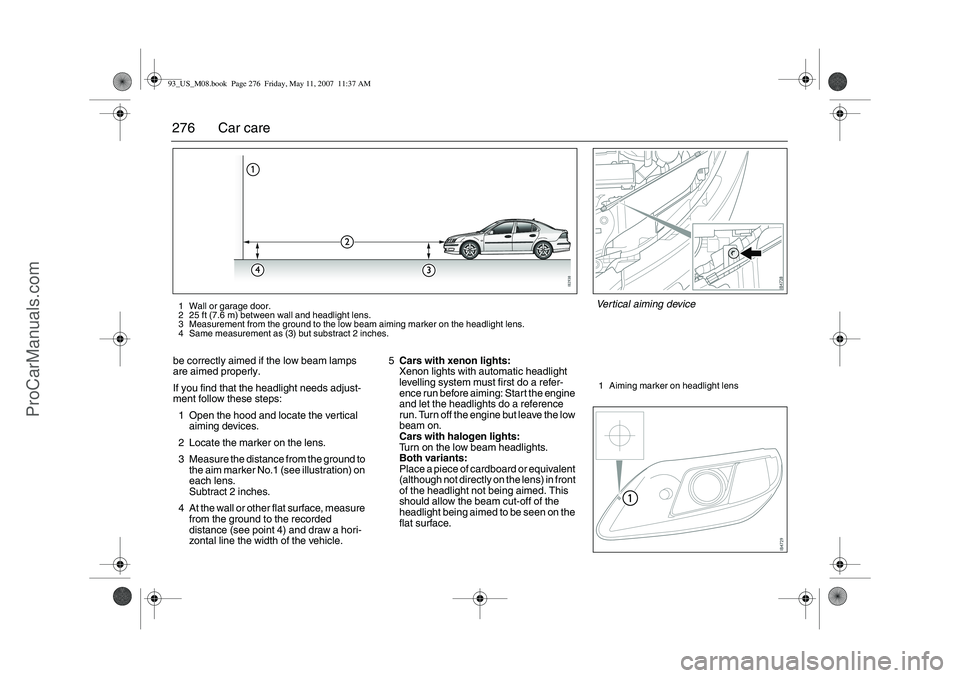
1 Open the hood and locate the vertical
aiming devices.
2 Locate the marker on the lens.
3 Measure the distance from the ground to
the aim marker No.1 (see illustration) on
each lens.
Subtract 2 inches.
4 At the wall or other flat surface, measure
from the ground to the recorded
distance (see point 4) and draw a hori-
zontal line the width of the vehicle.5Cars with xenon lights:
Xenon lights with automatic headlight
levelling system must first do a refer-
ence run before aiming: Start the engine
and let the headlights do a reference
run. Turn off the engine but leave the low
beam on.
Cars with halogen lights:
Turn on the low beam headlights.
Both variants:
Place a piece of cardboard or equivalent
(although not directly on the lens) in front
of the headlight not being aimed. This
should allow the beam cut-off of the
headlight being aimed to be seen on the
flat surface.1 Wall or garage door.
2 25 ft (7.6 m) between wall and headlight lens.
3 Measurement from the ground to the low beam aiming marker on the headlight lens.
4 Same measurement as (3) but substract 2 inches.
Vertical aiming device1 Aiming marker on headlight lens
93_US_M08.book Page 276 Friday, May 11, 2007 11:37 AM
ProCarManuals.com
Page 277 of 320

277 Car care
6 Turn the vertical aiming screw until the
horizontal cut-off of the headlight is
aligned with the horizontal line on the
wall.
7 If an optical headlight aimer device is
used follow point 1 and 2 and center the
lens of the optical headlight aimer
device at the intersection of the two
markers on the headlight lens.
Then follow the instructions in the optical
headlight aimer instruction manual and
point 1, 2, 5, and 6 in this instruction.NOTEDo not cover a headlight directly on the
lens to improve beam cut-off when aim-
ing. Covering a headlight may cause
excessive heat build-up that may cause
damage to the headlight.
Horizontal line on wall or other flat surface
Correctly adjusted low beam
93_US_M08.book Page 277 Friday, May 11, 2007 11:37 AM
ProCarManuals.com
Page 291 of 320

291 Technical data
Fuel
EnginesElectrical systemFuel tank capacity 16.05 U.S. gal. (61 l)
For optimum performance Saab recom-
mends:Gasoline engines –
AON 90.
Gasoline with a lower octane rating can be used, although not
lower than AON 87. However, engine performance will fall slightly
and heavy loading and laboring should be avoided. For optimum
performance, use the recommended grade of fuel.
For further information on fuel, see page 161.
2.0T Ecopower
Rating, EEC at 5300 rpm ____________ 210 hp (155 kW)
Maximum torque, EEC at 2500-4000 rpm 221 ft.lb. (300 Nm)
Compression ratio__________________ 9.5:1
2.8 V6 Ecopower
Rating, EEC at 5500 rpm ____________ 255 hp (187 kW)
Maximum torque, EEC at 1800-4500 rpm 258 ft.lb. (350 Nm)
Compression ratio__________________ 10.0:1Voltage ___________________________ 12 V
Battery capacity ____________________ 60 Ah
Starter motor:
4-cyl engine ______________________ 1.8 kW
V6 engine ________________________ 1.4 kW
Alternator rating:
4-cyl engine with manual gearbox _____ 120 A/14 V
4-cyl engine with automatic gearbox ___ 140 A/14 V
V6 engine ________________________ 155 A/14 V
Firing order:
4-cyl engine ______________________ 1-3-4-2
V6 engine ________________________ 1-2-3-4-5-6
Spark plugs:
4-cyl engine
Type ____________________________ NGK PFR6T-10G
Electrode gap _____________________ 0.9–1.0 mm
Tightening torque __________________ 20 ft.lb. (28 Nm)
V6 engine
Type ____________________________ PLFR6C 10G
Electrode gap _____________________ 0.9–1.0 mm
Tightening torque __________________ 20 ft.lb. (28 Nm)93_US_M08.book Page 291 Friday, May 11, 2007 11:37 AM
ProCarManuals.com
Page 299 of 320

299 Technical data
Customized systemsSeveral of the systems in your Saab can be
customized to better suit your individual
needs. Contact your Saab dealer
Central locking system
Some functions are governed by legal
requirements and cannot therefore be
reprogrammed.
We recommend that you consult a Saab
dealer for further information.
Listed below are a number of examples of
programmable functions.
Audible confirmation of arming/disarming
the car alarm.
Automatic unlocking when car stopped
and remote control removed from the igni-
tion switch.
Trunk lid locked when car driven off or
30 seconds after being shut.Courtesy Headlamp Feature
The length of time the lights are on.
Whether the reversing light or tail lights
should come on as well as the dipped
beam.
Automatic Climate System (ACC)
Convertible: A/C compressor not
switched off when the soft top is open.93_US_M08.book Page 299 Friday, May 11, 2007 11:37 AM
ProCarManuals.com
Page 300 of 320

300 Technical dataWarning and indications that can
be shown on the SIDWhich warnings and indications that can be
shown depends on engine variant and car
specification.
Symbol Text
Antilock brake malfunc.
Contact service.
Brake malfunction.
Make a safe stop.
Brake fluid level low.
Make a safe stop.
Release park brake.
Oil pressure low.
Make a safe stop.
Low engine oil level.
Fill oil now.
Reduced engine power.
Contact service.
Limited performance.
Coolant level low.
Refill.
Hot engine. Make a
safe stop. Idle engine.
Airbag malfunction.
Contact service.
Gearbox too hot. Make a
safe stop. Open hood.
Battery not charging.
Make a safe stop.
Headlight levelling
malfunction.
Cornering headlights
malfunction
Tap brakes lightly
before using cruise ctrl.
Traction control failure.
Contact service.
Stability control failure.
Contact service.
Turn on the lights.
Washer fluid level low.
Refill.
Rain sensor malfunc.
Contact service.
Key not accepted.
Contact service.
Remote control battery
low. Replace battery.
Number of keys:
Active key number:
Steering lock malfunc.
Make a safe stop.
Pull out key, turn
steering wheel. Restart.
Theft protection failure.
Contact service.
Alarm tripped during
last arming period.
Rear left seat
backrest unlocked.
Rear right seat
backrest unlocked.
93_US_M08.book Page 300 Friday, May 11, 2007 11:37 AM
ProCarManuals.com