2008 PONTIAC TORRENT remote start
[x] Cancel search: remote startPage 289 of 434

A. Engine Air Cleaner/Filter. SeeEngine Air
Cleaner/Filter on page 5-20.
B. Engine Oil Fill Cap. See “When to Add Engine Oil”
underEngine Oil on page 5-15.
C. Engine Oil Dipstick. See “Checking Engine Oil”
underEngine Oil on page 5-15.
D. Brake Fluid Reservoir. SeeBrakes on page 5-34.E. Engine Compartment Fuse Block. SeeFuses and
Circuit Breakers on page 5-99.
F. Remote Positive (+) Terminal. SeeJump Starting on
page 5-38.
G. Engine Coolant Surge Tank. SeeEngine Coolant on
page 5-22.
H. Windshield Washer Fluid Reservoir. SeeWindshield
Washer Fluid on page 5-33.
5-13
Page 291 of 434

A. Engine Air Cleaner/Filter. SeeEngine Air
Cleaner/Filter on page 5-20.
B. Power Steering Fluid Reservoir (Out of View). See
Power Steering Fluid on page 5-32.
C. Engine Oil Fill Cap (Out of View). See “When to Add
Engine Oil” underEngine Oil on page 5-15.
D. Engine Oil Dipstick. See “Checking Engine Oil”
underEngine Oil on page 5-15.
E. Brake Fluid Reservoir. See “Brake Fluid” under
Brakes on page 5-34.
F. Underhood Fuse Block. SeeEngine Compartment
Fuse Block on page 5-102.
G. Remote Positive (+) Terminal. SeeJump Starting on
page 5-38.
H. Engine Coolant Recovery Tank. SeeCooling System
on page 5-27.
I. Windshield Washer Fluid Reservoir. See “Adding
Washer Fluid” underWindshield Washer Fluid
on page 5-33.Engine Oil
Checking Engine Oil
It is a good idea to check the engine oil every time you
get fuel. In order to get an accurate reading, the oil
must be warm and the vehicle must be on level ground.
The engine oil dipstick handle is a yellow loop. See
Engine Compartment Overview on page 5-12for
the location of the engine oil dipstick.
1. Turn off the engine and give the oil several minutes
to drain back into the oil pan. If you do not do this,
the oil dipstick might not show the actual level.
2. Pull out the dipstick and clean it with a paper towel
or cloth, then push it back in all the way. Remove it
again, keeping the tip down, and check the level.
5-15
Page 315 of 434

3. Turn off the ignition on both vehicles. Unplug
unnecessary accessories plugged into the cigarette
lighter or the accessory power outlet. Turn off
the radio and all lamps that are not needed. This
will avoid sparks and help save both batteries.
And it could save your radio!
4. Open the hoods and locate the positive (+) and
negative (−) terminal locations on each vehicle.
You will not need to access your battery for jump
starting. Your vehicle has a remote positive (+)
and a remote negative (−) jump starting terminal
for that purpose.
The remote positive (+) terminal is located under
the engine compartment fuse block cover, and
is marked with a plus (+) symbol on the cover.
To remove the fuse block cover, push in the
two locking tabs located on the rear of the cover,
and lift. To reinstall, t together the tabs located
on the front of the cover and push down on
the cover until the tabs on the rear of the cover,
click into place.
5-39
Page 318 of 434
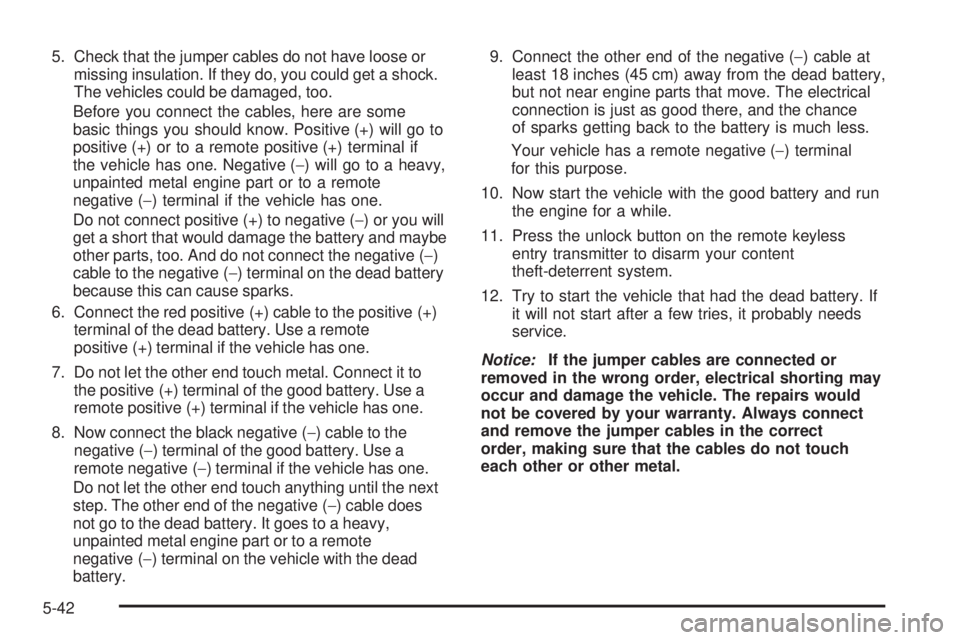
5. Check that the jumper cables do not have loose or
missing insulation. If they do, you could get a shock.
The vehicles could be damaged, too.
Before you connect the cables, here are some
basic things you should know. Positive (+) will go to
positive (+) or to a remote positive (+) terminal if
the vehicle has one. Negative (−) will go to a heavy,
unpainted metal engine part or to a remote
negative (−) terminal if the vehicle has one.
Do not connect positive (+) to negative (−) or you will
get a short that would damage the battery and maybe
other parts, too. And do not connect the negative (−)
cable to the negative (−) terminal on the dead battery
because this can cause sparks.
6. Connect the red positive (+) cable to the positive (+)
terminal of the dead battery. Use a remote
positive (+) terminal if the vehicle has one.
7. Do not let the other end touch metal. Connect it to
the positive (+) terminal of the good battery. Use a
remote positive (+) terminal if the vehicle has one.
8. Now connect the black negative (−) cable to the
negative (−) terminal of the good battery. Use a
remote negative (−) terminal if the vehicle has one.
Do not let the other end touch anything until the next
step. The other end of the negative (−) cable does
not go to the dead battery. It goes to a heavy,
unpainted metal engine part or to a remote
negative (−) terminal on the vehicle with the dead
battery.9. Connect the other end of the negative (−) cable at
least 18 inches (45 cm) away from the dead battery,
but not near engine parts that move. The electrical
connection is just as good there, and the chance
of sparks getting back to the battery is much less.
Your vehicle has a remote negative (−) terminal
for this purpose.
10. Now start the vehicle with the good battery and run
the engine for a while.
11. Press the unlock button on the remote keyless
entry transmitter to disarm your content
theft-deterrent system.
12. Try to start the vehicle that had the dead battery. If
it will not start after a few tries, it probably needs
service.
Notice:If the jumper cables are connected or
removed in the wrong order, electrical shorting may
occur and damage the vehicle. The repairs would
not be covered by your warranty. Always connect
and remove the jumper cables in the correct
order, making sure that the cables do not touch
each other or other metal.
5-42
Page 342 of 434

TPMS Sensor Matching Process
Each TPMS sensor has a unique identication code.
Any time you rotate your vehicle’s tires or replace one or
more of the TPMS sensors, the identication codes
will need to be matched to the new tire/wheel position.
The sensors are matched to the tire/wheel positions
in the following order: driver side front tire, passenger
side front tire, passenger side rear tire, and driver
side rear tire using a TPMS diagnostic tool. See your
dealer/retailer for service.
The TPMS sensors can also be matched to each
tire/wheel position by increasing or decreasing the tire’s
air pressure. If increasing the tire’s air pressure, do
not exceed the maximum ination pressure indicated on
the tire’s sidewall.
To decrease air-pressure out of a tire you can use the
pointed end of the valve cap, a pencil-style air pressure
gage, or a key.You have two minutes to match the rst tire/wheel
position, and ve minutes overall to match all four
tire/wheel positions. If it takes longer than two minutes,
to match the rst tire and wheel, or more than ve
minutes to match all four tire and wheel positions the
matching process stops and you need to start over.
The TPMS sensor matching process is outlined below:
1. Set the parking brake.
2. Turn the ignition switch to ON/RUN with the
engine off.
3. Press the Remote Keyless Entry (RKE) transmitter’s
LOCK and UNLOCK buttons at the same time for
approximately ve seconds. The horn sounds twice
to signal the receiver is in relearn mode and
TIRE LEARNING ACTIVE message displays on the
DIC screen.
4. Start with the driver side front tire.
5-66
Page 419 of 434
OnStar®
If your vehicle has OnStar and you subscribe to the
OnStar services, please refer to the OnStar Terms and
Conditions for information on data collection and
use. See alsoOnStar
®System on page 2-39in this
manual for more information.
Navigation System
If your vehicle has a navigation system, use of the
system may result in the storage of destinations,
addresses, telephone numbers, and other trip
information. Refer to the navigation system operating
manual for information on stored data and for deletion
instructions.
Radio Frequency
Identication (RFID)
RFID technology is used in some vehicles for functions
such as tire pressure monitoring and ignition system
security, as well as in connection with conveniences
such as key fobs for remote door locking/unlocking and
starting, and in-vehicle transmitters for garage door
openers. RFID technology in GM vehicles does not use
or record personal information or link with any other
GM system containing personal information.
7-19
Page 430 of 434

Reclining Seatbacks, Manual.............................. 1-5
Recommended Fluids and Lubricants.................6-12
Recreational Vehicle Towing.............................4-27
Reduced Engine Power Light............................3-41
Remote Keyless Entry (RKE) System.................. 2-4
Remote Keyless Entry (RKE) System,
Operation..................................................... 2-5
Remote Vehicle Start........................................ 2-8
Removing the Flat Tire and Installing the Spare
Tire ...........................................................5-79
Removing the Spare Tire and Tools...................5-78
Replacement Bulbs.........................................5-50
Replacement Parts, Maintenance......................6-14
Reporting Safety Defects
Canadian Government..................................7-16
General Motors...........................................7-16
United States Government............................7-15
Restraint System Check
Checking the Restraint Systems....................1-71
Replacing Restraint System Parts After
a Crash..................................................1-72
Retained Accessory Power (RAP)......................2-22
Roadside
Assistance Program....................................... 7-7
Rocking Your Vehicle to Get it Out....................4-22
Routing, Engine Drive Belt...............................6-15
Running the Engine While Parked.....................2-36S
Safety Belt
Reminder Light............................................3-28
Safety Belts
Care of......................................................5-92
How to Wear Safety Belts Properly................1-17
Lap-Shoulder Belt........................................1-25
Safety Belt Extender....................................1-30
Safety Belt Use During Pregnancy.................1-30
Safety Belts Are for Everyone.......................1-12
Safety Warnings and Symbols.............................. iii
Scheduled Maintenance..................................... 6-4
Seatback, Folding Passenger............................. 1-8
Seats
Driver Seat Height Adjuster............................. 1-3
Head Restraints............................................ 1-7
Heated Seats............................................... 1-4
Manual Lumbar............................................. 1-4
Manual Reclining Seatbacks........................... 1-5
Passenger Folding Seatback........................... 1-8
Power Seat.................................................. 1-3
Split Folding Rear Seat................................1-10
10
Page 431 of 434
Securing a Child Restraint
Rear Seat Position......................................1-50
Right Front Seat Position..............................1-52
Security Light.................................................3-40
Service........................................................... 5-3
Accessories and Modications......................... 5-3
Adding Equipment to the Outside of Your
Vehicle..................................................... 5-5
All-Wheel-Drive Light....................................3-42
California Pershlorate Materials
Requirements............................................ 5-4
California Proposition 65 Warning.................... 5-4
Doing Your Own Work................................... 5-4
Engine Soon Light.......................................3-36
Publications Ordering Information...................7-16
Vehicle Soon Light.......................................3-43
Service, Scheduling Appointments.....................7-10
Servicing Your Airbag-Equipped Vehicle..............1-69
Sheet Metal Damage.......................................5-96
Shifting Into Park (P).......................................2-33
Shifting Out of Park (P)...................................2-35
Signals, Turn and Lane-Change.......................... 3-8
Spare Tire
Compact....................................................5-88
Installing....................................................5-79
Removing...................................................5-78
Storing.......................................................5-86Specications, Capacities...............................5-105
Speedometer..................................................3-28
Split Folding Rear Seat....................................1-10
StabiliTrak
®System.......................................... 4-7
Start Vehicle, Remote....................................... 2-8
Starting the Engine.........................................2-22
Steering.......................................................... 4-9
Steering Wheel Controls, Audio.......................3-110
Steering Wheel, Tilt Wheel................................. 3-7
Storage Areas
Center Console Storage Area........................2-43
Convenience Net.........................................2-48
Cupholder(s)...............................................2-43
Glove Box..................................................2-43
Luggage Carrier..........................................2-43
Rear Compartment Storage Panel/Cover.........2-45
Rear Seat Armrest.......................................2-46
Table.........................................................2-47
Stuck in Sand, Mud, Ice, or Snow.....................4-21
Sun Visors.....................................................2-17
Sunroof.........................................................2-48
11