2008 PONTIAC SOLSTICE ignition
[x] Cancel search: ignitionPage 238 of 348

Notice:If you leave your radio or other accessories
on during the jump starting procedure, they could
be damaged. The repairs would not be covered
by your warranty. Always turn off your radio and
other accessories when jump starting your vehicle.
3. Turn off the ignition on both vehicles. Unplug
unnecessary accessories plugged into the cigarette
lighter or the accessory power outlet. Turn off the
radio and all lamps that are not needed. This will
avoid sparks and help save both batteries. And it
could save the radio!
4. Open the hood on the other vehicle and locate the
positive (+) and negative (−) terminal locations on
that vehicle.
You will not need to access your battery for jump
starting. Your vehicle has a remote positive (+) and
a remote negative (−) jump starting terminal.
The remote positive (+)
terminal is located under a
red plastic cover on the
engine compartment fuse
block. Open the red plastic
cover to access the
terminal.Do not remove fuse block cover to jump start the
vehicle.
The remote negative (−)
ground bracket is located
in the rear of the engine
compartment, on the
passenger’s side of the
vehicle, and is marked
GND (−).
SeeEngine Compartment Overview on page 5-12
for more information on the location of the
positive (+) and negative (−) terminals on
your vehicle.
{CAUTION:
An electric fan can start up even when the
engine is not running and can injure you.
Keep hands, clothing and tools away from
any underhood electric fan.
5-42
Page 257 of 348

Tire Pressure Monitor Operation
The Tire Pressure Monitor System (TPMS) is designed
to warn the driver when a low tire pressure condition
exists. TPMS sensors are mounted onto each tire
and wheel assembly. The TPMS sensors monitor the
air pressure in the vehicle’s tires and transmits the
tire pressure readings to a receiver located in the
vehicle.
When a low tire pressure
condition is detected, the
TPMS illuminates the low
tire pressure warning light
located on the instrument
panel cluster.
At the same time a message to check the pressure
in a specic tire appears on the Driver Information
Center (DIC) display. The low tire pressure warning light
and the DIC warning message come on at each ignition
cycle until the tires are inated to the correct ination
pressure. Using the DIC, tire pressure levels can be
viewed by the driver. For additional information and
details about the DIC operation and displays seeDIC
Operation and Displays on page 3-38andDIC Warnings
and Messages on page 3-40.The low tire pressure warning light may come on in
cool weather when the vehicle is rst started, and then
turn off as you start to drive. This could be an early
indicator that the air pressure in the tire(s) are getting
low and need to be inated to the proper pressure.
A Tire and Loading Information label, attached to
your vehicle, shows the size of your vehicle’s original
equipment tires and the correct ination pressure for your
vehicle’s tires when they are cold. SeeLoading Your
Vehicle on page 4-24, for an example of the Tire and
Loading Information label and its location on your vehicle.
Also seeInflation - Tire Pressure on page 5-58.
Your vehicle’s TPMS system can warn you about a low
tire pressure condition but it does not replace normal
tire maintenance. SeeTire Inspection and Rotation
on page 5-65andTires on page 5-51.
Notice:Using non-approved tire sealants could
damage the Tire Pressure Monitor System (TPMS)
sensors. TPMS sensor damage caused by using
an incorrect tire sealant is not covered by the
vehicle warranty. Always use the GM approved
tire sealant available through your dealer/retailer.
Your vehicle, when new, included a factory-installed
Tire Inator Kit. This kit uses a GM approved liquid
tire sealant. Using non-approved tire sealants could
damage the TPMS sensors. SeeTire Sealant and
Compressor Kit on page 5-76for information regarding
the inator kit materials and instructions.
5-61
Page 258 of 348

TPMS Malfunction Light and Message
The TPMS will not function properly if one or more of
the TPMS sensors are missing or inoperable. When the
system detects a malfunction, the low tire warning light
ashes for about one minute and then stays on for the
remainder of the ignition cycle. A DIC warning message
is also displayed. The low tire warning light and DIC
warning message come on at each ignition cycle until
the problem is corrected. Some of the conditions that
can cause the malfunction light and DIC message to
come on are:
The TPMS sensor matching process was started but
not completed or not completed successfully after
rotating the vehicle’s tires. The DIC message and
TPMS malfunction light should go off once the TPMS
sensor matching process is performed successfully.
See “TPMS Sensor Matching Process” later in this
section.
One or more TPMS sensors are missing or
damaged. The DIC message and the TPMS
malfunction light should go off when the TPMS
sensors are installed and the sensor matching
process is performed successfully. See your
dealer/retailer for service.
Replacement tires or wheels do not match your
vehicle’s original equipment tires or wheels. Tires
and wheels other than those recommended for your
vehicle could prevent the TPMS from functioning
properly. SeeBuying New Tires on page 5-68.
Operating electronic devices or being near facilities
using radio wave frequencies similar to the TPMS
could cause the TPMS sensors to malfunction.
If the TPMS is not functioning it cannot detect or
signal a low tire condition. See your dealer/retailer for
service if the TPMS malfunction light and DIC message
comes on and stays on.
TPMS Sensor Matching Process
Each TPMS sensor has a unique identication code.
Any time you replace one or more of the TPMS sensors
or rotate the vehicle’s tires, the identication codes
need to be matched to the new tire/wheel position.
The sensors are matched, to the tire/wheel positions,
in the following order: driver side front tire, passenger
side front tire, passenger side rear tire, and driver
side rear tire using a TPMS diagnostic tool. See
your dealer/retailer for service.
5-62
Page 259 of 348

The TPMS sensors can also be matched to each
tire/wheel position by increasing or decreasing the tire’s
air pressure. When increasing the tire’s pressure, do
not exceed the maximum ination pressure indicated on
the tire’s sidewall. To decrease the tire’s air-pressure
use the pointed end of the valve cap, a pencil-style
air pressure gage, or a key.
You have two minutes to match each tire and wheel
position. If it takes longer than two minutes to match any
tire and wheel position, the matching process stops and
you need to start over.
TPMS Matching Process for Vehicles
with Remote Keyless Entry (RKE)
1. Set the parking brake.
2. Turn the ignition switch to ON/RUN with the
engine off.
3. Press and hold the Remote Keyless Entry (RKE)
transmitter’s LOCK and UNLOCK buttons, at the
same time, for about ve seconds to start the TPMS
learn mode. The horn sounds twice indicating the
TPMS receiver is ready and in learn mode.
4. Start with the driver side front tire. The driver side
front turn signal also comes on to indicate that
corner’s sensor is ready to be learned.5. Remove the valve cap from the tire’s valve stem.
Activate the TPMS sensor by increasing or
decreasing the tire’s air pressure for about
eight seconds. The horn chirp, can take up to
30 seconds to sound. It chirps one time and then
all the turn signals ash one time to conrm the
sensor identication code has been matched to
the tire/wheel position.
6. The passenger side front turn signal comes on to
indicate that corner sensor is ready to be learned.
Proceed to the passenger side front tire and
repeat the procedure in Step 5.
7. The passenger side rear turn signal comes on to
indicate that corner sensor is ready to be learned.
Proceed to the passenger side rear tire and
repeat the procedure in Step 5.
8. The driver side rear turn signal comes on to
indicate that corner sensor is ready to be learned.
Proceed to the driver side rear tire, and repeat
the procedure in Step 5.
9. After hearing the single horn chirp for the driver
side rear tire, two additional horn chirps sound
to indicate the tire learning process is done.
Turn the ignition switch to LOCK/OFF.
If no tires are learned after entering the TPMS learn
mode, or if communication with the receiver stops, or
if the time limit has expired, turn the ignition switch to
LOCK/OFF and start over beginning with Step 2.
5-63
Page 260 of 348

10. Set all four tires to the recommended air pressure
level as indicated on the Tire and Loading
Information label.
11. Put the valve caps back on the valve stems.
TPMS Matching Process for Vehicles
without Remote Keyless Entry (RKE)
1. Set the parking brake.
2. Turn the ignition switch to ON/RUN with the
engine off.
3. Using the Driver Information Center (DIC), press
the INFO and Set/Reset buttons at the same time
for about one second. Then press and release
the INFO button until the TIRE LEARN? message
displays.
4. Press and hold the Set/Reset DIC button for
approximately three seconds to start the TPMS
learn mode. The horn sounds twice to indicate
the TPMS receiver is ready and the TIRE LEARN
ON message displays. The driver side front
turn signal also comes on to indicate that
corner sensor is ready to be learned.
5. Start with the driver side front tire.
6. Remove the valve cap from the tire’s valve stem.
Activate the TPMS sensor by increasing or
decreasing the tire’s air pressure for about eight
seconds. The horn chirp, can take up to 30 secondsto sound. It chirps one time and then all the turn
signals ash one time to conrm the sensor
identication code has been matched to the
tire/wheel position.
7. The passenger side front turn signal comes on to
indicate that corner sensor is ready to be learned.
Proceed to the passenger side front tire and
repeat the procedure in Step 6.
8. The passenger side rear turn signal comes on to
indicate that corner sensor is ready to be learned.
Proceed to the passenger side rear tire and
repeat the procedure in Step 6.
9. The driver side rear turn signal comes on to
indicate that corner sensor is ready to be learned.
Proceed to the driver side rear tire, and repeat
the procedure in Step 6.
10. After hearing the single horn chirp for the driver
side rear tire, two additional horn chirps sound
to indicate the tire learning process is done.
The LEARN COMPLETE message displays if all
four tire positions are learned. Turn the ignition
switch to LOCK/OFF.
If no tires are learned after entering the TPMS learn
mode, or if communication with the receiver stops,
or if the time limit has expired, the TIRE LEARN?
message displays on the DIC. Turn the ignition
switch to LOCK/OFF and start over beginning
with Step 2.
5-64
Page 292 of 348

Floor Console Fuse Block
The oor console fuse block is located on the passenger
side of the vehicle under the carpet.
Remove the fuse block cover to access the fuses.
Use the fuse puller to remove fuses.
After re-installing the fuse block cover, be sure to tuck
the carpet under the heater oor outlets.
Fuses Usage
1 Fuse Puller
2 Empty
3 Empty
4 Empty
5 Empty
6 Amplier
7 Cluster
8 Ignition Switch, PassKey III+
9 Stoplamp
10Climate Control System,
PassKey III+
11 Empty
12 Spare
13 Airbag
14 Spare
15 Wiper
5-96
Page 295 of 348
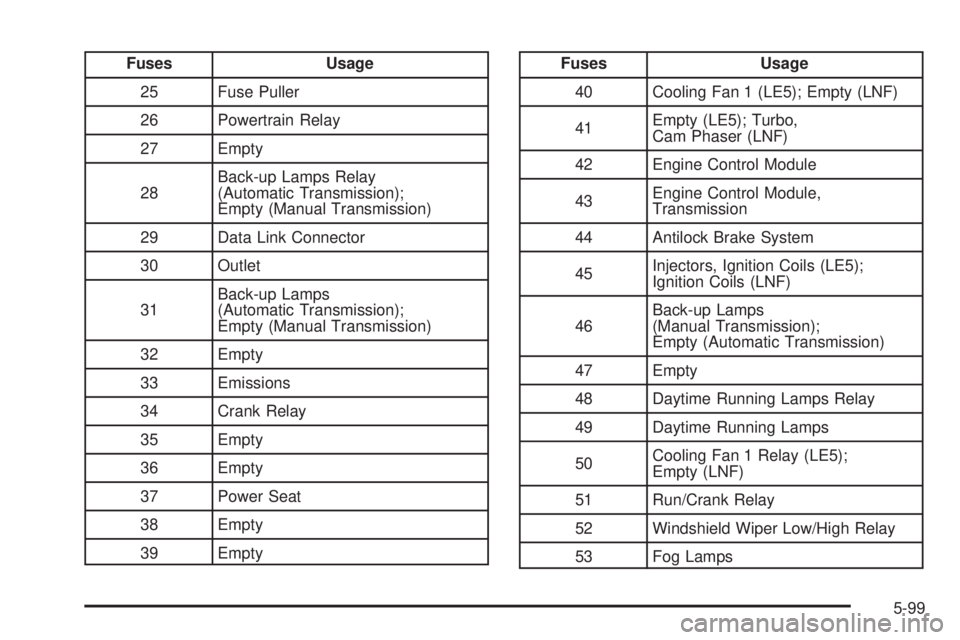
Fuses Usage
25 Fuse Puller
26 Powertrain Relay
27 Empty
28Back-up Lamps Relay
(Automatic Transmission);
Empty (Manual Transmission)
29 Data Link Connector
30 Outlet
31Back-up Lamps
(Automatic Transmission);
Empty (Manual Transmission)
32 Empty
33 Emissions
34 Crank Relay
35 Empty
36 Empty
37 Power Seat
38 Empty
39 EmptyFuses Usage
40 Cooling Fan 1 (LE5); Empty (LNF)
41Empty (LE5); Turbo,
Cam Phaser (LNF)
42 Engine Control Module
43Engine Control Module,
Transmission
44 Antilock Brake System
45Injectors, Ignition Coils (LE5);
Ignition Coils (LNF)
46Back-up Lamps
(Manual Transmission);
Empty (Automatic Transmission)
47 Empty
48 Daytime Running Lamps Relay
49 Daytime Running Lamps
50Cooling Fan 1 Relay (LE5);
Empty (LNF)
51 Run/Crank Relay
52 Windshield Wiper Low/High Relay
53 Fog Lamps
5-99
Page 296 of 348

Fuses Usage
54 Fog Lamps Relay
55 Horn Relay
56S Band, OnStar
®, Remote Keyless
Entry System
57 Antilock Brake System
58 Wiper Diode
59 Windshield Wiper
60 Horn
61 Antilock Brake System
62 Instrument Panel Ignition
63 Driver Side High Beam
Fuses Usage
64 Canister Vent
65 Driver Side Low-Beam Headlamp
66Passenger Side Low-Beam
Headlamp
67Passenger Side High-Beam
Headlamp
68 Parking Lamps Relay
69 Parking Lamps
70 Windshield Wiper On/Off Relay
71 Low-Beam Headlamp Relay
72 High-Beam Headlamp Relay
5-100