2008 PONTIAC SOLSTICE parking brake
[x] Cancel search: parking brakePage 86 of 348

Running the Engine While Parked
It is better not to park with the engine running.
But if you ever have to, here are some things to know.
{CAUTION:
Idling the engine with the climate control
system off could allow dangerous exhaust
into your vehicle. See the earlier caution under
Engine Exhaust on page 2-29.
Also, idling in a closed-in place can let deadly
carbon monoxide (CO) into your vehicle even
if the climate control fan is at the highest
setting. One place this can happen is a garage.
Exhaust — with CO — can come in easily.
NEVER park in a garage with the engine
running.
Another closed-in place can be a blizzard.
SeeWinter Driving on page 4-19.
{CAUTION:
It can be dangerous to get out of your vehicle
if the automatic transmission shift lever is not
fully in PARK (P) with the parking brake rmly
set. Your vehicle can roll. Do not leave your
vehicle when the engine is running unless you
have to. If you have left the engine running,
the vehicle can move suddenly. You or others
could be injured. To be sure your vehicle
will not move, even when it is on fairly level
ground, always set the parking brake and
move the automatic transmission shift lever
to PARK (P), or the manual transmission shift
lever to NEUTRAL.
Follow the proper steps to be sure your vehicle will
not move. SeeShifting Into PARK (P) (Automatic
Transmission) on page 2-26andParking Your Vehicle
(Manual Transmission) on page 2-28.
2-30
Page 93 of 348

Notice:Leaving the convertible top down and
exposing the interior of your vehicle to outdoor
conditions may cause damage. Always close
the convertible top if leaving your vehicle outdoors.
Notice:Lowering the convertible top when there
are objects in the storage area could damage
it or break the glass rear window. Always verify
that no objects are in the storage area before
lowering the convertible top.
Notice:Lowering the top if it is damp, wet, or
dirty can cause stains, mildew, and damage to
the inside of your vehicle. Dry off the top before
lowering it.
Notice:If you lower the top on your vehicle in
cold weather (0°F/-18°C or lower), you may damage
top components. Do not lower the top in cold
weather.Notice:If you raise or lower the convertible top
while the vehicle is in motion, you could damage
the top or the top mechanism. The repairs would
not be covered by your warranty. Always put
an automatic transmission in PARK (P) or a manual
transmission in FIRST (1) or REVERSE (R), turn
the ignition off and engage the parking brake before
raising or lowering the convertible top.
{CAUTION:
Moving parts of the convertible top can be
dangerous. People can be injured by the
convertible top and its mechanism. Keep
people away from your vehicle when you
are lowering or raising the top.
2-37
Page 94 of 348
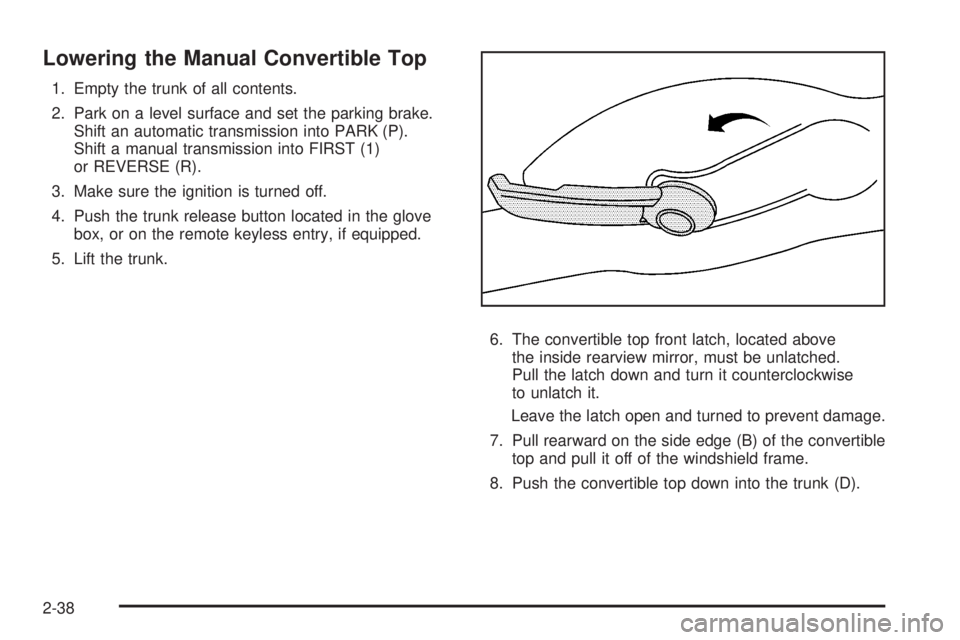
Lowering the Manual Convertible Top
1. Empty the trunk of all contents.
2. Park on a level surface and set the parking brake.
Shift an automatic transmission into PARK (P).
Shift a manual transmission into FIRST (1)
or REVERSE (R).
3. Make sure the ignition is turned off.
4. Push the trunk release button located in the glove
box, or on the remote keyless entry, if equipped.
5. Lift the trunk.
6. The convertible top front latch, located above
the inside rearview mirror, must be unlatched.
Pull the latch down and turn it counterclockwise
to unlatch it.
Leave the latch open and turned to prevent damage.
7. Pull rearward on the side edge (B) of the convertible
top and pull it off of the windshield frame.
8. Push the convertible top down into the trunk (D).
2-38
Page 95 of 348

9. After the top is stored, apply one even push,
as shown, on the convertible top to ensure that
the top is fully retracted and securely stored.
10. Close the trunk (D) by pressing down from the
rear center of it with a swift, rm motion.
Do not operate the rear defogger when the convertible
top is down.A clear Mylar
®protective lm has been installed at the
factory on the trunk lid surface under the convertible
top buttresses. This lm is designed to help prevent
paint damage to the trunk lid. Do not remove this
protective lm. It is intended to remain permanently
affixed to the trunk lid surface.
Raising the Manual Convertible Top
1. Park on a level surface, set the parking brake rmly
and shift an automatic transmission into PARK (P).
Shift a manual transmission into FIRST (1) or
REVERSE (R).
2. Make sure the ignition is turned off, and lower the
windows.
3. Push the trunk release button located in the glove
box, or on the remote keyless entry, if equipped.
4. Lift the trunk.
2-39
Page 101 of 348

The main components of your instrument panel are the following:
A. Side Window Outlets. SeeClimate Control
System on page 3-17.
B. Air Outlets. SeeOutlet Adjustment on page 3-20.
C. Turn Signal/Multifunction Lever. SeeTurn
Signal/Multifunction Lever on page 3-7.
D. Cruise Control Buttons (If Equipped).
SeeCruise Control on page 3-10.
E. Instrument Panel Cluster. SeeInstrument
Panel Cluster on page 3-21.
F. Audio Steering Wheel Controls (If Equipped).
SeeAudio Steering Wheel Controls on page 3-69.
G. Instrument Panel Brightness Control.
SeeInstrument Panel Brightness on page 3-15.
H. Passenger Air Bag Status Indicator. See
Passenger Airbag Status Indicator on page 3-25.
I. Hazard Warning Flashers Button.
SeeHazard Warning Flashers on page 3-6.
J. Fog Lamp Button (If Equipped).
SeeFog Lamps on page 3-14.
K. Electronic Stability Control (ESC)/Traction
Control System (TCS) Button (If Equipped).
SeeElectronic Stability Control (ESC) on page 4-9
orTraction Control System (TCS) on page 4-6.L. Driver Information Center (DIC) Controls.
SeeDriver Information Center (DIC) on page 3-37.
M. Horn. SeeHorn on page 3-6.
N. Windshield Wiper/Washer Controls. SeeWindshield
Wipers on page 3-9andWindshield Washer
on page 3-10.
O. Climate Controls. SeeClimate Control System
on page 3-17.
P. Cigarette Lighter (If Equipped). Accessory Power
Outlet (If Equipped). SeeAshtray(s) and Cigarette
Lighter on page 3-16andAccessory Power Outlet(s)
on page 3-16.
Q. Shift Lever. SeeManual Transmission Operation
on page 2-24. SeeAutomatic Transmission
Operation on page 2-22(If equipped with
automatic transmission).
R. Parking Brake Lever. SeeParking Brake
on page 2-25.
S. Audio System. SeeAudio System(s) on page 3-49.
T. Cupholder. SeeCupholder(s) on page 2-35.
U. Trunk Release. SeeTrunk on page 2-9.
V. Glove Box. SeeGlove Box on page 2-35.
3-5
Page 109 of 348

Headlamps
The lever on the left side of the steering column
operates the exterior lamps.
The exterior lamp switch has the following four positions:
2(Headlamps):This position turns on the
headlamps, parking lamps, and taillamps.
;(Parking Lamps):This position turns on the
parking lamps and taillamps only.
AUTO (Automatic Headlamp System):This position
automatically turns on the Daytime Running Lamps
(DRL) during daytime, and the headlamps, parking
lamps, and taillamps at night.
P(Off/On):This position is an Off/On switch for the
Automatic Headlamp System. In Canada, this applies to
vehicles with an automatic transmission set to PARK (P)
and manual transmission vehicles with the parking brake
engaged.
When operating in AUTO, a brief turn of the switch to
off/on will turn off the Automatic Headlamp System.
An AUTO LIGHTS OFF message will display on the
Driver Information Center (DIC) and a chime will sound.
Turning the switch to off/on again will turn the Automatic
Headlamp System back on. An AUTO LIGHTS ON
message will display on the Driver Information
Center (DIC).
The Automatic Headlamp System is always turned on at
the beginning of an ignition cycle for vehicles with manual
transmission. When the parking brake is engaged, the
automatic headlamps will turn off.
For vehicles with an automatic transmission, when the
shift lever is shifted out of PARK (P), the Automatic
Headlamp System will turn on. Shifting the lever back to
PARK (P) will turn off the automatic headlamp system.
Headlamps on Reminder
If the driver’s door is opened with the ignition off and
the lamps on, a warning chime will sound. This lets
you know that the headlamps are still on.
3-13
Page 124 of 348

When the ignition is on, the brake system warning light
will also come on when you set the parking brake.
The light will stay on if your parking brake does
not release fully. If it stays on after your parking brake
is fully released, it means you have a brake problem.
If the light comes on while you are driving, pull off
the road and stop carefully. Make sure the parking brake
is fully released. You may notice that the pedal is
harder to push or, the pedal may go closer to the oor.
It may take longer to stop. If the light is still on, have
the vehicle towed for service. SeeTowing Your Vehicle
on page 4-29.
{CAUTION:
Your brake system may not be working
properly if the brake system warning light is
on. Driving with the brake system warning
light on can lead to an accident. If the light
is still on after you have pulled off the road
and stopped carefully, have the vehicle towed
for service.
Antilock Brake System
Warning Light
For vehicles with
the Antilock Brake
System (ABS), this
light will come on
briey when you
start the engine.
That is normal. If the light does not come on then, have it
xed so it will be ready to warn you if there is a problem.
If the ABS light stays on, turn the ignition off, if the light
comes on when you are driving, stop as soon as it
is safely possible and turn the ignition off. Then start
the engine again to reset the system. If the ABS light still
stays on, or comes on again while you are driving,
your vehicle needs service. If the regular brake system
warning light is not on, you still have brakes, but
you do not have antilock brakes. If the regular brake
system warning light is also on, you do not have antilock
brakes and there is a problem with your regular
brakes. SeeBrake System Warning Light on page 3-27
For vehicles with a Driver Information Center (DIC),
seeDIC Warnings and Messages on page 3-40for
all brake related DIC messages.
3-28
Page 138 of 348

ESC (Electronic Stability Control) OFF
If your vehicle has Electronic Stability Control (ESC),
this message displays and the ESC/TCS light on
the instrument panel cluster comes on solid when
ESC is turned off. Adjust your driving accordingly.
SeeElectronic Stability Control (ESC) on page 4-9and
Electronic Stability Control (ESC)/Traction Control
System (TCS) Indicator/Warning Light on page 3-29
for more information.
KEY FOB BATT (Battery) LOW
This message displays if the Remote Keyless Entry
(RKE) transmitter battery is low. Replace the battery
in the transmitter. See “Battery Replacement” under
Remote Keyless Entry (RKE) System Operation
on page 2-4.
LEARN COMPLETE
On vehicles without the Remote Keyless Entry (RKE)
system, this message displays when the Tire Pressure
Monitor System (TPMS) has completed the tire
learning process. SeeTire Pressure Monitor System
on page 5-59for more information.
LOW TRACTION
If your vehicle has the Traction Control System (TCS),
this message displays and the ESC/TCS light on
the instrument panel cluster ashes when the system
is actively limiting wheel spin. Slippery road conditions
may exist if this message is displayed, so adjust
your driving accordingly. This message stays on for a
few seconds after the system stops limiting wheel spin.
SeeTraction Control System (TCS) on page 4-6and
Electronic Stability Control (ESC)/Traction Control
System (TCS) Indicator/Warning Light on page 3-29
for more information.
PARKING BRAKE
This message displays if the parking brake is left
engaged. SeeParking Brake on page 2-25for more
information.
SERVICE AIR BAG
This message displays when there is a problem with
the airbag system. Have your vehicle serviced by
your dealer/retailer immediately.
3-42