Page 180 of 408

acceleration and speed may be reduced. Anytime this
message stays on, the vehicle should be taken to
your dealer/retailer for service as soon as possible.
ICE POSSIBLE
This message displays when the outside air temperature
is cold enough to create icy road conditions. Adjust
your driving accordingly.
KEY FOB BATT (Battery) LOW
This message displays if the Remote Keyless Entry
(RKE) transmitter battery is low. Replace the battery in
the transmitter. See “Battery Replacement” under
Remote Keyless Entry (RKE) System Operation on
page 2-4.
LEARN COMPLETE
On vehicles without the Remote Keyless Entry (RKE)
system, this message displays when the Tire Pressure
Monitor System (TPMS) has completed the tire
learning process. SeeTire Pressure Monitor System on
page 5-70for more information.
LOW FUEL
This message displays along with a low fuel warning
light on the instrument panel cluster when your vehicle is
low on fuel. Rell the fuel tank as soon as possible.
SeeLow Fuel Warning Light on page 3-42,Fuel
on page 5-6, andFilling the Tank on page 5-9.
LOW WASHER FLUID
This message displays when the vehicle’s windshield
washer uid is low. Fill the windshield washer uid
reservoir to the proper level as soon as possible. See
Windshield Washer Fluid on page 5-41.
PARKING BRAKE
This message displays if the parking brake is left
engaged and you try to drive away. SeeParking Brake
on page 2-31for more information.
POWER STEERING
This message displays if a problem has been detected
with the electric power steering, if your vehicle has
this feature. Have your vehicle serviced immediately by
your dealer/retailer.
SERVICE AIR BAG
This message displays when there is a problem with the
airbag system. Have your vehicle serviced by your
dealer/retailer immediately.
SVC (Service) TIRE MONITOR
This message displays if a part on the Tire Pressure
Monitor System (TPMS) is not working properly. The tire
pressure light also ashes and then remains on during
the same ignition cycle. SeeTire Pressure Light on
page 3-37. Several conditions may cause this message
3-48
Page 220 of 408
You can run the engine to keep warm, but be careful.
{CAUTION:
Snow can trap exhaust gases under your
vehicle. This can cause deadly CO (carbon
monoxide) gas to get inside. CO could
overcome you and kill you. You cannot see it
or smell it, so you might not know it is in your
vehicle. Clear away snow from around the
base of your vehicle, especially any that is
blocking the exhaust pipe. And check around
again from time to time to be sure snow does
not collect there.
Open a window just a little on the side of the
vehicle that is away from the wind. This will
help keep CO out.
Run your engine only as long as you must. This saves
fuel. When you run the engine, make it go a little
faster than just idle. That is, push the accelerator
slightly. This uses less fuel for the heat that you get and
it keeps the battery charged. You will need a
well-charged battery to restart the vehicle, and possibly
for signaling later on with the headlamps. Let the
heater run for a while.
4-18
Page 229 of 408
For vehicles that can be dinghy towed with all four
wheels on the ground:
1. Position the vehicle to tow and then secure it.
2. Turn the ignition to LOCK/OFF.
3. Set the parking brake.
4. To prevent your battery from draining while the
vehicle is being towed, remove the following
fuse from the instrument panel fuse block: (IGN
SENSOR). SeeInstrument Panel Fuse Block
on page 5-110for more information.5. Turn the ignition to ACC/ACCESSORY.
6. Shift your transmission to NEUTRAL (N).
7. Release the parking brake.
Notice:If you exceed 65 mph (105 km/h) while
towing your vehicle, it could be damaged. Never
exceed 65 mph (105 km/h) while towing your vehicle.
Notice:Towing your vehicle from the rear could
damage it. Also, repairs would not be covered by
the warranty. Never have your vehicle towed
from the rear.
4-27
Page 237 of 408

Service............................................................5-4
Accessories and Modications..........................5-4
California Proposition 65 Warning.....................5-5
California Perchlorate Materials Requirements.....5-5
Doing Your Own Service Work.........................5-5
Adding Equipment to the Outside of Your
Vehicle......................................................5-6
Fuel................................................................5-6
Gasoline Octane............................................5-6
Gasoline Specications....................................5-7
California Fuel...............................................5-7
Additives.......................................................5-8
Fuels in Foreign Countries...............................5-8
Filling the Tank..............................................5-9
Filling a Portable Fuel Container.....................5-11
Checking Things Under
the Hood....................................................5-12
Hood Release..............................................5-12
Engine Compartment Overview.......................5-14
Engine Oil...................................................5-21
Engine Oil Life System..................................5-24
Engine Air Cleaner/Filter................................5-26
Automatic Transmission Fluid
(3.9L Engine)............................................5-27Automatic Transmission Fluid
(2.4L L4, 3.5L and 3.6L V6 Engines)............5-30
Engine Coolant.............................................5-30
Pressure Cap...............................................5-33
Engine Overheating.......................................5-33
Overheated Engine Protection
Operating Mode........................................5-35
Cooling System............................................5-36
Power Steering Fluid.....................................5-40
Windshield Washer Fluid................................5-41
Brakes........................................................5-42
Battery........................................................5-45
Jump Starting...............................................5-46
Bulb Replacement..........................................5-51
Halogen Bulbs..............................................5-52
Headlamps, Front Turn Signal, Sidemarker,
and Parking Lamps....................................5-52
Center High-Mounted Stoplamp (CHMSL)
(Sedan)...................................................5-54
Center High-Mounted Stoplamp (CHMSL)
(Retractable Hardtop and Coupe).................5-54
Taillamps, Turn Signal, Sidemarker, Stoplamps
and Back-up Lamps (Sedan).......................5-55
Taillamps, Turn Signal, Sidemarker, Stoplamps
and Back-up Lamps (Coupe).......................5-56
Section 5 Service and Appearance Care
5-1
Page 251 of 408
A. Engine Air Cleaner/Filter. SeeEngine Air
Cleaner/Filter on page 5-26.
B. Engine Oil Fill Cap. See “When to Add Engine Oil”
underEngine Oil on page 5-21.
C. Engine Oil Dipstick (Out of View). See “Checking
Engine Oil” underEngine Oil on page 5-21.
D. Engine Coolant Surge Tank. SeeEngine Coolant on
page 5-30.
E. Pressure Cap. SeePressure Cap on page 5-33.F. Brake Master Cylinder Reservoir. See “Brake Fluid”
underBrakes on page 5-42.
G. Battery. SeeBattery on page 5-45.
H. Windshield Washer Fluid Reservoir. See “Adding
Washer Fluid” underWindshield Washer Fluid
on page 5-41.
I. Engine Compartment Fuse Block. SeeEngine
Compartment Fuse Block on page 5-112.
5-15
Page 253 of 408
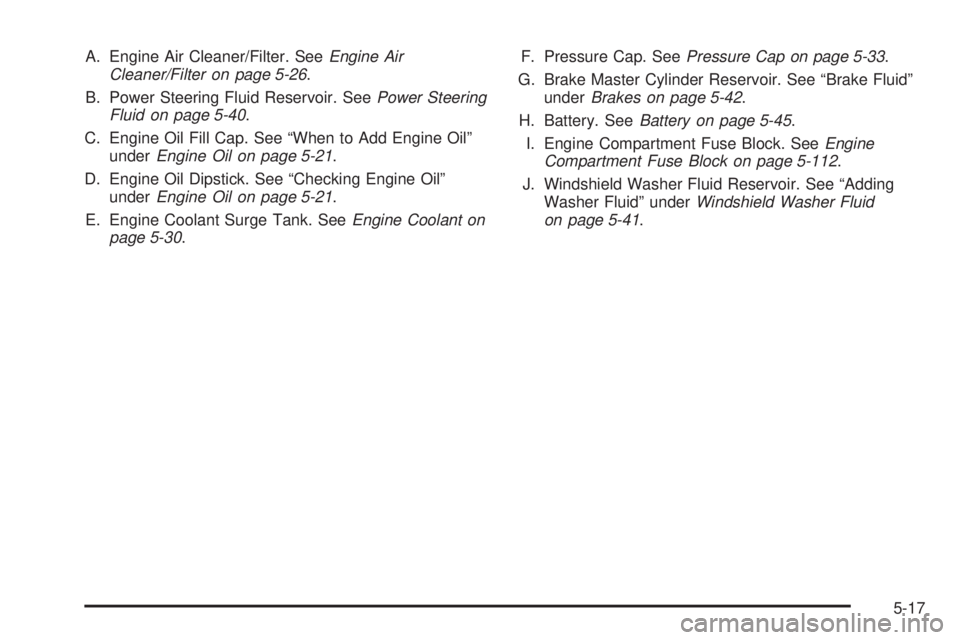
A. Engine Air Cleaner/Filter. SeeEngine Air
Cleaner/Filter on page 5-26.
B. Power Steering Fluid Reservoir. SeePower Steering
Fluid on page 5-40.
C. Engine Oil Fill Cap. See “When to Add Engine Oil”
underEngine Oil on page 5-21.
D. Engine Oil Dipstick. See “Checking Engine Oil”
underEngine Oil on page 5-21.
E. Engine Coolant Surge Tank. SeeEngine Coolant on
page 5-30.F. Pressure Cap. SeePressure Cap on page 5-33.
G. Brake Master Cylinder Reservoir. See “Brake Fluid”
underBrakes on page 5-42.
H. Battery. SeeBattery on page 5-45.
I. Engine Compartment Fuse Block. SeeEngine
Compartment Fuse Block on page 5-112.
J. Windshield Washer Fluid Reservoir. See “Adding
Washer Fluid” underWindshield Washer Fluid
on page 5-41.
5-17
Page 255 of 408

A. Engine Air Cleaner/Filter. SeeEngine Air
Cleaner/Filter on page 5-26.
B. Power Steering Fluid Reservoir. SeePower Steering
Fluid on page 5-40.
C. Engine Oil Fill Cap. See “When to Add Engine Oil”
underEngine Oil on page 5-21.
D. Engine Oil Dipstick. See “Checking Engine Oil”
underEngine Oil on page 5-21.
E. Electric Engine Cooling Fans (Out of View). See
Cooling System on page 5-36.
F. Engine Coolant Surge Tank. SeeEngine Coolant on
page 5-30.
G. Pressure Cap. SeePressure Cap on page 5-33.H. Brake Master Cylinder Reservoir. See “Brake Fluid”
underBrakes on page 5-42.
I. Automatic Transmission Fluid Dipstick. See
“Checking the Fluid Level” underAutomatic
Transmission Fluid (3.9L Engine) on page 5-27or
Automatic Transmission Fluid (2.4L L4, 3.5L
and 3.6L V6 Engines) on page 5-30.
J. Battery. SeeBattery on page 5-45.
K. Underhood Fuse Block. SeeEngine Compartment
Fuse Block on page 5-112.
L. Windshield Washer Fluid Reservoir. See “Adding
Washer Fluid” underWindshield Washer Fluid
on page 5-41.
5-19
Page 257 of 408

A. Engine Air Cleaner/Filter. SeeEngine Air
Cleaner/Filter on page 5-26.
B. Engine Coolant Bleed Valve.
C. Power Steering Fluid. SeePower Steering Fluid on
page 5-40.
D. Automatic Transmission Fluid Dipstick (Out of View).
See “Checking the Fluid Level” underAutomatic
Transmission Fluid (3.9L Engine) on page 5-27or
Automatic Transmission Fluid (2.4L L4, 3.5L
and 3.6L V6 Engines) on page 5-30.
E. Engine Oil Fill Cap. See “When to Add Engine Oil”
underEngine Oil on page 5-21.
F. Engine Oil Dipstick. See “Checking Engine Oil”
underEngine Oil on page 5-21.
G. Engine Coolant Surge Tank. SeeEngine Coolant on
page 5-30.
H. Pressure Cap. SeePressure Cap on page 5-33.
I. Brake Master Cylinder Reservoir. See “Brake Fluid”
underBrakes on page 5-42.
J. Battery. SeeBattery on page 5-45.
K. Windshield Washer Fluid Reservoir. See “Adding
Washer Fluid” underWindshield Washer Fluid
on page 5-41.
L. Engine Compartment Fuse Block. SeeEngine
Compartment Fuse Block on page 5-112.Engine Oil
Checking Engine Oil
It is a good idea to check the engine oil every time you
get fuel. In order to get an accurate reading, the oil
must be warm and the vehicle must be on level ground.
The engine oil dipstick handle is a yellow loop. See
Engine Compartment Overview on page 5-14for
the location of the engine oil dipstick.
1. Turn off the engine and give the oil several minutes
to drain back into the oil pan. If you do not do this,
the oil dipstick might not show the actual level.
2. Pull the dipstick and clean it with a paper towel or
cloth, then push it back in all the way. Remove it
again, keeping the tip down and check the level.
5-21