2008 PONTIAC G5 flat tire
[x] Cancel search: flat tirePage 315 of 388
{CAUTION:
Rust or dirt on a wheel, or on the parts to which
it is fastened, can make wheel nuts become
loose after time. The wheel could come off and
cause an accident. When you change a wheel,
remove any rust or dirt from places where the
wheel attaches to the vehicle. In an emergency,
you can use a cloth or a paper towel to do this;
but be sure to use a scraper or wire brush later,
if needed, to get all the rust or dirt off. See
Changing a Flat Tire on page 5-72.
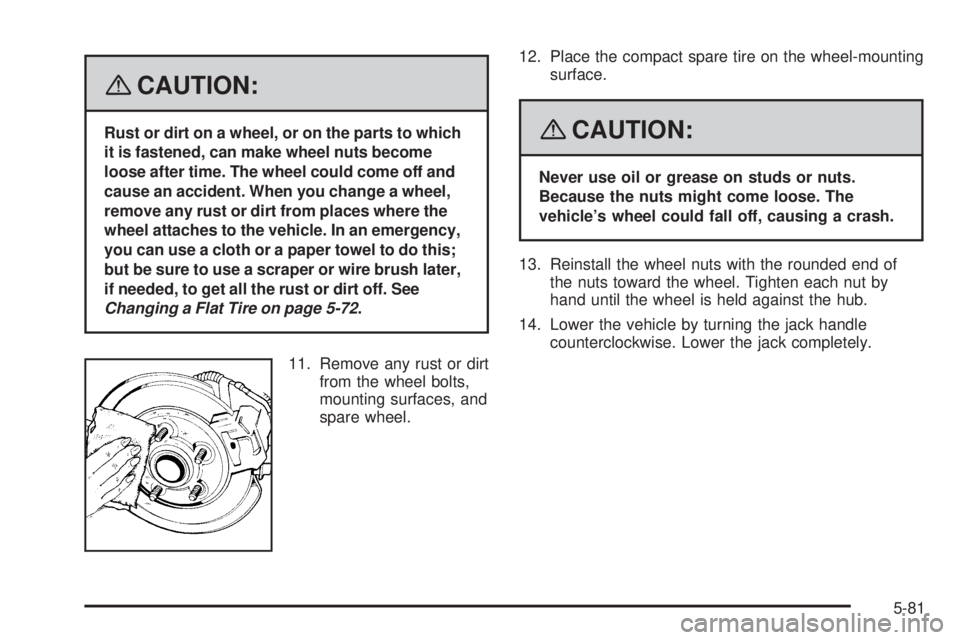
11. Remove any rust or dirt
from the wheel bolts,
mounting surfaces, and
spare wheel.12. Place the compact spare tire on the wheel-mounting
surface.{CAUTION:
Never use oil or grease on studs or nuts.
Because the nuts might come loose. The
vehicle’s wheel could fall off, causing a crash.
13. Reinstall the wheel nuts with the rounded end of
the nuts toward the wheel. Tighten each nut by
hand until the wheel is held against the hub.
14. Lower the vehicle by turning the jack handle
counterclockwise. Lower the jack completely.
5-81
Page 317 of 388

Storing a Flat or Spare Tire
and Tools
{CAUTION:
Storing a jack, a tire, or other equipment in the
passenger compartment of the vehicle could
cause injury. In a sudden stop or collision,
loose equipment could strike someone.
Store all these in the proper place.A. Cover
B. Retainer
C. Jack and Wheel
Wrench
D. Stow Bolt
Extension Rod
E. Spare Tire
F. Bolt
Base Model
5-83
Page 347 of 388

Engine Coolant Level Check
Check the engine coolant level and add DEX-COOL®
coolant mixture if necessary. SeeEngine Coolant
on page 5-19.
Windshield Washer Fluid Level Check
Check the windshield washer uid level in the
windshield washer uid reservoir and add the proper
uid if necessary.
At Least Once a Month
Tire Ination Check
Inspect your vehicle’s tires and make sure they are
inated to the correct pressures. Do not forget to
check the spare tire. SeeInflation - Tire Pressure on
page 5-55. Check to make sure the spare tire is stored
securely. SeeChanging a Flat Tire on page 5-72.
Tire Wear Inspection
Tire rotation may be required for high mileage highway
drivers prior to the Engine Oil Life System service
notication. Check the tires for wear and, if necessary,
rotate the tires. SeeTire Inspection and Rotation on
page 5-62.
At Least Once a Year
Starter Switch Check
{CAUTION:
When you are doing this inspection, the
vehicle could move suddenly. If the vehicle
moves, you or others could be injured.
1. Before you start, be sure you have enough room
around the vehicle.
2. Firmly apply both the parking brake and the regular
brake. SeeParking Brake on page 2-32.
Do not use the accelerator pedal, and be ready to
turn off the engine immediately if it starts.
3. On automatic transmission vehicles, try to start the
engine in each gear. The vehicle should start only in
PARK (P) or NEUTRAL (N). If the vehicle starts in
any other position, contact your dealer/retailer for
service.
On manual transmission vehicles, put the shift lever
in NEUTRAL, push the clutch pedal down halfway,
and try to start the engine. The vehicle should start
only when the clutch pedal is pushed down all the
way to the oor. If the vehicle starts when the clutch
pedal is not pushed all the way down, contact your
dealer/retailer for service.
6-9
Page 364 of 388

Flat Tire Change:Installation of a spare tire in
good condition, when equipped and properly
inated, is covered at no charge. The customer is
responsible for the repair or replacement of the
tire if not covered by a warrantable failure.
Jump Start:A battery jump start is covered at no
charge if the vehicle does not start.
Trip Routing Service (Canada only):Upon
request, Roadside Assistance will send you detailed,
computer personalized maps, highlighting your
choice of either the most direct route or the most
scenic route to your destination, anywhere in North
America, along with helpful travel information
pertaining to your trip.
Please allow three weeks before your planned
departure date. Trip routing requests will be limited to
six per calendar year.
Trip Interruption Benets and Assistance
(Canada only):In the event of a warranty
related vehicle disablement, while en route
and over 250 kilometres from the original
point of departure, you may qualify for trip
interruption expense assistance.This assistance covers reasonable reimbursement of
up to a maximum of $500 (Canadian) for (A) meals
(maximum of $50/day), (B) lodging (maximum of
$100/night) and (C) alternate ground transportation
(maximum of $40/day). This benet is to assist you
with some of the unplanned expense you may incur
while waiting for your vehicle to be repaired.
Pre-authorization, original detailed receipts and a
copy of the repair order are required.
Once authorization has been given, your advisor will
help you make any necessary arrangements and
explain how to claim for trip interruption expense
assistance.
Alternative Service (Canada only):There may be
times, when Roadside Assistance cannot provide
timely assistance. Your advisor may authorize you to
secure local emergency road service, and you will be
reimbursed up to $100 upon submission of the
original receipt to Roadside Assistance.
In many instances, mechanical failures may be covered.
However, any cost for parts and labor for non-warranty
repairs are the responsibility of the driver.
Pontiac and General Motors of Canada Limited reserve
the right to limit services or reimbursement to an owner
or driver when, in their sole discretion, the claims become
excessive in frequency or type of occurrence.
7-8
Page 379 of 388

E
Easy Entry Seat............................................... 1-8
EDR .............................................................7-17
Electrical System
Add-On Equipment......................................5-96
Engine Compartment Fuse Block...................5-99
Floor Console Fuse Block.............................5-97
Fuses and Circuit Breakers...........................5-97
Headlamp Wiring.........................................5-96
Power Windows and Other Power Options......5-96
Windshield Wiper Fuses...............................5-96
Electronic Stability Control................................4-10
Electronic Stability Control Indicator Light...........3-35
Engine
Air Cleaner/Filter.........................................5-17
Check and Service Engine Soon Light............3-37
Coolant......................................................5-19
Coolant Heater............................................2-26
Coolant Temperature Warning Light................3-36
Drive Belt Routing.......................................6-15
Engine Compartment Overview......................5-12
Exhaust.....................................................2-36
Oil .............................................................5-13
Oil Life System...........................................5-16
Overheating................................................5-22
Starting......................................................2-24Enhanced Traction System (ETS)........................ 4-9
Warning Light.............................................3-34
Entry/Exit Lighting...........................................3-17
Event Data Recorders.....................................7-17
Extender, Safety Belt.......................................1-29
F
Filter
Engine Air Cleaner......................................5-17
Finish Damage...............................................5-93
Fixed Mast Antenna........................................3-77
Flashers, Hazard Warning.................................. 3-6
Flash-to-Pass................................................... 3-8
Flat Tire........................................................5-71
Flat Tire, Changing.........................................5-72
Flat Tire, Storing.............................................5-83
Fluid.............................................................5-19
Automatic Transmission................................5-18
Windshield Washer......................................5-29
Fog Lamp
Fog ...........................................................3-16
Fog Lamp Light..............................................3-40
Folding Rear Seat............................................ 1-9
5
Page 384 of 388

R
Radio Frequency Identication (RFID), Privacy......7-18
Radio(s)........................................................3-59
Radios
Reception...................................................3-76
Setting the Clock.........................................3-56
Theft-Deterrent............................................3-75
Rear Door Security Locks................................2-11
Rearview Mirror with OnStar
®...........................2-38
Rearview Mirrors.............................................2-38
Reclining Seatbacks.......................................... 1-4
Recommended Fluids and Lubricants.................6-12
Recreational Vehicle Towing.............................4-30
Remote Keyless Entry (RKE) System.................. 2-3
Remote Keyless Entry (RKE) System, Operation..... 2-4
Remote Vehicle Start........................................ 2-6
Removing the Flat Tire and Installing the
Spare Tire..................................................5-78
Removing the Spare Tire and Tools...................5-73
Replacement Bulbs.........................................5-47
Replacement Parts, Maintenance......................6-14
Reporting Safety Defects
Canadian Government..................................7-15
General Motors...........................................7-15
United States Government............................7-15Restraint System Check
Checking the Restraint Systems....................1-66
Replacing Restraint System Parts
After a Crash..........................................1-67
Retained Accessory Power (RAP)......................2-24
Roadside
Assistance Program....................................... 7-7
Rocking Your Vehicle to Get it Out....................4-24
Routing, Engine Drive Belt...............................6-15
Running Out of Fuel........................................2-37
S
Safety Belt
Reminder Light............................................3-28
Safety Belts
Care of......................................................5-89
How to Wear Safety Belts Properly................1-15
Lap-Shoulder Belt........................................1-23
Safety Belt Extender....................................1-29
Safety Belt Use During Pregnancy.................1-29
Safety Belts Are for Everyone.......................1-10
Safety Warnings and Symbols.............................. iii
Scheduled Maintenance..................................... 6-4
10
Page 386 of 388

T
Tachometer....................................................3-27
Taillamps
Turn Signal Lamps......................................5-44
Turn Signal, Stoplamps and Back-up Lamps......5-45
Theft-Deterrent, Radio.....................................3-75
Theft-Deterrent Systems...................................2-16
Content Theft-Deterrent................................2-17
PASS-Key
®III+...........................................2-18
PASS-Key®III+ Operation.............................2-19
Tilt Wheel........................................................ 3-7
Time, Setting..................................................3-56
Tire
Pressure Light.............................................3-36
Tires.............................................................5-48
Aluminum or Chrome-Plated Wheels,
Cleaning.................................................5-92
Buying New Tires........................................5-65
Chains.......................................................5-70
Changing a Flat Tire....................................5-72
Cleaning....................................................5-93
Compact Spare Tire.....................................5-85
Different Size..............................................5-66
If a Tire Goes Flat.......................................5-71
Ination - Tire Pressure................................5-55
Inspection and Rotation................................5-62Tires (cont.)
Installing the Spare Tire................................5-78
Pressure Monitor Operation...........................5-58
Pressure Monitor System..............................5-56
Removing the Flat Tire.................................5-78
Removing the Spare Tire and Tools...............5-73
Storing a Flat or Spare Tire and Tools............5-83
Tire Sidewall Labeling..................................5-49
Tire Terminology and Denitions....................5-52
Uniform Tire Quality Grading.........................5-67
Wheel Alignment and Tire Balance.................5-68
Wheel Replacement.....................................5-68
When It Is Time for New Tires......................5-64
Towing
Recreational Vehicle.....................................4-30
Towing a Trailer..........................................4-32
Your Vehicle...............................................4-30
Traction
Control System (TCS).................................... 4-6
Enhanced Traction System (ETS).................... 4-9
Enhanced Traction System (ETS)
Warning Light..........................................3-34
Traction Control System...................................3-35
Transmission
Fluid, Automatic...........................................5-18
Fluid, Manual..............................................5-19
Up-Shift Light..............................................3-32
12