2008 Peugeot Boxer engine
[x] Cancel search: enginePage 113 of 154

123
7
CHECKS
Cooling system
Only use the fluid recommended by the
manufacturer. Otherwise, you risk seriously
damaging your engine. When the engine
is warm, the temperature of the coolant is
controlled by the engine fan. As this fan can
operate with the ignition key removed and
because the cooling system is pressurised,
wait for at least one hour after the engine
has stopped before carrying out any work.
Slacken the cap by 1/4 of a turn to release
the pressure to prevent any risk of scalding.
When the pressure has dropped, remove the
cap and top up the level with coolant.
If fluid has to be added frequently, this
indicates a failure which must be checked by
a PEUGEOT dealer as soon as possible.
Power steering fluid level
The vehicle must be parked on level ground with
the engine cold. Unscrew the cap integrated with
the gauge and check the level which must be
between the MIN and MAX marks.
Used oil
Avoid prolonged contact of used oil with the
skin.
Brake fluid is harmful to health and very
corrosive.
Do not dispose of used oil, brake fluid or
coolant into drains or into the ground but
into the containers dedicated to this use at
PEUGEOT dealerships.
Topping up
The level must be between the MIN and
MAX marks on the expansion bottle. If
more than 1 litre of fluid is required to top
up the level, have the system checked by a
PEUGEOT dealer.
Windscreen wash and headlamp
wash level
For best quality cleaning and to prevent
freezing, this fluid must not be topped up or
replaced with water.
Capacity of the reservoir: approximately
5.5 litres. Levels
Page 114 of 154
124
CHECKS
Air filter and passenger
compartment filter
A clogged passenger compartment filter
may reduce the performance of the
air conditioning system and generate
undesirable odours. The replacement
intervals for these components are indicated
in the servicing booklet.
Depending on the environment (dusty
atmosphere...) and the use of the vehicle
(urban driving...), change them twice as
often if necessary, refer to the "Under the
bonnet" section of chapter 7.
Manual gearbox
Have the level checked in accordance with
the manufacturer ’s servicing schedule.To check the main levels and certain
components, in accordance with the
manufacturer ’s servicing schedule, refer
to the pages of the servicing booklet which
correspond to your vehicle’s engine.
Only use products recommended by
PEUGEOT or products of equivalent quality
and characteristics.
In order to optimise the operation of units as
important as the braking circuit, PEUGEOT
selects and offers specific products.
In order to avoid damaging the electrical
units, high pressure washing to clean the
engine compartment is strictly prohibited.
Handbrake
Where the handbrake travel is too great
or there is a reduction in the performance
of the system, the handbrake should be
adjusted, even between services.
Have the system checked by a PEUGEOT
dealer.
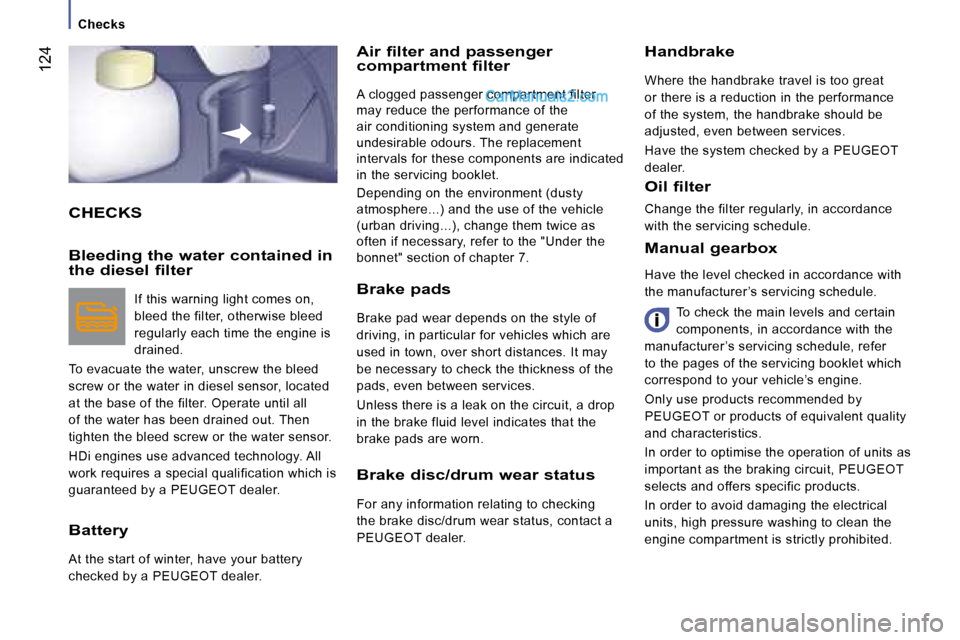
Bleeding the water contained in
the diesel filter
If this warning light comes on,
bleed the filter, otherwise bleed
regularly each time the engine is
drained.
To evacuate the water, unscrew the bleed
screw or the water in diesel sensor, located
at the base of the filter. Operate until all
of the water has been drained out. Then
tighten the bleed screw or the water sensor.
HDi engines use advanced technology. All
work requires a special qualification which is
guaranteed by a PEUGEOT dealer.
Battery
At the start of winter, have your battery
checked by a PEUGEOT dealer.
Brake pads
Brake pad wear depends on the style of
driving, in particular for vehicles which are
used in town, over short distances. It may
be necessary to check the thickness of the
pads, even between services.
Unless there is a leak on the circuit, a drop
in the brake fluid level indicates that the
brake pads are worn.
Brake disc/drum wear status
For any information relating to checking
the brake disc/drum wear status, contact a
PEUGEOT dealer.
Oil filter
Change the filter regularly, in accordance
with the servicing schedule.
Checks
Page 115 of 154

126
Low fuel level
When the fuel tank level E
(Empty) is reached, this warning
light comes on. At this moment,
you have enough fuel left to
drive approximately 30 miles (50 km) ,
depending on the driving conditions, the
engine and the profile of the road. Fill up
without delay to avoid running out of fuel. The fuel tank must be illed
with the engine off.
- Open the fuel filler flap.
- Support the cap with one hand.
- With the other hand, insert the key, then turn it anticlockwise.
- Remove the cap and hook it onto the clip located on the inside of the flap.
A label affixed to the inside of the flap
reminds you of the type of fuel to be used.
When filling the fuel tank, do not continue
after the 3rd cut-off of the nozzle. This could
cause malfunctions.
The capacity of the fuel tank is
approximately 90 litres.
- After filling the fuel tank, lock the cap and close the flap.
FUEL CIRCUIT DEACTIVATED
In the event of a serious collision, a device
automatically cuts off the fuel supply
to the engine and the vehicle’s electrical
supply.
FILLING WITH FUEL
Fuel tanks of different capacities,
60 and 125 litres, are sold. Check that there is no smell or leak of fuel
outside the vehicle.
Restore the supply by pressing:
- the first button,
located below the steering wheel.
- the second button, ocated in the battery l compartment
under the front passenger ’s floor.
Fuel
Page 116 of 154

C
B
A
127
TROUBLESHOOTING
8
A. Positive metal point on your vehicle
B. Slave battery
C. Earth on your vehicle
CHARGING THE BATTERY USING
A CHARGER
- disconnect the battery,
- follow the instructions for use given by
the battery charger manufacturer,
- reconnect starting with the negative (-) terminal,
- check that the terminals and connectors are clean. If they are covered with
sulphate (white or greenish deposit),
disconnect them and clean them. The charging operation must be carried
out in a ventilated area away from naked
flames or any possible sources of sparks to
eliminate the risk of explosion and fire.
Do not attempt to charge a frozen battery: it
must first be thawed to eliminate the risks of
explosion. If the battery has frozen, before
charging it have it checked by a specialist
who will check that the internal components
have not been damaged and that the
container is not cracked, which could mean
that there is a risk of a leak of toxic and
corrosive acid.
BATTERY
STARTING FROM ANOTHER BATTERY
- connect the red cable to the metal point
A then to the positive (+) terminal of the
slave battery B,
- connect one end of the green or black cable to the negative (-) terminal of the
slave battery B,
- connect the other end of the green or black cable to the earth point C on your
vehicle,
- operate the starter, let the engine run,
- wait for the engine to return to idle, then disconnect the cables. Battery
Page 117 of 154

128
The batteries contain harmful
substances such as sulphuric acid and
lead. They must be discarded in accordance
with the provisions of the law and must not,
in any circumstances, be discarded with
household waste.
Take used batteries to a special collection
point. It is advisable to disconnect the
negative (-) terminal of the battery if
the vehicle is not to be used for a period of
more than one month.
Before disconnecting the battery, you must
wait for 2 minutes after switching off the
ignition.
Never disconnect a terminal when the
engine is running.
Never charge a battery without first
disconnecting the terminals.
Close the windows and doors before
disconnecting the battery.
After every reconnection of the battery,
switch on the ignition and wait 1 minute
before starting to allow the electronic
systems to be initialised. If slight difficulties
are experienced after this, please contact a
PEUGEOT dealer. If the battery has been disconnected
for some time, it may be necessary to
reinitialise the following functions:
- the display parameters (date, time,
language, distance unit and temperature
unit),
- the radio stations,
- the central locking.
Some settings are cleared and must be
reprogrammed, consult a PEUGEOT.
If your vehicle is fitted with a
chronotachograph or an alarm,
disconnection of the negative (-) terminal of
the battery (located under the floor on the
left-hand side, in the cab) is recommended if
the vehicle is not to be used for a period of
more than 5 days.
Battery
Page 127 of 154

138
The three fuse boxes are placed on the
fascia panel on the passenger's side, in the
driver's pillar and in the engine.
The pliers are secured to the fuse box on
the driver's side.
Removing and fitting a fuse
Before changing a fuse, the cause of the
fault must be found and rectified. The fuse
numbers are indicated on the fuse box.
- Use the pliers.Always replace a faulty fuse with a fuse
of the same rating.
PEUGEOT will not accept responsibility for
the cost incurred in repairing your vehicle or
for rectifying malfunctions resulting from the
installation of accessories not supplied and
not recommended by PEUGEOT and not
installed in accordance with its instructions,
in particular in the case of equipment
the consumption of which exceeds
10 milliamperes.
CHANGING A FUSE
Changing a fuse
Page 130 of 154
141
TROUBLESHOOTING
8
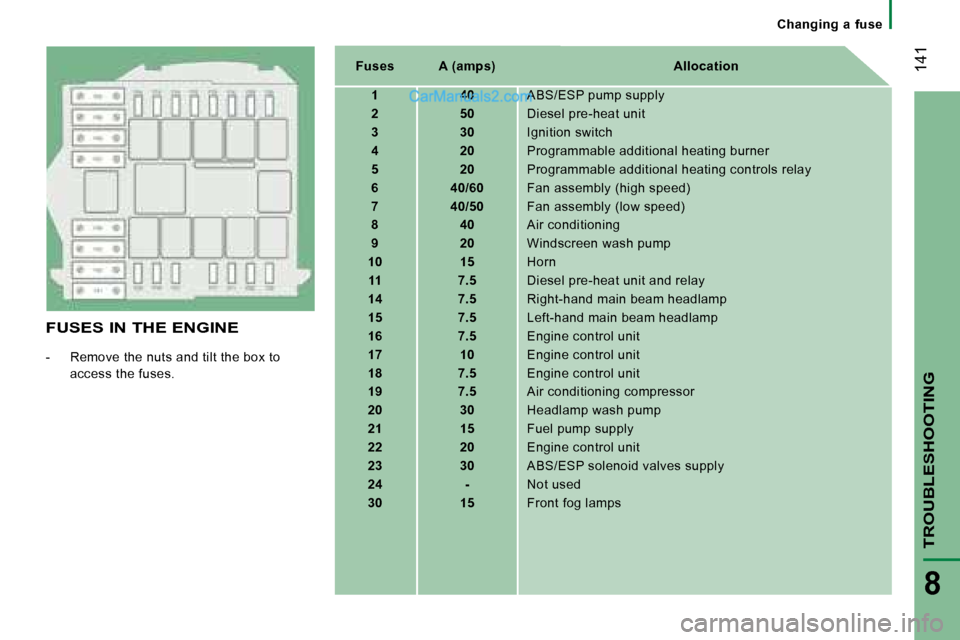
FUSES IN THE ENGINE
- Remove the nuts and tilt the box to access the fuses. Fuses A (amps) Allocation
1 40 ABS/ESP pump supply
2 50 Diesel pre-heat unit
3 30 Ignition switch
4 20 Programmable additional heating burner
5 20 Programmable additional heating controls relay
6 40/60 Fan assembly (high speed)
7 40/50 Fan assembly (low speed)
8 40 Air conditioning
9 20 Windscreen wash pump
10 15 Horn
11 7.5 Diesel pre-heat unit and relay
14 7.5 Right-hand main beam headlamp
15 7.5 Left-hand main beam headlamp
16 7.5 Engine control unit
17 10 Engine control unit
18 7.5 Engine control unit
19 7.5 Air conditioning compressor
20 30 Headlamp wash pump
21 15 Fuel pump supply
22 20 Engine control unit
23 30 ABS/ESP solenoid valves supply
24 - Not used
30 15 Front fog lamps Changing a fuse
Page 132 of 154

143
TROUBLESHOOTING
8
BEING TOWED
Without lifting
(four wheels on the ground)
You must always use a towbar.
From the rear
Hook the bar onto the rigid eye located
under the bumper.
From the front
The removable towing eye is located in the
box under the front passenger seat.
Unclip the cover using a flat tool.
Screw the removable towing eye in fully.
Place the gear lever in neutral. Failure to
observe this special condition may result in
damage to certain braking components and
the absence of braking assistance when the
engine is re-started.
With lifting
(2 wheels only on the ground)
It is preferable to lift the vehicle using
professional lifting equipment.When being towed with the engine
off, there is no braking or steering
assistance.
Being towed