Page 39 of 154

55
3
ERGONOMICS AND COMFORT
Ventilation
Setting the time of the internal clock
Set the clock on the control panel before
programming the deferred switching on of
the heating. Immediate switching on of the
heating
Before switching on the heating, check that:
- the temperature setting control is in the
"Hot air" position (red).
- the air low setting control is in position 2. This symbol or the previous stored time
and the number (e.g. 1) corresponding to
the recalled pre-selection are displayed for
ten seconds.
Note: if you wish to recall the other pre-
selected times, press the SET button several
times before the ten seconds have elapsed.
Press this button.
The display and the associated
indicator light come on.
Within ten seconds, press these two setting
buttons until the correct time is displayed.
Press ">" to increase the hours or
"<" to decrease.
Press and hold the button for
more rapid scrolling of the digits.
Reading the time Press this button.
This indicator light comes
on, the time is displayed for
approximately ten seconds. Press this button.
The display and the heating
cycle indicator light come on
and remain on throughout the
duration of operation.
Switching on the deferred heating
Switching on can be programmed between
one minute and twenty-four hours in
advance.
You can store up to three different start
times, but programme one deferred start
only.
Note: if you wish to start the heating at a
fixed time each day, simply reprogramme
the stored time each day.
Press this button, the display
becomes overbright. Within the ten seconds, press
these two setting buttons to
select the required start time.
Setting of the stored time is
confirmed by clearing of the
start time, displaying of the pre-
selection number (e.g. 1) and
overbrightness of the display
lighting.
Page 40 of 154

56
Ventilation
Cancelling the programming Press this button briefly to clear
the programmed start time.
The display lighting and the
pre-selection number (e.g. 1) are
switched off. Good practice
To avoid any risk of poisoning or
asphyxiation, the additional heating must
not be used, even for short periods, in
an enclosed space such as a garage or
workshop which is not fitted with an exhaust
gas extraction system.
The additional heating is supplied by the
vehicle's fuel tank. Ensure that the fuel
gauge indicator light is not at reserve.
Always switch off the additional heating
when filling with fuel to avoid any risk of fire
or explosion.
Do not park the vehicle on an inflammable
surface (dry grass, dead leaves, paper…),
there is a risk of fire.
The temperature near the heater must not
exceed 120 °C. A temperature higher than
this (for example in the case of painting in
an oven) could damage the components of
the electronic circuits.
The additional heating system is fitted with
a temperature limiter which cuts off the
combustion in the event of overheating due
to a lack of coolant.
Top up the coolant, then press the
programme selection control before
switching the heating on again. Have the additional heating system
checked at least once a year at the
beginning of winter. Maintenance and
repairs should only be carried out by a
PEUGEOT dealer.
Use recommended replacement parts only.
Recalling one of the pre-selected
start times Press this button as many times
as necessary until the number
corresponding to the required
pre-selected start time (e.g. 2)
appears.
After ten seconds, the time is cleared but
remains stored for as long as the number
(e.g. 2) and the display remain lit.
Switching off the heating
Press this button.
The heating cycle indicator light
and the display are switched off. Two different types of equipment
The additional heating is autonomous and
programmable. Before you enter the vehicle,
it gradually increases the temperature of the
engine to make starting easier. This also
facilitates passenger compartment heating,
de-icing and demisting.
The additional passenger compartment
heating system supplements the
standard equipment. Its operation may be
independent of the engine. Switching on of
the heating may be programmable.
Page 42 of 154
12
58
Lumbar support
Turn the control. Seat cushion adjustment
Lift the handle
1 to raise or lower the front of
the seat.
Lift the handle 2 to raise or lower the rear of
the seat. Heated seat
Use this control to switch the heating of the
seat on or off.
Seat with variable vibration
reduction
If your seat is fitted with this system, turn the
control to adjust the vibration reduction in
accordance with the driver ’s weight.
Seat back angle
Turn the control to adjust the angle of the
seat back.
Forwards-backwards adjustment
Lift the control bar, located under the seat,
and adjust to the required position.
Seats
Page 128 of 154

139
TROUBLESHOOTING
8
PASSENGER'S SIDE FASCIA PANEL FUSES
- Remove the bolts and tilt the box to access the fuses.
Fuses A (amps) Allocation
12 7.5 Right-hand dipped headlamp
13 7.5 Left-hand dipped headlamp - Headlamp height adjuste r
31 7.5 Relay supply
32 10 Minibus interior lighting - Hazard warning lights
33 15 Rear 12 V socket
34 - Not used
35 7.5 Reversing lights - Water in diesel sensor
36 20 Door locking/unlocking unit
37 10 Brake lights switch - Third brake light - Instrumen t panel
38 10 Interior relays
39 10 Audio equipment - Diagnostics socket - Alarm siren - Programmable additional heating controls
40 15 De-icing: rear screen (left-hand side), mirror (pas senger side)
41 15 De-icing: rear screen (right-hand side), mirror (dr iver's side)
42 7.5 ABS control unit and sensor - ESP sensor - Brake li ghts switch
43 30 Windscreen wiper motor
44 20 Lighter - Front 12 V socket
45 7.5 Electric window and mirror switches (driver's side) - Passenger electric window
46 - Not used
47 20 Driver's electric window motor
48 20 Passenger electric window motor
49 7.5 Rain/brightness sensor - Audio equipment - Driver's electric window motor - Alarm - Instrument panel controls
50 7.5 Air bags and pre-tensioners unit
51 7.5 Chronotachograph - Cruise control - Air conditionin g controls
52 7.5 Passenger compartment relays
53 7.5 Instrument panel - Rear fog lamps Changing a fuse
Page 129 of 154
140Fuses A (amps) Allocation54 - Not used
55 15 Heated seats
56 15 Rear 12 V socket - Lighter
57 10 Ventilation/heating motor under the driver's seat
58 10 Direction indicators
59 - Not used
60 - Not used
61 - Not used
62 - Not used
63 10 Programmable additional heating switch
64 - Not used
65 30 Rear blower
DRIVER'S PILLAR FUSES
- Unclip the cover.
When you have finished, close the cover
carefully.Changing a fuse
Page 130 of 154
141
TROUBLESHOOTING
8
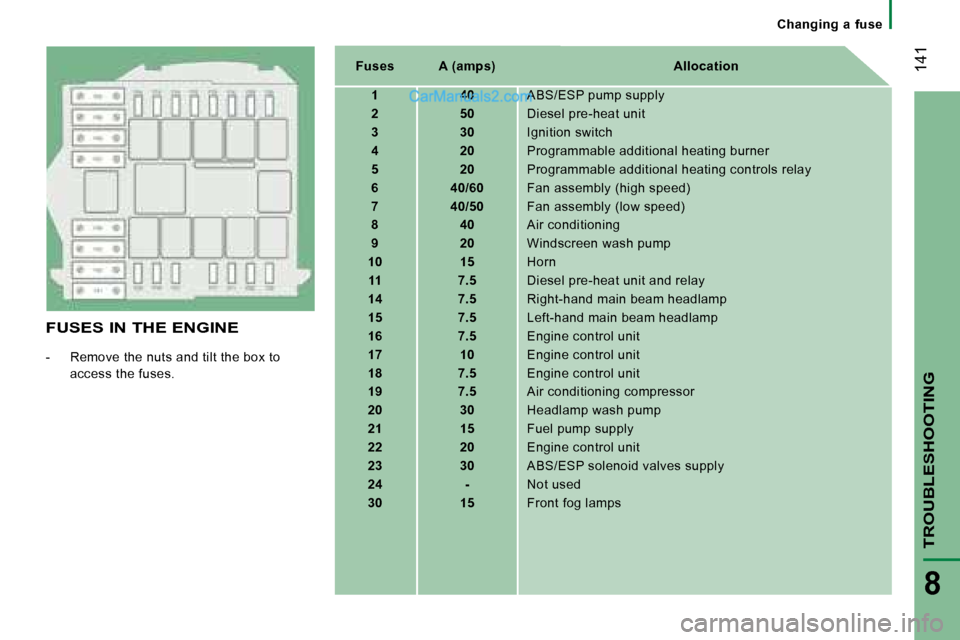
FUSES IN THE ENGINE
- Remove the nuts and tilt the box to access the fuses. Fuses A (amps) Allocation
1 40 ABS/ESP pump supply
2 50 Diesel pre-heat unit
3 30 Ignition switch
4 20 Programmable additional heating burner
5 20 Programmable additional heating controls relay
6 40/60 Fan assembly (high speed)
7 40/50 Fan assembly (low speed)
8 40 Air conditioning
9 20 Windscreen wash pump
10 15 Horn
11 7.5 Diesel pre-heat unit and relay
14 7.5 Right-hand main beam headlamp
15 7.5 Left-hand main beam headlamp
16 7.5 Engine control unit
17 10 Engine control unit
18 7.5 Engine control unit
19 7.5 Air conditioning compressor
20 30 Headlamp wash pump
21 15 Fuel pump supply
22 20 Engine control unit
23 30 ABS/ESP solenoid valves supply
24 - Not used
30 15 Front fog lamps Changing a fuse