2008 Peugeot Boxer ESP
[x] Cancel search: ESPPage 87 of 154

102
Driving safety
TRACTION CONTROL (ASR) AND
DYNAMIC STABILITY CONTROL (ESP)
These systems are linked and complement
the ABS.
The ASR system is very useful for
maintaining optimum drive and avoiding
losses of control of the vehicle on
acceleration.
The system optimises drive to prevent the
wheels skidding, by acting on the brakes of
the drive wheels and on the engine. It also
allows the directional stability of the vehicle
to be improved on acceleration.
Use the ESP to hold your course without
attempting to countersteer.If there is a variation between the trajectory
followed by the vehicle and that required
by the driver, the ESP system automatically
acts on the engine and the brake of one
or more wheels, in order to put the vehicle
back on course.
DISARMING THE ASR SYSTEM
In certain exceptional conditions (when
starting a vehicle stuck in mud or snow, or
on loose ground...), it could prove useful to
disarm the ASR system to make the wheels
spin and regain grip.
Operation of the ASR and ESP
systems The luminous diode flashes when
the ASR or ESP is triggered. Press this button.
The diode on the button comes on: the
ASR system no longer acts on the engine
operation, but continues to act on the brakes.
MALFUNCTION
When a malfunction of the ASR
system occurs, this warning light
comes on, accompanied by an
audible signal and confirmed by a
message on the display.
Page 88 of 154

103
5
SAFETY
Driving safety
FIXED SPEED LIMITER
If your vehicle is fitted with this function,
the speed of your vehicle can be limited
to a fixed speed of approximately 55 mph
(90 km/h) or 60 mph (100 km/h). This
maximum speed cannot be changed.
A label in the passenger compartment
indicates this maximum speed.
The fixed speed limiter is not a function
of the cruise control type. It cannot be
activated or deactivated by the driver while
driving.
When a malfunction of the ESP
system occurs, this warning light
comes on, accompanied by an
audible signal and confirmed by a
message on the display.
Contact a PEUGEOT dealer to have the
system checked.
Good practice
The ASR/ESP systems offer increased
safety during normal driving, but should not
incite the driver to take risks or to drive at
high speed.
The operation of these systems is ensured
if the recommendations of the manufacturer
regarding the wheels (tyres and rims),
the braking components, the electronic
components and the fitting and repair
procedures within the PEUGEOT network
are observed.
After an impact, have these systems
checked by a PEUGEOT dealer.
Page 89 of 154

103
5
SAFETY
Driving safety
FIXED SPEED LIMITER
If your vehicle is fitted with this function,
the speed of your vehicle can be limited
to a fixed speed of approximately 55 mph
(90 km/h) or 60 mph (100 km/h). This
maximum speed cannot be changed.
A label in the passenger compartment
indicates this maximum speed.
The fixed speed limiter is not a function
of the cruise control type. It cannot be
activated or deactivated by the driver while
driving.
When a malfunction of the ESP
system occurs, this warning light
comes on, accompanied by an
audible signal and confirmed by a
message on the display.
Contact a PEUGEOT dealer to have the
system checked.
Good practice
The ASR/ESP systems offer increased
safety during normal driving, but should not
incite the driver to take risks or to drive at
high speed.
The operation of these systems is ensured
if the recommendations of the manufacturer
regarding the wheels (tyres and rims),
the braking components, the electronic
components and the fitting and repair
procedures within the PEUGEOT network
are observed.
After an impact, have these systems
checked by a PEUGEOT dealer.
Page 114 of 154
124
CHECKS
Air filter and passenger
compartment filter
A clogged passenger compartment filter
may reduce the performance of the
air conditioning system and generate
undesirable odours. The replacement
intervals for these components are indicated
in the servicing booklet.
Depending on the environment (dusty
atmosphere...) and the use of the vehicle
(urban driving...), change them twice as
often if necessary, refer to the "Under the
bonnet" section of chapter 7.
Manual gearbox
Have the level checked in accordance with
the manufacturer ’s servicing schedule.To check the main levels and certain
components, in accordance with the
manufacturer ’s servicing schedule, refer
to the pages of the servicing booklet which
correspond to your vehicle’s engine.
Only use products recommended by
PEUGEOT or products of equivalent quality
and characteristics.
In order to optimise the operation of units as
important as the braking circuit, PEUGEOT
selects and offers specific products.
In order to avoid damaging the electrical
units, high pressure washing to clean the
engine compartment is strictly prohibited.
Handbrake
Where the handbrake travel is too great
or there is a reduction in the performance
of the system, the handbrake should be
adjusted, even between services.
Have the system checked by a PEUGEOT
dealer.
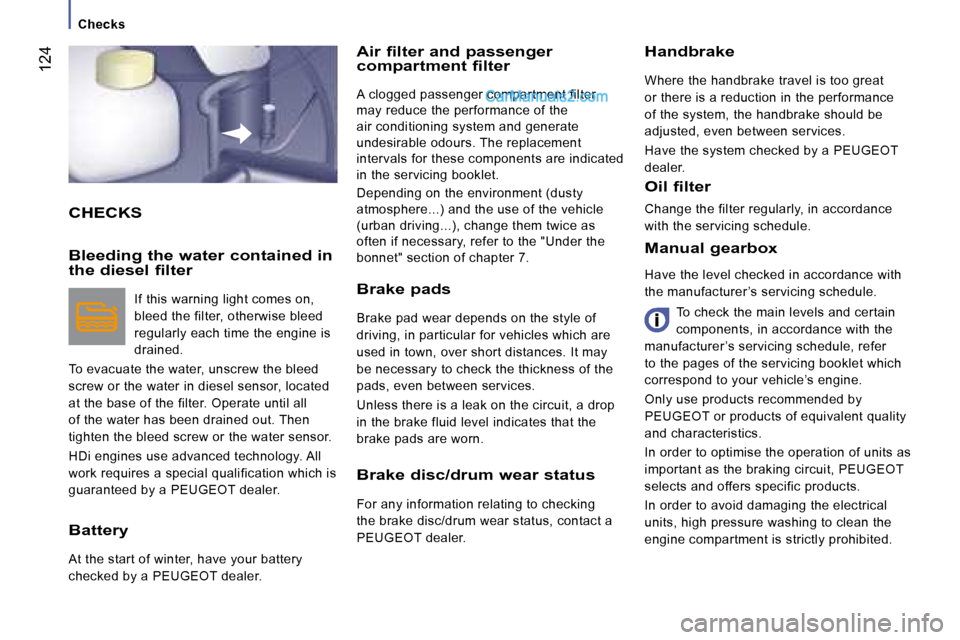
Bleeding the water contained in
the diesel filter
If this warning light comes on,
bleed the filter, otherwise bleed
regularly each time the engine is
drained.
To evacuate the water, unscrew the bleed
screw or the water in diesel sensor, located
at the base of the filter. Operate until all
of the water has been drained out. Then
tighten the bleed screw or the water sensor.
HDi engines use advanced technology. All
work requires a special qualification which is
guaranteed by a PEUGEOT dealer.
Battery
At the start of winter, have your battery
checked by a PEUGEOT dealer.
Brake pads
Brake pad wear depends on the style of
driving, in particular for vehicles which are
used in town, over short distances. It may
be necessary to check the thickness of the
pads, even between services.
Unless there is a leak on the circuit, a drop
in the brake fluid level indicates that the
brake pads are worn.
Brake disc/drum wear status
For any information relating to checking
the brake disc/drum wear status, contact a
PEUGEOT dealer.
Oil filter
Change the filter regularly, in accordance
with the servicing schedule.
Checks
Page 127 of 154

138
The three fuse boxes are placed on the
fascia panel on the passenger's side, in the
driver's pillar and in the engine.
The pliers are secured to the fuse box on
the driver's side.
Removing and fitting a fuse
Before changing a fuse, the cause of the
fault must be found and rectified. The fuse
numbers are indicated on the fuse box.
- Use the pliers.Always replace a faulty fuse with a fuse
of the same rating.
PEUGEOT will not accept responsibility for
the cost incurred in repairing your vehicle or
for rectifying malfunctions resulting from the
installation of accessories not supplied and
not recommended by PEUGEOT and not
installed in accordance with its instructions,
in particular in the case of equipment
the consumption of which exceeds
10 milliamperes.
CHANGING A FUSE
Changing a fuse
Page 128 of 154

139
TROUBLESHOOTING
8
PASSENGER'S SIDE FASCIA PANEL FUSES
- Remove the bolts and tilt the box to access the fuses.
Fuses A (amps) Allocation
12 7.5 Right-hand dipped headlamp
13 7.5 Left-hand dipped headlamp - Headlamp height adjuste r
31 7.5 Relay supply
32 10 Minibus interior lighting - Hazard warning lights
33 15 Rear 12 V socket
34 - Not used
35 7.5 Reversing lights - Water in diesel sensor
36 20 Door locking/unlocking unit
37 10 Brake lights switch - Third brake light - Instrumen t panel
38 10 Interior relays
39 10 Audio equipment - Diagnostics socket - Alarm siren - Programmable additional heating controls
40 15 De-icing: rear screen (left-hand side), mirror (pas senger side)
41 15 De-icing: rear screen (right-hand side), mirror (dr iver's side)
42 7.5 ABS control unit and sensor - ESP sensor - Brake li ghts switch
43 30 Windscreen wiper motor
44 20 Lighter - Front 12 V socket
45 7.5 Electric window and mirror switches (driver's side) - Passenger electric window
46 - Not used
47 20 Driver's electric window motor
48 20 Passenger electric window motor
49 7.5 Rain/brightness sensor - Audio equipment - Driver's electric window motor - Alarm - Instrument panel controls
50 7.5 Air bags and pre-tensioners unit
51 7.5 Chronotachograph - Cruise control - Air conditionin g controls
52 7.5 Passenger compartment relays
53 7.5 Instrument panel - Rear fog lamps Changing a fuse
Page 130 of 154
141
TROUBLESHOOTING
8
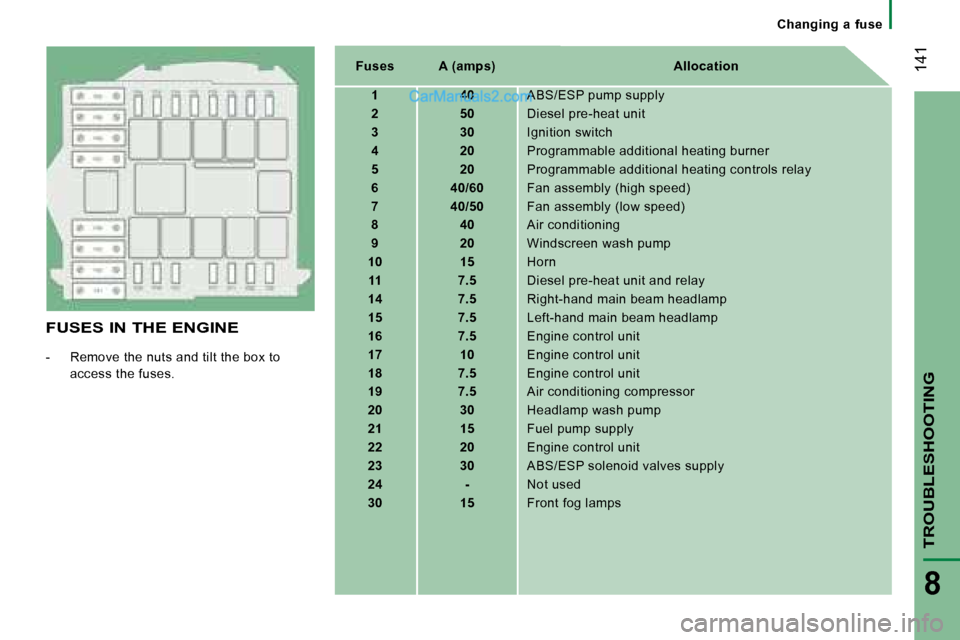
FUSES IN THE ENGINE
- Remove the nuts and tilt the box to access the fuses. Fuses A (amps) Allocation
1 40 ABS/ESP pump supply
2 50 Diesel pre-heat unit
3 30 Ignition switch
4 20 Programmable additional heating burner
5 20 Programmable additional heating controls relay
6 40/60 Fan assembly (high speed)
7 40/50 Fan assembly (low speed)
8 40 Air conditioning
9 20 Windscreen wash pump
10 15 Horn
11 7.5 Diesel pre-heat unit and relay
14 7.5 Right-hand main beam headlamp
15 7.5 Left-hand main beam headlamp
16 7.5 Engine control unit
17 10 Engine control unit
18 7.5 Engine control unit
19 7.5 Air conditioning compressor
20 30 Headlamp wash pump
21 15 Fuel pump supply
22 20 Engine control unit
23 30 ABS/ESP solenoid valves supply
24 - Not used
30 15 Front fog lamps Changing a fuse
Page 153 of 154

44
Steering wheel controls
Selecting the function - ON
When the selection is set
to ON , this switches the
function on.
If your vehicle is fitted
with this display, a message confirms the
action.
Programming a speed
Accelerate to the required speed, with 4th or
5th gear engaged.
Move the control upwards (+), for
approximately one second, to store this
speed.
Release the pressure on the accelerator
pedal, the vehicle will maintain this speed. Restore - RES
To restore the vehicle's
programmed speed (for example
after pressing the brake or clutch
pedal), gradually return to the chosen speed
and press RES.
The indicator light comes on, the cruise
control function is restored.Switching off / deactivating the
function
Press the brake or clutch pedal or place
the dial in the OFF position, the indicator
light is switched off.
If the ESP or ASR comes into operation,
the cruise control function is deactivated
temporarily.
Changing the programmed speed
while the cruise control is in operation
You can:
- increase the speed in steps, by means of brief presses, or continuously by
pressing and holding the control
upwards ( + sign),
Temporary exceeding of the speed
When the cruise control is active, it is
still possible to exceed the programmed
speed by pressing the accelerator pedal (to
overtake another vehicle for example).
- decrease the speed continuously
by pressing and holding the control
downwards (- sign).