2008 NISSAN TITAN lock
[x] Cancel search: lockPage 56 of 408
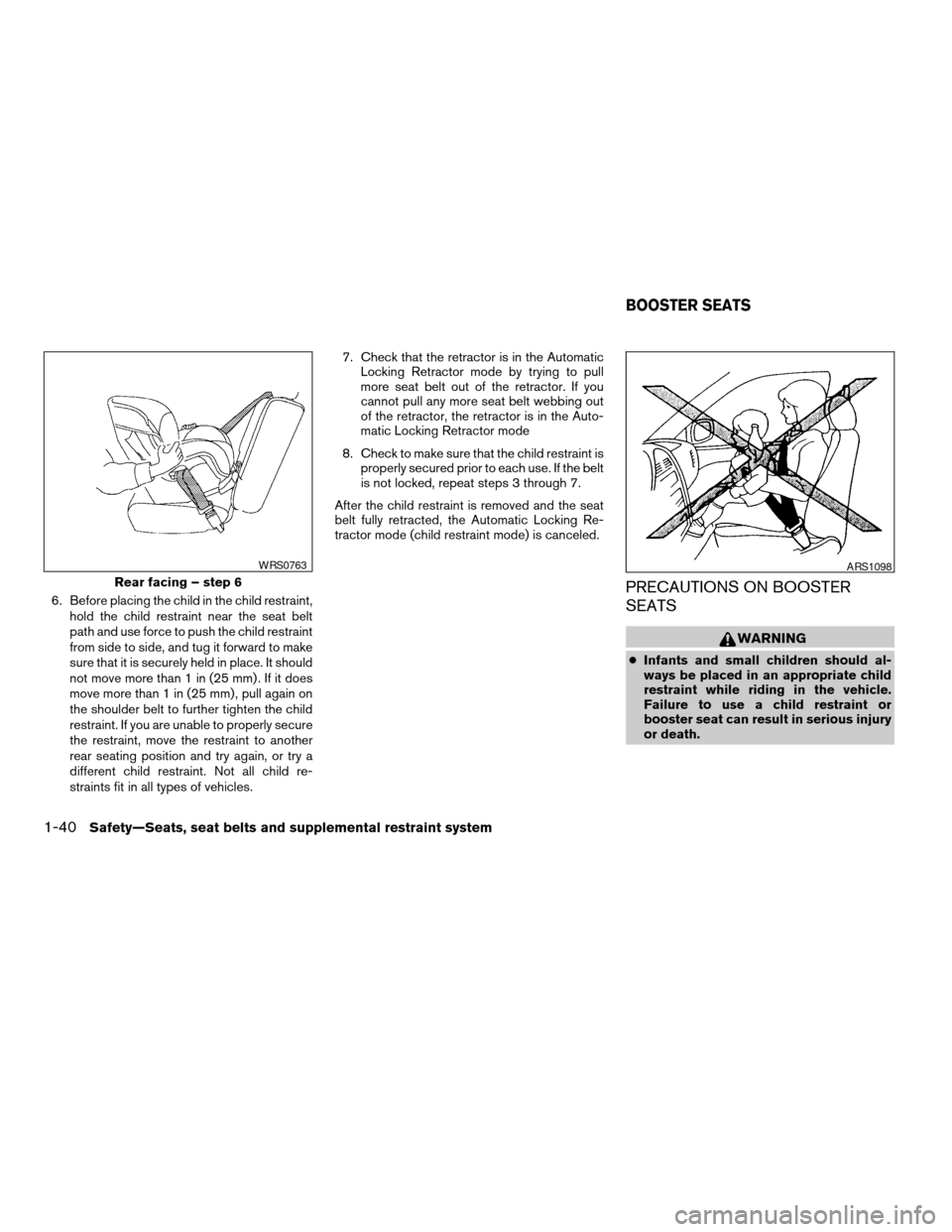
6. Before placing the child in the child restraint,
hold the child restraint near the seat belt
path and use force to push the child restraint
from side to side, and tug it forward to make
sure that it is securely held in place. It should
not move more than 1 in (25 mm) . If it does
move more than 1 in (25 mm) , pull again on
the shoulder belt to further tighten the child
restraint. If you are unable to properly secure
the restraint, move the restraint to another
rear seating position and try again, or try a
different child restraint. Not all child re-
straints fit in all types of vehicles.7. Check that the retractor is in the Automatic
Locking Retractor mode by trying to pull
more seat belt out of the retractor. If you
cannot pull any more seat belt webbing out
of the retractor, the retractor is in the Auto-
matic Locking Retractor mode
8. Check to make sure that the child restraint is
properly secured prior to each use. If the belt
is not locked, repeat steps 3 through 7.
After the child restraint is removed and the seat
belt fully retracted, the Automatic Locking Re-
tractor mode (child restraint mode) is canceled.PRECAUTIONS ON BOOSTER
SEATS
WARNING
cInfants and small children should al-
ways be placed in an appropriate child
restraint while riding in the vehicle.
Failure to use a child restraint or
booster seat can result in serious injury
or death.
Rear facing – step 6
WRS0763ARS1098
BOOSTER SEATS
1-40Safety—Seats, seat belts and supplemental restraint system
ZREVIEW COPYÐ2008 Titan(tzw)
Owners ManualÐUSA_English(nna)
03/05/07Ðtbrooks
X
Page 59 of 408
BOOSTER SEAT INSTALLATION
WARNING
NISSAN recommends that booster seats
be installed in the rear seat. However, if
you must install a booster seat in the front
passenger seat, move the passenger’s
seat to the rearmost position.
CAUTION
Do not use the lap/shoulder belt auto-
matic locking retractor mode when using
a booster seat with the seat belts.
Follow these steps to install a booster seat in the
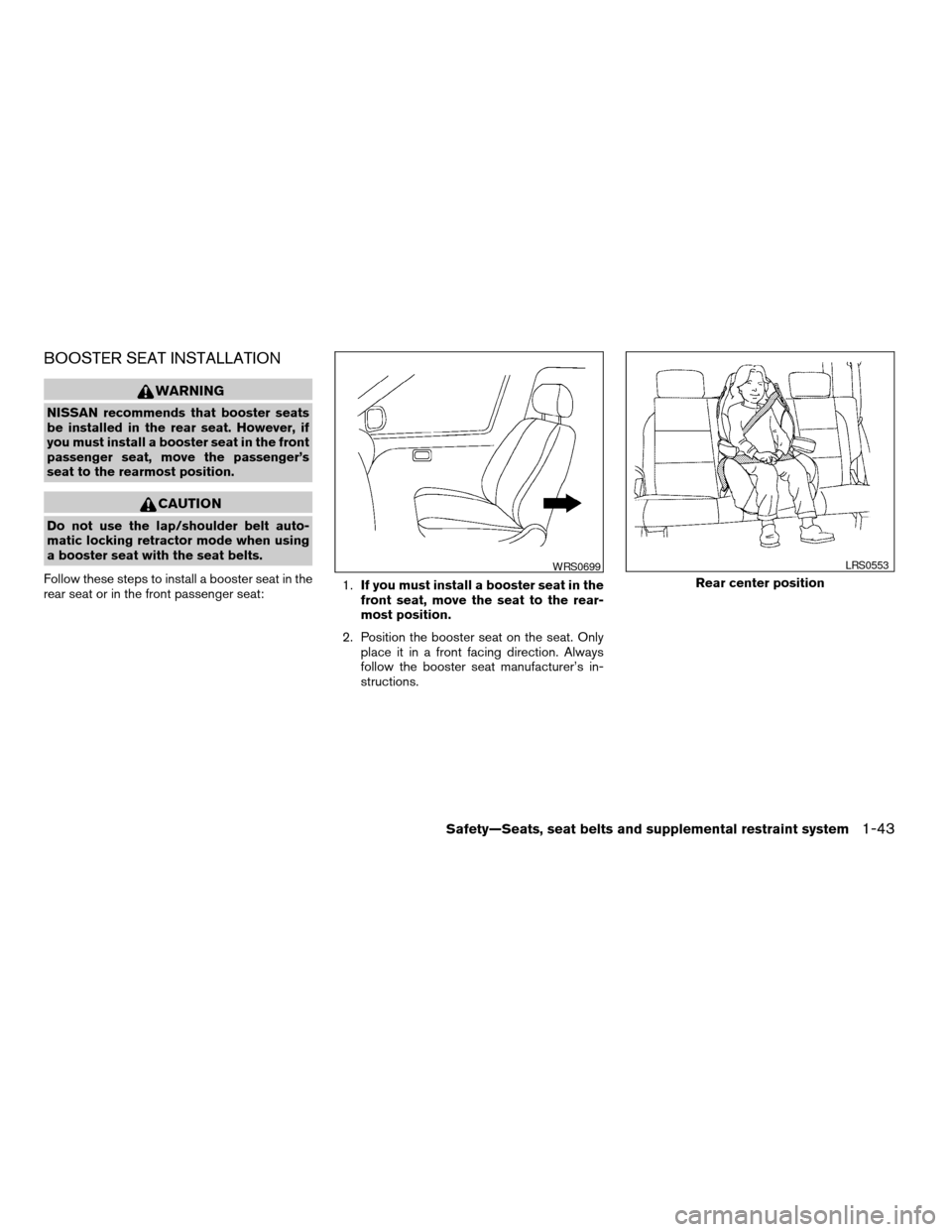
rear seat or in the front passenger seat:1.If you must install a booster seat in the
front seat, move the seat to the rear-
most position.
2. Position the booster seat on the seat. Only
place it in a front facing direction. Always
follow the booster seat manufacturer’s in-
structions.
WRS0699
Rear center position
LRS0553
Safety—Seats, seat belts and supplemental restraint system1-43
ZREVIEW COPYÐ2008 Titan(tzw)
Owners ManualÐUSA_English(nna)
03/05/07Ðtbrooks
X
Page 70 of 408
Front passenger air bag and status light
WARNING
The right front passenger air bag is de-
signed to automatically turn OFF under
some conditions. Read this section care-
fully to learn how it operates. Proper use
of the seat, seat belt and child restraints is
necessary for most effective protection.
Failure to follow all instructions in this
manual concerning the use of seats, seat
belts and child restraints can increase the
risk or severity of injury in an accident.Status light
The right front passenger air bag status
light
is located under the climate controls.
The light operates as follows:
cUnoccupied passenger’s seat: The
is
OFF and the front passenger air bag is OFF
and will not inflate in a crash.
cPassenger’s seat occupied by a small adult,
child or child restraint as outlined in this
section: The
illuminates to indicate
that the front passenger air bag is OFF and
will not inflate in a crash.
cOccupied passenger seat and the passen-
ger meets the conditions outlined in this
section: The light
is OFF to indicate
that the front passenger air bag is opera-
tional.
Front passenger air bag
The right front passenger air bag is designed to
automatically turn OFF when the vehicle is oper-
ated under some conditions as described below
in accordance with U.S. regulations. If the front
passenger air bag is OFF, it will not inflate in a
crash. The driver air bag and other air bags in your
vehicle are not part of this system.
The purpose of the regulation is to help reduce
the risk of injury or death from an inflating air bagto certain front passenger seat occupants, such
as children, by requiring the air bag to be auto-
matically turned OFF. Certain sensors are used
to meet the requirements.
One sensor used is the occupant classification
sensor (pressure sensor) . It is in the bottom of the
right front passenger seat cushion and is de-
signed to detect an occupant and objects on the
right front seat by weight. It works together with
seat belt sensors described later. For example, if
a child is in the right front passenger seat, the
advanced air bag system is designed to turn the
passenger air bag OFF in accordance with the
regulations. Also, if a child restraint of the type
specified in the regulations is on the seat, its
weight and the child’s weight can be detected
and cause the air bag to turn OFF. Occupant
classification sensor operation can vary depend-
ing on the right front passenger seat belt sensors.
The right front passenger seat belt sensors are
designed to detect if the seat belt is buckled and
the amount of tension on the seat belt, such as
when it is in the Automatic Locking Retractor
mode (child restraint mode) . Based on the
weight on the seat detected by the occupant
classification sensor and the belt tension de-
tected on the seat belt, the advanced air bag
system determines whether the front passenger
air bag should be automatically turned OFF as
required by the regulations.
LRS0316
1-54Safety—Seats, seat belts and supplemental restraint system
ZREVIEW COPYÐ2008 Titan(tzw)
Owners ManualÐUSA_English(nna)
03/05/07Ðtbrooks
X
Page 71 of 408

Right front passenger seat adult occupants who
are properly seated and using the seat belt as
outlined in this manual should not cause the
passenger air bag to be automatically turned
OFF. For small adults it may be turned OFF;
however, if the occupant takes his/her weight off
the seat cushion (for example, by not sitting up-
right, by sitting on an edge of the seat, or by
otherwise being out of position) , this could cause
the sensor to turn the air bag OFF. In addition, if
the occupant improperly uses the right front seat
belt in the Automatic Locking Retractor mode
(child restraint mode) , this could cause the air
bag to be turned OFF. Always be sure to be
seated and wearing the seat belt properly for the
most effective protection by the seat belt and
supplemental air bag.
NISSAN recommends that pre-teens and chil-
dren be properly restrained in a rear seat.
NISSAN also recommends that appropriate child
restraints and booster seats be properly installed
in a rear seat. If this is not possible, the occupant
classification sensor and seat belt sensors are
designed to operate as described above to turn
the front passenger air bag OFF for specified
child restraints as required by the regulations.
Failing to properly secure child restraints and to
use the Automatic Locking Retractor mode (child
restraint mode) may allow the restraint to tip or
move in an accident or sudden stop. This canalso result in the passenger air bag inflating in a
crash instead of being OFF. See “Child re-
straints” earlier in this section for proper use and
installation.
If the right front passenger seat is not occupied
the passenger air bag is designed not to inflate in
a crash. However, heavy objects placed on the
seat could result in air bag inflation, because of
the object’s weight detected by the occupant
classification sensor. Other conditions could also
result in air bag inflation, such as if a child is
standing on the seat, or if two children are on the
seat, contrary to the instructions in this manual.
Always be sure that you and all vehicle occupants
are seated and restrained properly.
Using the passenger air bag status light, you can
monitor when the front passenger air bag is au-
tomatically turned OFF with the seat occupied.
The light will not illuminate when the right front
passenger seat is unoccupied.
If an adult occupant is in the seat but the passen-
ger air bag status light is illuminated (indicating
that the air bag is OFF) , it could be that the
person is a small adult, or is not sitting on the seat
properly or not using the seat belt properly.
If a child restraint must be used in the front seat,
the passenger air bag status light may or may not
be illuminated, depending on the size of the child
and the type of child restraint being used. If the airbag status light is not illuminated (indicating that
the air bag might inflate in a crash) , it could be
that the child restraint or seat belt is not being
used properly. Make sure that the child restraint is
installed properly, the seat belt is used properly
and the occupant is positioned properly. If the air
bag status light is not illuminated, reposition the
occupant or child restraint in a rear seat.
If the passenger air bag status light will not illu-
minate even though you believe that the child
restraint, the seat belts and the occupant are
properly positioned, the system may be sensing
an unoccupied seat (in which case the air bag is
OFF) . Your NISSAN dealer can check that the
system is OFF by using a special tool. However,
until you have confirmed with your dealer that
your air bag is working properly, reposition the
occupant or child restraint in a rear seat.
The air bag system and passenger air bag status
light will take a few seconds to register a change
in the passenger seat status. For example, if a
large adult who is sitting in the front passenger
seat exits the vehicle, the passenger air bag
status light will go from OFF to ON for a few
seconds and then to OFF. This is normal system
operation and does not indicate a malfunction.
If a malfunction occurs in the front passenger air
bag system, the supplemental air bag warning
light
, located in the meter and gauges area
Safety—Seats, seat belts and supplemental restraint system1-55
ZREVIEW COPYÐ2008 Titan(tzw)
Owners ManualÐUSA_English(nna)
03/05/07Ðtbrooks
X
Page 77 of 408
When the ignition key is in the ON or START
position, the supplemental air bag warning light
illuminates for about 7 seconds and then turns
off. This means the system is operational.
If any of the following conditions occur, the
supplemental front air bag, front seat-mounted
side-impact supplemental air bag, roof-mounted
curtain side-impact and rollover supplemental air
bag and pretensioner systems need servicing:
cThe supplemental air bag warning light re-
mains on after approximately 7 seconds.
cThe supplemental air bag warning light
flashes intermittently.
cThe supplemental air bag warning light does
not come on at all.
Under these conditions, the supplemental front
air bag, front seat-mounted side-impact supple-
mental air bags and roof-mounted curtain side-
impact and rollover supplemental air bag or pre-
tensioner systems may not operate properly. It
must be checked and repaired. Take your vehicle
to the nearest NISSAN dealer.WARNING
If the supplemental air bag warning light
is on, it could mean that the supplemental
front air bag, front seat-mounted side-
impact supplemental air bag, roof-
mounted curtain side-impact and rollover
supplemental air bag systems and/or pre-
tensioner systems will not operate in an
accident. To help avoid injury to yourself
or others, have your vehicle checked by a
NISSAN dealer as soon as possible.
Repair and replacement procedure
The supplemental front air bags, front seat-
mounted side-impact supplemental air bags,
roof-mounted curtain side-impact and rollover
supplemental air bags and seat belts with preten-
sioner are designed to inflate on a one-time-only
basis. As a reminder, unless it is damaged, the
supplemental air bag warning light remains illu-
minated after inflation has occurred. Repair and
replacement of these supplemental air bag sys-
tems should be done only by a NISSAN dealer.
When maintenance work is required on the ve-
hicle, the supplemental front air bags, front seat-
mounted side-impact supplemental air bags,
roof-mounted curtain side-impact and rollover
supplemental air bags, seat belts pretensioners
and related parts should be pointed out to theperson performing the maintenance. The ignition
key should always be in the LOCK position when
working under the hood or inside the vehicle.
WARNING
cOnce a supplemental front air bag, front
seat-mounted side-impact supplemen-
tal air bags, roof-mounted curtain side-
impact and rollover supplemental air
bag has inflated, the air bag module will
not function again and must be re-
placed. Additionally, if any of the
supplemental front air bags inflate, the
activated seat belts with pretensioners
must also be replaced. The air bag mod-
ule and seat belts with pretensioners
should be replaced by a NISSAN dealer.
The air bag module and seat belts with
pretensioners cannot be repaired.
cThe supplemental front air bag, roof-
mounted curtain side-impact and roll-
over supplemental air bag systems, and
the seat belts with pretensioners
should be inspected by a NISSAN
dealer if there is any damage to the
front end or side portion of the vehicle.
Safety—Seats, seat belts and supplemental restraint system1-61
ZREVIEW COPYÐ2008 Titan(tzw)
Owners ManualÐUSA_English(nna)
03/06/07Ðtbrooks
X
Page 80 of 408

2 Instruments and controls
Instrument panel...................................2-2
Meters and gauges................................2-4
Speedometer and odometer.....................2-5
Tachometer....................................2-6
Engine coolant temperature gauge...............2-6
Fuel gauge....................................2-7
Engine oil pressure gauge.......................2-7
Voltmeter......................................2-8
Automatic transmission fluid temperature
gauge (if so equipped)..........................2-8
Compass and outside temperature display
(if so equipped)...................................2-9
Outside temperature display.....................2-9
Compass display..............................2-10
Warning/indicator lights and audible reminders......2-13
Checking bulbs...............................2-13
Warning lights................................2-13
Indicator lights................................2-18
Audible reminders.............................2-20
Vehicle Information Display........................2-21
How to use the Vehicle Information Display.......2-21
Security systems (if so equipped)..................2-27
Vehicle security system.........................2-27NISSAN vehicle immobilizer system.............2-28
Windshield wiper and washer switch...............2-29
Switch operation..............................2-29
Rear window and outside mirror defroster switch
(if so equipped)..................................2-30
Headlight and turn signal switch....................2-31
Headlight control switch........................2-31
Daytime running light system (Canada only)......2-33
Instrument brightness control...................2-34
Turn signal switch.............................2-34
Fog light switch (if so equipped)................2-35
Hazard warning flasher switch.....................2-35
Cargo lamp switch...............................2-36
Horn............................................2-36
Heated seat (if so equipped).......................2-36
Vehicle dynamic control (VDC) off switch
(if so equipped)..................................2-37
Electronic locking rear differential (E-Lock) system
switch (if so equipped)............................2-37
Rear sonar system off switch (if so equipped)........2-38
Tow mode switch.................................2-39
Power outlet.....................................2-39
Cigarette lighter..................................2-41
ZREVIEW COPYÐ2008 Titan(tzw)
Owners ManualÐUSA_English(nna)
03/06/07Ðtbrooks
X
Page 81 of 408

Storage.........................................2-42
Instrument panel storage trays..................2-42
Console box (if so equipped)...................2-42
Center armrest storage (if so equipped)..........2-44
Glove box....................................2-44
Sunglasses holder (if so equipped)..............2-45
Map pockets..................................2-45
Seatback pocket (if so equipped)...............2-46
Overhead console (if so equipped)..............2-46
Cup holders..................................2-47
Grocery hooks (if so equipped).................2-49
Lockable bedside storage compartment
(if so equipped)...............................2-50
Windows........................................2-50
Power windows (if so equipped)................2-50
Manual windows..............................2-53
Rear sliding window (if so equipped)............2-53Rear power window switch (if so equipped)......2-53
Sunroof (if so equipped)...........................2-54
Automatic sunroof.............................2-54
Interior light......................................2-55
Console light (if so equipped)...................2-56
Personal lights (if so equipped)....................2-57
Map lights (if so equipped)........................2-57
HomeLinkTuniversal transceiver (if so equipped).....2-57
Programming HomeLinkT.......................2-58
Programming HomeLinkTfor Canadian
customers....................................2-59
Operating the HomeLinkTuniversal
transceiver....................................2-59
Programming trouble-diagnosis.................2-60
Clearing the programmed information............2-60
Reprogramming a single HomeLinkTbutton......2-60
If your vehicle is stolen.........................2-60
ZREVIEW COPYÐ2008 Titan(tzw)
Owners ManualÐUSA_English(nna)
03/06/07Ðtbrooks
X
Page 83 of 408

17. Power outlet/Cigarette lighter
(accessory) (P. 2-39/P. 2-41)
18. Heated seat switch (if so equipped)
(P. 2-36)
19. Storage compartment (P. 2-42)
20. Vehicle dynamic control (VDC) off
switch (if so equipped) (P. 2-37)
21. Tow mode switch (P. 2-39)
22. Electronic locking rear differential
(E-Lock) system switch (if so
equipped) (P.2-37)
23. Shift selector lever (console)
(if so equipped) (P. 5-11)
24. Hazard warning flasher switch (P. 2-35)
25. Front passenger air bag status light
(P. 1-54)
26. Power outlet (P. 2-39)
27. 4WD shift switch (if so equipped)
(P. 5-24)
28. Shift selector lever (column)
(if so equipped) (P. 5-11)
29. Tilt steering wheel control (P. 3-12)
30. Cargo lamp switch (P. 2-36)
31. Rear sonar system off switch
(if so equipped) (P. 2-38)
32. Pedal position adjustment switch
(if so equipped) (P. 3-12)33. Rear power window switch
(if so equipped) (P. 2-53)
*: Refer to the separate Navigation System Own-
er’s Manual (if so equipped) .
See the page number indicated in paren-
theses for operating details.
Instruments and controls2-3
ZREVIEW COPYÐ2008 Titan(tzw)
Owners ManualÐUSA_English(nna)
03/06/07Ðtbrooks
X