2008 NISSAN ROGUE warning
[x] Cancel search: warningPage 247 of 309
Black plate (254,1)
Model "S35-D" EDITED: 2007/ 12/ 19
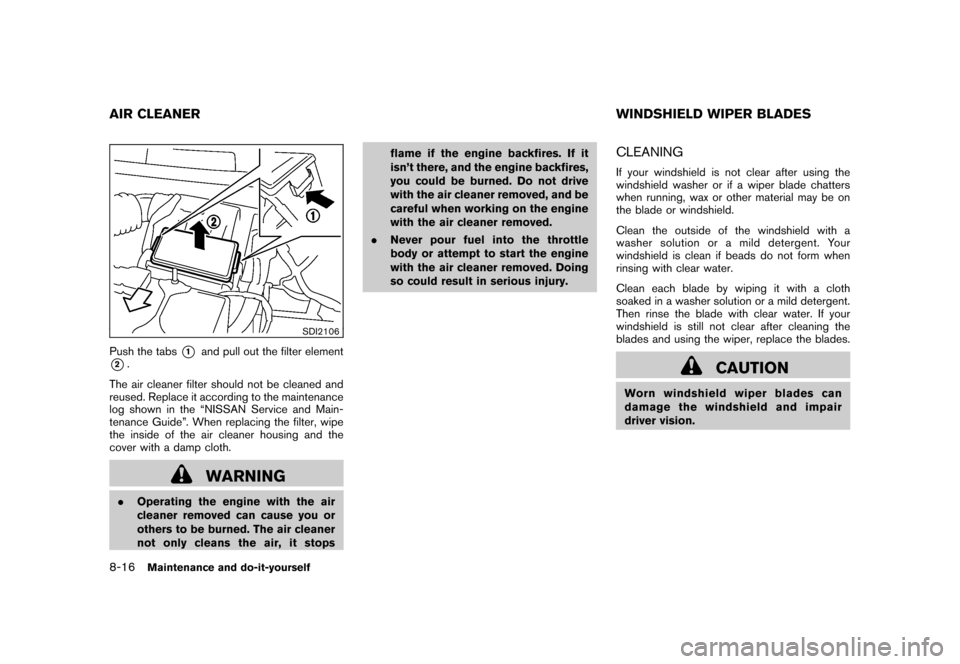
SDI2106
Push the tabs
*1
and pull out the filter element
*2.
The air cleaner filter should not be cleaned and
reused. Replace it according to the maintenance
log shown in the “NISSAN Service and Main-
tenance Guide”. When replacing the filter, wipe
the inside of the air cleaner housing and the
cover with a damp cloth.
WARNING
.Operating the engine with the air
cleaner removed can cause you or
others to be burned. The air cleaner
not only cleans the air, it stopsflame if the engine backfires. If it
isn’t there, and the engine backfires,
you could be burned. Do not drive
with the air cleaner removed, and be
careful when working on the engine
with the air cleaner removed.
.Never pour fuel into the throttle
body or attempt to start the engine
with the air cleaner removed. Doing
so could result in serious injury.
CLEANINGIf your windshield is not clear after using the
windshield washer or if a wiper blade chatters
when running, wax or other material may be on
the blade or windshield.
Clean the outside of the windshield with a
washer solution or a mild detergent. Your
windshield is clean if beads do not form when
rinsing with clear water.
Clean each blade by wiping it with a cloth
soaked in a washer solution or a mild detergent.
Then rinse the blade with clear water. If your
windshield is still not clear after cleaning the
blades and using the wiper, replace the blades.
CAUTION
Worn windshield wiper blades can
damage the windshield and impair
driver vision.
AIR CLEANER WINDSHIELD WIPER BLADES8-16
Maintenance and do-it-yourself
Page 249 of 309
Black plate (256,1)
Model "S35-D" EDITED: 2007/ 12/ 19
Contact a NISSAN dealer if checking or
replacement is required.If the brakes do not operate properly, have the
brakes checked by a NISSAN dealer.
SELF-ADJUSTING BRAKESYour vehicle is equipped with self-adjusting
brakes.
The disc-type brakes self-adjust every time the
brake pedal is applied.
WARNING
See a NISSAN dealer for a brake
system check if the brake pedal height
does not return to normal.BRAKE PAD WEAR INDICATORSThe disc brake pads on your vehicle have
audible wear indicators. When a brake pad
requires replacement, it will make a high pitched
scraping or screeching sound when the vehicle
is in motion. The sound will be heard whether or
not the brake pedal is depressed. Have the
brakes checked as soon as possible if the wear
indicator sound is heard.
Under some driving or climate conditions,
occasional brake squeak, squeal or other noise
may be heard. Occasional brake noise during
light to moderate stops is normal and does not
affect the function or performance of the brake
system.Proper brake inspection intervals should
be followed.For additional information, see the
maintenance log section of your “NISSAN
Service and Maintenance Guide”.
REAR WINDOW WIPER BLADE BRAKES8-18
Maintenance and do-it-yourself
Page 256 of 309
Black plate (263,1)
Model "S35-D" EDITED: 2007/ 12/ 19
HEADLIGHTSFog may temporarily form inside the lens of the
exterior lights in the rain or in a car wash. A
temperature difference between the inside and
the outside of the lens causes the fog. This is
not a malfunction. If large drops of water collect
inside the lens, contact a NISSAN dealer.ReplacingXenon headlight bulb:
WARNINGHIGH VOLTAGE
When xenon headlights are on, they
produce a high voltage. To prevent an
electric shock, never attempt to modify
or disassemble. Always have your xe-
non headlights replaced at a NISSAN
dealer. For additional information, see
“HEADLIGHT AND TURN SIGNAL
SWITCH” in the “2. Instruments and
controls” section.
If replacement is required, see a NISSAN dealer.
CAUTION
Use the same number and wattage as
originally installed:
Low beam:
Wattage: 35
Bulb no.: D2R
High beam:
Wattage: 60
Bulb no.: HB3
Halogen headlight bulb:
The headlight is a semi-sealed beam type which
uses a replaceable headlight (halogen) bulb.
CAUTION
.Do not leave the bulb out of the
headlight reflector for a long period
of time. Dust, moisture, smoke, etc.
entering the headlight body may
affect bulb performance.
.High pressure halogen gas is sealed
inside the halogen bulb. The bulb
may break if the glass envelope is
scratched or the bulb is dropped.
.Only touch the plastic base whenhandling the bulb. Never touch the
glass envelope.
.Use the same number and wattage
as originally installed:
Low beam:
Wattage: 55
Bulb no.: H11
High beam:
Wattage: 60
Bulb no.: HB3
.Aiming is not necessary after repla-
cing the bulb. When aiming adjust-
ment is necessary, contact a
NISSAN dealer.
Maintenance and do-it-yourself
8-25
Page 261 of 309
Black plate (268,1)
Model "S35-D" EDITED: 2007/ 12/ 19
If you have a flat tire, see “FLAT TIRE” in
the “6. In case of emergency” section.TIRE PRESSURE
Tire Pressure Monitoring System (TPMS)This vehicle is equipped with the Tire Pressure
Monitoring System (TPMS) . It monitors tire
pressure of all tires except the spare. When
the low tire pressure warning light is lit, one or
more of your tires is significantly under-inflated.
The TPMS will activate only when the vehicle is
driven at speeds above 16 MPH (25 km/h) .
Also, this system may not detect a sudden drop
in tire pressure (for example a flat tire while
driving) .
For more details, see “Low tire pressure warning
light” in the “2. Instruments and controls”
section, “TIRE PRESSURE MONITORING SYS-
TEM (TPMS)” in the “5. Starting and driving”
section and “TIRE PRESSURE MONITORING
SYSTEM (TPMS)” in the “6. In case of
emergency” section.Tire inflation pressureCheck the pressure of the tires (including
the spare) often and always prior to long
distance trips. The recommended tire
pressure specifications are shown on the
Tire and Loading Information label under
the “Cold Tire Pressure” heading. The Tireand Loading Information label is affixed to
the driver side center pillar. Tire pressures
should be checked regularly because:
.
Most tires naturally lose air over time.
.
Tires can lose air suddenly when driven
over potholes or other objects or if the
vehicle strikes a curb while parking.
The tire pressures should be checked
when the tires are cold. The tires are
considered COLD after the vehicle has
been parked for 3 or more hours, or driven
less than 1 mile (1.6 km) at moderate
speeds.
Incorrect tire pressure, including un-
der inflation, may adversely affect tire
life and vehicle handling.
WARNING
.
Improperly inflated tires can fail
suddenly and cause an accident.
.
The Gross Vehicle Weight rating
(GVWR) is located on the F.M.V.
S.S./C.M.V.S.S. certification la-
bel. The vehicle weight capacity
is indicated on the Tire and
Loading Information label. Donot load your vehicle beyond
this capacity. Overloading your
vehicle may result in reduced
tire life, unsafe operating condi-
tions due to premature tire fail-
ure, or unfavorable handling
characteristics and could also
lead to a serious accident. Load-
ing beyond the specified capa-
city may also result in failure of
other vehicle components.
.
Before taking a long trip, or
whenever you heavily load your
vehicle, use a tire pressure
gauge to ensure that the tire
pressures are at the specified
level.
.
Do not drive your vehicle over 85
MPH (137 km/h) unless it is
equipped with high speed rated
tires. Driving faster than 85 MPH
(137 km/h) may result in tire
failure, loss of control and pos-
sible injury.
.
For additional information re-
garding tires, refer to “Important
Tire Safety Information” (US) or
“Tire Safety Information” (Cana-
WHEELS AND TIRES8-30
Maintenance and do-it-yourself
Page 266 of 309
Black plate (273,1)
Model "S35-D" EDITED: 2007/ 12/ 19
tire.
*6
Term of “tubeless” or “tube type”
Indicates whether the tire requires an
inner tube (“tube type”) or not
(“tubeless”) .
*7
The word “radial”
The word “radial” is shown, if the tire
has radial structure.
*8
Manufacturer or brand name
Manufacturer or brand name is
shown.
Other tire-related terminology:
In addition to the many terms that are
defined throughout this section, Intended
Outboard Sidewall is (1) the sidewall that
contains a whitewall, bears white lettering
or bears manufacturer, brand and/or model
name molding that is higher or deeper than
the same molding on the other sidewall of
the tire, or (2) the outward facing sidewall
of an asymmetrical tire that has a particular
side that must always face outward when
mounted on a vehicle.
TYPES OF TIRES
WARNING
.When changing or replacing tires,
be sure all four tires are of the same
type (Example: Summer, All Season
or Snow) and construction. A
NISSAN dealer may be able to help
you with information about tire type,
size, speed rating and availability.
.Replacement tires may have a lower
speed rating than the factory
equipped tires, and may not match
the potential maximum vehicle
speed. Never exceed the maximum
speed rating of the tire.
.Replacing tires with those not ori-
ginally specified by NISSAN could
affect the proper operation of the
TPMS.
.For additional information regard-
ing tires, refer to “Important Tire
Safety Information” (US) or “Tire
Safety Information” (Canada) in the
Warranty Information Booklet.
All season tiresNISSAN specifies all season tires on some
models to provide good performance all year,
including snowy and icy road conditions. All
Season tires are identified by ALL SEASON
and/or M&S (Mud and Snow) on the tire
sidewall. Snow tires have better snow traction
than All Season tires and may be more appro-
priate in some areas.Summer tiresNISSAN specifies summer tires on some
models to provide superior performance on dry
roads. Summer tire performance is substantially
reduced in snow and ice. Summer tires do not
have the tire traction rating M&S on the tire
sidewall.
If you plan to operate your vehicle in snowy or
icy conditions, NISSAN recommends the use of
SNOW tires or ALL SEASON tires on all four
wheels.Snow tiresIf snow tires are needed, it is necessary to select
tires equivalent in size and load rating to the
original equipment tires. If you do not, it can
adversely affect the safety and handling of your
vehicle.
Generally, snow tires will have lower speed
ratings than factory equipped tires and may not
match the potential maximum vehicle speed.
Maintenance and do-it-yourself
8-35
Page 268 of 309
Black plate (275,1)
Model "S35-D" EDITED: 2007/ 12/ 19
SDI1662
CHANGING WHEELS AND TIRES
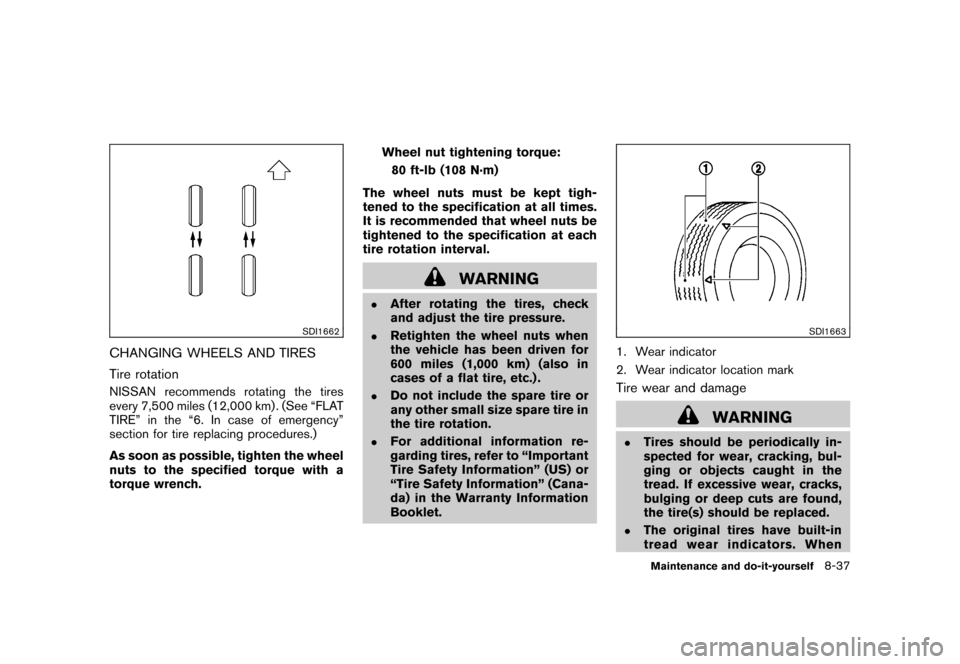
Tire rotationNISSAN recommends rotating the tires
every 7,500 miles (12,000 km) . (See “FLAT
TIRE” in the “6. In case of emergency”
section for tire replacing procedures.)
As soon as possible, tighten the wheel
nuts to the specified torque with a
torque wrench.Wheel nut tightening torque:
80 ft-lb (108 N·m)
The wheel nuts must be kept tigh-
tened to the specification at all times.
It is recommended that wheel nuts be
tightened to the specification at each
tire rotation interval.
WARNING
.
After rotating the tires, check
and adjust the tire pressure.
.
Retighten the wheel nuts when
the vehicle has been driven for
600 miles (1,000 km) (also in
cases of a flat tire, etc.) .
.
Do not include the spare tire or
any other small size spare tire in
the tire rotation.
.
For additional information re-
garding tires, refer to “Important
Tire Safety Information” (US) or
“Tire Safety Information” (Cana-
da) in the Warranty Information
Booklet.
SDI1663
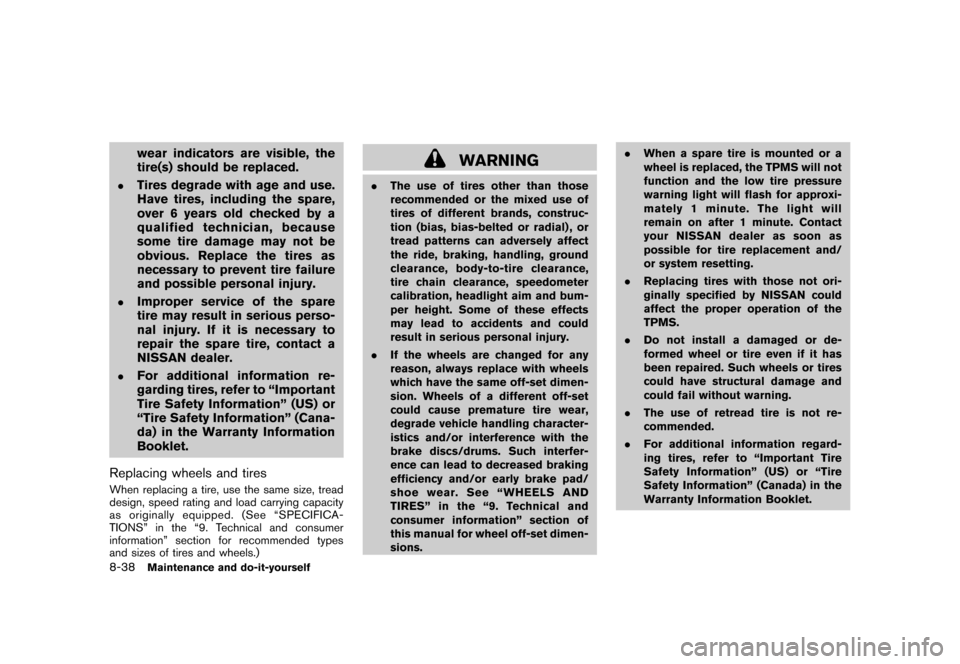
1. Wear indicator
2. Wear indicator location markTire wear and damage
WARNING
.
Tires should be periodically in-
spected for wear, cracking, bul-
ging or objects caught in the
tread. If excessive wear, cracks,
bulging or deep cuts are found,
the tire(s) should be replaced.
.
The original tires have built-in
tread wear indicators. WhenMaintenance and do-it-yourself
8-37
Page 269 of 309
Black plate (276,1)
Model "S35-D" EDITED: 2007/ 12/ 19
wear indicators are visible, the
tire(s) should be replaced.
.
Tires degrade with age and use.
Have tires, including the spare,
over 6 years old checked by a
qualified technician, because
some tire damage may not be
obvious. Replace the tires as
necessary to prevent tire failure
and possible personal injury.
.
Improper service of the spare
tire may result in serious perso-
nal injury. If it is necessary to
repair the spare tire, contact a
NISSAN dealer.
.
For additional information re-
garding tires, refer to “Important
Tire Safety Information” (US) or
“Tire Safety Information” (Cana-
da) in the Warranty Information
Booklet.
Replacing wheels and tiresWhen replacing a tire, use the same size, tread
design, speed rating and load carrying capacity
as originally equipped. (See “SPECIFICA-
TIONS” in the “9. Technical and consumer
information” section for recommended types
and sizes of tires and wheels.)
WARNING
.The use of tires other than those
recommended or the mixed use of
tires of different brands, construc-
tion (bias, bias-belted or radial) , or
tread patterns can adversely affect
the ride, braking, handling, ground
clearance, body-to-tire clearance,
tire chain clearance, speedometer
calibration, headlight aim and bum-
per height. Some of these effects
may lead to accidents and could
result in serious personal injury.
.If the wheels are changed for any
reason, always replace with wheels
which have the same off-set dimen-
sion. Wheels of a different off-set
could cause premature tire wear,
degrade vehicle handling character-
istics and/or interference with the
brake discs/drums. Such interfer-
ence can lead to decreased braking
efficiency and/or early brake pad/
shoe wear. See “WHEELS AND
TIRES” in the “9. Technical and
consumer information” section of
this manual for wheel off-set dimen-
sions..When a spare tire is mounted or a
wheel is replaced, the TPMS will not
function and the low tire pressure
warning light will flash for approxi-
mately 1 minute. The light will
remain on after 1 minute. Contact
your NISSAN dealer as soon as
possible for tire replacement and/
or system resetting.
.Replacing tires with those not ori-
ginally specified by NISSAN could
affect the proper operation of the
TPMS.
.Do not install a damaged or de-
formed wheel or tire even if it has
been repaired. Such wheels or tires
could have structural damage and
could fail without warning.
.The use of retread tire is not re-
commended.
.For additional information regard-
ing tires, refer to “Important Tire
Safety Information” (US) or “Tire
Safety Information” (Canada) in the
Warranty Information Booklet.
8-38
Maintenance and do-it-yourself
Page 270 of 309
Black plate (277,1)
Model "S35-D" EDITED: 2007/ 12/ 19
CAUTION
Always use tires of the same type, size,
brand, construction (bias, bias-belted
or radial) , and tread pattern on all four
wheels. Failure to do so may result in a
circumference difference between tires
on the front and rear axles which will
cause excessive tire wear and may
damage the transmission, transfer case
and differential gears (AWD models) .Wheel balanceUnbalanced wheels may affect vehicle handling
and tire life. Even with regular use, wheels can
get out of balance. Therefore, they should be
balanced as required.
Wheel balance service should be per-
formed with the wheels off the vehicle.
Spin balancing the wheels on the vehicle
could lead to mechanical damage.
For additional information regarding tires, refer
to “Important Tire Safety Information” (US) or
“Tire Safety Information” (Canada) in the War-
ranty Information Booklet.Care of wheels.Wash the wheels when washing the vehicle
to maintain their appearance..Clean the inner side of the wheels when the
wheel is changed or the underside of the
vehicle is washed.
.Do not use abrasive cleaners when washing
the wheels.
.Inspect wheel rims regularly for dents or
corrosion. Such damage may cause loss of
pressure or poor seal at the tire bead.
.NISSAN recommends that the road wheels
be waxed to protect against road salt in
areas where it is used during winter.
Spare tireWhen a spare tire is mounted (TEMPORARY
USE ONLY or conventional) , the TPMS will not
function.
Observe the following precautions if the TEM-
PORARY USE ONLY spare tire must be used,
otherwise your vehicle could be damaged or
involved in an accident.
WARNING
.The TEMPORARY USE ONLY spare
tire should be used for emergency
use. It should be replaced with the
standard tire at the first opportunity
to avoid possible tire or differential
damage..Drive carefully while the TEMPOR-
ARY USE ONLY spare tire is in-
stalled. Avoid sharp turns and
abrupt braking while driving.
.Periodically check spare tire infla-
tion pressure. Always keep the
pressure of the TEMPORARY USE
ONLY spare tire at 60 psi (420 kPa,
4.2 bar) . Always keep the pressure
of the full size spare tire (if so
equipped) at the recommended
pressure for standard tires, as in-
dicated on the Tire and Loading
Information label.
.With the TEMPORARY USE ONLY
spare tire installed do not drive your
vehicle at speeds faster than 50
MPH (80 km/h) .
.When driving on roads covered with
snow or ice, the TEMPORARY USE
ONLY spare tire should be used on
the rear wheels and original tire
used on the front wheels (drive
wheels) . Use tire chains only on
the front (original) tires.
.Tire tread of the TEMPORARY USE
ONLY spare tire will wear at a faster
rate than the standard tire. Replace
Maintenance and do-it-yourself
8-39