2008 NISSAN FRONTIER coolant temperature
[x] Cancel search: coolant temperaturePage 268 of 352
The engine cooling system is filled at the factory
with Genuine NISSAN Long Life
Antifreeze/Coolant to provide year-round anti-
freeze and coolant protection.The anti-freeze so-
lution contains rust and corrosion inhibitors. Ad-
ditional engine cooling system additives are not
necessary.
WARNING
cNever remove the radiator or coolant
reservoir cap when the engine is hot.
Wait until the engine and radiator cool
down. Serious burns could be caused
by high pressure fluid escaping from
the radiator. See precautions in “If your
vehicle overheats” found in the “In case
of emergency” section of this manual.
cThe radiator is equipped with a pres-
sure type radiator cap. To prevent en-
gine damage, use only a genuine
NISSAN radiator cap.
CAUTION
When adding or replacing coolant, be sure
to use only a Genuine NISSAN Long Life
Antifreeze/Coolant (green) or equivalent
with the proper mixture ratio of 50% anti-
freeze and 50% demineralized or distilled
water. The use of other types of coolant
solutions or coolant colors, such as or-
ange, may damage the engine cooling
system.
Outside temperature
down toGenuine
NISSAN
Long Life
Antifreeze/
Coolant or
equivalentDemineral-
ized or dis-
tilled water
°C °F
-35 -30 50% 50%
CHECKING ENGINE COOLANT
LEVEL
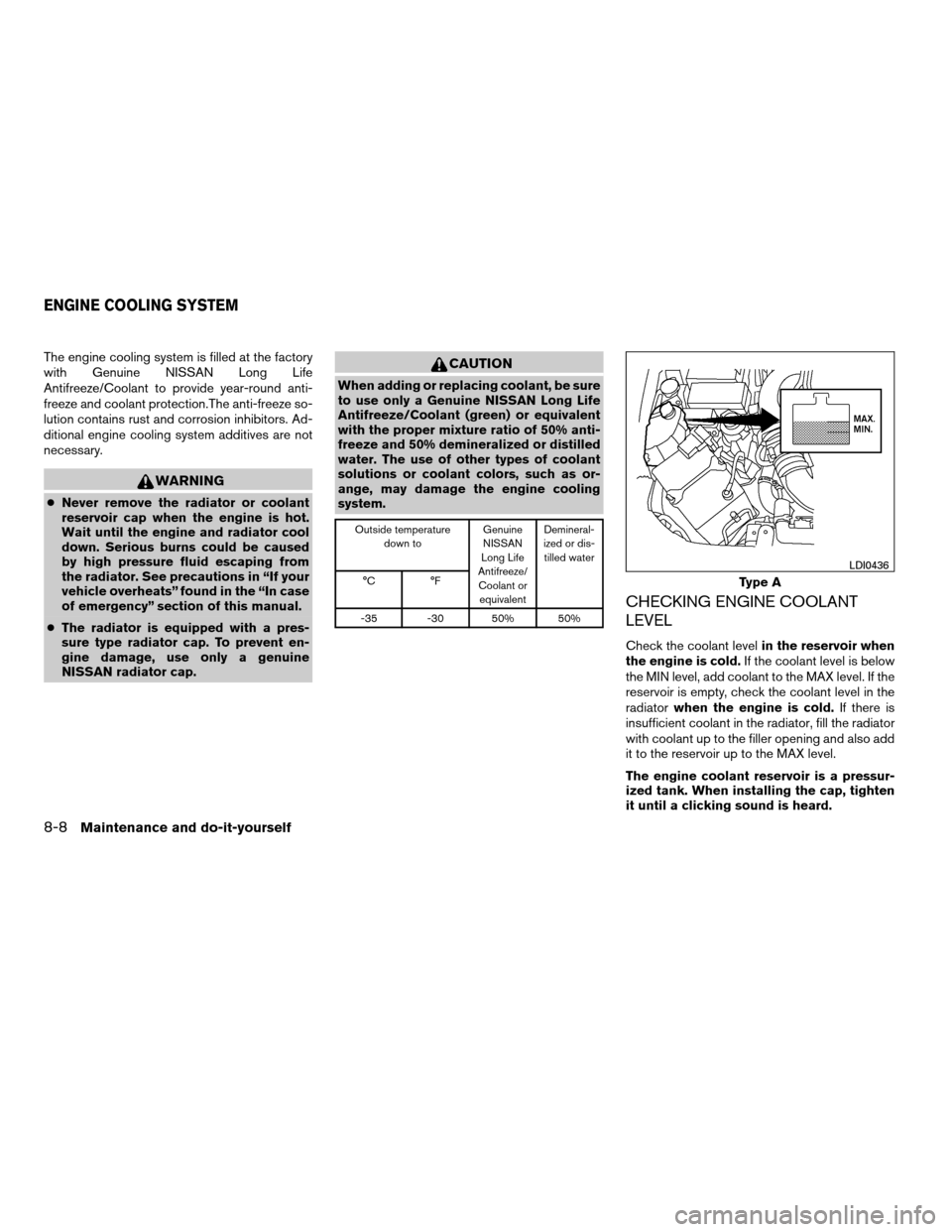
Check the coolant levelin the reservoir when
the engine is cold.If the coolant level is below
the MIN level, add coolant to the MAX level. If the
reservoir is empty, check the coolant level in the
radiatorwhen the engine is cold.If there is
insufficient coolant in the radiator, fill the radiator
with coolant up to the filler opening and also add
it to the reservoir up to the MAX level.
The engine coolant reservoir is a pressur-
ized tank. When installing the cap, tighten
it until a clicking sound is heard.
Type A
LDI0436
ENGINE COOLING SYSTEM
8-8Maintenance and do-it-yourself
ZREVIEW COPYÐ2008 08+ Truck/Frontier(fro)
Owners ManualÐUSA_English(nna)
06/30/07Ðdebbie
X
Page 269 of 352
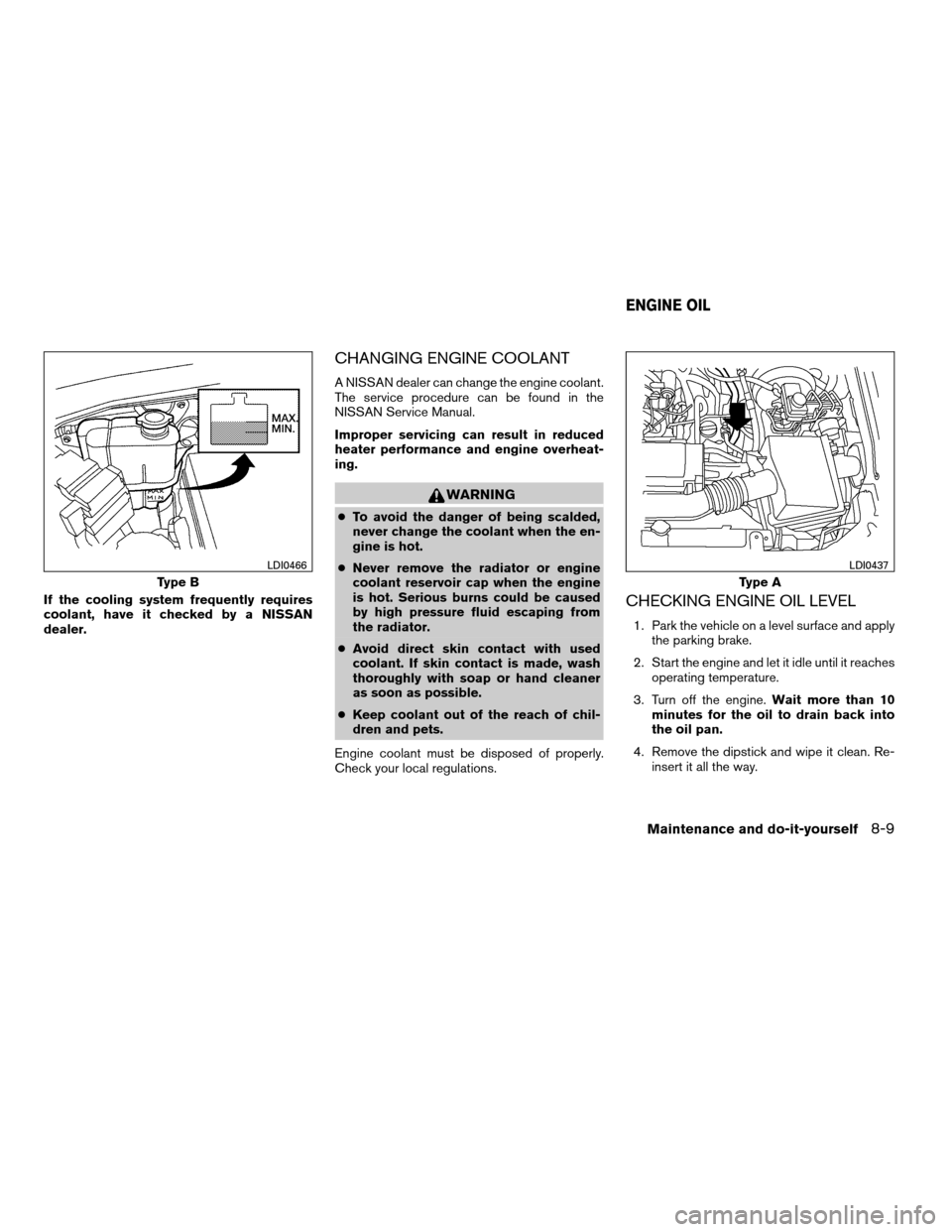
If the cooling system frequently requires
coolant, have it checked by a NISSAN
dealer.
CHANGING ENGINE COOLANT
A NISSAN dealer can change the engine coolant.
The service procedure can be found in the
NISSAN Service Manual.
Improper servicing can result in reduced
heater performance and engine overheat-
ing.
WARNING
cTo avoid the danger of being scalded,
never change the coolant when the en-
gine is hot.
cNever remove the radiator or engine
coolant reservoir cap when the engine
is hot. Serious burns could be caused
by high pressure fluid escaping from
the radiator.
cAvoid direct skin contact with used
coolant. If skin contact is made, wash
thoroughly with soap or hand cleaner
as soon as possible.
cKeep coolant out of the reach of chil-
dren and pets.
Engine coolant must be disposed of properly.
Check your local regulations.
CHECKING ENGINE OIL LEVEL
1. Park the vehicle on a level surface and apply
the parking brake.
2. Start the engine and let it idle until it reaches
operating temperature.
3. Turn off the engine.Wait more than 10
minutes for the oil to drain back into
the oil pan.
4. Remove the dipstick and wipe it clean. Re-
insert it all the way.
Type B
LDI0466
Type A
LDI0437
ENGINE OIL
Maintenance and do-it-yourself8-9
ZREVIEW COPYÐ2008 08+ Truck/Frontier(fro)
Owners ManualÐUSA_English(nna)
06/30/07Ðdebbie
X
Page 306 of 352
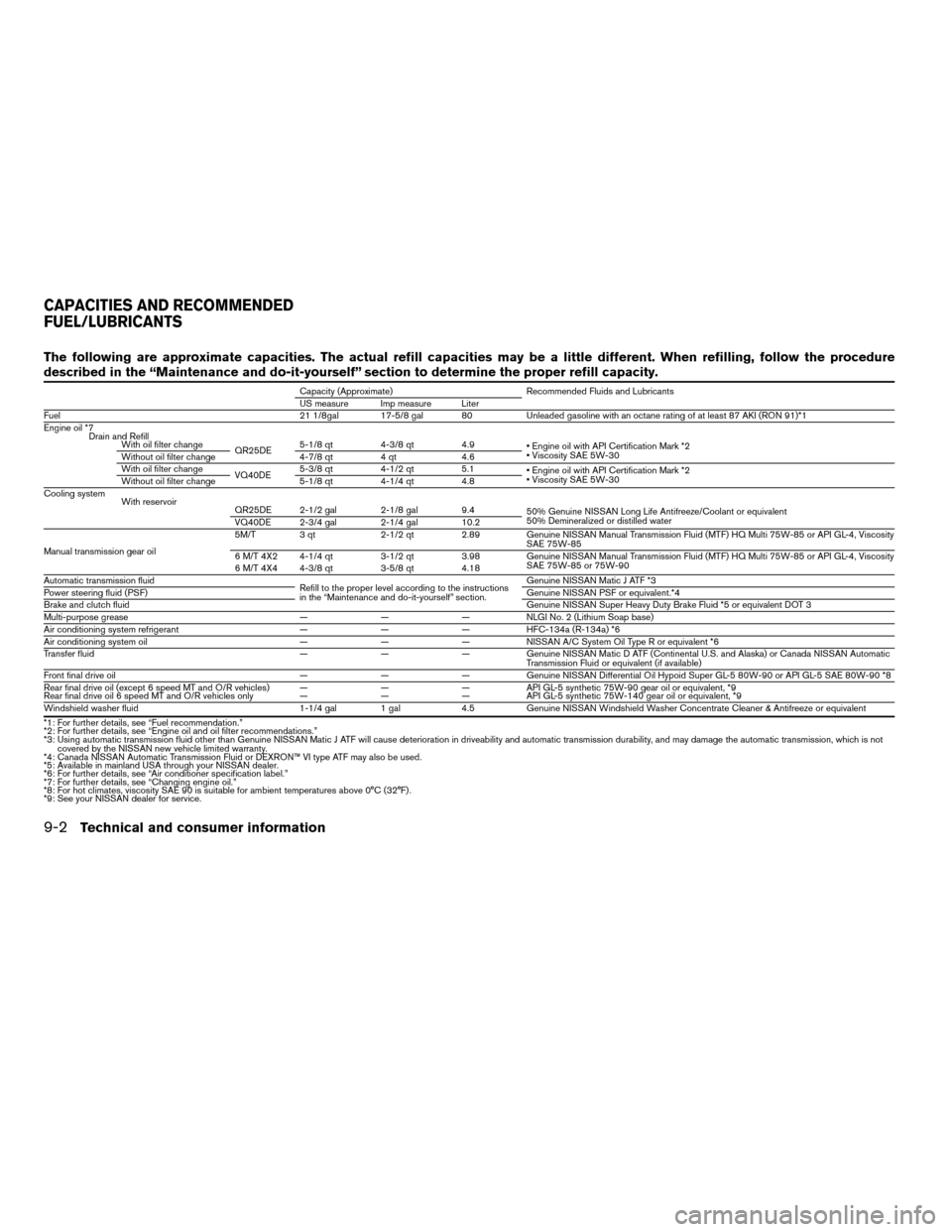
The following are approximate capacities. The actual refill capacities may be a little different. When refilling, follow the procedure
described in the “Maintenance and do-it-yourself” section to determine the proper refill capacity.
Capacity (Approximate) Recommended Fluids and Lubricants
US measure Imp measure Liter
Fuel 21 1/8gal 17-5/8 gal 80 Unleaded gasoline with an octane rating of at least 87 AKI (RON 91)*1
Engine oil *7
Drain and Refill
With oil filter change
QR25DE5-1/8 qt 4-3/8 qt 4.9
• Engine oil with API Certification Mark *2
• Viscosity SAE 5W-30
Without oil filter change 4-7/8 qt 4 qt 4.6
With oil filter change
VQ40DE5-3/8 qt 4-1/2 qt 5.1
• Engine oil with API Certification Mark *2
• Viscosity SAE 5W-30
Without oil filter change 5-1/8 qt 4-1/4 qt 4.8
Cooling system
With reservoir
QR25DE 2-1/2 gal 2-1/8 gal 9.4
50% Genuine NISSAN Long Life Antifreeze/Coolant or equivalent
50% Demineralized or distilled water
VQ40DE 2-3/4 gal 2-1/4 gal 10.2
Manual transmission gear oil5M/T 3 qt 2-1/2 qt 2.89 Genuine NISSAN Manual Transmission Fluid (MTF) HQ Multi 75W-85 or API GL-4, Viscosity
SAE 75W-85
6 M/T 4X2 4-1/4 qt 3-1/2 qt 3.98 Genuine NISSAN Manual Transmission Fluid (MTF) HQ Multi 75W-85 or API GL-4, Viscosity
SAE 75W-85 or 75W-90
6 M/T 4X4 4-3/8 qt 3-5/8 qt 4.18
Automatic transmission fluid
Refill to the proper level according to the instructions
in the “Maintenance and do-it-yourself” section.Genuine NISSAN Matic J ATF *3
Power steering fluid (PSF)Genuine NISSAN PSF or equivalent.*4
Brake and clutch fluidGenuine NISSAN Super Heavy Duty Brake Fluid *5 or equivalent DOT 3
Multi-purpose grease — — — NLGI No. 2 (Lithium Soap base)
Air conditioning system refrigerant — — — HFC-134a (R-134a) *6
Air conditioning system oil — — — NISSAN A/C System Oil Type R or equivalent *6
Transfer fluid — — — Genuine NISSAN Matic D ATF (Continental U.S. and Alaska) or Canada NISSAN Automatic
Transmission Fluid or equivalent (if available)
Front final drive oil — — — Genuine NISSAN Differential Oil Hypoid Super GL-5 80W-90 or API GL-5 SAE 80W-90 *8
Rear final drive oil (except 6 speed MT and O/R vehicles) — — — API GL-5 synthetic 75W-90 gear oil or equivalent, *9
Rear final drive oil 6 speed MT and O/R vehicles only — — — API GL-5 synthetic 75W-140 gear oil or equivalent, *9
Windshield washer fluid 1-1/4 gal 1 gal 4.5 Genuine NISSAN Windshield Washer Concentrate Cleaner & Antifreeze or equivalent
*1: For further details, see “Fuel recommendation.”
*2: For further details, see “Engine oil and oil filter recommendations.”
*3: Using automatic transmission fluid other than Genuine NISSAN Matic J ATF will cause deterioration in driveability and automatic transmission durability, and may damage the automatic transmission, which is not
covered by the NISSAN new vehicle limited warranty.
*4: Canada NISSAN Automatic Transmission Fluid or DEXRON™ VI type ATF may also be used.
*5: Available in mainland USA through your NISSAN dealer.
*6: For further details, see “Air conditioner specification label.”
*7: For further details, see “Changing engine oil.”
*8: For hot climates, viscosity SAE 90 is suitable for ambient temperatures above 0°C (32°F) .
*9: See your NISSAN dealer for service.
CAPACITIES AND RECOMMENDED
FUEL/LUBRICANTS
9-2Technical and consumer information
ZREVIEW COPYÐ2008 08+ Truck/Frontier(fro)
Owners ManualÐUSA_English(nna)
06/30/07Ðdebbie
X
Page 336 of 352

To drive away:
1. Start the vehicle.
2. Apply and hold the brake pedal.
3. Shift the transmission into gear.
4. Release the parking brake.
5. Drive slowly until the vehicle and trailer are
clear from the blocks.
6. Apply and hold the brake pedal.
7. Have someone retrieve and store the blocks.
c
When going down a hill, shift into a lower gear
and use the engine braking effect. When go-
ing up a long grade, downshift the transmis-
sion to a lower gear and reduce speed to
reduce chances of engine overloading and/or
overheating. However, for long steep grades,
do not stay in 1st gear when driving above 35
MPH (56 km/h) or 2nd gear when driving
above 58 MPH (93 km/h) .
cIf the engine coolant rises to an extremely
high temperature when the air conditioner
system is on, turn off the air conditioner.
Coolant heat can be additionally vented by
opening the windows, switching the fan
control to high and setting the temperature
control to the HOT position.cTrailer towing requires more fuel than normal
circumstances.
cAvoid towing a trailer for your vehicle’s first
500 miles (805 km) .
cFor the first 500 miles (805 km) that you do
tow, do not drive over 50 MPH (80 km/h) .
cHave your vehicle serviced more often than
at intervals specified in the recommended
Maintenance Schedule in the “NISSAN Ser-
vice and Maintenance Guide”.
cWhen making a turn, your trailer wheels will
be closer to the inside of the turn than your
vehicle wheels. To compensate for this,
make a larger than normal turning radius
during the turn.
cCrosswinds and rough roads will adversely
affect vehicle/trailer handling, possibly caus-
ing vehicle sway. When being passed by
larger vehicles, be prepared for possible
changes in crosswinds that could affect ve-
hicle handling.
Do the following if the trailer begins to sway:
1.
Take your foot off the accelerator pedal to
allow the vehicle to coast and steer as straight
ahead as the road conditions allow. This com-
bination will help stabilize the vehicle
– Do not correct trailer sway by steering or
applying the brakes.
2. When the trailer sway stops, gently apply the
brakes and pull to the side of the road in a
safe area.
3. Try to rearrange the trailer load so it is bal-
anced as described earlier in this section.
cBe careful when passing other vehicles.
Passing while towing a trailer requires con-
siderably more distance than normal pass-
ing. Remember, the length of the trailer must
also pass the other vehicle before you can
safely change lanes.
cDownshift the transmission to a lower gear
for engine braking when driving down steep
or long hills. This will help slow the vehicle
without applying the brakes.
cTo maintain engine braking efficiency and
electrical charging performance, do not use
overdrive.
cAvoid holding the brake pedal down too long
or too frequently. This could cause the
brakes to overheat, resulting in reduced
braking efficiency.
cIncrease your following distance to allow for
greater stopping distances while towing a
trailer. Anticipate stops and brake gradually.
9-32Technical and consumer information
ZREVIEW COPYÐ2008 08+ Truck/Frontier(fro)
Owners ManualÐUSA_English(nna)
06/30/07Ðdebbie
X
Page 340 of 352
WARNING
Always drive the vehicle in a safe and
prudent manner according to traffic con-
ditions and obey all traffic laws.
1. Start the engine when the engine coolant
temperature gauge needle points to C. Al-
low the engine to idle until the gauge needle
points between the C and H (normal oper-
ating temperature) .
2. Accelerate the vehicle to 55 MPH (88
km/h) , then quickly release the accelerator
pedal completely and keep it released for at
least 10 seconds.
3. Quickly depress the accelerator pedal for a
moment, then drive the vehicle at a speed of
53 - 60 MPH (86 - 96 km/h) for at least 9
minutes.
4. Stop the vehicle.
5. Accelerate the vehicle to 35 MPH (55 km/h)
and maintain the speed for 20 seconds.
6. Repeat steps 4 through 5 at least 10 times.
7. Accelerate the vehicle to 55 MPH (88 km/h)
and maintain the speed for at least 3 min-
utes.8. Stop the vehicle. Place the transmission se-
lector lever in the P (Park) or N (Neutral)
position.
9. Turn the engine off.
10. Repeat steps1-8atleast one more time.
If steps 1 through 7 are interrupted, repeat the
preceding step. Any safe driving mode is accept-
able between steps. Do not stop the engine until
step 7 is completed.This vehicle is equipped with an Event Data Re-
corder (EDR) . The main purpose of an EDR is to
record, in certain crash or near crash-like situa-
tions, such as an air bag deployment or hitting a
road obstacle, data that will assist in understand-
ing how a vehicle’s systems performed. The EDR
is designed to record data related to vehicle
dynamics and safety systems for a short period of
time, typically 30 seconds or less. The EDR in this
vehicle is designed to record such data as:
cHow various systems in your vehicle were
operating;
cWhether or not the driver and passenger
safety belts were buckled/fastened;
cHow far (if at all) the driver was depressing
the accelerator and/or brake pedal; and,
cHow fast the vehicle was traveling.
cSounds are not recorded.
These data can help provide a better understand-
ing of the circumstances in which crashes and
injuries occur. NOTE: EDR data are recorded by
your vehicle only if a nontrivial crash situation
occurs; no data are recorded by the EDR under
normal driving conditions and no personal data
(e.g. name, gender, age and crash location) are
recorded. However, other parties, such as law
enforcement, could combine the EDR data with
EVENT DATA RECORDERS
9-36Technical and consumer information
ZREVIEW COPYÐ2008 08+ Truck/Frontier(fro)
Owners ManualÐUSA_English(nna)
06/30/07Ðdebbie
X
Page 344 of 352

Precautions on child
restraints............1-21, 1-32, 1-45
Top tether strap anchor point locations . .1-27
Child safety rear door lock............3-6
Chimes, audible reminders...........2-21
Cleaning exterior and interior..........7-2
Clock......................4-17
Clutch
Clutch fluid.................8-14
Clutch interlock (clutch start) switch.....2-33
C.M.V.S.S. certification label..........9-10
Cold weather driving..............5-35
Compact disc (CD) player...........4-18
Compass display.................2-9
Console box...................2-38
Controls
Audio controls (steering wheel)......4-26
Heater and air conditioner controls.....4-2
Coolant
Capacities and recommended
fuel/lubricants.................9-2
Changing engine coolant..........8-9
Checking engine coolant level........8-8
Engine coolant temperature gauge.....2-6
Corrosion protection...............7-5
Cruise control..................5-19
Cup holders...................2-40
Curtain side-impact and rollover air bag . . .1-63
D
Daytime running light system
(Canada only)..................2-27Defroster switch
Rear window and outside mirror defroster
switch....................2-24
Dimensions and weights.............9-8
Dimmer switch for instrument panel......2-28
Door locks....................3-3
Door open warning light............2-14
Drive belt....................8-18
Driving
Cold weather driving............5-35
Driving with automatic transmission. . . .5-12
Driving with manual transmission.....5-16
Precautions when starting and driving . . .5-2
E
Economy - fuel.................5-21
Electronic locking rear differential (E-Lock)
system......................5-27
Electronic locking rear differential (E-Lock)
system switch..................2-32
Emission control information label.......9-11
Emission control system warranty.......9-35
Engine
Before starting the engine.........5-10
Block heater.................5-36
Capacities and recommended
fuel/lubricants.................9-2
Changing engine coolant..........8-9
Changing engine oil............8-10
Changing engine oil filter..........8-12
Checking engine coolant level........8-8
Checking engine oil level..........8-9
Engine compartment check locations. . . .8-6
Engine coolant temperature gauge.....2-6Engine cooling system............8-8
Engine oil...................8-9
Engine oil and oil filter recommendation . .9-5
Engine oil pressure warning light.....2-14
Engine oil viscosity..............9-5
Engine serial number............9-10
Engine specifications.............9-7
Starting the engine.............5-11
Engine oil pressure gauge............2-8
Event data recorders..............9-36
Exhaust gas (Carbon monoxide)........5-2
F
First aid kit....................6-2
Flashers
(See hazard warning flasher switch)......2-29
Flat tire......................6-3
Floor mat positioning aid.............7-4
Fluid
Brake fluid..................8-14
Capacities and recommended
fuel/lubricants.................9-2
Clutch fluid.................8-14
Engine coolant................8-8
Engine oil...................8-9
Power steering fluid.............8-13
Window washer fluid............8-15
F.M.V.S.S. certification label..........9-10
Fog light switch.................2-28
Front air bag system
(See supplemental restraint system).....1-59
Front seats....................1-2
10-2
ZREVIEW COPYÐ2008 08+ Truck/Frontier(fro)
Owners ManualÐUSA_English(nna)
06/30/07Ðdebbie
X
Page 345 of 352

Fuel
Capacities and recommended
fuel/lubricants.................9-2
Fuel economy................5-21
Fuel gauge..................2-7
Fuel octane rating..............9-4
Fuel recommendation............9-3
Fuel-filler cap................3-10
Fuel-filler door and cap...........3-10
Fuel-filler lid.................3-10
Fuses......................8-24
Fusible links...................8-25
G
Garage door opener, HomeLinkTUniversal
Transceiver...................2-49
Gascap .................3-10, 3-10
Gauge
Engine coolant temperature gauge.....2-6
Engine oil pressure gauge..........2-8
Fuel gauge..................2-7
Odometer...................2-4
Speedometer.................2-4
Tachometer..................2-6
Trip computer.................2-5
Trip odometer.................2-4
Voltmeter...................2-8
General maintenance..............8-2
Glove box....................2-38
H
Hands-free phone system, BluetoothT. . . .4-27Hazard warning flasher switch.........2-29
Head restraints..................1-6
Active Head Restraint............1-6
Headlight and turn signal switch........2-25
Headlight control switch............2-25
Headlights....................8-28
Heated seats..................2-30
Heater
Heater and air conditioner controls.....4-2
Heater operation...............4-4
Hill descent control switch...........2-31
Hill descent control system..........5-34
Hill start assist system.............5-34
HomeLinkTUniversal Transceiver.......2-49
Hood release...................3-9
Horn.......................2-29
I
Ignition switch..................5-8
Immobilizer system.........2-22, 3-2, 5-10
Important vehicle information label.......9-10
In-cabin microfilter...............8-21
Increasing fuel economy............5-21
Indicator lights and audible reminders
(See warning/indicator lights and audible
reminders)....................2-12
Inside automatic anti-glare mirror.......3-13
Inside mirror...................3-12
Instrument brightness control.........2-28
Instrument panel..............0-6, 2-2
Instrument panel dimmer switch........2-28
Interior light...................2-47
ISOFIX child restraints.............1-23J
Jump seat.....................1-5
Jump starting...................6-9
K
Key ........................3-2
Keyfob battery replacement..........8-27
Keyless entry system
(See remote keyless entry system).......3-6
L
Labels
Air conditioner specification label.....9-11
C.M.V.S.S. certification label........9-10
Emission control information label.....9-11
Engine serial number............9-10
F.M.V.S.S. certification label........9-10
Vehicle identification number (VIN) plate . .9-9
Warning labels (for SRS)..........1-66
LATCH (Lower Anchors and Tethers
for CHildren) System..............1-23
License plate
Installing the license plate.........9-12
Light
Air bag warning light.........1-66, 2-17
Brake light (See stop light).........8-30
Bulb check/instrument panel........2-13
Bulb replacement..............8-30
Charge warning light............2-14
Fog light switch...............2-28
10-3
ZREVIEW COPYÐ2008 08+ Truck/Frontier(fro)
Owners ManualÐUSA_English(nna)
06/30/07Ðdebbie
X
Page 348 of 352

Headlight control switch..........2-25
Hill descent control switch.........2-31
Ignition switch................5-8
Overdrive switch..............5-15
Power door lock switch...........3-4
Rear window and outside mirror defroster
switch....................2-24
Turn signal switch..............2-28
Vehicle dynamic control (VDC) off
switch....................2-31
Windshield wiper and washer switch . . .2-23
T
Tachometer....................2-6
Tailgate latch..................3-15
Temperature gauge
Engine coolant temperature gauge.....2-6
Theft (NISSAN vehicle immobilizer system) ,
engine start.............2-22, 3-2, 5-10
Three-way catalyst................5-2
Tie down hooks.................3-16
Tilting steering wheel..............3-11
Tire
Flat tire....................6-3
Spare tire...................6-4
Tire chains..................8-40
Tire placard.................9-11
Tire pressure................8-33
Tire rotation.................8-40
Tires of 4-wheel drive............8-42
Types of tires................8-39
Uniform tire quality grading.........9-34
Wheels and tires..............8-33
Wheel/tire size................9-8Tire pressure
Low tire pressure warning light......2-15
Tire Pressure Monitoring System (TPMS) . . .5-3
Top tether strap child restraint.........1-24
Towing
2-wheel drive models............6-13
4-wheel drive models............6-14
Flat towing..................9-33
Tow truck towing..............6-12
Towing load/specification.........9-27
Trailer towing................9-23
Transceiver
HomeLinkTUniversal Transceiver.....2-49
Transmission
Driving with automatic transmission. . . .5-12
Driving with manual transmission.....5-16
Selector lever lock release.........5-14
Travel (See registering your vehicle in
another country).................9-9
Trip computer...................2-5
Trip odometer...................2-4
Truck - camper loading.............9-22
Turn signal switch................2-28
U
Uniform tire quality grading...........9-34
V
Vanity mirror...................3-12
Vehicle dimensions and weights........9-8
Vehicle dynamic control (VDC) off switch. . .2-31
Vehicle dynamic control (VDC) system. . . .5-32Vehicle identification...............9-9
Vehicle identification number (VIN)
(Chassis number).................9-9
Vehicle identification number (VIN) plate. . . .9-9
Vehicle loading information...........9-12
Vehicle recovery.................6-15
Vehicle security system.............2-21
Vehicle security system (NISSAN vehicle
immobilizer system) , engine start. .2-22, 3-2, 5-10
Ventilators.....................4-2
Visors......................3-11
Voltmeter.....................2-8
W
Warning
4WD warning light.............2-15
Air bag warning light.........1-66, 2-17
Anti-lock brake warning light........2-13
Battery charge warning light........2-14
Brake warning light.............2-13
Door open warning light..........2-14
Engine oil pressure warning light.....2-14
Hazard warning flasher switch.......2-29
Low fuel warning light...........2-15
Low tire pressure warning light......2-15
Low washer fluid warning light.......2-16
Passenger air bag and status light.....1-60
Seat belt warning light...........2-16
Vehicle security system...........2-21
Warning labels (for SRS)..........1-66
Warning/indicator lights and audible
reminders..................2-12
Warning lights..................2-12
10-6
ZREVIEW COPYÐ2008 08+ Truck/Frontier(fro)
Owners ManualÐUSA_English(nna)
06/30/07Ðdebbie
X