Page 479 of 801

478 Controls in detailDriving systemsPark Assist is automatically activated
when the engine is running and the trans-
mission is in drive position D, reverse
gearR or neutral positionN.
The Park Assist system deactivates at
speeds over approximately 10 mph
(16 km/h). At lower speeds the Parktronic
system turns on again.
Park Assist is also switched off when you
set the automatic transmission to P or
switch off the engine.
While the transmission is in neutral
positionN, Park Assist is switched off if
you secure the vehicle in place with the
electronic parking brake.
The Park Assist system monitors the sur-
roundings of your vehicle with four sensors
in the front bumper and two sensors in the
rear bumper.Range of the sensors
The sensors of the Park Assist system are
integrated in the front and rear bumpers.
Make sure that the bumpers are clear of
dirt, ice and slush in the area of the sen-
sors, as otherwise, Park Assist may not
function properly, see “Cleaning the driv-
ing systems sensors” (
�page 620).
Page 526 of 801

525 Controls in detail
Loading and storing
�Loading and storing
Roof rack*
�
Flip the covers upward.
�
Only attach the roof-rack system to the
anchorage points under the covers.
Observe manufacturer’s instructions
for installation.
Loading instructions
The total load weight including vehicle oc-
cupants and luggage/cargo should not
exceed the load limit as indicated on the
corresponding placard located on the driv-
er’s door B-pillar (
�page 585).
Warning!
G
Only use roof racks approved by
Mercedes-Benz for your vehicle model to
avoid damage to the vehicle.
Follow the manufacturer’s installation
instructions. Otherwise, an improperly
attached roof rack system or its load could
become detached from the vehicle.
Do not exceed the maximum roof load of
220 lb (100 kg).
Take into consideration that when the roof
rack is loaded, the handling characteristics
are different from those when operating the
vehicles without the roof rack loaded.
!
Load the roof rack in such a way that the ve-
hicle cannot be damaged while driving.
Make sure
�
you can fully raise tilt/sliding sunroof or the
panorama roof with tilt/sliding panel*
�
you can fully open the trunk
Warning!
G
Always fasten items being carried as secure-
ly as possible using cargo tie-down hooks
and fastening materials appropriate for the
weight and size of the load.
In an accident, during hard braking or sud-
den maneuvers, loose items will be thrown
around inside the vehicle and can cause in-
jury to vehicle occupants unless the items
are securely fastened in the vehicle.
��
Page 527 of 801

526 Controls in detailLoading and storing
Storage compartments Storage compartments in the front pas-
senger compartment
Glove box
The glove box can be unlocked and locked
with the mechanical key (
�page 708).
�
Opening: Press glove box lid
release1.
�
Closing: Push the lid up.
To help avoid personal injury during a colli-
sion or sudden maneuver, exercise care
when transporting cargo. Put luggage or car-
go in the trunk if possible.
Do not pile luggage or cargo higher than the
seat backs. Do not place anything on the
rear-window shelf.
Never drive vehicle with trunk open. Deadly
carbon monoxide (CO) gases may enter ve-
hicle interior resulting in unconsciousness
and death.
Warning!
G
To help avoid personal injury during a colli-
sion or sudden maneuver, exercise care
when storing objects in the vehicle. Put lug-
gage or cargo in the trunk if possible. Do not
pile luggage or cargo higher than the seat
backs.
Parcel nets cannot secure hard or heavy ob-
jects.
Keep compartment lids closed. This will help
to prevent stored objects from being thrown
about and injuring vehicle occupants during�
braking
�
vehicle maneuvers or
�
an accident.
i
An overview of the storage compartments
can be found on (
�page 36).
1
Glove box lid release
2
Unlocking glove box
3
Locking glove box
��
Page 533 of 801
532 Controls in detailLoading and storingTrunk
Storage spaces under trunk floor
You can place a suitcase in the hollow un-
der the front part of the trunk floor.
1Trunk floor
2Storage spaces1Storage space
2Trunk floorCargo tie-down hooks
4 hooks are located in the trunk.
�
Carefully secure cargo by applying
even load on all hooks with rope of suf-
ficient strength to hold down the cargo.
!
Fold down the suitcase handle before clos-
ing the trunk to avoid damaging the trunk lid.
Page 534 of 801
533 Controls in detail
Loading and storing
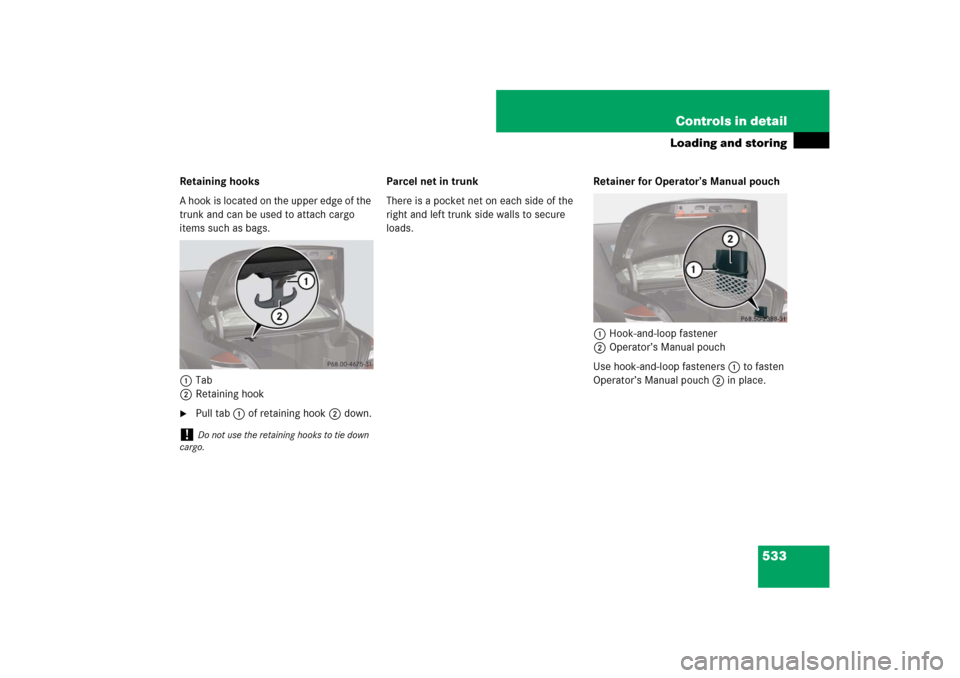
Retaining hooks
A hook is located on the upper edge of the
trunk and can be used to attach cargo
items such as bags.
1Tab
2Retaining hook�
Pull tab1 of retaining hook2 down.Parcel net in trunk
There is a pocket net on each side of the
right and left trunk side walls to secure
loads.Retainer for Operator’s Manual pouch
1Hook-and-loop fastener
2Operator’s Manual pouch
Use hook-and-loop fasteners1 to fasten
Operator’s Manual pouch2 in place.
!
Do not use the retaining hooks to tie down
cargo.
Page 537 of 801

536 Controls in detailUseful featuresAshtrays
Center console ashtray
1Button for disengaging ashtray
2Cover plateOpening ashtray
�
Press mark on cover plate2 forward.
Removing ashtray insert
�
Push sliding button1 to the left.
The ashtray is disengaged and slides
out a short way.
�
Remove the insert from the ashtray
frame.
Reinstalling ashtray insert
�
Install the insert by pushing it back into
the frame until it engages.
Closing ashtray
�
Briefly press mark on cover plate2
forward.
Rear door ashtray
Opening ashtray
�
Lift up the cover.Removing ashtray insert
1Insert
�
Press the open cover outwards beyond
the stop.
Ashtray insert1 pops out of the hold-
er.
�
Remove insert by pulling it upward.
Reinstalling ashtray insert
�
Install the insert by pushing it back into
the frame until it engages.
Warning!
G
Remove ashtray only with vehicle standing
still. Engage the electronic parking brake to
secure vehicle from movement. Set auto-
matic transmission to park positionP. With
the automatic transmission set to park
positionP, turn off the engine.
Page 539 of 801

538 Controls in detailUseful features
Power outlet
The power outlet is located in the rear cen-
ter console.�
Switch on the ignition (
�page 370).
�
Flip up cover1 and insert electrical
plug (cigarette lighter type).
Floormats*
!
The lighter socket can be used to accommo-
date 12V DC electrical accessories (up to a max-
imum of 85 W) designed for use with the
standard “cigarette lighter” plug type. Keep in
mind, however, that connecting accessories to
the lighter socket (for example extensive con-
necting and disconnecting, or using plugs that do
not fit properly) can damage the lighter socket.
With the socket damaged, the lighter may no
longer be able to be placed in the heating
(pushed-in) position, or the lighter may pop out
too early with the lighter not hot enough.
To help avoid damaging the cigarette lighter
socket, we recommend connecting 12V DC elec-
trical accessories designed for use with a stan-
dard “cigarette lighter” plug type.
i
Operation of the rear door lighters is only
possible, if the override switch (
�page 64) is de-
activated.
i
If the engine is off and the cigarette lighter is
being used extensively, the vehicle battery may
become discharged.
i
The power outlet can be used to
accommodate 12V DC electrical accessories
(e.g. air pump, auxiliary lamps) up to a maximum
of 180 W.
If the engine is off and the outlet is being used
extensively, the vehicle battery may become dis-
charged.
Warning!
G
Whenever you are using floormats, make
sure there is enough clearance and that the
floormats are securely fastened.
Floormats should always be securely fas-
tened using the eyelets and the retainer
pins.
Before driving off, check that the floormats
are securely in place and adjust them if nec-
essary. A loose floormat could slip and
hinder proper functioning of the pedals.
Do not place several floormats on top of
each other as this may impair pedal move-
ment.i
To install or remove the floormat more easi-
ly, move the driver’s seat or front passenger seat
as far to the rear as possible (
�page 373).
Page 568 of 801

567 Operation
Driving instructions
Passenger compartmentDriving abroad
Abroad, there is an extensive
Mercedes-Benz service network at your
disposal. If you plan to drive into areas
which are not listed in the index of your
Mercedes-Benz Center directory, you
should request pertinent information from
an authorized Mercedes-Benz Center.Control and operation of radio
transmitters
COMAND, radio, and telephone*Telephones and two-way radios
Radio transmitters, such as a portable tele-
phone or a citizens band unit should only
be used inside the vehicle if they are con-
nected to an antenna that is installed on
the outside of the vehicle.
Refer to the radio transmitter operation in-
structions regarding use of an external an-
tenna.
Warning!
G
Always fasten items being carried as secure-
ly as possible.
In an accident, during hard braking or sud-
den maneuvers, loose items will be thrown
around inside the vehicle, and cause injury
to vehicle occupants unless the items are
securely fastened in the vehicle.
The trunk is the preferred place to carry ob-
jects.
Warning!
G
Please do not forget that your primary re-
sponsibility is to drive the vehicle safely.
Only operate the COMAND (Cockpit Man-
agement and Data System), radio, or tele-
phone
1 if road, weather and traffic
conditions permit. Otherwise, you may not
be able to observe traffic conditions and
could endanger yourself and others.
Bear in mind that at a speed of just 30 mph
(approximately 50 km/h), your vehicle is
covering a distance of 44 feet (approximate-
ly 14 m) every second.
1Observe all legal requirements.
Warning!
G
Never operate radio transmitters equipped
with a built-in or attached antenna (i.e. with-
out being connected to an external antenna)
from inside the vehicle while the engine is
running. Doing so could lead to a malfunc-
tion of the vehicle’s electronic system, pos-
sibly resulting in an accident and/or
personal injury.