Page 293 of 601

292 Controls in detail
Driving systems
Switching off
�Press Parktronic switch1.
Indicator lamp2 comes on.
Switching on
�Press Parktronic switch1 once more.
Indicator lamp2 goes out.Parktronic system* malfunction
If only the red distance segments illumi-
nate and an acoustic warning sounds,
there is a malfunction in the Parktronic
system. The Parktronic system will auto-
matically switch off after 20 seconds and
the indicator lamp in the Parktronic switch
comes on.
�Have the Parktronic system checked
by an authorized Mercedes-Benz Light
Truck Center as soon as possible.
If only the red distance segments illumi-
nate and no acoustic warning sounds, the
Parktronic system sensors are dirty (e.g.
slush, snow or ice) or there is an interfer-
ence from other radio or ultrasonic signals
(e.g. working jackhammers, car wash or
the air brakes of trucks). The Parktronic
system will automatically switch off after
20 seconds and the indicator lamp in the
Parktronic switch comes on.
�Switch off the ignition (�page 42).
�Clean the Parktronic system sensors
(
�page 430).
�Switch on the ignition (�page 42).
or
�Check the Parktronic system operation
at another location to rule out interfer-
ence from outside radio or ultrasonic
signals.
iThe Parktronic system switches on
automatically when you switch on the ignition
(
�page 42).
Vehicles with original equipment Mercedes-Benz
Trailer Hitch Kit:
The rear Parktronic sensor will automatically
disengage when towing a trailer.
164.boo Seite 292 Freitag, 30. März 2007 12:54 12
Page 401 of 601
400 Operation
Tires and wheels
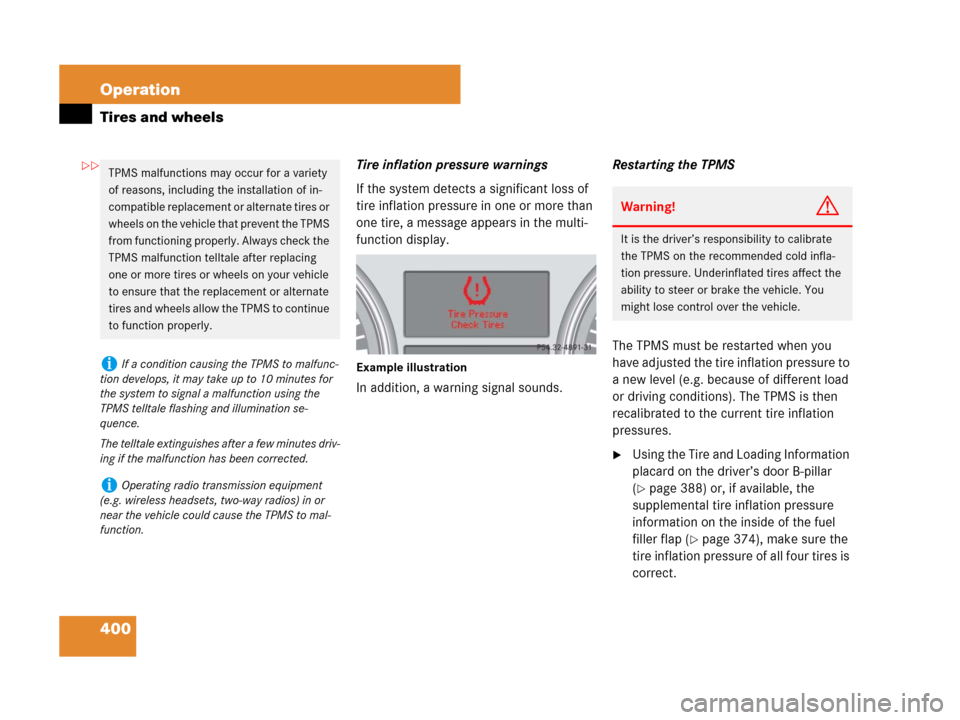
Tire inflation pressure warnings
If the system detects a significant loss of
tire inflation pressure in one or more than
one tire, a message appears in the multi-
function display.
Example illustration
In addition, a warning signal sounds.Restarting the TPMS
The TPMS must be restarted when you
have adjusted the tire inflation pressure to
a new level (e.g. because of different load
or driving conditions). The TPMS is then
recalibrated to the current tire inflation
pressures.
�Using the Tire and Loading Information
placard on the driver’s door B-pillar
(
�page 388) or, if available, the
supplemental tire inflation pressure
information on the inside of the fuel
filler flap (
�page 374), make sure the
tire inflation pressure of all four tires is
correct.
TPMS malfunctions may occur for a variety
of reasons, including the installation of in-
compatible replacement or alternate tires or
wheels on the vehicle that prevent the TPMS
from functioning properly. Always check the
TPMS malfunction telltale after replacing
one or more tires or wheels on your vehicle
to ensure that the replacement or alternate
tires and wheels allow the TPMS to continue
to function properly.
iIf a condition causing the TPMS to malfunc-
tion develops, it may take up to 10 minutes for
the system to signal a malfunction using the
TPMS telltale flashing and illumination se-
quence.
The telltale extinguishes after a few minutes driv-
ing if the malfunction has been corrected.
iOperating radio transmission equipment
(e.g. wireless headsets, two-way radios) in or
near the vehicle could cause the TPMS to mal-
function.
Warning!G
It is the driver’s responsibility to calibrate
the TPMS on the recommended cold infla-
tion pressure. Underinflated tires affect the
ability to steer or brake the vehicle. You
might lose control over the vehicle.
��
164.boo Seite 400 Freitag, 30. März 2007 12:54 12
Page 404 of 601
403 Operation
Tires and wheels
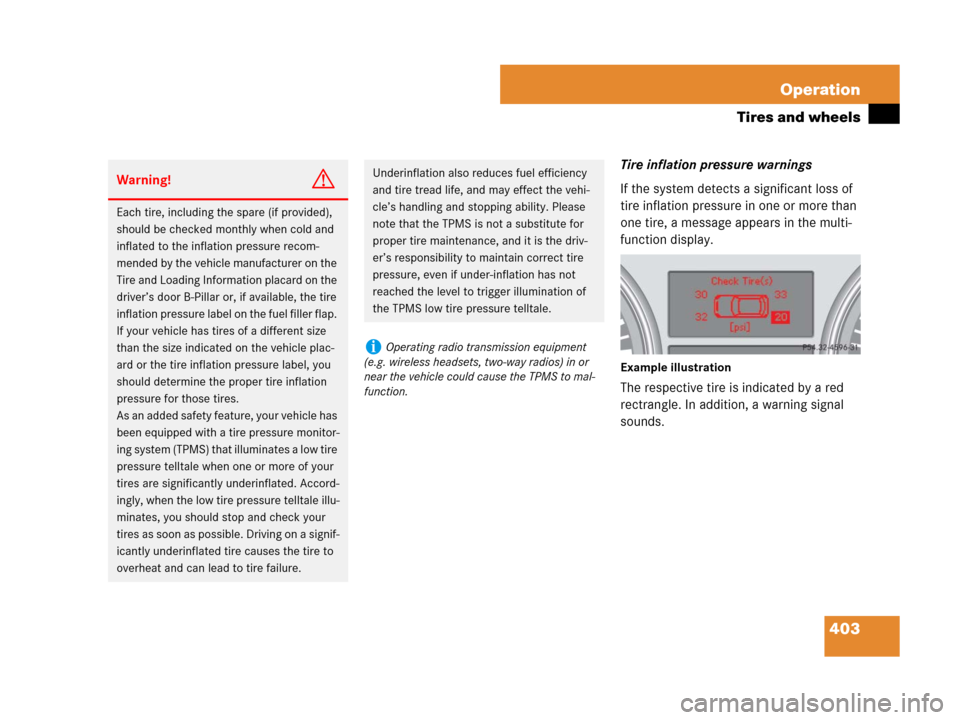
Tire inflation pressure warnings
If the system detects a significant loss of
tire inflation pressure in one or more than
one tire, a message appears in the multi-
function display.
Example illustration
The respective tire is indicated by a red
rectrangle. In addition, a warning signal
sounds.
Warning!G
Each tire, including the spare (if provided),
should be checked monthly when cold and
inflated to the inflation pressure recom-
mended by the vehicle manufacturer on the
Tire and Loading Information placard on the
driver’s door B-Pillar or, if available, the tire
inflation pressure label on the fuel filler flap.
If your vehicle has tires of a different size
than the size indicated on the vehicle plac-
ard or the tire inflation pressure label, you
should determine the proper tire inflation
pressure for those tires.
As an added safety feature, your vehicle has
been equipped with a tire pressure monitor-
ing system (TPMS) that illuminates a low tire
pressure telltale when one or more of your
tires are significantly underinflated. Accord-
ingly, when the low tire pressure telltale illu-
minates, you should stop and check your
tires as soon as possible. Driving on a signif-
icantly underinflated tire causes the tire to
overheat and can lead to tire failure.
Underinflation also reduces fuel efficiency
and tire tread life, and may effect the vehi-
cle’s handling and stopping ability. Please
note that the TPMS is not a substitute for
proper tire maintenance, and it is the driv-
er’s responsibility to maintain correct tire
pressure, even if under-inflation has not
reached the level to trigger illumination of
the TPMS low tire pressure telltale.
iOperating radio transmission equipment
(e.g. wireless headsets, two-way radios) in or
near the vehicle could cause the TPMS to mal-
function.
164.boo Seite 403 Freitag, 30. März 2007 12:54 12