Page 149 of 509
148 Controls in detail
Instrument cluster
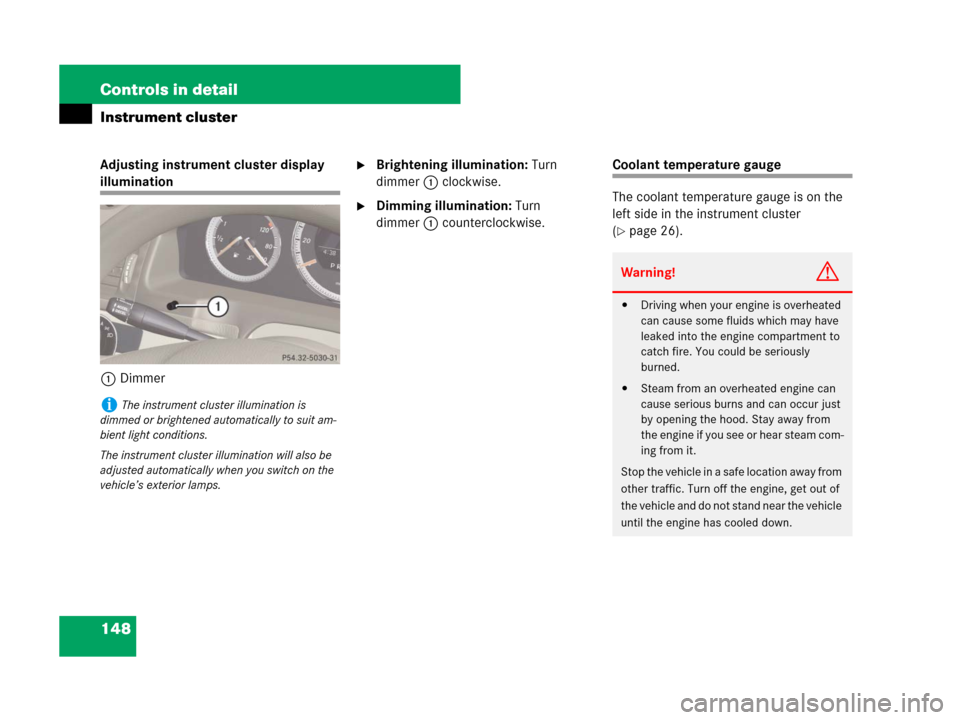
Adjusting instrument cluster display
illumination
1Dimmer
�Brightening illumination: Turn
dimmer1 clockwise.
�Dimming illumination: Turn
dimmer1 counterclockwise.
Coolant temperature gauge
The coolant temperature gauge is on the
left side in the instrument cluster
(
�page 26).
iThe instrument cluster illumination is
dimmed or brightened automatically to suit am-
bient light conditions.
The instrument cluster illumination will also be
adjusted automatically when you switch on the
vehicle’s exterior lamps.
Warning!G
�Driving when your engine is overheated
can cause some fluids which may have
leaked into the engine compartment to
catch fire. You could be seriously
burned.
�Steam from an overheated engine can
cause serious burns and can occur just
by opening the hood. Stay away from
the engine if you see or hear steam com-
ing from it.
Stop the vehicle in a safe location away from
other traffic. Turn off the engine, get out of
the vehicle and do not stand near the vehicle
until the engine has cooled down.
Page 322 of 509
321 Operation
Driving instructions
Coolant temperature
During severe operating conditions,
e.g. stop-and-go traffic, the coolant tem-
perature may rise to approximately 248°F
(120°C).
The engine should not be operated with
the coolant temperature over 248°F
(120°C). Doing so may cause serious en-
gine damage which is not covered by the
Mercedes-Benz Limited Warranty.
Warning!G
�Driving when your engine is badly over-
heated can cause some fluids, which
may have leaked into the engine com-
partment, to catch fire. You could be se-
riously burned.
�Steam from an overheated engine can
cause serious burns and can occur just
by opening the hood. Stay away from
the engine if you see or hear steam com-
ing from it.
Stop the vehicle in a safe location away from
other traffic. Turn off the engine, get out of
the vehicle and do not stand near the vehicle
until the engine has cooled down.
Page 365 of 509
364 Operation
Vehicle care
Cleaning and care of vehicle
Regular and proper care will help to main-
tain the value of your vehicle. The best way
to protect your vehicle from harmful envi-
ronmental influences is to wash it and use
protective treatments regularly.
While in operation, even while parked, your
vehicle is subjected to varying external in-
fluences which, if gone unchecked, can
attack the paintwork as well as the vehicle
underbody and cause lasting damage.Such damage is caused not only by
extreme and varying climatic conditions,
but also by:
�Air pollution
�Road salt
�Tar
�Gravel and stone chipping
To avoid paint damage, you should imme-
diately remove:
�Grease and oil
�Fuel
�Coolant
�Brake fluid
�Bird droppings
�Insects
�Tree resins, etc.
Frequent washing reduces and/or elimi-
nates the aggressiveness and potency of
the above adverse influences.More frequent washings are necessary to
deal with unfavorable conditions:
�near the ocean
�in industrial areas (smoke, exhaust
emissions)
�during winter operation
You should check your vehicle from time to
time for stone chipping or other damage.
Any damage should be repaired as soon as
possible to prevent corrosion.
In doing so, do not neglect the underbody
of the vehicle. A prerequisite for a
thorough check is a washing of the
underbody followed by a thorough
inspection. Damaged areas need to be
re-undercoated.
Your vehicle has been treated at the facto-
ry with a wax-base rustproofing in the body
cavities which will last for the lifetime of
the vehicle. Post-production treatment is
neither necessary nor recommended by
Mercedes-Benz because of the possibility
Warning!G
Many cleaning products can be hazardous.
Some are poisonous, others are flammable.
Always follow the instructions on the partic-
ular container. Always open your vehicle’s
doors or windows when cleaning the inside.
Never use fluids or solvents that are not de-
signed for cleaning your vehicle.
Always lock away cleaning products and
keep them out of reach of children.
Page 403 of 509
402 Practical hints
What to do if …?
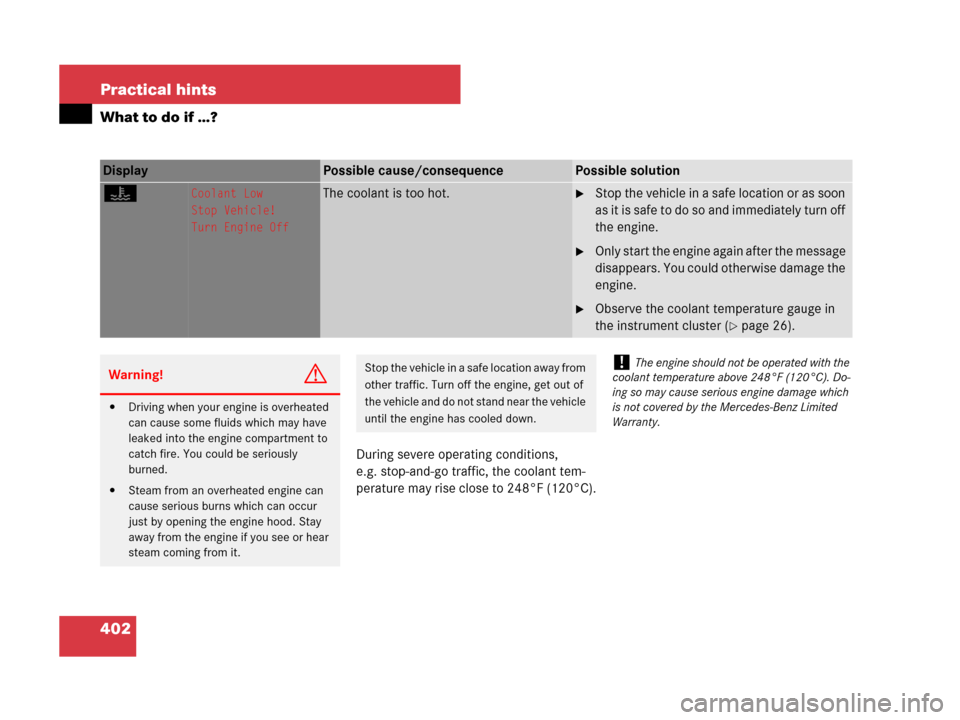
During severe operating conditions,
e.g. stop-and-go traffic, the coolant tem-
perature may rise close to 248°F (120°C).
Display Possible cause/consequencePossible solution
•Coolant Low
Stop Vehicle!
Turn Engine OffThe coolant is too hot. �Stop the vehicle in a safe location or as soon
as it is safe to do so and immediately turn off
the engine.
�Only start the engine again after the message
disappears. You could otherwise damage the
engine.
�Observe the coolant temperature gauge in
the instrument cluster (
�page 26).
Warning!G
�Driving when your engine is overheated
can cause some fluids which may have
leaked into the engine compartment to
catch fire. You could be seriously
burned.
�Steam from an overheated engine can
cause serious burns which can occur
just by opening the engine hood. Stay
away from the engine if you see or hear
steam coming from it.
Stop the vehicle in a safe location away from
other traffic. Turn off the engine, get out of
the vehicle and do not stand near the vehicle
until the engine has cooled down.!The engine should not be operated with the
coolant temperature above 248°F (120°C). Do-
ing so may cause serious engine damage which
is not covered by the Mercedes-Benz Limited
Warranty.
Page 477 of 509
476 Technical data
Fuels, coolants, lubricants, etc.
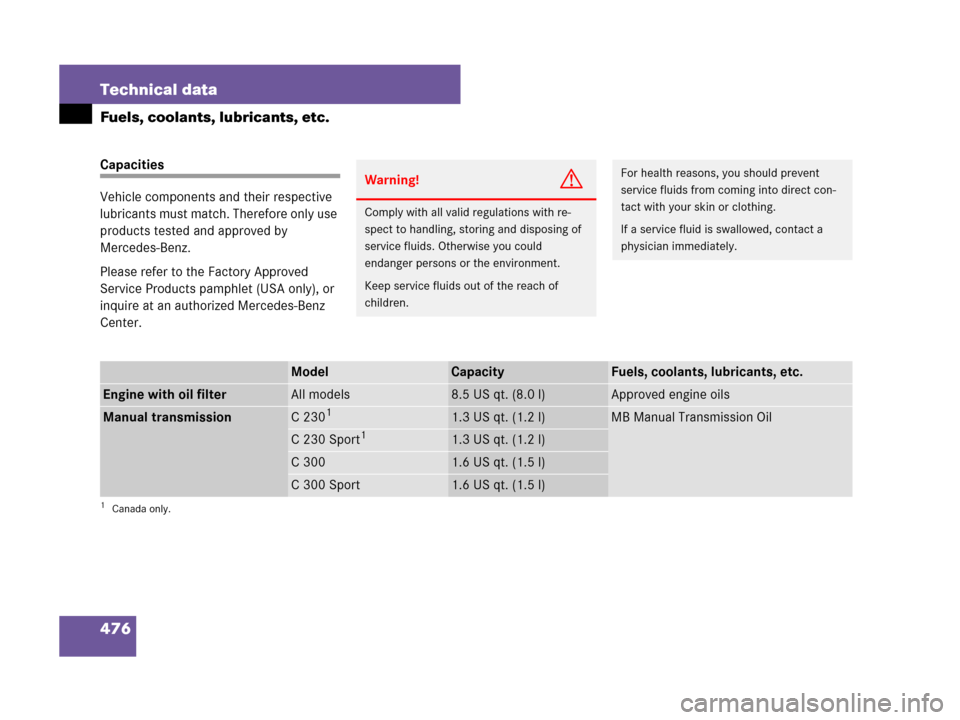
Capacities
Vehicle components and their respective
lubricants must match. Therefore only use
products tested and approved by
Mercedes-Benz.
Please refer to the Factory Approved
Service Products pamphlet (USA only), or
inquire at an authorized Mercedes-Benz
Center.
Warning!G
Comply with all valid regulations with re-
spect to handling, storing and disposing of
service fluids. Otherwise you could
endanger persons or the environment.
Keep service fluids out of the reach of
children.
For health reasons, you should prevent
service fluids from coming into direct con-
tact with your skin or clothing.
If a service fluid is swallowed, contact a
physician immediately.
ModelCapacityFuels, coolants, lubricants, etc.
Engine with oil filterAll models8.5 US qt. (8.0 l)Approved engine oils
Manual transmissionC 2301
1Canada only.
1.3 US qt. (1.2 l)MB Manual Transmission Oil
C 230 Sport11.3 US qt. (1.2 l)
C 3001.6 US qt. (1.5 l)
C 300 Sport1.6 US qt. (1.5 l)
Page 494 of 509

493 Index
ESP®62
Four wheel electronic traction system
with ESP
®65
Messages in display 389, 397, 398
Warning lamp 27, 376, 379, 380
ETD 49
Safety guidelines 38
Ethanol fuel
At the gas station 322
Switching fuels 483
Exterior rear view mirrors
Adjusting 97
Auto-dimming on the driver’s
side 99, 100
Fold-in settings 175
Power folding* 98F
Fahrenheit see Temperature display
mode 167
First aid kit 420
Flat tire 440
Lowering the vehicle 445
Mounting the Minispare wheel 441
Preparing the vehicle 440
Flexible fuel vehicles 482
At the gas station 322
Switching fuels 483
Floormats* 294
Fluids
Automatic transmission fluid 476,
477
Brake fluid 478, 480
Capacities 476
Engine coolant 329, 478, 484
Engine oil 328, 476, 480
Power steering fluid 478
Windshield washer and headlamp
cleaning system 479, 486
Fog lamps 431
Messages in display 410
Replacing bulbs 431, 432, 436Four wheel electronic traction system
(4MATIC) with ESP
®65
4MATIC 65
Front air bags 39
Front lamps see headlamps
Front passenger front air bag 39
Messages in display 393
Front passenger front air bag off indicator
lamp 29, 45, 385
Front seats
Heating* 91
Fuel 322, 478, 481
Additives 481
Capacity, Fuel tank 478
Cruising range 483
E85 (Ethanol fuel) 478, 483
Filling the tank 322
Fuel filler flap and cap 322
Fuel reserve warning lamp 27, 150,
380
Gauge 27, 150
Premium unleaded gasoline 478,
481
Requirements, Octane rating 482
Switching (Flexible fuel vehicle) 483