Page 211 of 305
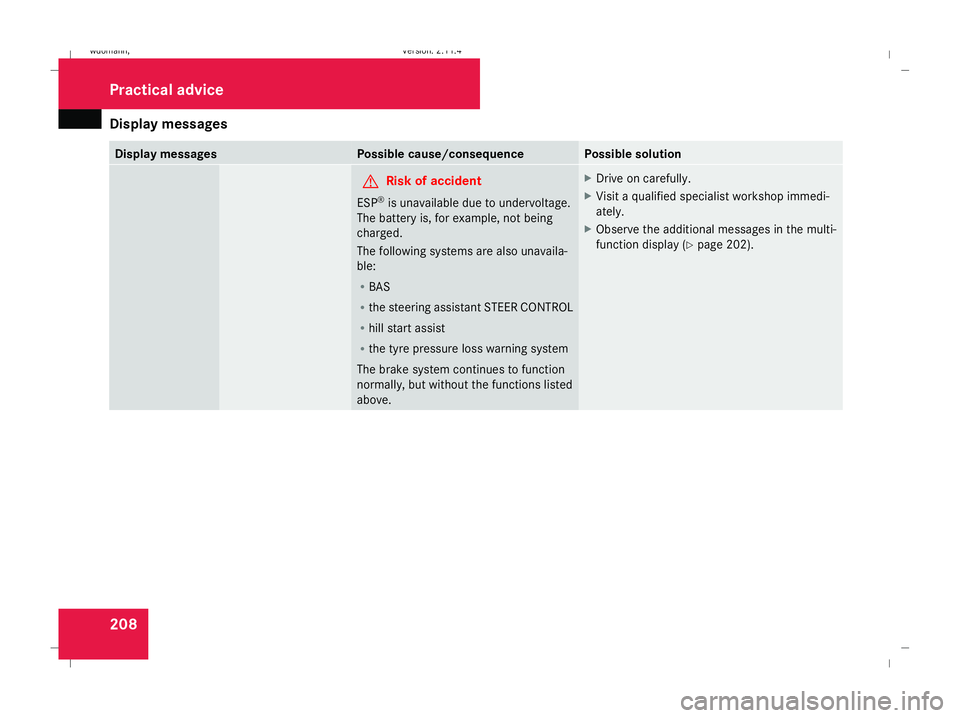
Display
messages 208 Display messages Possible cause/consequence Possible solution
G
Risk of accident
ESP ®
is unavailable due to undervoltage.
The battery is, for example, not being
charged.
The following systems are also unavaila-
ble:
R BAS
R the steering assistant STEER CONTROL
R hill start assist
R the tyre pressure loss warning system
The brake system continues to function
normally, but without the functions listed
above. X
Drive on carefully.
X Visit a qualified specialist workshop immedi-
ately.
X Observe the additional messages in the multi-
function display (Y page 202). Practical advi
ce
245_AKB; 2; 7, en-GB
wdomann,
Version: 2.11.4 2008-10-17T11:22:31+02:00 - Seite 208Dateiname: 6515_1640_02_buchblock.pdf; preflight
Page 216 of 305

Display
messages 213Display messages Possible cause/consequence Possible solution
D The engine fan is faulty. X
If the coolant temperature is less than 120 †,
you can continue driving to the nearest quali-
fied specialist workshop.
X Avoid subjecting the engine to heavy loads, e.g.
driving in mountainous terrain, and stop-and-
go driving. # The battery is not being charged. One (or
more) of the following could be the cause:
R
a faulty alternator
R a torn poly-V-belt
R a malfunction in the electronics X
Stop immediately and safely when traffic con-
ditions permit and switch off the engine.
X Check the poly-V-belt.
X If the poly-V-belt is torn: do not continue
driving. Consult a qualified specialist work-
shop.
X If the poly-V-belt is not damaged: have the
vehicle checked immediately at a qualified spe-
cialist workshop. The on-board voltage is too high. X
Have the alternator checked at a qualified spe-
cialist workshop. 2 Brake wear The brake pads/linings have reached
their wear limit. X
Visit a qualified specialist workshop. Practical advi
ce
245_AKB; 2; 7, en-GB
wdomann,
Version: 2.11.4 2008-10-17T11:22:31+02:00 - Seite 213 ZDateiname: 6515_1640_02_buchblock.pdf; preflight
Page 225 of 305

Troubleshooting
222 Troubleshooting
Points to remember
G
Risk of accident and injury
The operating safety of your vehicle could be compromised if service work is carried out improperly. You could lose control of the vehicle,
thereby causing an accident. Safety systems may also not be able to protect you or others as intended.
Always have maintenance work carried out at a qualified specialist workshop which has the necessary specialist knowledge and tools to
carry out the work required.
Mercedes-Benz recommends that you use a Mercedes-Benz Service Centre for this purpose.
In particular, work relevant to safety or on safety-related systems must be carried out at a qualified specialist workshop. Warning and indicator lamps in switches and buttons
Problem Possible cause/consequence Suggested solutions
One or all of the indicator lamps
in the seat heating* button are
flashing. The seat heating* has
switched itself off automatically. The on-board voltage is too low,
because too many consumers are
switched on. X
Switch off consumers that are not required, e. g. reading lamp or
interior lighting.
Once the battery is sufficiently charged, the seat ventilation* will
switch back on automatically. The indicator lamp in the
2
button on the air-conditioning */
Ther motronic* control panel
lights up. The cooling system can-
not be switched on. Cooling has been deactivated
due to a malfunction. X
Visit a qualified specialist workshop. Practical advice
* optional
245_AKB; 2; 7, en-GB
wdomann,
Version: 2.11.4 2008-10-17T11:22:31+02:00 - Seite 222Dateiname: 6515_1640_02_buchblock.pdf; preflight
Page 226 of 305

Troubleshooting
223Problem Possible cause/consequence Suggested solutions
The indicator lamp in the
F/
1 rear-window heating button
is flashing. The rear-window heat-
ing has switched itself off prema-
turely or cannot be switched on. The on-board voltage is too low,
because too many consumers are
switched on. X
Switch off consumers that are not required, e. g. reading lamp or
interior lighting.
Once the battery is sufficiently charged, the rear window heating
will switch back on automatically. Vehicles with automatic child
seat recognition on the front-
passenger seat:
The
5 PASSENGER AIRBAG
OFF warning lamp on the centre
console is lit. A special Mercedes-Benz child
seat with automatic child seat
recognition has been fitted to the
front-passenger seat. The front-
passenger airbag has therefore
been disabled as desired.
G
Risk of injury
There is no child seat fitted to the
front-passenger seat. The auto-
matic child seat recognition is
malfunctioning. X
Remove electronic equipment from the front-passenger seat, for
example
R
notebook
R mobile phone
R cards with transponders, e.g. ski passes or access passes
If the 5 PASSENGER AIRBAG OFF warning lamp is still lit:
X Visit a qualified specialist workshop. You have started the engine with
the key. The indicator lamp in the
ECO start/stop function* button
does not light up or goes out
again after a short time. You have deactivated the ECO
start/stop function*. X
Activate the ECO start/stop function* again. The ECO start/stop function*is
not available due to a fault. X
Visit a qualified specialist workshop. Practical advice
* optional
245_AKB; 2; 7, en-GB
wdomann,
Version: 2.11.4
2008-10-17T11:22:31+02:00 - Seite 223 ZDateiname: 6515_1640_02_buchblock.pdf; preflight
Page 236 of 305

Troubleshooting
233Engine
Problem Possible cause/consequence Suggested solutions
The engine will not start. You can
hear the starter motor operating. R
The engine electronics system
is malfunctioning.
R There is a malfunction in the
fuel supply.
R The on-board voltage is too low
because the starter battery is
too weak or discharged. X
Turn the key back to position 0(Y page 62) in the ignition lock
before the next starting attempt.
X Try to start the engine again (Y page 86). When doing so, remember
that excessively long and frequent attempts to start the engine will
drain the battery.
If the engine does not start after several attempts:
X Consult a qualified specialist workshop. The engine will not start. You can
hear the starter motor operating.
The reserve fuel warning lamp is
on and the fuel gauge shows
0. The fuel tank has been run dry. X
Refuel the vehicle.
X Bleed the fuel system (Y page 232).The engine will not start. You can-
not hear the starter motor oper-
ating. The on-board voltage is too low
because the starter battery is too
weak or discharged. X
Jump-start the vehicle (Y page 266).
If the engine does not start despite attempting to jump-start it:
X Consult a qualified specialist workshop. The starter motor was exposed to
a thermal load that was too high. X
Allow the starter motor to cool down for approximately two
minutes.
X Try to start the engine again.
If the engine still does not start:
X Consult a qualified specialist workshop. Practical advice
245_AKB; 2; 7, en-GB
wdomann,
Version: 2.11.4
2008-10-17T11:22:31+02:00 - Seite 233 ZDateiname: 6515_1640_02_buchblock.pdf; preflight
Page 242 of 305

Troubleshooting
239Key
Problem Possible cause/consequence Suggested solutions
You cannot lock or unlock the
vehicle using the key. The key batteries are discharged
or nearly discharged. X
Point the tip of the key at the driver's door handle from close range
and try to unlock or lock the vehicle again.
If this does not work:
X Unlock the vehicle using the emergency key element
(Y page 241).
X Check the key batteries (Y page 244) and replace them if neces-
sary (Y page 244). The key is faulty. X
Unlock the vehicle using the emergency key element
(Y page 241).
X Have the key checked at a qualified specialist workshop. The battery charge indicator lamp
of the key does not go on during
the test. The key batteries are discharged. X
Change the batteries (Y page 244).You have lost a key. X
Have the key cancelled at a Mercedes-Benz Service Centre.
X Report the loss immediately to the vehicle insurers.
X If necessary, have the manual locks changed too. You have lost the emergency key
element. X
Report the loss immediately to the vehicle insurers.
X If necessary, have the manual locks changed too. The engine cannot be started
using the key. The steering lock is mechanically
blocked. X
Remove the key and reinsert it into the ignition lock. While doing
this, turn the steering wheel in both directions. Practical advice
245_AKB; 2; 7, en-GB
wdomann,
Version: 2.11.4
2008-10-17T11:22:31+02:00 - Seite 239 ZDateiname: 6515_1640_02_buchblock.pdf; preflight
Page 243 of 305

Troubleshooting
240 Trailer towing
Problem Possible cause/consequence Suggested solutions
The ball coupling cannot be
locked.
The key cannot be removed from
the ball coupling.
G
Risk of accident
The ball coupling is dirty.
The trailer tow hitch is damaged. X
Remove the ball coupling and clean it (Y page 196). If the ball cou-
pling still cannot be locked, remove the ball coupling. It must no
longer be used to tow a trailer, as safe operation is not guaranteed.
X Have the entire trailer tow hitch checked at a qualified specialist
workshop. Parking up the vehicle
Problem Possible cause/consequence Suggested solutions
The vehicle is to be left parked up
for longer than six weeks. Damage resulting from non-use
may occur if the vehicle is parked
up for long periods. X
Visit a qualified specialist workshop and seek advice.
X Disconnect the battery ( Ypage 264). Practical advice
245_AKB; 2; 7, en-GB
wdomann,
Version: 2.11.4 2008-10-17T11:22:31+02:00 - Seite 240Dateiname: 6515_1640_02_buchblock.pdf; preflight
Page 246 of 305

Changing the batteries
243Releasing the parking lock manually
on vehicles with AUTOTRONIC*
In the event of an electrical fault, it is possible
to release the selector lever lock manually to
move it out of position P, e.g. if you wish to
tow the vehicle away. 1
Cup holder
X Apply the parking brake.
X Pull up cup holder 1. Releasing the parking lock manually
1
Screwdriver or similar implement
2 Release pin G
Risk of injury
Release pin 2can become very hot. There-
fore only press the release pin with a suit-
able screwdriver or similar implement; oth-
erwise, you could burn yourself.
X Use implement 1to press release pin 2
and simultaneously move the selector lever
out of position P.
The selector lever can now be moved freely
until it is returned to position P. Changing the batteries
Notes
It is advisable to have the batteries replaced
at a qualified specialist workshop, e.g. at a
Mercedes-Benz Service Centre. G
Risk of poisoning
Batteries contain toxic and caustic sub-
stances. For this reason, keep batteries
away from children.
If a battery is swallowed, consult a doctor
immediately. H
Environmental note
Do not dispose of batteries with the house-
hold rubbish. They contain highly toxic sub-
stances.
Take discharged batteries to a qualified
specialist workshop, e.g. a Mercedes-Benz
Service Centre, or to a special collection
point for old batteries. Practical advice
* optional
245_AKB; 2; 7, en-GB
wdomann,
Version: 2.11.4 2008-10-17T11:22:31+02:00 - Seite 243 ZDateiname: 6515_1640_02_buchblock.pdf; preflight