2008 MAZDA MODEL 5 battery
[x] Cancel search: batteryPage 257 of 376

Black plate (257,1)
Keep all flames, including cigarettes, and sparks away from open battery cells:
Flames and sparks near open battery cells are dangerous. Hydrogen gas, produced
during normal battery operation, could ignite and cause the battery to explode. An
exploding battery can cause serious burns and injuries.
Do not jump-start a frozen battery or one with a low fluid level: Jump-starting a frozen battery or one with a low fluid level is dangerous. It may
rupture or explode, causing serious injury.
Connect the negative cable to a good ground point away from the battery: Connecting the end of the second jumper cable to the negative (
) terminal of the
discharged battery is dangerous.
A spark could cause the gas around the battery to explode and injure someone.
Route the jumper cables away from parts that will be moving: Connecting a jumper cable near or to moving parts (cooling fans, belts) is dangerous.
The cable could get caught when the engine starts and cause serious injury.
CAUTION
Use only a 12 V booster system. You can damage a 12 V starter, ignition system, and
other electrical parts beyond repair with a 24 V power supply (two 12 V batteries in
series or a 24 V motor generator set).
Connect cables in numerical order and disconnect in reverse order.
Jumper cables
Booster battery
Discharged
battery
In Case of an Emergency
Emergency Starting
7-17
Mazda5_8X53-EA-07I_Edition3 Page257
Thursday, March 20 2008 4:12 PM
Form No.8X53-EA-07I
Page 258 of 376

Black plate (258,1)
1. For vehicles equipped with an enginecover, remove the engine cover.
2. Remove the battery cover from its front
side.
3. Make sure the booster battery is 12 Vand that its negative terminal is
grounded.
4. If the booster battery is in another vehicle, don't allow both vehicles to
touch. Turn off the engine of the
vehicle with the booster battery and all
unnecessary electrical loads in both
vehicles. 5. Connect the jumper cables in the exact
sequence as in the illustration.
lConnect one end of a cable to the
positive terminal on the discharged
battery (1).
lAttach the other end to the positive
terminal on the booster battery (2).
lConnect one end of the other cable
to the negative terminal of the
booster battery (3).
lConnect the other end to the ground
point indicated in the illustration
away from the discharged battery
(4).
6. Start the engine of the booster vehicle and run it a few minutes. Then start the
engine of the other vehicle.
7. When finished, carefully disconnect the cables in the reverse order described in
the illustration.
8. If the engine cover and the battery cover have been removed, install them
as they were previously installed.
NOTE
Verify that the covers are securely installed.
7-18
In Case of an Emergency
Emergency Starting
Mazda5_8X53-EA-07I_Edition3 Page258
Thursday, March 20 2008 4:12 PM
Form No.8X53-EA-07I
Page 265 of 376

Black plate (265,1)
8Maintenance and Care
How to keep your Mazda in top condition.
Introduction .................................................................................. 8-2Introduction ............................................................................... 8-2
Scheduled Maintenance ................................................................ 8-3 Scheduled Maintenance (USA, Canada, and Puerto Rico) ....... 8-3
Scheduled Maintenance (Mexico) ............................................. 8-8
Owner Maintenance ................................................................... 8-15 Owner Maintenance Schedule ................................................ 8-15
Owner Maintenance Precautions ............................................. 8-16
Engine Compartment Overview .............................................. 8-17
Engine Oil ............................................................................... 8-18
Engine Coolant ....................................................................... 8-20
Brake/Clutch Fluid .................................................................. 8-22
Power Steering Fluid ............................................................... 8-23
Automatic transaxle Fluid (ATF) ............................................ 8-23
Washer Fluid ........................................................................... 8-24
Body Lubrication .................................................................... 8-25
Wiper Blades ........................................................................... 8-26
Battery ..................................................................................... 8-29
Tires ........................................................................................ 8-31
Light Bulbs ............................................................................. 8-35
Fuses ....................................................................................... 8-42
Appearance Care ........................................................................ 8-48 How to Minimize Environmental Paint Damage .................... 8-48
Exterior Care ........................................................................... 8-50
Interior Care ............................................................................ 8-53
8-1
Mazda5_8X53-EA-07I_Edition3 Page265
Thursday, March 20 2008 4:12 PM
Form No.8X53-EA-07I
Page 281 of 376

Black plate (281,1)
Engine Compartment Overview
Engine oil-filler cap
Power steering
fluid reservoir
Engine oil dipstick
Cooling System Cap Automatic transaxle fluid-level
dipstick (only for automatic transaxle)
Fuse block
Brake/Clutch fluid
reservoir
Battery
Engine coolant reservoir
Windshield
washer fluid
reservoir
Maintenance and Care
Owner Maintenance
8-17
Mazda5_8X53-EA-07I_Edition3 Page281
Thursday, March 20 2008 4:13 PM
Form No.8X53-EA-07I
Page 293 of 376

Black plate (293,1)
Battery
WARNING
Read the following precautions carefully before using the battery or inspecting
to ensure safe and correct handling:
Always wear eye protection when working near the battery:
Working without eye protection is dangerous. Battery fluid contains SULFURIC ACID
which could cause blindness if splashed into your eyes. Also, hydrogen gas produced
during normal battery operation, could ignite and cause the battery to explode.
Wear eye protection and protective gloves to prevent contact with battery
fluid: Spilled battery fluid is dangerous.
Battery fluid contains SULFURIC ACID which could cause serious injuries if it gets in
eyes, or on the skin or clothing. If this happens, immediately flush your eyes with
water for 15 minutes or wash your skin thoroughly and get medical attention.
Always keep batteries out of the reach of children:
Allowing children to play near batteries is dangerous. Battery fluid could cause
serious injuries if it gets in the eyes or on the skin.
Keep flames and sparks away from open battery cells and do not allow metal
tools to contact the positive (
) or negative () terminal of the battery when
working near a battery. Do not allow the positive (
) terminal to contact the vehicle
body:
Flames and sparks near open battery cells are dangerous. Hydrogen gas, produced
during normal battery operation, could ignite and cause the battery to explode. An
exploding battery can cause serious burns and injuries. Keep all flames including
cigarettes and sparks away from open battery cells.
Keep all flames, including cigarettes, and sparks away from open battery cells:
Flames and sparks near open battery cells are dangerous. Hydrogen gas, produced
during normal battery operation, could ignite and cause the battery to explode. An
exploding battery can cause serious burns and injuries.
Maintenance and Care
Owner Maintenance
8-29
Mazda5_8X53-EA-07I_Edition3 Page293
Thursday, March 20 2008 4:13 PM
Form No.8X53-EA-07I
Page 294 of 376

Black plate (294,1)
NOTE
Remove the battery cover before performing
battery maintenance.
qBattery Maintenance
To get the best service from a battery:lKeep it securely mounted.lKeep the top clean and dry.lKeep terminals and connections clean,
tight, and coated with petroleum jelly
or terminal grease.
lRinse off spilled electrolyte
immediately with a solution of water
and baking soda.
lIf the vehicle will not be used for an
extended time, disconnect the battery
cables and charge the battery every six
weeks.
qInspecting Electrolyte Level
A low level of electrolyte fluid will cause
the battery to discharge quickly.
Upper level
Lower level
Inspect the electrolyte level at least once a
week. If it's low, remove the caps and add
enough distilled water to bring the level
between the upper and lower level
(illustration).
Don't overfill.
Examine the specific gravity of the
electrolyte with a hydrometer, especially
during cold weather. If it's low, recharge
the battery.
8-30
Maintenance and Care
Owner Maintenance
Mazda5_8X53-EA-07I_Edition3 Page294
Thursday, March 20 2008 4:13 PM
Form No.8X53-EA-07I
Page 300 of 376
Black plate (300,1)
WARNING
Do not replace the xenon fusion bulbs
yourself:Replacing the xenon fusion bulbs
yourself is dangerous. Because the
xenon fusion bulbs require high
voltage, you could receive an electric
shock if the bulbs are handled
incorrectly. Consult an Authorized
Mazda Dealer when the replacement
is necessary.
Never touch the glass portion of a
halogen bulb with your bare hands and
always wear eye protection when
handling or working around the bulbs: When a halogen bulb breaks, it is
dangerous. These bulbs contain
pressurized gas. If one is broken, it
will explode and serious injuries
could be caused by the flying glass.
If the glass portion is touched with
bare hands, body oil could cause the
bulb to overheat and explode when
lit.
Always keep halogen bulbs out of the
reach of children: Playing with a halogen bulb is
dangerous. Serious injuries could be
caused by dropping a halogen bulb
or breaking it some other way.
qReplacing Exterior Light Bulbs
Replacing a headlight bulbs
1. Make sure the ignition switch is turned
off and the headlight switch is off.
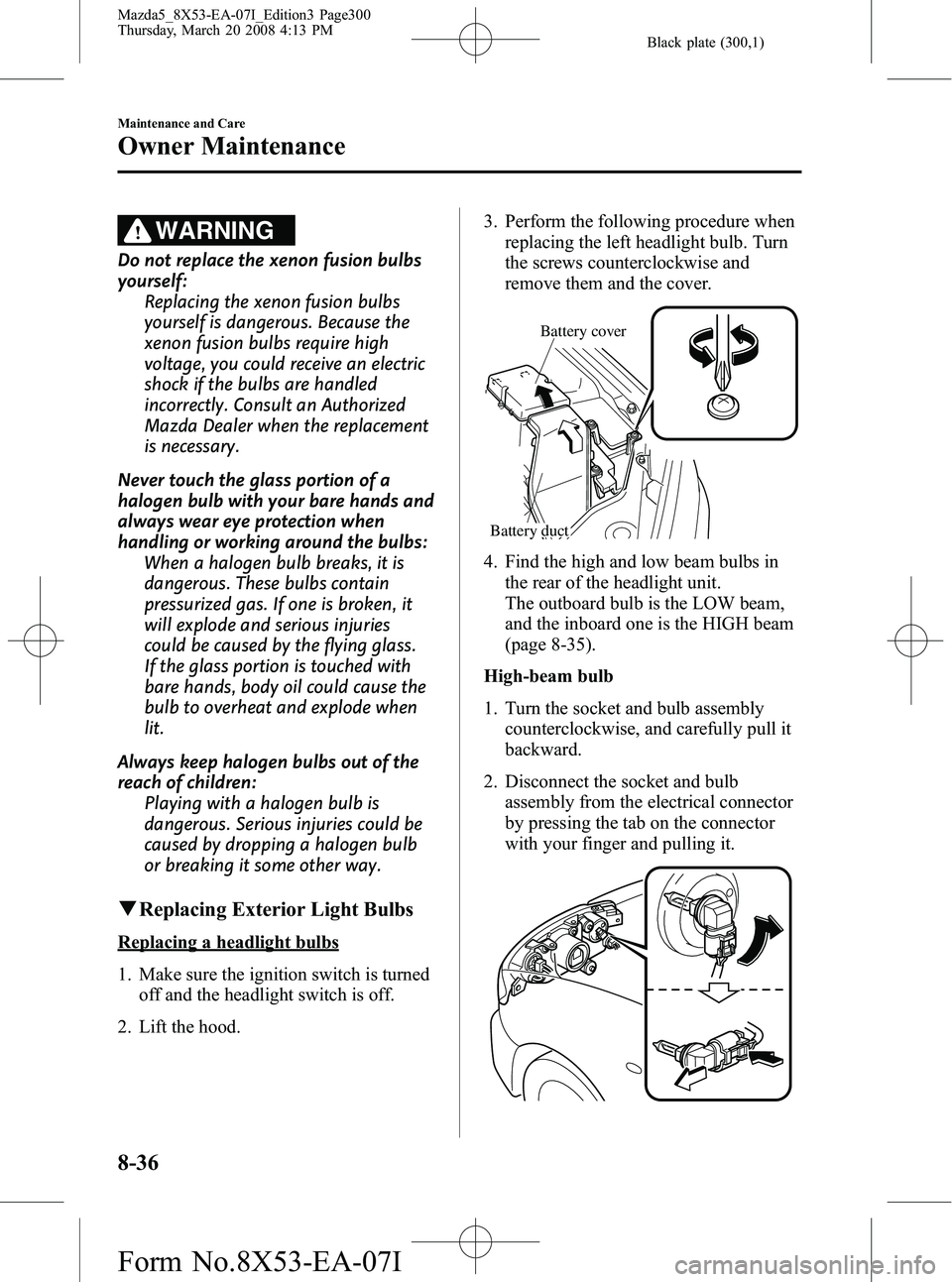
2. Lift the hood. 3. Perform the following procedure when
replacing the left headlight bulb. Turn
the screws counterclockwise and
remove them and the cover.
Battery duct
Battery cover
4. Find the high and low beam bulbs inthe rear of the headlight unit.
The outboard bulb is the LOW beam,
and the inboard one is the HIGH beam
(page 8-35).
High-beam bulb
1. Turn the socket and bulb assembly counterclockwise, and carefully pull it
backward.
2. Disconnect the socket and bulb assembly from the electrical connector
by pressing the tab on the connector
with your finger and pulling it.
8-36
Maintenance and Care
Owner Maintenance
Mazda5_8X53-EA-07I_Edition3 Page300
Thursday, March 20 2008 4:13 PM
Form No.8X53-EA-07I
Page 347 of 376

Black plate (347,1)
qGlossary of Terms
Tire Placard: A label indicating the OE tire sizes, recommended inflation pressure, and
the maximum weight the vehicle can carry.
Tire Identification Number (TIN): A number on the sidewall of each tire providing
information about the tire brand and manufacturing plant, tire size, and date of
manufacture.
Inflation Pressure: A measure of the amount of air in a tire.
kPa: Kilopascal, the metric unit for air pressure.
psi: Pounds per square inch, the English unit for air pressure.
B-pillar: The structural member at the side of the vehicle behind the front door.
Original Equipment (OE): Describes components originally equipped on the vehicle.
Vehicle Load Limit: The maximum value of the combination weight of occupants and
cargo.
Bead Area of the Tire: Area of the tire next to the rim.
Sidewall Area of the Tire: Area between the bead area and the tread.
Tread Area of the Tire: Area on the perimeter of the tire that contacts the road when it's
mounted on the vehicle.
Seating capacity means the total allowable number of vehicle occupants. Seating capacity
is described on the tire label.
Production options weight is the combination weight of installed regular production
options weighing over 2.3 kilograms in excess of the standard items which they replace,
and not previously considered in the curb weight or accessory weight, including heavy
duty brakes, ride levelers, roof rack, heavy duty battery, and special trim.
Rim is the metal support (wheel) for a tire or a tire and tube assembly upon which the tire
beads are seated.
Customer Information
Tire Information (U.S.A.)
9-29
Mazda5_8X53-EA-07I_Edition3 Page347
Thursday, March 20 2008 4:13 PM
Form No.8X53-EA-07I