2008 LINCOLN NAVIGATOR window
[x] Cancel search: windowPage 270 of 352

Fuse/Relay
LocationFuse Amp
RatingPassenger Compartment Fuse Panel
Description
1 30A Smart window #1
2 15A Driver side power seat memory
3 15A FES, Audio rear seat controls, SDARS
4 30A Smart window #2
5 10A Keypad illumination, 3rd row seat enable,
Brake Shift Interlock (BSI), SPDJB
6 20A Turn signals
7 10A Low beam headlamps (left)
8 10A Low beam headlamps (right)
9 15A Interior lights
10 15A Switch backlighting, Puddle lamps
11 10A Not used (Spare)
12 7.5A Power mirror switch, Driver seat switch
13 7.5A Not used (Spare)
14 10A Clock, Power liftgate module – keep-alive
power, Power running board module –
keep-alive power
15 10A Climate control
16 15A Not used (Spare)
17 20A All lock motor feeds, Liftgate release,
Liftglass release
18 20A Not used (Spare)
19 25A Rear wiper
20 15A Adjustable pedals, Datalink
21 15A Fog lamps, Cornering lamps
22 15A Park lamps relay
23 15A High beam headlamps
24 20A Horn relay
25 10A Demand lamps, Glovebox, Visor
26 10A Instrument panel cluster
27 20A Ignition switch
28 5A Radio
2008 Navigator(nav)
Owners Guide (post-2002-fmt)
USA(fus)
Roadside Emergencies
270
Page 271 of 352

Fuse/Relay
LocationFuse Amp
RatingPassenger Compartment Fuse Panel
Description
29 5A Instrument panel cluster
30 5A Not used (Spare)
31 10A Compass, Automatic dimming rear view
mirror
32 10A Restraints control module
33 10A Not used (Spare)
34 5A Not used (spare)
35 10A Rear park assist, 4x4, rear video camera
36 5A PATS transceiver
37 10A Climate control
38 20A Subwoofer/Amp (Audiophile radio), THX
Amp/DSP
39 20A Radio
40 20A THX Amp/DSP
41 15A Not used (Spare)
42 10A Trailer tow battery charge coil
43 10A Rear wiper logic
44 10A Not used (Spare)
45 5A Front wiper logic
46 7.5A Climate control, Auxiliary relay control
47 30A Circuit
BreakerPower windows, Moon roof
48 — Delayed accessory relay
Power distribution box
The power distribution box is located in the engine compartment. The
power distribution box contains high-current fuses that protect your
vehicle’s main electrical systems from overloads.
Always disconnect the battery before servicing high current
fuses.
2008 Navigator(nav)
Owners Guide (post-2002-fmt)
USA(fus)
Roadside Emergencies
271
Page 272 of 352

To reduce risk of electrical shock, always replace the cover to
the Power Distribution Box before reconnecting the battery or
refilling fluid reservoirs.
If the battery has been disconnected and reconnected, refer to the
Batterysection of theMaintenance and Specificationschapter.
The high-current fuses are coded as follows:
Fuse/Relay
LocationFuse Amp
RatingPower Distribution Box Description
1 — Blower relay
2 — Not used
3 — Rear window defroster relay
4 30A** Third row seats (driver side)
5 30A** Trailer tow connector (electric brake)
6 60A ** ABS (valves)
7 40A** Power running boards
8 40A** Heated/cooled seats
9 60A** ABS (pump)
10 20A** Rear console power point
11 30A** Auxiliary blower
12 25A* Trailer tow connector (park lamps)
13 30A* Trailer tow connector (battery charge)
14 — Not used
2008 Navigator(nav)
Owners Guide (post-2002-fmt)
USA(fus)
Roadside Emergencies
272
Page 273 of 352

Fuse/Relay
LocationFuse Amp
RatingPower Distribution Box Description
15 — Not used
16 — A/C clutch relay
17 — Driver side HID headlamp relay
18 — Fuel pump relay
19 — Back-up relay
20 — Trailer tow connector relay (left turn signal)
21 —
Trailer tow connector relay (right turn signal)
22 — Passenger side HID headlamp relay
23 15A* Heated mirrors
24 40A** Blower motor
25 — Not used
26 — Not used
27 30A** Power liftgate
28 40A** Rear window defroster, Heated mirror
29 30A** Passenger seat
30 10A* A/C clutch
31 15A* Brake lamps
32 20A* Fuel pump
33 20A* Back-up lamps
34 25A* Trailer tow connector (stop/turn lamps)
35 20A* 4x4 module
36 10A* Powertrain Control Module (PCM) – Keep
alive power, Canister vent
37 15A* Transmission B+
38 30A** Third row seats (passenger side)
39 60A** Air suspension pump
40 30A** Starter motor
41 20A** IP/Console power point
42 — Not used
43 — Not used
44 20A** Driver side HID headlamp
2008 Navigator(nav)
Owners Guide (post-2002-fmt)
USA(fus)
Roadside Emergencies
273
Page 304 of 352

•For routine cleaning, use Motorcraft Detail Wash (ZC-3-A).
•If tar or grease spots are present, use Motorcraft Bug and Tar
Remover (ZC-42).
•For plastic headlamp lenses, use Motorcraft Ultra Clear Spray Glass
Cleaner (ZC-23).
WINDOWS AND WIPER BLADES
The windshield, rear and side windows and the wiper blades should be
cleaned regularly. If the wipers do not wipe properly, substances on the
vehicle’s glass or the wiper blades may be the cause. These may include
hot wax treatments used by commercial car washes, water repellent
coatings, tree sap, or other organic contamination; these contaminants
may cause squeaking or chatter noise from the blades, and streaking and
smearing of the windshield. To clean these items, follow these tips:
•The windshield, rear windows and side windows may be cleaned with
a non-abrasive cleaner such as Motorcraft Ultra-Clear Spray Glass
Cleaner (ZC-23), available from your authorized dealer.
•The wiper blades can be cleaned with isopropyl (rubbing) alcohol or
Motorcraft Premium Windshield Washer Concentrate (ZC-32-A),
available from your authorized dealer. This washer fluid contains
special solution in addition to alcohol which helps to remove the hot
wax deposited on the wiper blade and windshield from automated car
wash facilities. Be sure to replace wiper blades when they appear
worn or do not function properly.
•Do not use abrasives, as they may cause scratches.
•Do not use fuel, kerosene, or paint thinner to clean any parts.
If you cannot remove those streaks after cleaning with the glass cleaner
or if the wipers chatter and move in a jerky motion, clean the outer
surface of the windshield and the wiper blades using a sponge or soft
cloth with a neutral detergent or mild-abrasive cleaning solution. After
cleaning, rinse the windshield and wiper blades with clean water. The
windshield is clean if beads do not form when you rinse the windshield
with water.
Do not use sharp objects, such as a razor blade, to clean the
inside of the rear window or to remove decals, as it may cause
damage to the rear window defroster’s heated grid lines.
INSTRUMENT PANEL/INTERIOR TRIM AND CLUSTER LENS
Clean the instrument panel, interior trim areas and cluster lens with a
clean and damp white cotton cloth, then with a clean and dry white
2008 Navigator(nav)
Owners Guide (post-2002-fmt)
USA(fus)
Cleaning
304
Page 311 of 352

CHANGING THE WIPER BLADES
It is recommended that wiper blades are renewed before winter.
To replace the wiper blades:
1. Fold back the wiper arm and
position the wiper blade at right
angles to the wiper arm.
2. To remove, press the retaining
clip (A) to disengage the wiper
blade, then pull the blade down
toward the windshield to remove it
from the arm.
3. Install the new wiper blade on the
arm and press it into place until a click is heard.
Replace wiper blades at least once per year for optimum performance.
Poor wiper quality can be improved by cleaning the wiper blades and
windshield, refer toWindows and wiper bladesin theCleaning
chapter.
To prolong the life of the wiper blades, it is highly recommended to
scrape off the ice on the windshield before turning on the wipers. The
layer of ice has many sharp edges and can damage the micro edge of the
wiper rubber element.
Changing the rear window wiper blade
To replace the rear wiper blade:
1. Pull the wiper arm as far away from the glass as possible. Do not use
excessive force because it can break the wiper arm. Hold it there until
the next step.
2. Grasp the wiper blade and rotate
it away from the wiper arm using
moderate force until it disengages
from the wiper arm.
3. Once the wiper blade is loose,
slide it away form the wiper arm.
2008 Navigator(nav)
Owners Guide (post-2002-fmt)
USA(fus)
Maintenance and Specifications
311
Page 331 of 352

•Fuel economy may decrease with lower temperatures during the first
8–10 miles (12–16 km) of driving.
•Driving on flat terrain offers improved fuel economy as compared to
driving on hilly terrain.
•Transmissions give their best fuel economy when operated in the top
cruise gear and with steady pressure on the gas pedal.
•Four-wheel-drive operation (if equipped) is less fuel efficient than
two-wheel-drive operation.
•Close windows for high speed driving.
EPA window sticker
The characteristics of the four wheel drive vehicle, like those of many,
similar competitive products, fit within categories where the fuel
economy labeling regulations do not apply. Therefore, the following
information applies only to the two wheel drive vehicle.
Every new vehicle should have the EPA window sticker. Contact your
authorized dealer if the window sticker is not supplied with your vehicle.
The EPA window sticker should be your guide for the fuel economy
comparisons with other vehicles.
It is important to note the box in the lower left corner of the window
sticker. These numbers represent the range of fuel economy expected on
the vehicle under optimum conditions. Your fuel economy may vary
depending upon the method of operation and conditions.
EMISSION CONTROL SYSTEM
Your vehicle is equipped with various emission control components and a
catalytic converter which will enable your vehicle to comply with
applicable exhaust emission standards. To make sure that the catalytic
converter and other emission control components continue to work
properly:
•Use only the specified fuel listed.
•Avoid running out of fuel.
•Do not turn off the ignition while your vehicle is moving, especially at
high speeds.
•Have the items listed inscheduled maintenance information
performed according to the specified schedule.
The scheduled maintenance items listed inscheduled maintenance
informationare essential to the life and performance of your vehicle
and to its emissions system.
2008 Navigator(nav)
Owners Guide (post-2002-fmt)
USA(fus)
Maintenance and Specifications
331
Page 348 of 352
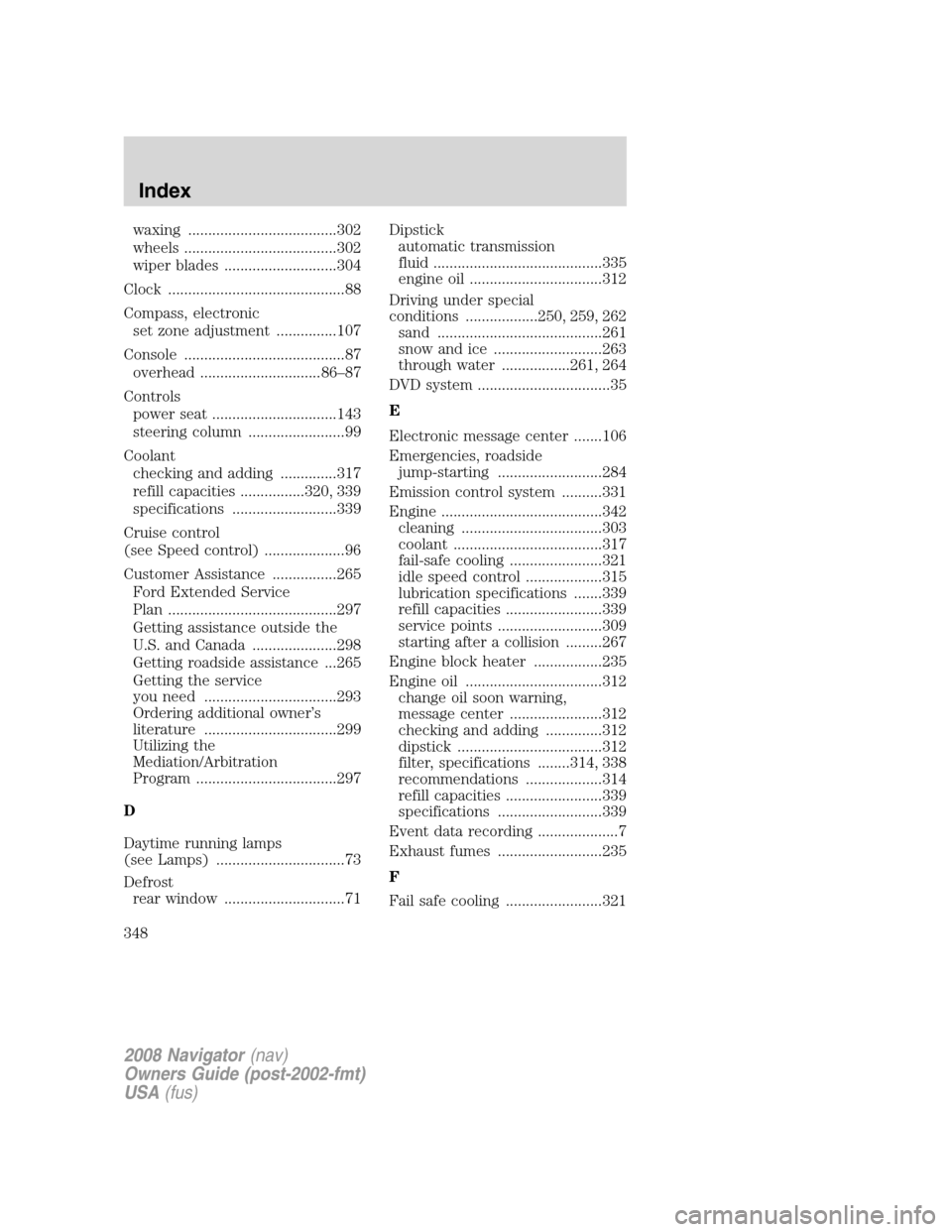
waxing .....................................302
wheels ......................................302
wiper blades ............................304
Clock ............................................88
Compass, electronic
set zone adjustment ...............107
Console ........................................87
overhead ..............................86–87
Controls
power seat ...............................143
steering column ........................99
Coolant
checking and adding ..............317
refill capacities ................320, 339
specifications ..........................339
Cruise control
(see Speed control) ....................96
Customer Assistance ................265
Ford Extended Service
Plan ..........................................297
Getting assistance outside the
U.S. and Canada .....................298
Getting roadside assistance ...265
Getting the service
you need .................................293
Ordering additional owner’s
literature .................................299
Utilizing the
Mediation/Arbitration
Program ...................................297
D
Daytime running lamps
(see Lamps) ................................73
Defrost
rear window ..............................71Dipstick
automatic transmission
fluid ..........................................335
engine oil .................................312
Driving under special
conditions ..................250, 259, 262
sand .........................................261
snow and ice ...........................263
through water .................261, 264
DVD system .................................35
E
Electronic message center .......106
Emergencies, roadside
jump-starting ..........................284
Emission control system ..........331
Engine ........................................342
cleaning ...................................303
coolant .....................................317
fail-safe cooling .......................321
idle speed control ...................315
lubrication specifications .......339
refill capacities ........................339
service points ..........................309
starting after a collision .........267
Engine block heater .................235
Engine oil ..................................312
change oil soon warning,
message center .......................312
checking and adding ..............312
dipstick ....................................312
filter, specifications ........314, 338
recommendations ...................314
refill capacities ........................339
specifications ..........................339
Event data recording ....................7
Exhaust fumes ..........................235
F
Fail safe cooling ........................321
2008 Navigator(nav)
Owners Guide (post-2002-fmt)
USA(fus)
Index
348