Page 275 of 352

Fuse/Relay
LocationFuse Amp
RatingPower Distribution Box Description
75 5A* 4x4 Integrated Wheel Ends (IWE) solenoid
76 20A* PCM – VPWR
77 10A* ABS logic, Heated PCV
* Mini Fuses ** Cartridge Fuses
CHANGING THE TIRES
If you get a flat tire while driving, do not apply the brake heavily.
Instead, gradually decrease your speed. Hold the steering wheel firmly
and slowly move to a safe place on the side of the road.
Note:The tire pressure monitoring system (TPMS) indicator light will
illuminate when the spare tire is in use. To restore the full functionality
of the monitoring system, all road wheels equipped with tire pressure
monitoring sensors must be mounted on the vehicle.
Have a flat serviced by an authorized dealer in order to prevent damage
to the TPMS sensors, refer toTire Pressure Monitoring System
(TPMS)in theTires, Wheels and Loadingchapter. Replace the spare
tire with a road tire as soon as possible.
The use of tire sealants may damage your Tire Pressure
Monitoring System and should not be used.
Refer toTire Pressure Monitoring System (TPMS)in theTires,
Wheels and Loadingchapter for important information. If the tire
pressure monitor sensor becomes damaged, it will no longer function.
Dissimilar spare tire/wheel information
Failure to follow these guidelines could result in an increased
risk of loss of vehicle control, injury or death.
If you have a dissimilar spare tire/wheel, then it is intended for
temporary use only. This means that if you need to use it, you should
replace it as soon as possible with a road tire/wheel that is the same size
and type as the road tires and wheels that were originally provided by
Ford. If the dissimilar spare tire or wheel is damaged, it should be
replaced rather than repaired.
2008 Navigator(nav)
Owners Guide (post-2002-fmt)
USA(fus)
Roadside Emergencies
275
Page 276 of 352

A dissimilar spare tire/wheel is defined as a spare tire and/or wheel that
is different in brand, size or appearance from the road tires and wheels
and can be one of three types:
1.T-type mini-spare:This spare tire begins with the letter “T” for tire
size and may have “Temporary Use Only” molded in the sidewall
2.Full-size dissimilar spare with label on wheel:This spare tire has
a label on the wheel that states: “THIS TIRE AND WHEEL FOR
TEMPORARY USE ONLY”
When driving with one of the dissimilar spare tires listed above,do not:
•Exceed 50 mph (80 km/h)
•Load the vehicle beyond maximum vehicle load rating listed on the
Safety Compliance Label
•Tow a trailer
•Use snow chains on the end of the vehicle with the dissimilar spare
tire
•Use more than one dissimilar spare tire at a time
•Use commercial car washing equipment
•Try to repair the dissimilar spare tire
Use of one of the dissimilar spare tires listed above at any one wheel
location can lead to impairment of the following:
•Handling, stability and braking performance
•Comfort and noise
•Ground clearance and parking at curbs
•Winter weather driving capability
•Wet weather driving capability
3.Full-size dissimilar spare without label on wheel
When driving with the full-size dissimilar spare tire/wheel,do not:
•Exceed 70 mph (113 km/h)
•Use more than one dissimilar spare tire/wheel at a time
•Use commercial car washing equipment
•Use snow chains on the end of the vehicle with the dissimilar spare
tire/wheel
2008 Navigator(nav)
Owners Guide (post-2002-fmt)
USA(fus)
Roadside Emergencies
276
Page 330 of 352

•Idling for long periods of time (greater than one minute) may waste
fuel.
•Anticipate stopping; slowing down may eliminate the need to stop.
•Sudden or hard accelerations may reduce fuel economy.
•Slow down gradually.
•Driving at reasonable speeds (traveling at 55 mph [88 km/h] uses 15%
less fuel than traveling at 65 mph [105 km/h]).
•Revving the engine before turning it off may reduce fuel economy.
•Using the air conditioner or defroster may reduce fuel economy.
•You may want to turn off the speed control in hilly terrain if
unnecessary shifting between the top gears occurs. Unnecessary
shifting of this type could result in reduced fuel economy.
•Warming up a vehicle on cold mornings is not required and may
reduce fuel economy.
•Resting your foot on the brake pedal while driving may reduce fuel
economy.
•Combine errands and minimize stop-and-go driving.
Maintenance
•Keep tires properly inflated and use only recommended size.
•Operating a vehicle with the wheels out of alignment will reduce fuel
economy.
•Use recommended engine oil. Refer toMaintenance product
specifications and capacitiesin this chapter.
•Perform all regularly scheduled maintenance items. Follow the
recommended maintenance schedule and owner maintenance checks
found inscheduled maintenance information.
Conditions
•Heavily loading a vehicle or towing a trailer may reduce fuel economy
at any speed.
•Carrying unnecessary weight may reduce fuel economy (as much as
1 mpg [0.4 km/L] is lost for every 400 lb [180 kg] of weight carried).
•Adding certain accessories to your vehicle (for example; bug
deflectors, rollbars/light bars, running boards, ski/luggage racks) may
reduce fuel economy.
•Using fuel blended with alcohol may lower fuel economy.
2008 Navigator(nav)
Owners Guide (post-2002-fmt)
USA(fus)
Maintenance and Specifications
330
Page 351 of 352
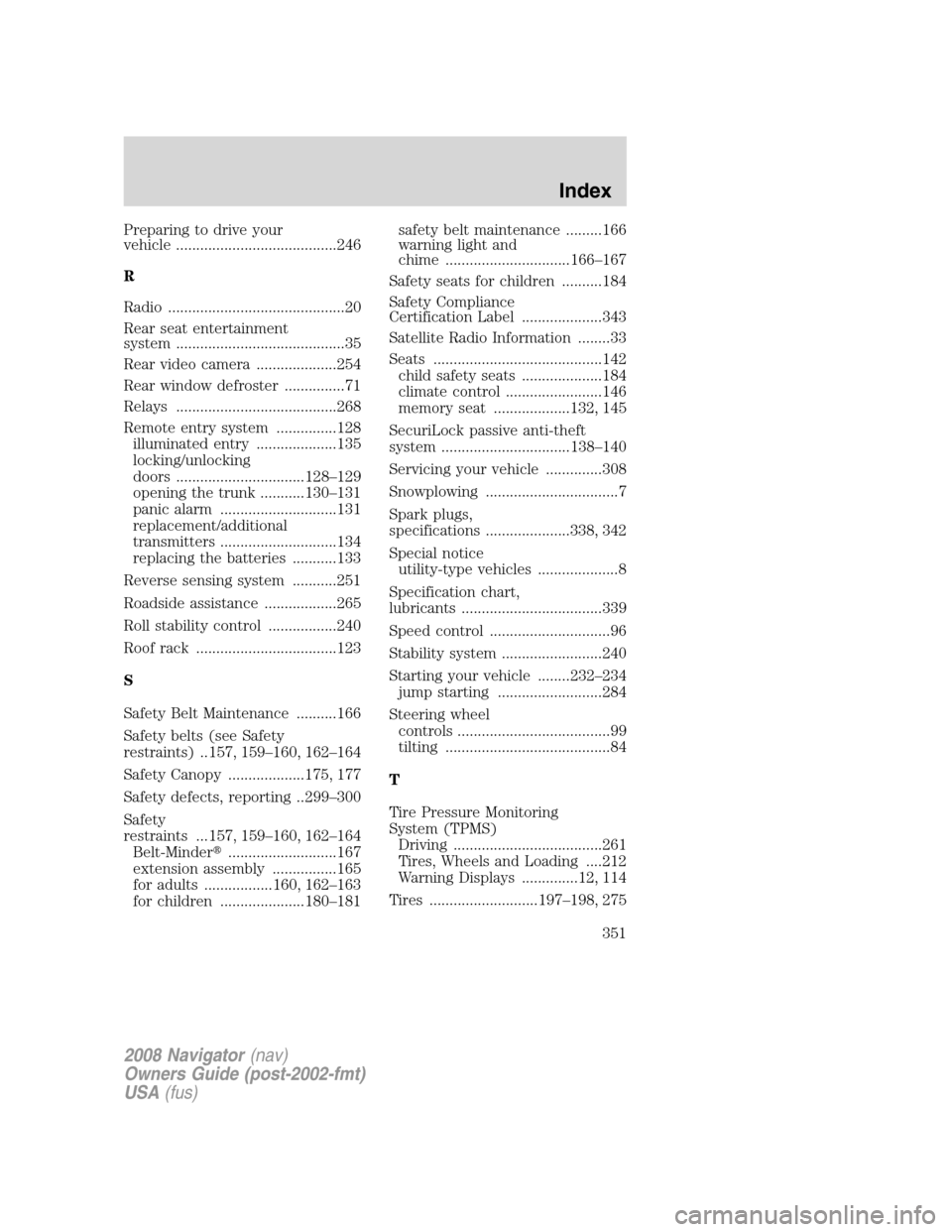
Preparing to drive your
vehicle ........................................246
R
Radio ............................................20
Rear seat entertainment
system ..........................................35
Rear video camera ....................254
Rear window defroster ...............71
Relays ........................................268
Remote entry system ...............128
illuminated entry ....................135
locking/unlocking
doors ................................128–129
opening the trunk ...........130–131
panic alarm .............................131
replacement/additional
transmitters .............................134
replacing the batteries ...........133
Reverse sensing system ...........251
Roadside assistance ..................265
Roll stability control .................240
Roof rack ...................................123
S
Safety Belt Maintenance ..........166
Safety belts (see Safety
restraints) ..157, 159–160, 162–164
Safety Canopy ...................175, 177
Safety defects, reporting ..299–300
Safety
restraints ...157, 159–160, 162–164
Belt-Minder�...........................167
extension assembly ................165
for adults .................160, 162–163
for children .....................180–181safety belt maintenance .........166
warning light and
chime ...............................166–167
Safety seats for children ..........184
Safety Compliance
Certification Label ....................343
Satellite Radio Information ........33
Seats ..........................................142
child safety seats ....................184
climate control ........................146
memory seat ...................132, 145
SecuriLock passive anti-theft
system ................................138–140
Servicing your vehicle ..............308
Snowplowing .................................7
Spark plugs,
specifications .....................338, 342
Special notice
utility-type vehicles ....................8
Specification chart,
lubricants ...................................339
Speed control ..............................96
Stability system .........................240
Starting your vehicle ........232–234
jump starting ..........................284
Steering wheel
controls ......................................99
tilting .........................................84
T
Tire Pressure Monitoring
System (TPMS)
Driving .....................................261
Tires, Wheels and Loading ....212
Warning Displays ..............12, 114
Tires ...........................197–198, 275
2008 Navigator(nav)
Owners Guide (post-2002-fmt)
USA(fus)
Index
351
Page:
< prev 1-8 9-16 17-24