2008 LINCOLN MARK LT steering wheel
[x] Cancel search: steering wheelPage 235 of 328

Descend a hill in the same gear you
would use to climb up the hill to
avoid excessive brake application
and brake overheating. Do not
descend in neutral; instead,
disengage overdrive or manually
shift to a lower gear. When
descending a steep hill, avoid
sudden hard braking as you could
lose control. When you brake hard,
the front wheels can’t turn and if
they aren’t turning, you won’t be
able to steer. The front wheels have to be turning in order to steer the
vehicle. Rapid pumping of the brake pedal will help you slow the vehicle
and still maintain steering control.
Apply the brakes steadily. Do not “pump” the brakes.
Driving on snow and ice
4WD vehicles have advantages over 2WD vehicles in snow and ice but
can skid like any other vehicle.
Should you start to slide while driving on snowy or icy roads, turn the
steering wheel in the direction of the slide until you regain control.
Avoid sudden applications of power and quick changes of direction on
snow and ice. Apply the accelerator slowly and steadily when starting
from a full stop.
Avoid sudden braking as well. Although a 4WD vehicle may accelerate
better than a two-wheel drive vehicle in snow and ice, it won’t stop any
faster, because as in other vehicles, braking occurs at all four wheels. Do
not become overconfident as to road conditions.
Make sure you allow sufficient distance between you and other vehicles
for stopping. Drive slower than usual and consider using one of the lower
gears. In emergency stopping situations, apply the brake steadily. Do not
“pump” the brakes. Refer to theBrakessection of this chapter for
additional information on the operation of the Anti-lock Brake System
(ABS).
Never drive with chains on the front tires of 4WD vehicles without also
putting them on the rear tires. This could cause the rear to slide and
swing around during braking.
2008 Mark LT(mlt)
Owners Guide (post-2002-fmt)
USA(fus)
Driving
235
Page 236 of 328

Maintenance and Modifications
The suspension and steering systems on your vehicle have been designed
and tested to provide predictable performance whether loaded or empty
and durable load carrying capability. For this reason, Ford Motor
Company strongly recommends that you do not make modifications such
as adding or removing parts (such as lift kits or stabilizer bars) or by
using replacement parts not equivalent to the original factory equipment.
A
ny modifications to a vehicle that raise the center of gravity can make it
more likely the vehicle will roll over as a result of a loss of control. Ford
Motor Company recommends that caution be used with any vehicle equipped
with a high load or device (such as ladder racks or pickup box cover).
Failure to maintain your vehicle properly may void the warranty, increase
your repair cost, reduce vehicle performance and operational capabilities
and adversely affect driver and passenger safety. Frequent inspection of
vehicle chassis components is recommended if the vehicle is subjected to
heavy off-road usage.
DRIVING THROUGH WATER
If driving through deep or standing
water is unavoidable, proceed very
slowly especially when the depth is
not known. Never drive through
water that is higher than the bottom
of the wheel rims (for cars) or the
bottom of the hubs (for trucks).
When driving through water, traction or brake capability may be limited.
Also, water may enter your engine’s air intake and severely damage your
engine or your vehicle may stall.Driving through deep water where
the transmission vent tube is submerged may allow water into the
transmission and cause internal transmission damage.
Once through the water, always dry the brakes by moving your
vehicle slowly while applying light pressure on the brake pedal.
Wet brakes do not stop the vehicle as quickly as dry brakes.
SNOWPLOWING
Your vehicle is not recommended for snowplowing. Ford makes no
representation as to the suitability of your vehicle for snowplowing, in
particular regarding the potential for exceeding vehicle weight limits,
airbag (SRS) deployment sensitivity, vehicle crash integrity, or
powertrain durability. The Snowplow Package Option is not available.
2008 Mark LT(mlt)
Owners Guide (post-2002-fmt)
USA(fus)
Driving
236
Page 239 of 328

HAZARD FLASHER CONTROL
The hazard flasher is located on the
steering column, just behind the
steering wheel. The hazard flashers
will operate when the ignition is in
any position or if the key is not in
the ignition.
Push in the flasher control and all
front and rear direction signals will
flash. Press the flasher control again
to turn them off. Use it when your
vehicle is disabled and is creating a
safety hazard for other motorists.
Note:With extended use, the flasher may run down your battery.
FUEL PUMP SHUT-OFF SWITCH
This device stops the electric fuel pump from sending fuel to the engine
when your vehicle has had a substantial jolt.
After an accident, if the engine cranks but does not start, this switch
may have been activated.
2008 Mark LT(mlt)
Owners Guide (post-2002-fmt)
USA(fus)
Roadside Emergencies
239
Page 247 of 328

•Without Daytime Running Lamp (DRL) and 4x4 options
The relays are coded as follows:
Fuse/Relay
LocationFuse Amp
RatingDescription
F03 5A Clockspring illumination
R01 Full ISO
Relay4x4 CCW
R02 Full ISO
Relay4x4 CW
R03
12ISO
RelayDaytime Running Lamps (DRL) high beam
disable
R201 Relay DRL
R202 Relay A/C clutch
D01 Diode A/C clutch
D02 Diode One Touch Integrated Start (OTIS)
CHANGING THE TIRES
If you get a flat tire while driving, do not apply the brake heavily.
Instead, gradually decrease your speed. Hold the steering wheel firmly
and slowly move to a safe place on the side of the road.
Note:The tire pressure monitoring system (TPMS) indicator light will
illuminate when the spare tire is in use. To restore the full functionality
of the monitoring system, all road wheels equipped with tire pressure
monitoring sensors must be mounted on the vehicle.
Have a flat serviced by an authorized dealer in order to prevent damage
to the TPMS sensors, refer toTire Pressure Monitoring System
(TPMS)in theTires, Wheels and Loadingchapter. Replace the spare
tire with a road tire as soon as possible.
2008 Mark LT(mlt)
Owners Guide (post-2002-fmt)
USA(fus)
Roadside Emergencies
247
Page 275 of 328

INSTRUMENT PANEL/INTERIOR TRIM AND CLUSTER LENS
Clean the instrument panel, interior trim areas and cluster lens with a
clean and damp white cotton cloth, then with a clean and dry white
cotton cloth; you may also use Motorcraft Dash & Vinyl Cleaner
(ZC-38-A) on the instrument panel and interior trim areas.
•Avoid cleaners or polishes that increase the gloss of the upper portion
of the instrument panel. The dull finish in this area helps protect the
driver from undesirable windshield reflection.
•Be certain to wash or wipe your hands clean if you have been in
contact with certain products such as insect repellent and suntan
lotion in order to avoid possible damage to the interior painted
surfaces.
•Do not use household or glass cleaners as these may damage the
finish of the instrument panel, interior trim and cluster lens.
Do not use chemical solvents or strong detergents when cleaning
the steering wheel or instrument panel to avoid contamination of
the airbag system.
If a staining liquid like coffee/juice has been spilled on the instrument
panel or on interior trim surfaces, clean as follows:
1. Wipe up spilled liquid using a clean, white, cotton cloth.
2. Apply Motorcraft Deluxe Leather and Vinyl Cleaner (ZC-11-A) [In
Canada use Motorcraft Multi-Purpose Cleaner (CXC-101)] to the wiped
area and spread around evenly.
3. Apply more Motorcraft cleaner to a clean, white, cotton cloth and
press the cloth onto the soiled area–allow this to set at room
temperature for 30 minutes.
4. Remove the soaked cloth, and if it is not soiled badly, use this cloth to
clean the area by using a rubbing motion for 60 seconds.
5. Following this, wipe area dry with a clean, white, cotton cloth.
2008 Mark LT(mlt)
Owners Guide (post-2002-fmt)
USA(fus)
Cleaning
275
Page 304 of 328

The OBD-II system is designed to check the emission control system
during normal driving. A complete check may take several days. If the
vehicle is not ready for I/M testing, the following driving cycle consisting
of mixed city and highway driving may be performed:
15 minutes of steady driving on an expressway/highway followed by 20
minutes of stop-and-go driving with at least four 30-second idle periods.
Allow the vehicle to sit for at least eight hours without starting the
engine. Then, start the engine and complete the above driving cycle. The
engine must warm up to its normal operating temperature. Once started,
do not turn off the engine until the above driving cycle is complete. If
the vehicle is still not ready for I/M testing, the above driving cycle will
have to be repeated.
POWER STEERING FLUID
Check the power steering fluid. Refer to thescheduled maintenance
informationfor the service interval schedules.
1. Start the engine and let it run
until it reaches normal operating
temperature (the engine coolant
temperature gauge indicator will be
near the center of the normal area
between H and C).
2. While the engine idles, turn the
steering wheel left and right several
times.
3. Turn the engine off.
4. Check the fluid level in the reservoir. It should be between the MIN
and MAX lines. Do not add fluid if the level is in this range.
5. If the fluid is low, add fluid in small amounts, continuously checking
the level until it reaches the range between the MIN and MAX lines. Be
sure to put the cap back on the reservoir. Refer toMaintenance
product specifications and capacitiesin this chapter for the proper
fluid type.
2008 Mark LT(mlt)
Owners Guide (post-2002-fmt)
USA(fus)
Maintenance and Specifications
304
Page 321 of 328

instrument panel ....................275
interior .....................................276
plastic parts ............................273
safety belts ..............................276
washing ....................................271
waxing .....................................272
wheels ......................................272
wiper blades ............................274
Climate control (see Air
conditioning or Heating) ............68
Clock adjust
6-CD in dash .............................25
Compass, electronic
set zone adjustment ...............103
Console ........................................83
overhead ....................................84
Controls
power seat ...............................136
steering column ........................96
Coolant
checking and adding ..............287
refill capacities ................291, 311
specifications ..........................311
Cruise control
(see Speed control) ....................93
Customer Assistance ................237
Ford Extended Service
Plan ..........................................267
Getting assistance outside the
U.S. and Canada .....................268
Getting roadside assistance ...237
Getting the service you
need .........................................263
Ordering additional owner’s
literature .................................269
Utilizing the
Mediation/Arbitration
Program ...................................267D
Daytime running lamps
(see Lamps) ................................73
Dipstick
automatic transmission
fluid ..........................................305
engine oil .................................282
Driveline universal joint and
slip yoke ....................................308
Driving under special
conditions ..................223, 231, 234
sand .........................................233
snow and ice ...........................235
through water .................233, 236
DVD system .................................38
E
Electronic message center .......102
Emergencies, roadside
jump-starting ..........................255
Emergency Flashers .................239
Emission control system ..........301
Engine ................................314–315
cleaning ...................................273
coolant .....................................287
fail-safe cooling .......................292
idle speed control ...................285
lubrication specifications .......311
refill capacities ........................311
service points ..................280–281
starting after a collision .........239
Engine block heater .................213
Engine oil ..................................282
change oil soon warning,
message center .......................282
checking and adding ..............282
dipstick ....................................282
2008 Mark LT(mlt)
Owners Guide (post-2002-fmt)
USA(fus)
Index
321
Page 325 of 328
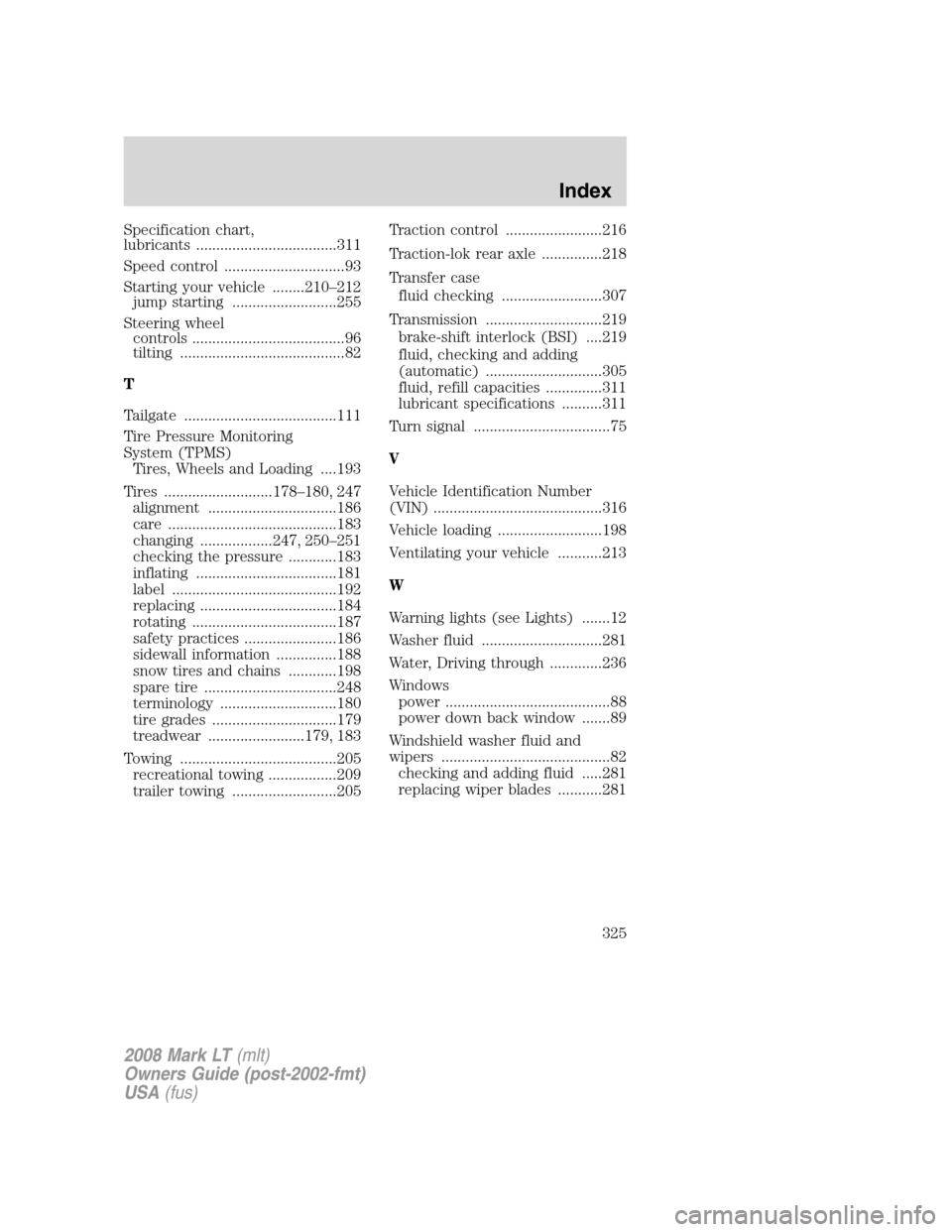
Specification chart,
lubricants ...................................311
Speed control ..............................93
Starting your vehicle ........210–212
jump starting ..........................255
Steering wheel
controls ......................................96
tilting .........................................82
T
Tailgate ......................................111
Tire Pressure Monitoring
System (TPMS)
Tires, Wheels and Loading ....193
Tires ...........................178–180, 247
alignment ................................186
care ..........................................183
changing ..................247, 250–251
checking the pressure ............183
inflating ...................................181
label .........................................192
replacing ..................................184
rotating ....................................187
safety practices .......................186
sidewall information ...............188
snow tires and chains ............198
spare tire .................................248
terminology .............................180
tire grades ...............................179
treadwear ........................179, 183
Towing .......................................205
recreational towing .................209
trailer towing ..........................205Traction control ........................216
Traction-lok rear axle ...............218
Transfer case
fluid checking .........................307
Transmission .............................219
brake-shift interlock (BSI) ....219
fluid, checking and adding
(automatic) .............................305
fluid, refill capacities ..............311
lubricant specifications ..........311
Turn signal ..................................75
V
Vehicle Identification Number
(VIN) ..........................................316
Vehicle loading ..........................198
Ventilating your vehicle ...........213
W
Warning lights (see Lights) .......12
Washer fluid ..............................281
Water, Driving through .............236
Windows
power .........................................88
power down back window .......89
Windshield washer fluid and
wipers ..........................................82
checking and adding fluid .....281
replacing wiper blades ...........281
2008 Mark LT(mlt)
Owners Guide (post-2002-fmt)
USA(fus)
Index
325