Page 342 of 487
340
4-3. Do-it-yourself maintenance
RX400h_U
Tire inflation pressure
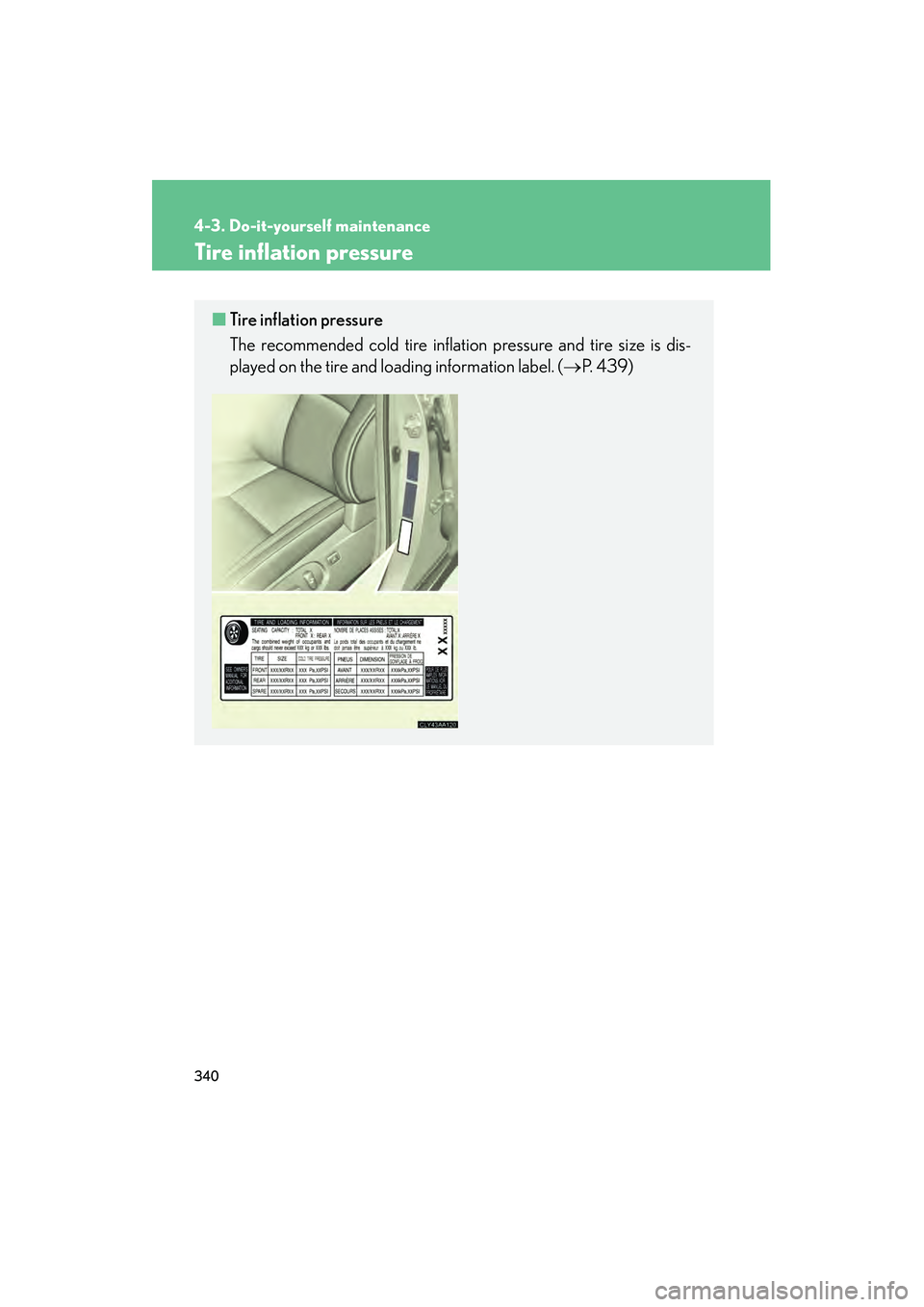
■Tire inflation pressure
The recommended cold tire inflation pressure and tire size is dis-
played on the tire and loading information label. ( →P. 4 3 9 )
Page 346 of 487

344
4-3. Do-it-yourself maintenance
RX400h_U
Wheels
■When replacing wheels
The wheels of your Lexus are equipped with tire pressure warning valves and trans-
mitters that allow the tire pressure warning system to provide advanced warning in
the event of a loss in tire inflation pressure. Whenever wheels are replaced, the tire
pressure warning valves and transmitters must be installed. (→P. 3 3 2 )
If a wheel is bent, cracked or heavily corroded, it should be replaced. Oth-
erwise, the tire may separate from the wheel or cause loss of handling con-
trol.
■Wheel selection
When replacing wheels, care should be taken to ensure that they
are equivalent to those removed in load capacity, diameter, rim
width, and offset.
Replacement wheels are available at your Lexus dealer.
Lexus does not recommend using:
• Wheels of different sizes or types
• Used wheels
• Bent wheels that have been straightened
■ Aluminum wheel precautions
● Use only Lexus wheel nuts and wrenches designed for use with
your aluminum wheels.
● When rotating, repairing or changing your tires, check that the
wheel nuts are still tight after driving 1000 miles (1600 km).
● Be careful not to damage the aluminum wheels when using tire
chains.
● Use only Lexus genuine balance weights or equivalent and a
plastic or rubber hammer when balancing your wheels.
Page 347 of 487
345
4-3. Do-it-yourself maintenance
4
Maintenance and care
RX400h_U
CAUTION
■When replacing wheels
●Do not use wheels that are a different size from those recommended in the
Owner’s Manual, as this may result in loss of handling control.
●Never use an inner tube in a leaking wheel which is designed for a tubeless tire.
Doing so may result in an accident, causing serious injury or death.
NOTICE
■Replacing tire pressure warning valves and transmitters
●Because tire repair or replacement may affect the tire pressure warning valves
and transmitters, make sure to have tires serviced by your Lexus dealer or other
qualified service shop. In addition, make sure to purchase your tire pressure
warning valves and transmitters at your Lexus dealer.
●Ensure that only genuine Lexus wheels are used on your vehicle.
Tire pressure warning valves and transmitters may not work properly with non-
genuine wheels.
Page 398 of 487

396
5-2. Steps to take in an emergency
RX400h_U
CAUTION
■Maintenance of the tires
Each tire, including the spare (if provided), should be checked monthly when cold
and inflated to the inflation pressure recommended by the vehicle manufacturer on
the vehicle placard or tire inflation pressure label (tire and load information label).
(If your vehicle has tires of a different size than the size indicated on the vehicle
placard or tire inflation pressure label [tire and load information label], you should
determine the proper tire inflation pressure for those tires.)
As an added safety feature, your vehicle has been equipped with a tire pressure
monitoring system (TPMS-tire pressure warning system) that illuminates a low tire
pressure telltale (tire pressure warning light) when one or more of your tires is sig-
nificantly under-inflated. Accordingly, when the low tire pressure telltale (tire pres-
sure warning light) illuminates, you should stop and check your tires as soon as
possible, and inflate them to the proper pressure. Driving on a significantly under-
inflated tire causes the tire to overheat and can lead to tire failure. Under-inflation
also reduces fuel efficiency and tire tread life, and may affect the vehicle's handling
and stopping ability.
Please note that the TPMS (tire pressure warning system) is not a substitute for
proper tire maintenance, and it is the driver's responsibility to maintain correct tire
pressure, even if under-inflation has not reached the level to trigger illumination of
the TPMS low tire pressure telltale (tire pressure warning light).
Your vehicle has also been equipped with a TPMS (tire pressure warning system)
malfunction indicator to indicate when the system is not operating properly. The
TPMS (tire pressure warning system) malfunction indicator is combined with the
low tire pressure telltale (tire pressure warning light). When the system detects a
malfunction, the telltale will flash for approximately one minute and then remain
continuously illuminated. This sequence will continue upon subsequent vehicle
start-ups as long as the malfunction exists. When the malfunction indicator is illumi-
nated, the system may not be able to detect or signal low tire pressure as intended.
TPMS (tire pressure warning system) malfunctions may occur for a variety of rea-
sons, including the installation of replacement or alternate tires or wheels on the
vehicle that prevent the TPMS (tire pressure warning system) from functioning
properly. Always check the TPMS (tire pressure warning system) malfunction tell-
tale after replacing one or more tires or wheels on your vehicle to ensure that the
replacement or alternate tires and wheels allow the TPMS (tire pressure warning
system) to continue to function properly.
Page 441 of 487
439
6-1. Specifications
6
Vehicle specifications
RX400h_U
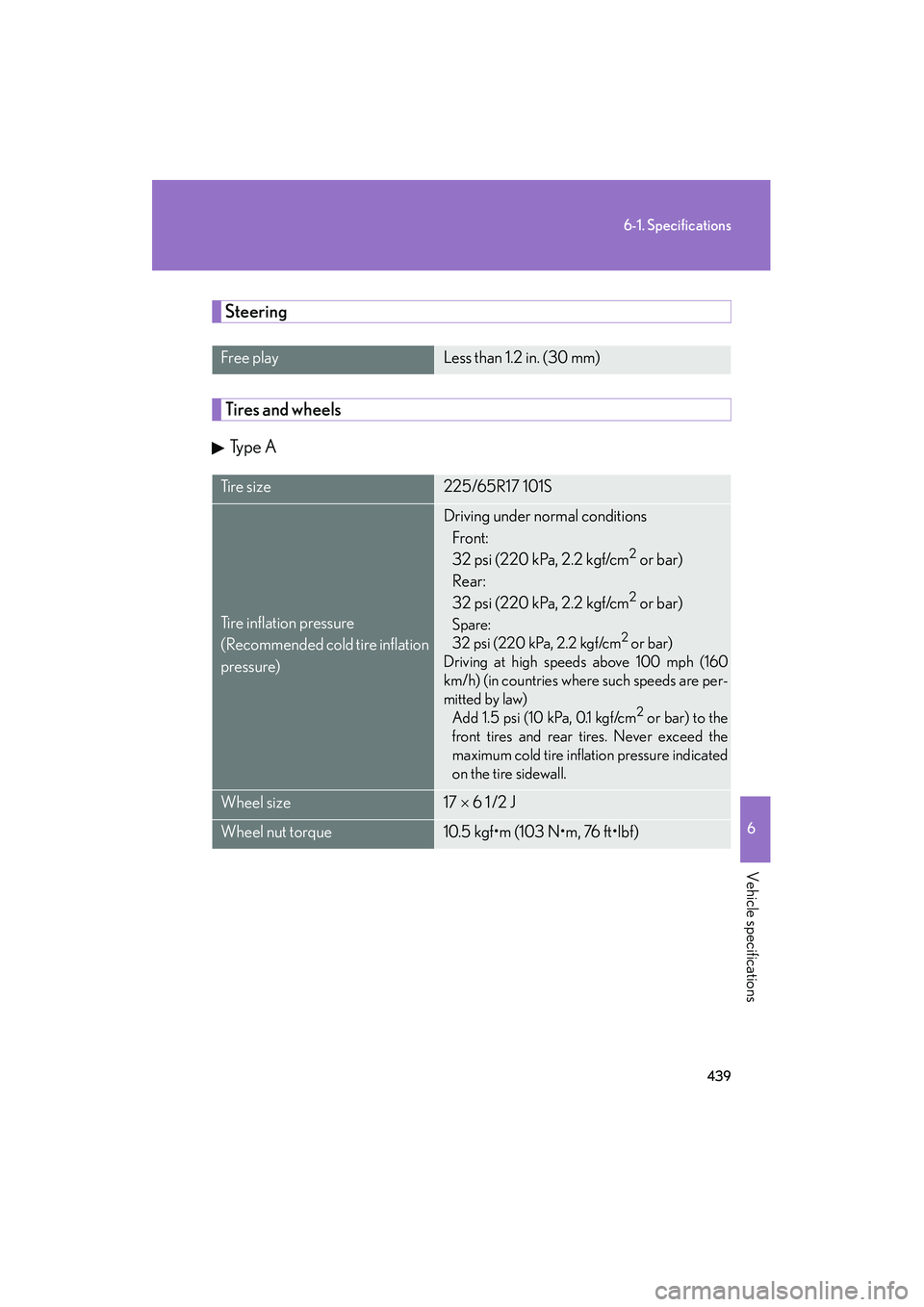
Steering
Tires and wheelsType A
Free playLess than 1.2 in. (30 mm)
Ti r e s i z e225/65R17 101S
Tire inflation pressure
(Recommended cold tire inflation
pressure)
Driving under normal conditions Front:
32 psi (220 kPa, 2.2 kgf/cm
2 or bar)
Rear:
32 psi (220 kPa, 2.2 kgf/cm
2 or bar)
Spare:
32 psi (220 kPa, 2.2 kgf/cm2 or bar)
Driving at high speeds above 100 mph (160
km/h) (in countries where such speeds are per-
mitted by law) Add 1.5 psi (10 kPa, 0.1 kgf/cm
2 or bar) to the
front tires and rear tires. Never exceed the
maximum cold tire inflation pressure indicated
on the tire sidewall.
Wheel size17 × 6 1 /2 J
Wheel nut torque10.5 kgf•m (103 N•m, 76 ft•lbf)
Page 442 of 487
440
6-1. Specifications
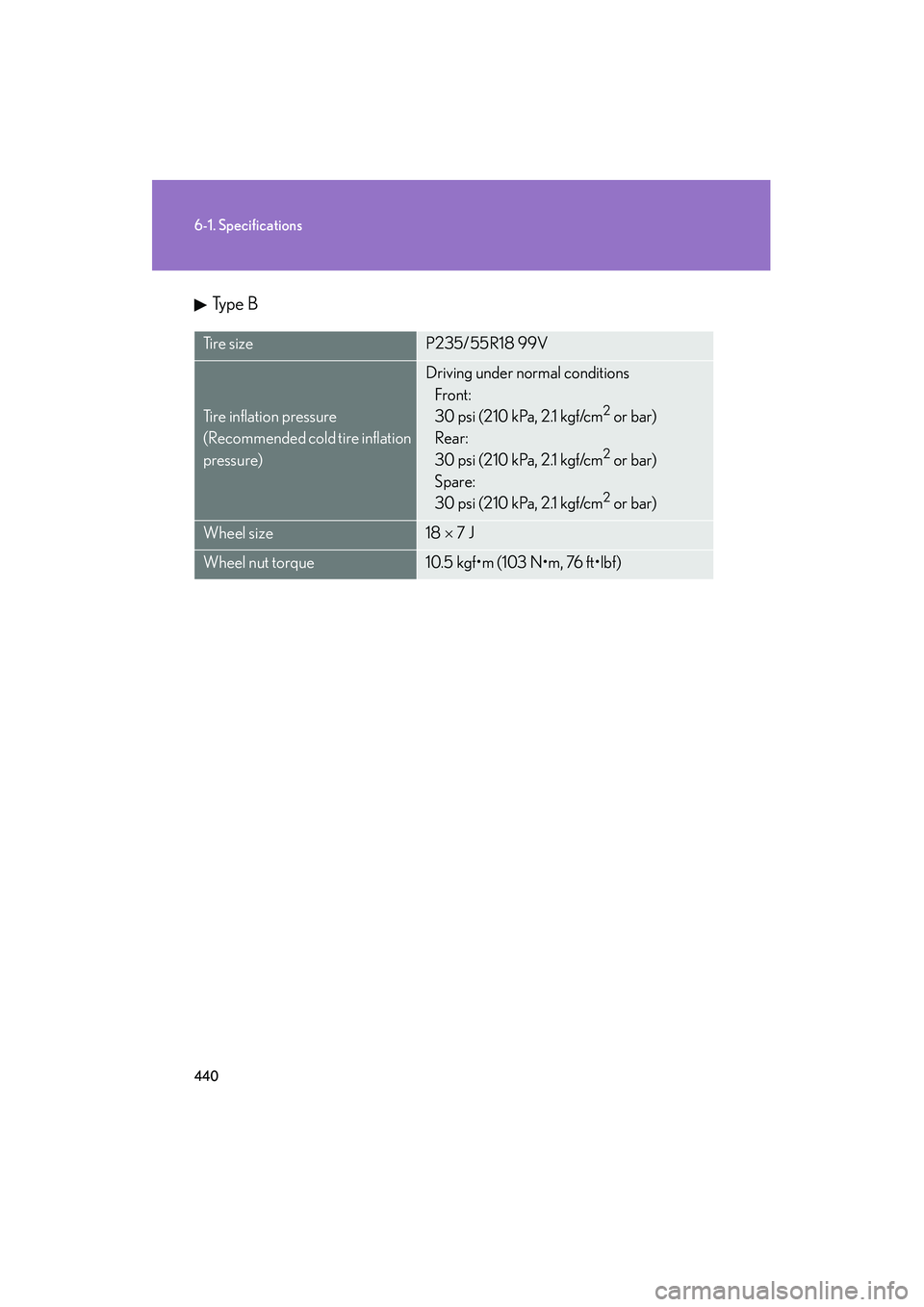
RX400h_UTy p e B
Ti r e s i z eP235/55R18 99V
Tire inflation pressure
(Recommended cold tire inflation
pressure)
Driving under normal conditions
Front:
30 psi (210 kPa, 2.1 kgf/cm
2 or bar)
Rear:
30 psi (210 kPa, 2.1 kgf/cm
2 or bar)
Spare:
30 psi (210 kPa, 2.1 kgf/cm
2 or bar)
Wheel size18 × 7 J
Wheel nut torque10.5 kgf•m (103 N•m, 76 ft•lbf)
Page 447 of 487
445
6-1. Specifications
6
Vehicle specifications
RX400h_U
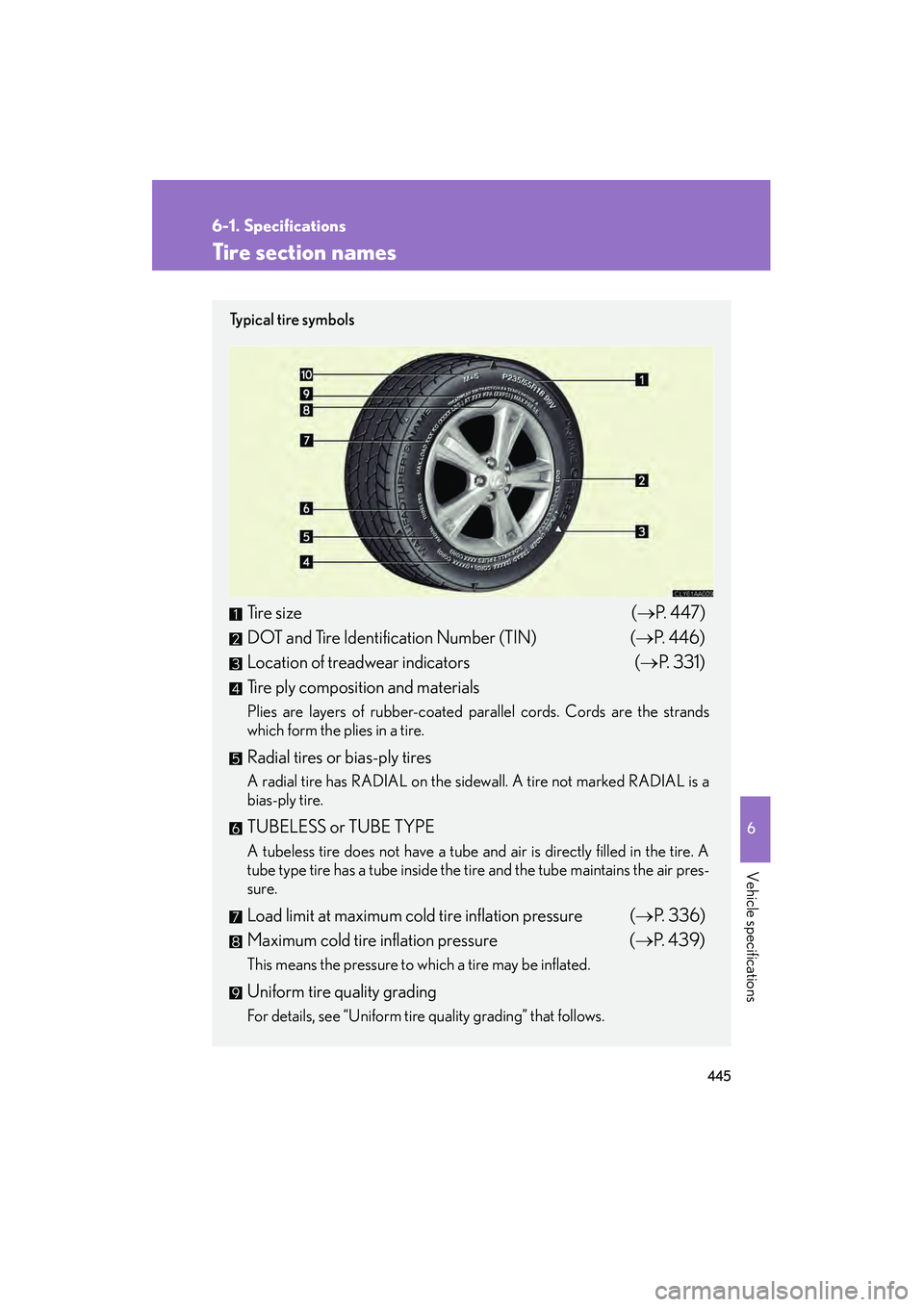
Tire section names
Ty p i c a l t i r e s y m b o l s
Tire size(→ P. 4 4 7 )
DOT and Tire Identification Number (TIN) (→P. 4 4 6 )
Location of treadwear indicators (→ P. 3 3 1 )
Tire ply composition and materials
Plies are layers of rubber-coated parallel cords. Cords are the strands
which form the plies in a tire.
Radial tires or bias-ply tires
A radial tire has RADIAL on the sidewall. A tire not marked RADIAL is a
bias-ply tire.
TUBELESS or TUBE TYPE
A tubeless tire does not have a tube and air is directly filled in the tire. A
tube type tire has a tube inside the ti re and the tube maintains the air pres-
sure.
Load limit at maximum cold tire inflation pressure ( →P. 3 3 6 )
Maximum cold tire inflation pressure ( →P. 4 3 9 )
This means the pressure to which a tire may be inflated.
Uniform tire quality grading
For details, see “Uniform tire quality grading” that follows.
Page 448 of 487
446
6-1. Specifications
RX400h_U
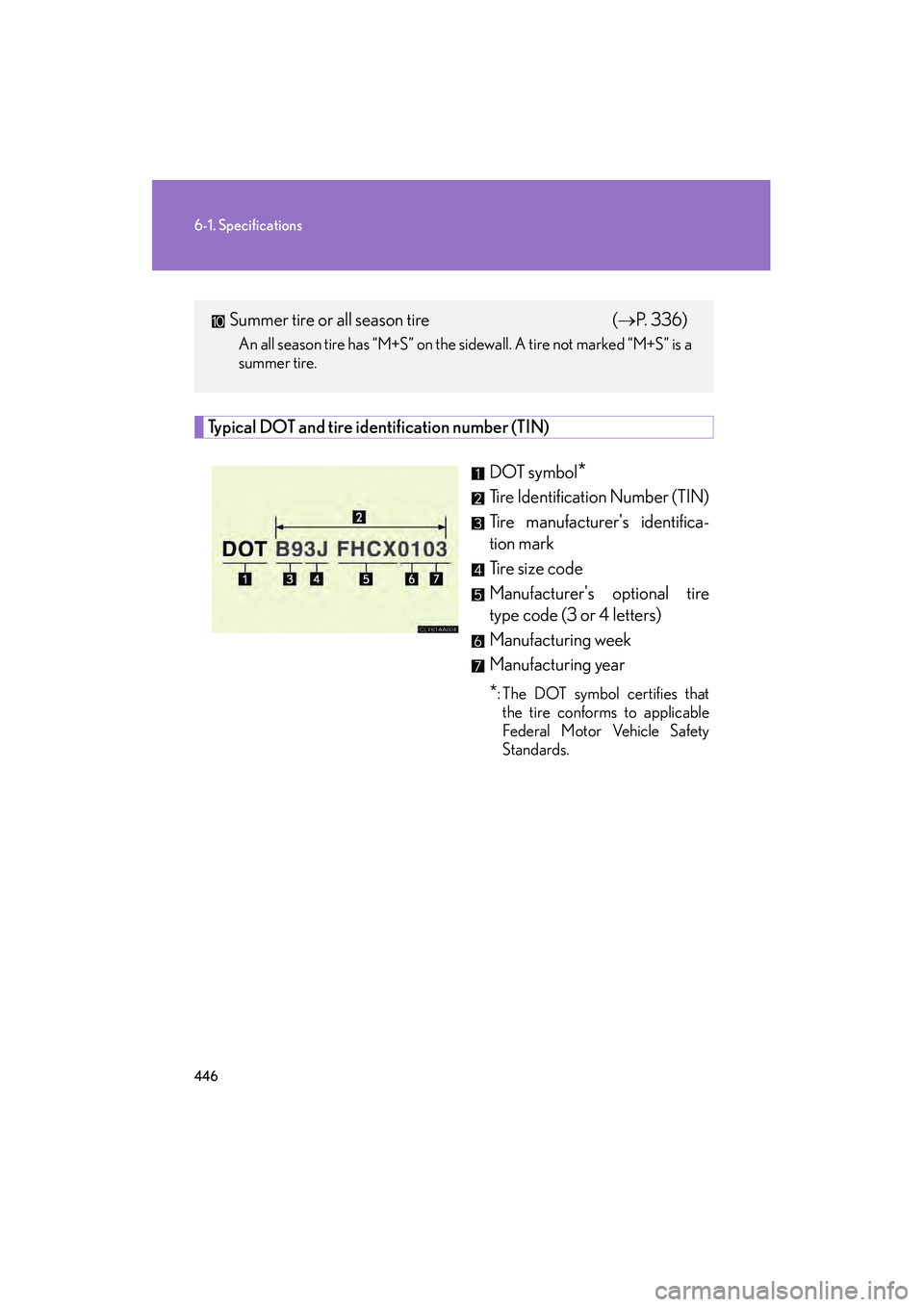
Typical DOT and tire iden tification number (TIN)
DOT symbol
*
Tire Identification Number (TIN)
Tire manufacturer's identifica-
tion mark
Tire size code
Manufacturer's optional tire
type code (3 or 4 letters)
Manufacturing week
Manufacturing year
*: The DOT symbol certifies thatthe tire conforms to applicable
Federal Motor Vehicle Safety
Standards.
Summer tire or all season tire (→ P. 3 3 6 )
An all season tire has “M+S” on the sidewall. A tire not marked “M+S” is a
summer tire.