Page 33 of 458
32
1-2. Opening, closing and locking the doors
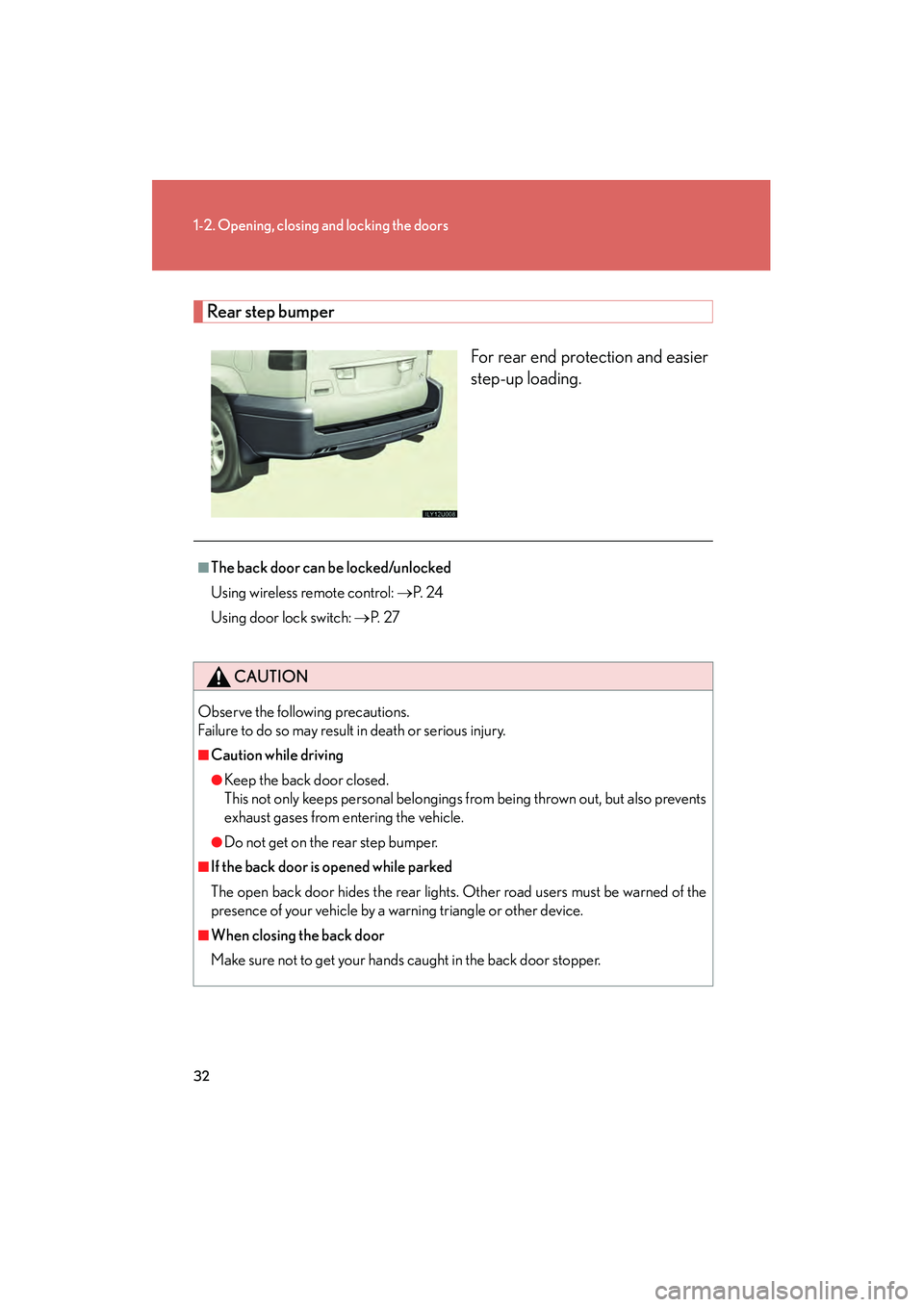
Rear step bumperFor rear end protection and easier
step-up loading.
■The back door can be locked/unlocked
Using wireless remote control: →P. 2 4
Using door lock switch: →P. 2 7
CAUTION
Observe the following precautions.
Failure to do so may result in death or serious injury.
■Caution while driving
●Keep the back door closed.
This not only keeps personal belongings from being thrown out, but also prevents
exhaust gases from entering the vehicle.
●Do not get on the rear step bumper.
■If the back door is opened while parked
The open back door hides the rear lights. Other road users must be warned of the
presence of your vehicle by a warning triangle or other device.
■When closing the back door
Make sure not to get your hands caught in the back door stopper.
Page 69 of 458
68
1-5. Refueling
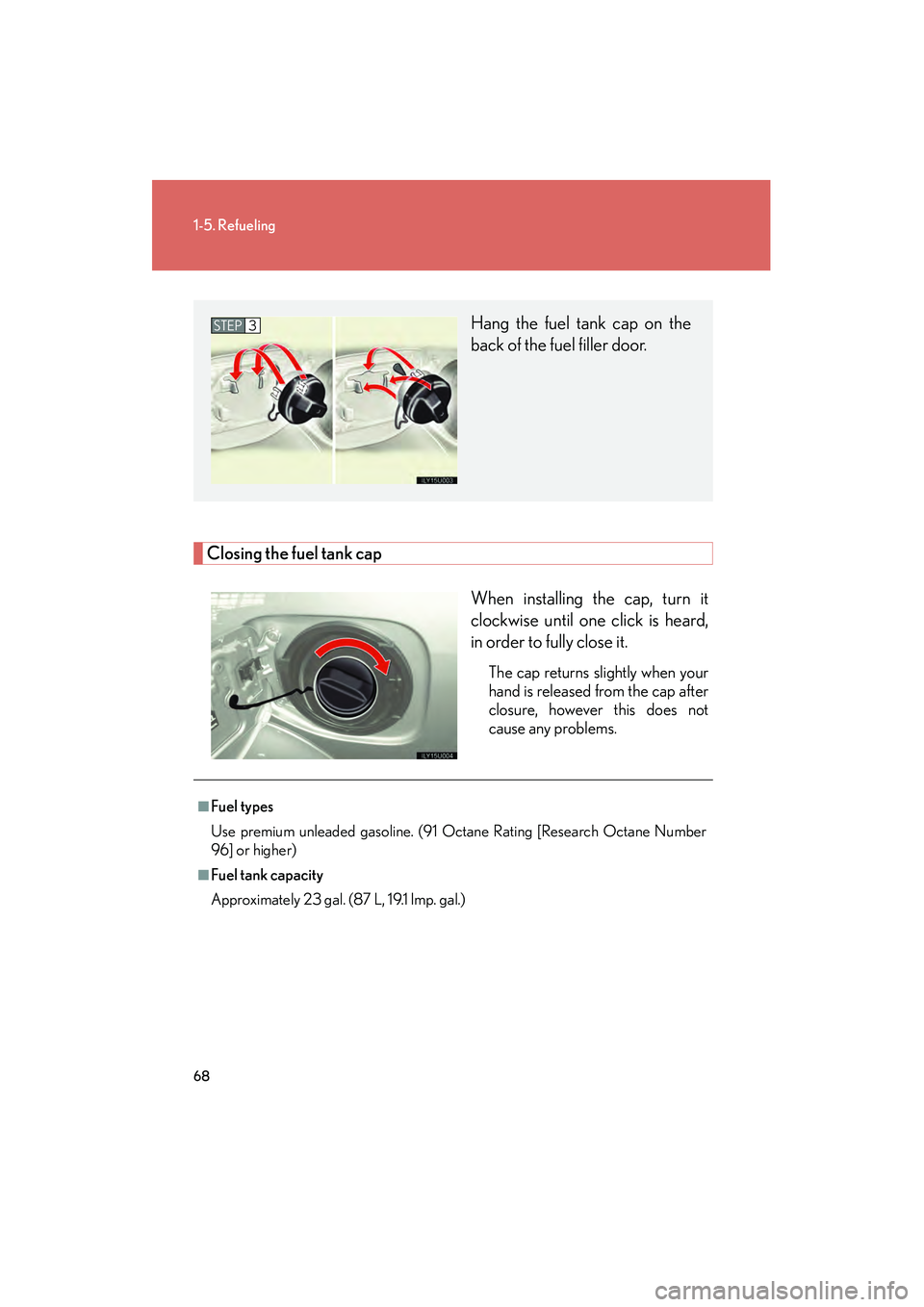
Closing the fuel tank capWhen installing the cap, turn it
clockwise until one click is heard,
in order to fully close it.
The cap returns slightly when your
hand is released from the cap after
closure, however this does not
cause any problems.
Hang the fuel tank cap on the
back of the fuel filler door.STEP3
■Fuel types
Use premium unleaded gasoline. (91 Octane Rating [Research Octane Number
96] or higher)
■Fuel tank capacity
Approximately 23 gal. (87 L, 19.1 Imp. gal.)
Page 80 of 458
79
1-7. Safety information
1
Before driving
The main SRS airbag system components are shown above. The SRS air-
bag system is controlled by the airbag sensor assembly. The airbag sen-
sor assembly consists of a safing sensor and an airbag sensor.
In certain types of severe frontal or side impacts, the SRS airbag system
triggers the airbag inflators. A chemical reaction in the inflators quickly
fills the airbags with non-toxic gas to help restrain the motion of the occu-
pants.
■If the SRS airbags deploy (inflate)
●Bruising and slight abrasions may result from contact with a deploying (inflating)
SRS airbag.
●A loud noise and white powder will be emitted.
●Parts of the airbag module (steering wheel hub, airbag cover and inflator) as
well as the front seats, and parts of the front pillar and roof side rail, may be hot
for several minutes. The airbag itself may also be hot.
●The windshield may crack.
Page 116 of 458

115
2-1. Driving procedures
2
When driving
CAUTION
■When the vehicle is parked
●Do not leave glasses, cigarette lighters, spray cans, or soft drink cans in the vehi-
cle when it is in the sun.
Failure to do so may result in the following:
• Gas may leak from a cigarette lighter or spray can, and may lead to a fire.
• The temperature inside the vehicle may cause the plastic lenses and plasticmaterial of eye glasses to deform or crack.
• Soft drink cans may fracture, causing the contents to spray over the interior of the vehicle, and may also cause a short circuit in the vehicle’s electrical com-
ponents.
●Always apply the parking brake, shift the shift lever to “P”, stop the engine and
lock the vehicle.
Do not leave the vehicle unattended while the engine is running.
●Do not touch the exhaust pipe while the engine is running or immediately after
turning the engine off.
Doing so may cause burns.
●Do not leave the engine running in an area with snow build-up, or where it is
snowing. If snowbanks build up around the vehicle while the engine is running,
exhaust gases may collect and enter the vehicle. This may lead to death or a seri-
ous health hazard.
■Exhaust gases
Exhaust gases include harmful carbon monoxide (CO) that is colorless and odor-
less. Inhaling exhaust gases may lead to death or a serious health hazard.
●If the vehicle is in a poorly ventilated area, turn the engine off. In a closed area,
such as a garage, exhaust gases may collect and enter the vehicle. This may lead
to death or a serious health hazard.
●The exhaust should be checked occasionally. If there is a hole or crack caused by
corrosion, damage to a joint or abnormal exhaust noise, be sure to have the vehi-
cle inspected and repaired by your Lexus dealer. Failure to do so may allow
exhaust gases to enter the vehicle, resulting in death or a serious health hazard.
Page 117 of 458

116
2-1. Driving procedures
CAUTION
■When taking a nap in the vehicle
Always turn the engine off.
Otherwise, you may accidentally move the shift lever or depress the accelerator
pedal, which could cause an accident or fire due to engine overheating. Addition-
ally, if the vehicle is parked in a poorly ventilated area, exhaust gases may collect
and enter the vehicle, leading to death or a serious health hazard.
■When braking the vehicle
●When the brakes are wet, drive more cautiously.
Braking distance increases when the brakes are wet, and may cause one side of
the vehicle to brake differently than the other side. Also the parking brake may
not securely hold the vehicle.
●If the power brake assist function does not operate, do not follow other vehicles
closely and avoid downhill or sharp turns that require braking.
In this case, braking is still possible, but it will require more force on the pedal than
usual. Braking distance may also increase.
●Do not pump the brake pedal if the engine stalls.
Each push on the pedal uses up the reserve for the power-assisted brakes.
●The brake system consists of 2 individual hydraulic systems: if one of the systems
fails, the other will still operate. In this case, the brake pedal should be depressed
more firmly than usual and braking distance becomes longer.
Do not drive your vehicle with only a single brake system. Have your brakes fixed
immediately.
NOTICE
■While driving the vehicle
Do not use the accelerator pedal or depress accelerator and brake pedals together
to hold the vehicle on a hill.
■When parking the vehicle
Always put the shift lever in “P”. Failure to do so may cause the vehicle to move or
the vehicle may accelerate suddenly if the accelerator pedal is accidentally
depressed.
Page 173 of 458
172
2-5. Driving information
CAUTION
■Things that must not be carried in the luggage compartment
The following things may cause a fire if loaded in the luggage compartment:
●Receptacles containing gasoline
●Aerosol cans
■Storage precautions
●Do not place anything on the luggage cover, and do not stack anything in the lug-
gage compartment higher than the seatbacks.
Such items may be thrown about and possibly injure people in the vehicle during
sudden braking or in an accident.
●Do not drive with objects on top of the instrument panel.
They may interfere with the driver’s field of view or move during sharp accelera-
tion or turning, thus impairing the driver’s control of the vehicle. In an accident
they may injure the vehicle occupants.
●Secure all items in the occupant compartment, as they may shift and injure some-
one during an accident or sudden braking.
●Never allow anyone to ride in the luggage compartment. It is not designed for
passengers. They should ride in their seats with their seat belts properly fastened.
Otherwise, they are much more likely to suffer serious bodily injury or death, in
the event of sudden braking or a collision.
■Capacity and distribution
●Do not exceed the maximum axle weight rating or the total vehicle weight rating.
●Even if the total load of occupant’s weight and the cargo load is less than the total
load capacity, do not apply the load unevenly. Improper loading may cause dete-
rioration of steering or braking control which may cause death or serious injury.
■Cross rail adjustment
Make sure the cross rails are locked securely by applying pressure forward and
rearward.
Failure to do so may cause an accident, death or serious injury in the event of emer-
gency braking or a collision.
Page 255 of 458
254
3-3. Using the rear audio system
CodeLanguageCodeLanguageCodeLanguage
0919Icelandic1307Malagasy1612Po l i s h
0923Hebrew1309Maori1619Pa s h t o,
Pushto
1009Yiddish1311Macedonian1721Quechua
1023Javanese1312Malayalam1813Rhaeto-
Romance
1101Georgian1314Mongolian1814Kirundi
1111Kazakh1315Moldavian1815Romanian
1112Greenlandic1318Marathi1823Kinyarwanda
1113Cambodian1319Malay1901Sanskrit
1114Kannada1320Maltese1904Sindhi
1119Kashmiri1325Burmese1907Sangho
1121Kurdish1401Nauru1908Serbo-
Croatian
1125Kirghiz1405Nepali1909Sinhalese
1201Latin1415Norwegian1911Slovak
1214Lingala1503Occitan1912Slovenian
1215Laothian1513(Afan)
Oromo1913Samoan
1220Lithuanian1518Oriya1914Shona
1222Latvian1601Pa n j a b i1915Somali
Page 308 of 458

307
4-1. Maintenance and care
4
Maintenance and care
■To prevent paint deterioration and corrosion on the body
●Wash the vehicle immediately in the following cases:
• After driving near the sea coast
• After driving on salted roads
• If you see coal tar or tree sap on the paint surface
• If you see dead insects or insect droppings on the paint
• After driving in an area contaminated with soot, oily smoke, mine dust, ironpowder or chemical substances
• If the vehicle becomes heavily soiled in dust or mud
• If liquids such as benzene and gasoline are spilled on the paint surface
●If the paint is chipped or scratched, have it repaired immediately.
CAUTION
■Caution about the exhaust pipe
Exhaust gasses cause the exhaust pipe to become quite hot.
When washing the vehicle, be careful not to touch the pipe until it has cooled suffi-
ciently, as touching a hot exhaust pipe can cause burns.
NOTICE
■To protect your vehicle’s painted surfaces
Do not use organic cleaners such as benzene or gasoline.
■If the windshield washer nozzle becomes blocked
Contact your Lexus dealer. Do not try to clean it with a pin or other object, as this
may damage the nozzle.
■Cleaning the exterior lights
Wash carefully. Do not use organic substances or scrub with a hard brush.
This may damage the surfaces of the lights.