Page 19 of 350
Knowing your vehicle
10 3
1
2
3
4
5
6
7
8
9
✽
NOTICE
If the door is locked/unlocked multi-
ple times in rapid succession with
either the vehicle key or door lock
switch, the system may stop operat-
ing temporarily in order to protect
the circuit and prevent damage to
system components.
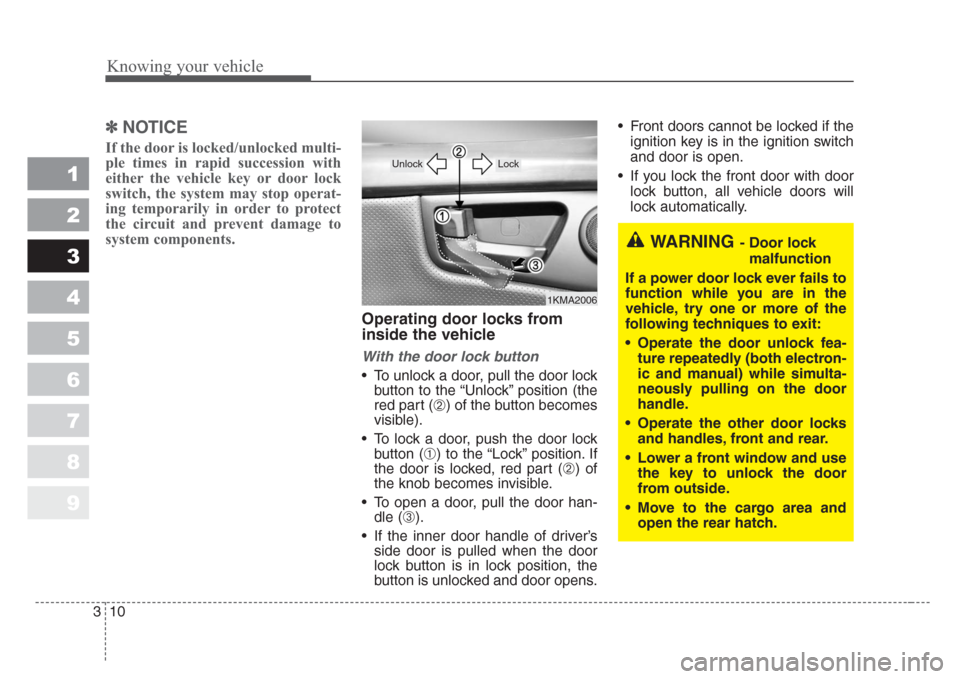
Operating door locks from
inside the vehicle
With the door lock button
• To unlock a door, pull the door lock
button to the “Unlock” position (the
red part (
➁) of the button becomes
visible).
• To lock a door, push the door lock
button (
➀) to the “Lock” position. If
the door is locked, red part (
➁) of
the knob becomes invisible.
• To open a door, pull the door han-
dle (
➂).
• If the inner door handle of driver’s
side door is pulled when the door
lock button is in lock position, the
button is unlocked and door opens.• Front doors cannot be locked if the
ignition key is in the ignition switch
and door is open.
• If you lock the front door with door
lock button, all vehicle doors will
lock automatically.
1KMA2006
Lock Unlock
WARNING- Door lock
malfunction
If a power door lock ever fails to
function while you are in the
vehicle, try one or more of the
following techniques to exit:
• Operate the door unlock fea-
ture repeatedly (both electron-
ic and manual) while simulta-
neously pulling on the door
handle.
• Operate the other door locks
and handles, front and rear.
• Lower a front window and use
the key to unlock the door
from outside.
• Move to the cargo area and
open the rear hatch.
Page 21 of 350
Knowing your vehicle
12 3
1
2
3
4
5
6
7
8
9
Impact sensing door unlock
system (if equipped)
All doors will be automatically
unlocked when the Supplemental
Restraint System (SRS) detects a
collision while the ignition switch is
ON.
However, the doors may not be
unlocked, if electrical power in the
vehicle should fail.
WARNING-Unlocked
vehicles
Leaving your vehicle unlocked
can invite theft or possible harm
to you or others from someone
hiding in your vehicle while you
are gone.Always remove the
ignition key, engage the parking
brake, close all windows and
lock all doors when leaving your
vehicle unattended.WARNING- Unattended
children
An enclosed vehicle can
become extremely hot, causing
death or severe injury to unat-
tended children or animals who
cannot escape the vehicle.
Furthermore, children might
operate features of the vehicle
that could injure them, or they
could encounter other harm,
possibly from someone gaining
entry to the vehicle.Never leave
children or animals unattended
in your vehicle.
Page 22 of 350
313
Knowing your vehicle
1
2
3
4
5
6
7
8
9
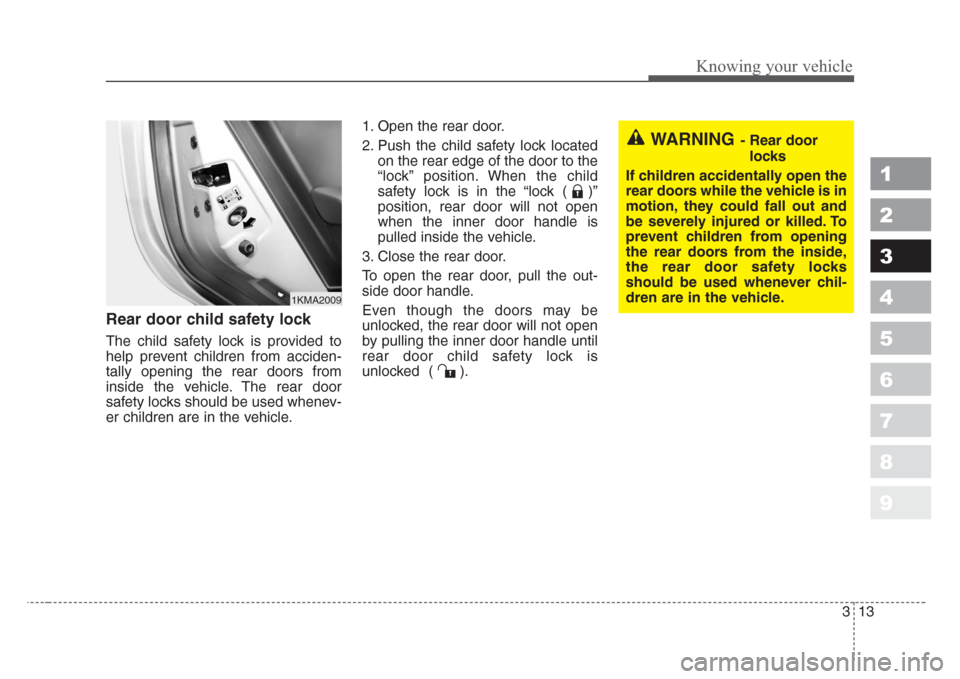
Rear door child safety lock
The child safety lock is provided to
help prevent children from acciden-
tally opening the rear doors from
inside the vehicle. The rear door
safety locks should be used whenev-
er children are in the vehicle.1. Open the rear door.
2. Push the child safety lock located
on the rear edge of the door to the
“lock” position. When the child
safety lock is in the “lock ( )”
position, rear door will not open
when the inner door handle is
pulled inside the vehicle.
3. Close the rear door.
To open the rear door, pull the out-
side door handle.
Even though the doors may be
unlocked, the rear door will not open
by pulling the inner door handle until
rear door child safety lock is
unlocked ( ).
WARNING- Rear door
locks
If children accidentally open the
rear doors while the vehicle is in
motion, they could fall out and
be severely injured or killed.To
prevent children from opening
the rear doors from the inside,
the rear door safety locks
should be used whenever chil-
dren are in the vehicle.
1KMA2009
Page 24 of 350
315
Knowing your vehicle
1
2
3
4
5
6
7
8
9
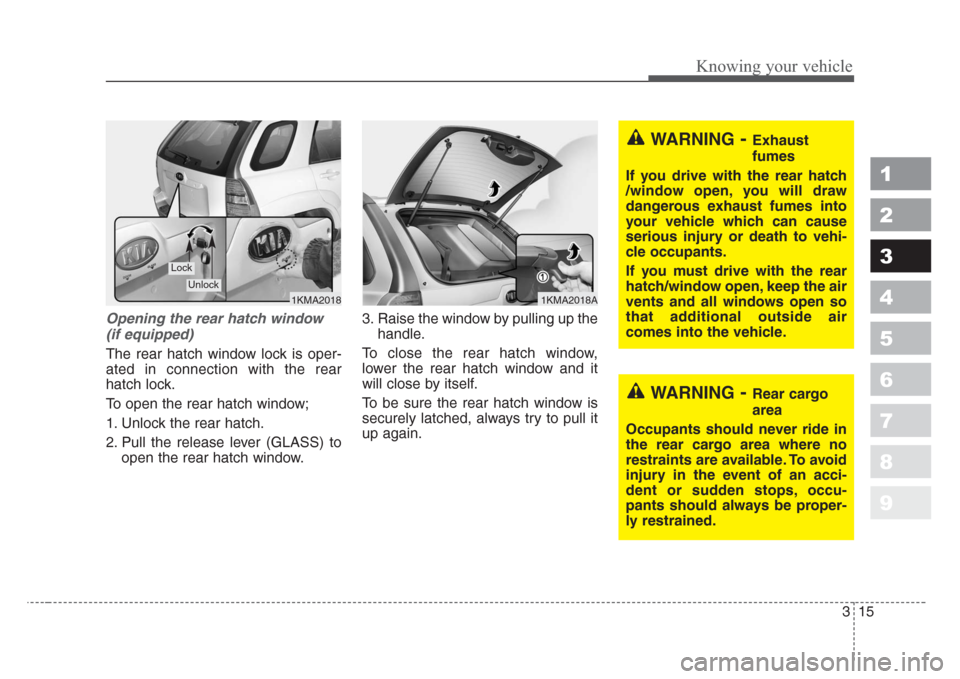
Opening the rear hatch window
(if equipped)
The rear hatch window lock is oper-
ated in connection with the rear
hatch lock.
To open the rear hatch window;
1. Unlock the rear hatch.
2. Pull the release lever (GLASS) to
open the rear hatch window.3. Raise the window by pulling up the
handle.
To close the rear hatch window,
lower the rear hatch window and it
will close by itself.
To be sure the rear hatch window is
securely latched, always try to pull it
up again.
1KMA2018A1KMA2018
Lock
Unlock
WARNING-Exhaust
fumes
If you drive with the rear hatch
/window open, you will draw
dangerous exhaust fumes into
your vehicle which can cause
serious injury or death to vehi-
cle occupants.
If you must drive with the rear
hatch/window open, keep the air
vents and all windows open so
that additional outside air
comes into the vehicle.
WARNING-Rear cargo
area
Occupants should never ride in
the rear cargo area where no
restraints are available.To a v oid
injury in the event of an acci-
dent or sudden stops, occu-
pants should always be proper-
ly restrained.
Page 29 of 350
Knowing your vehicle
20 3
1
2
3
4
5
6
7
8
9
(Continued)
• Always drive and ride with
your seatback upright and the
lap portion of the safety belt
snug and low across the hips.
This is the best position to
protect you in case of an acci-
dent.
• In order to avoid unnecessary
and perhaps severe airbag
injuries,always sit as far back
as possible from the steering
wheel so that your chest is at
least 250 mm (10 inches) away
from the steer
ing wheel.
WARNING-Loose
objects
Loose objects in the driver’s
foot area could interfere with
the operation of the foot pedals,
possibly causing an accident.
Do not place anything under the
front seats.WARNING- Driver’s seat
• Never attempt to adjust seat
while the vehicle is moving.
This could result in loss of
control, and an accident caus-
ing death,serious injury, or
property damage.
• Do not allow anything to inter-
fere with the normal position
of the seatback.Storing items
against a seatback or in any
other way interfering with
proper locking of a seatback
could result in s
erious or fatal
injury in a sudden stop or col-
lision.
(Continued)
Page 31 of 350
Knowing your vehicle
22 3
1
2
3
4
5
6
7
8
9
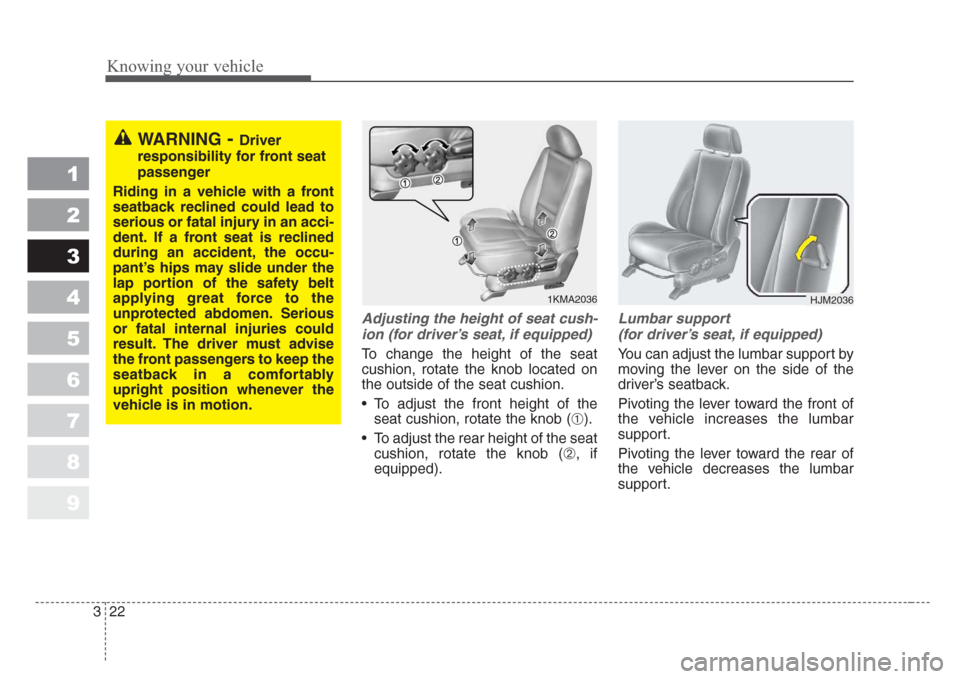
Adjusting the height of seat cush-
ion (for driver’s seat,if equipped)
To change the height of the seat
cushion, rotate the knob located on
the outside of the seat cushion.
• To adjust the front height of the
seat cushion, rotate the knob (
➀).
• To adjust the rear height of the seat
cushion, rotate the knob (
➁, if
equipped).
Lumbar support
(for driver’s seat,if equipped)
You can adjust the lumbar support by
moving the lever on the side of the
driver’s seatback.
Pivoting the lever toward the front of
the vehicle increases the lumbar
support.
Pivoting the lever toward the rear of
the vehicle decreases the lumbar
support.
WARNING-Driver
responsibility for front seat
passenger
Riding in a vehicle with a front
seatback reclined could lead to
serious or fatal injury in an acci-
dent.If a front seat is reclined
during an accident, the occu-
pant’s hips may slide under the
lap portion of the safety belt
applying great force to the
unprotected abdomen.Serious
or fatal internal injuries could
result.The dr
iver must advise
the front passengers to keep the
seatback in a comfortably
upright position whenever the
vehicle is in motion.
1KMA2036HJM2036
Page 32 of 350
323
Knowing your vehicle
1
2
3
4
5
6
7
8
9
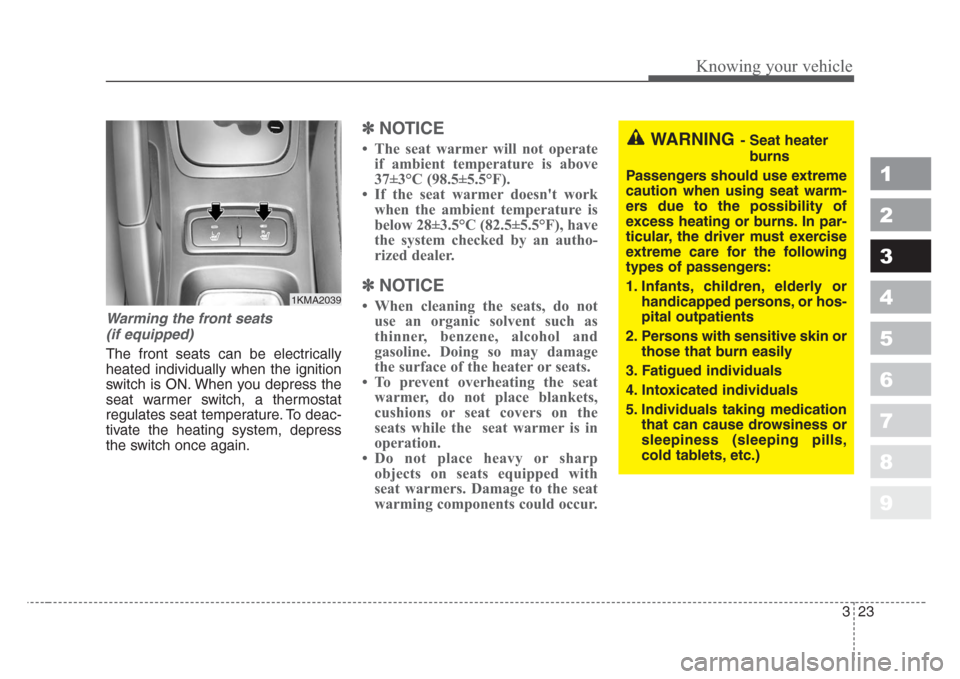
Warming the front seats
(if equipped)
The front seats can be electrically
heated individually when the ignition
switch is ON. When you depress the
seat warmer switch, a thermostat
regulates seat temperature. To deac-
tivate the heating system, depress
the switch once again.
✽
NOTICE
• The seat warmer will not operate
if ambient temperature is above
37±3°C (98.5±5.5°F).
• If the seat warmer doesn't work
when the ambient temperature is
below 28±3.5°C (82.5±5.5°F), have
the system checked by an autho-
rized dealer.
✽
NOTICE
• When cleaning the seats, do not
use an organic solvent such as
thinner, benzene, alcohol and
gasoline. Doing so may damage
the surface of the heater or seats.
• To prevent overheating the seat
warmer, do not place blankets,
cushions or seat covers on the
seats while the seat warmer is in
operation.
• Do not place heavy or sharp
objects on seats equipped with
seat warmers. Damage to the seat
warming components could occur.
WARNING- Seat heater
burns
Passengers should use extreme
caution when using seat warm-
ers due to the possibility of
excess heating or burns.In par-
ticular, the driver must exercise
extreme care for the following
types of passengers:
1.Infants,children, elderly or
handicapped persons, or hos-
pital outpatients
2.Persons with sensitive skin or
those that burn easily
3
.Fatigued individuals
4.Intoxicated individuals
5.Individuals taking medication
that can cause drowsiness or
sleepiness (sleeping pills,
cold tablets,etc.)
1KMA2039
Page 33 of 350
Knowing your vehicle
24 3
1
2
3
4
5
6
7
8
9
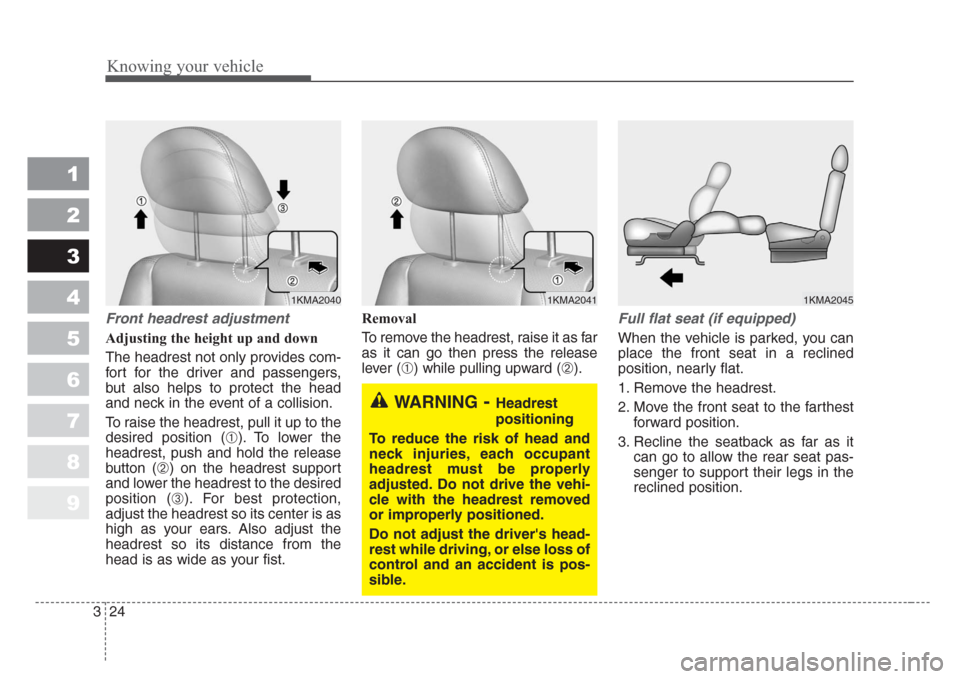
Front headrest adjustment
Adjusting the height up and down
The headrest not only provides com-
fort for the driver and passengers,
but also helps to protect the head
and neck in the event of a collision.
To raise the headrest, pull it up to the
desired position (
➀). To lower the
headrest, push and hold the release
button (
➁) on the headrest support
and lower the headrest to the desired
position (
➂). For best protection,
adjust the headrest so its center is as
high as your ears. Also adjust the
headrest so its distance from the
head is as wide as your fist.Removal
To remove the headrest, raise it as far
as it can go then press the release
lever (
➀) while pulling upward (➁).
Full flat seat (if equipped)
When the vehicle is parked, you can
place the front seat in a reclined
position, nearly flat.
1. Remove the headrest.
2. Move the front seat to the farthest
forward position.
3. Recline the seatback as far as it
can go to allow the rear seat pas-
senger to support their legs in the
reclined position.
1KMA2041
WARNING-Headrest
positioning
To reduce the risk of head and
neck injuries, each occupant
headrest must be properly
adjusted.Do not drive the vehi-
cle with the headrest removed
or improperly positioned.
Do not adjust the driver's head-
rest while driving, or else loss of
control and an accident is pos-
sible.
1KMA20451KMA2040