Page 232 of 326
Driving tips
24 5
After off-road driving
Remove any brush or debris that has col-
lected on the underbody, chassis or
under the hood. These accumulations
can be a fire hazard.
After driving in mud or sand, clean and
check the brake linings. Accumulation of
mud or sand can cause glazing and
uneven braking. Check the body struc-
ture, steering, suspension, wheels, tires,
and exhaust system for damage. Also,
check the fuel lines and cooling system
for any leakage. Your vehicle will also
require more frequent service due to off-
road use.WARNING- Water
Driving through rushing water can
be dangerous. Deep water can
sweep your vehicle downstream
and you and your passengers could
drown. If it’s only inches deep, it
can still wash away the ground from
under your tires, and you could lose
traction and roll the vehicle. Never
drive through rushing water.
Page 246 of 326

Driving tips
38 5
Maintenance when trailer towing
Your vehicle will need service more often
when you regularly pull a trailer.
Important items to pay particular atten-
tion to include engine oil, automatic
transmission fluid, axle lubricant and
cooling system fluid. Brake condition is
another important item to frequently
check. Each item is covered in this man-
ual, and the Index will help you find them
quickly. If you’re trailering, it’s a good idea
to review these sections before you start
your trip.
Don’t forget to also maintain your trailer
and hitch. Follow the maintenance
schedule that accompanied your trailer
and check it periodically. Preferably, con-
duct the check at the start of each day’s
driving. Most importantly, all hitch nuts
and bolts should be tight.CAUTION
• Due to higher load during trailer
usage, overheating might occur
in hot days or during uphill driv-
ing. If the coolant gauge indicates
over-heating, switch off the A/C
and stop the vehicle in a safe area
to cool down the engine.
• When towing check transmission
fluid more frequently.
• If your vehicle is not equipped
with the air conditioner, you
should install a condenser fan to
improve engine performance
when towing a trailer.
Page 252 of 326

In case of an emergency
4 6
EMERGENCY STARTING
Jump starting
Jump starting can be dangerous if done
incorrectly. Therefore, to avoid harm to
yourself or damage to your vehicle or
battery, follow the jump starting proce-
dures listed on page 6-6. If in doubt, we
strongly recommend that you have a
competent technician or towing service
jump start your vehicle.
✽
NOTICE
Use only a 12-volt jumper system. You
can damage a 12-volt starting motor,
ignition system, and other electrical
parts beyond repair by use of a 24-volt
power supply (either two 12-volt batter-
ies in series or a 24-volt motor generator
set). WARNING- Battery
• Keep all flames or sparks away
from the battery. The battery pro-
duces hydrogen gas which may
explode if exposed to flame or
sparks.
• Do not attempt to jump start the
vehicle if the discharged battery
is frozen or if the electrolyte level
is low; the battery may rupture or
explode.
WARNING- Battery
Never attempt to check the elec-
trolyte level of the battery as this
may cause the battery to rupture or
explode causing serious injury.
Page 262 of 326
In case of an emergency
14 6
TOWING
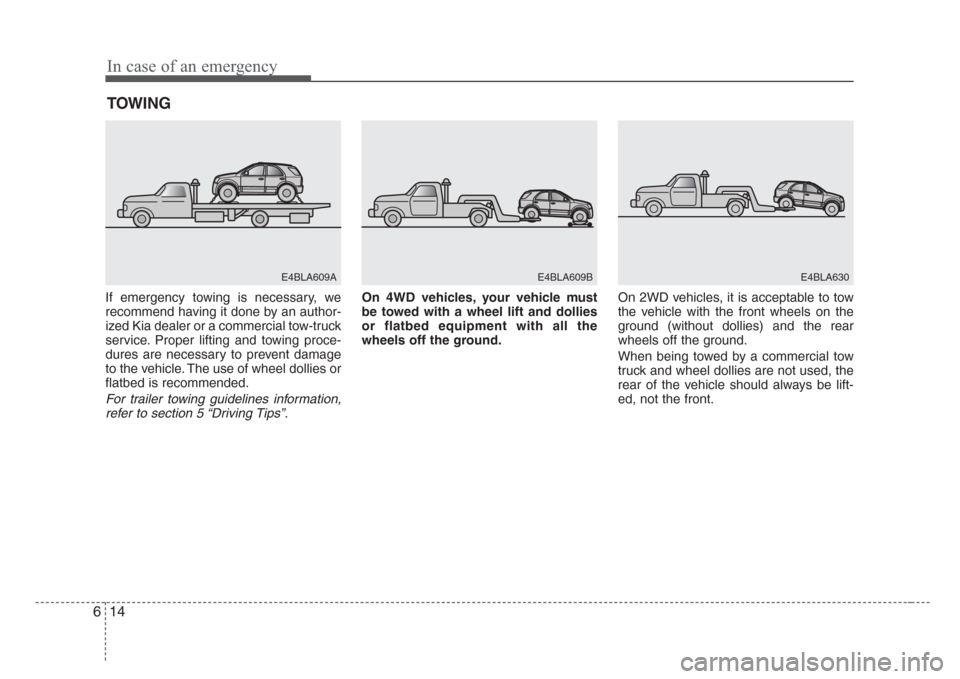
If emergency towing is necessary, we
recommend having it done by an author-
ized Kia dealer or a commercial tow-truck
service. Proper lifting and towing proce-
dures are necessary to prevent damage
to the vehicle. The use of wheel dollies or
flatbed is recommended.
For trailer towing guidelines information,
refer to section 5 “Driving Tips”.
On 4WD vehicles, your vehicle must
be towed with a wheel lift and dollies
or flatbed equipment with all the
wheels off the ground.On 2WD vehicles, it is acceptable to tow
the vehicle with the front wheels on the
ground (without dollies) and the rear
wheels off the ground.
When being towed by a commercial tow
truck and wheel dollies are not used, the
rear of the vehicle should always be lift-
ed, not the front.
E4BLA609AE4BLA609BE4BLA630
Page 263 of 326
615
In case of an emergency
When towing your vehicle in an emer-
gency without wheel dollies (2WD
Vehicles or Part-time 4WD Vehicles):
1. Set the ignition switch in the ACC posi-
tion.
2. Place the transmission shift lever in N
(Neutral).
3. Place the transfer shift knob for part-
time 4WD operation in the 2HI posi-
tion.
4. Release the parking brake.
Towing with a vehicle other than
a tow truck
If towing is necessary, we recommend
you to have it done by an Authorized Kia
dealer or a commercial tow truck service.
E4BLA610
CAUTION
• Do not tow the vehicle forwards
with the rear wheels on the
ground as this may cause dam-
age to the vehicle.
• Do not tow with sling-type equip-
ment. Use wheel lift or flatbed
equipment.
CAUTION
Failure to place the transmission
shift lever in N (Neutral) and the
transfer shift knob for part-time
4WD operation to 2HI may cause
internal damage to the transmis-
sion.
6BLA611
Page 264 of 326

In case of an emergency
16 6
If towing service is not available in an
emergency, your vehicle may be tem-
porarily towed using a cable or chain
secured to the emergency towing hook
under the front of the vehicle. Use
extreme caution when towing the vehicle.
A driver must be in the vehicle to steer it
and operate the brakes.
Towing in this manner may be done only
on hard-surfaced roads for a short dis-
tance and at low speeds. Also, the
wheels, axles, power train, steering and
brakes must all be in good condition.
• Do not use the tow hooks to pull a
vehicle out of mud, sand or other con-
ditions from which the vehicle cannot
be driven out under its own power.
• Avoid towing a vehicle heavier than the
vehicle doing the towing.
• The drivers of both vehicles should
communicate with each other frequent-
ly.• Before emergency towing, check that
the hook is not broken or damaged.
• Fasten the towing cable or chain
securely to the hook.
• Do not jerk the hook. Apply steady and
even force.
• To avoid damaging the hook, do not
pull from the side or at a vertical angle.
Always pull straight ahead.CAUTION
• Attach a towing strap to the tow
hook.
•Using a portion of the vehicle
other than the tow hooks for tow-
ing may damage the body of your
vehicle.
•Use only a cable or chain specifi-
cally intended for use in towing
vehicles. Securely fasten the
cable or chain to the towing hook
provided.
WARNING
Use extreme caution when towing
the vehicle.
• Avoid sudden starts or erratic
driving maneuvers which would
place excessive stress on the
emergency towing hook and tow-
ing cable or chain. The hook and
towing cable or chain may break
and cause serious injury or dam-
age.
• If the towing vehicle can hardly
move, do not forcibly continue
the towing. Contact an Authorized
Kia dealer or a commercial tow
truck service for assistance.
• Tow the vehicle as straight ahead
as possible.
• Keep away from the vehicle dur-
ing towing.
Page 270 of 326

In case of an emergency
22 6
• Do not take this vehicle through an
automatic car wash.
• This tire should not be installed on
the front axle if the vehicle must be
driven in snow or on ice.
• Do not use the compact spare tire
on any other vehicle because this
tire has been designed especially
for your vehicle.
• The compact spare tire’s tread life
is shorter than a regular tire.
Inspect your compact spare tire
regularly and replace worn com-
pact spare tires with the same size
and design, mounted on the same
wheel.Changing tires
Jacking instructions
The jack is provided for emergency
tire changing only.
Follow jacking instructions to reduce
the possibility of personal injury.
WARNING- Changing
tires
• Never attempt vehicle repairs
in the traffic lanes of a public
road or highway.
•Always move the vehicle com-
pletely off the road and onto
the shoulder before trying to
change a tire. If you cannot
find a firm, level place off the
road, call a towing service
company for assistance.
• Be sure to use the correct
front and rear jacking posi-
tions on the vehicle; never use
the bumpers or any other part
of the vehicle for jack support.
(Continued)
(Continued)
• The vehicle can easily roll off
the jack causing serious
injury or death. Never allow
any portion of your body to
get beneath the vehicle while
using the jack.
• Do not start or run the engine
while the vehicle is on the
jack.
• Do not allow anyone to remain
in the vehicle while it is on the
jack.
• Make sure any children pres-
ent are in a secure place away
from the road and from the
vehicle to be raised with the
jack.
Page 273 of 326
625
In case of an emergency
10. Mount the spare tire into position
and install the wheel lug nuts
with the beveled edge inward.11. Gradually loosen the valve of the
jack with the groove on the jack
handle to lower the vehicle.12. Once the wheel lug nuts have
been tightened, lower the vehicle
fully to the ground and continue
to tighten the lug nuts until they
are fully secured. Tighten the
wheel lug nuts firmly in a “star”
pattern.
If you are unsure of the tightness
of the wheel lug nuts, have them
checked at the nearest service
station. The specified tightening
torque is 9~12 kg•m (88-118
N•m, 65-87 ft•Ib).
E2BLA622E2BLA621B
1
3
42
5
E2BLA623