Page 103 of 219
Knowing your vehicle
94 3
1.AUDIO/MP3 CD/AUX Select
Button
AUDIO/MP3 CD Select
• Insert the CD with the label facing
upward.
• Insert the CD to start CD playback,
during radio operation.
• If you press the CD/AUX button while a
disc is in the CD deck, the CD player
will begin playing even if the radio or
cassette player is being used.
• The CD/AUX player can be used when
the ignition switch is in either the “ON”
or “ACC” position.
• Push the CD/AUX button to turn on
that function without pushing the
Power ON-OFF control knob.
✽
NOTICE
• Do not stick paper or tape etc., on the
label side or the recording side of any
discs, as it may cause a malfunction.
• The unit can play a multi-session CD-
R (recordable CD) and CD-RW
(rewritable CD) that consists of more
than two sessions.
Please refer to the manual of CD-
R/CD-RW recoder or CD-R/CD-RW
software for more information on
finalization process.
• Depending on the recording status,
some CD-Rs/CD-RWs may not be
played on this unit.
✽
NOTICE
Playback of MP3 and WMA file formats
are supported. Load to play time for
these formats may be longer due to the
compressed nature of these discs.
AUX-IN Select
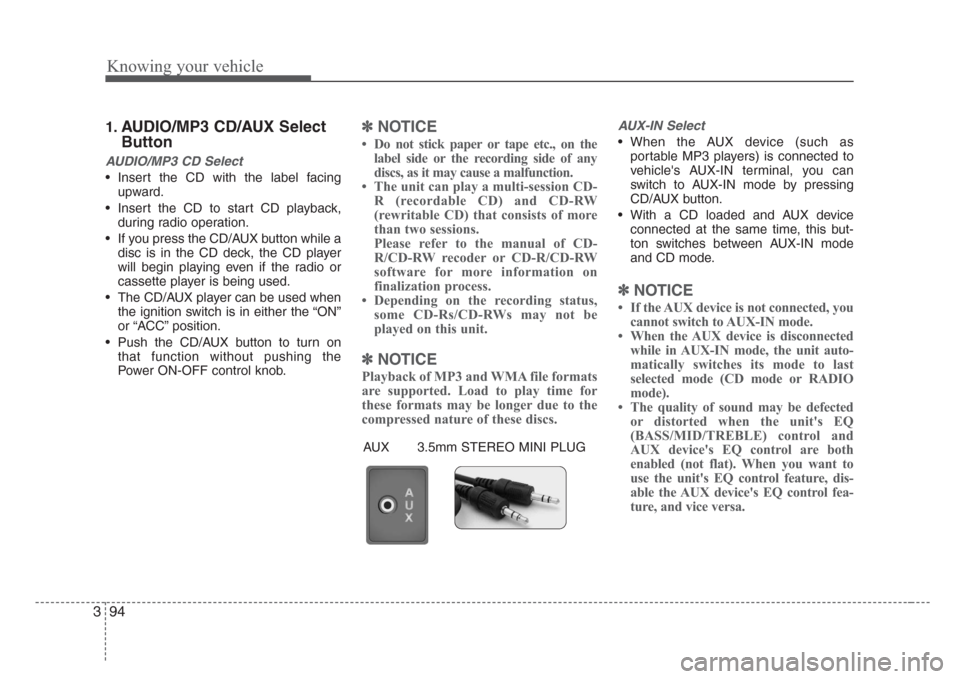
• When the AUX device (such as
portable MP3 players) is connected to
vehicle's AUX-IN terminal, you can
switch to AUX-IN mode by pressing
CD/AUX button.
• With a CD loaded and AUX device
connected at the same time, this but-
ton switches between AUX-IN mode
and CD mode.
✽
NOTICE
• If the AUX device is not connected, you
cannot switch to AUX-IN mode.
• When the AUX device is disconnected
while in AUX-IN mode, the unit auto-
matically switches its mode to last
selected mode (CD mode or RADIO
mode).
• The quality of sound may be defected
or distorted when the unit's EQ
(BASS/MID/TREBLE) control and
AUX device's EQ control are both
enabled (not flat). When you want to
use the unit's EQ control feature, dis-
able the AUX device's EQ control fea-
ture, and vice versa.
AUX 3.5mm STEREO MINI PLUG
Page 148 of 219
55
Driving tips
SUGGESTIONS FOR ECONOMICAL OPERATION
Your vehicle's fuel economy depends
mainly on your style of driving, where you
drive and when you drive.
Each of these factors affects how many
kilometers (miles) you can get from a
liter (gallon) of fuel. To operate your vehi-
cle as economically as possible, use the
following driving suggestions to help
save money in both fuel and repairs:
• Avoid lengthy warm-up idling. Once the
engine is running smoothly, begin driv-
ing. Remember, engine warm-up may
take a little longer on cold days.
• Save fuel by accelerating slowly after
stopping.
• Keep the engine in tune and follow the
recommended periodic maintenance
schedule. This will increase the life of
all parts and lower your operating
costs.
• Do not use the air conditioner unnec-
essarily.
• Slow down when driving on rough
roads.
• For longer tire life and better fuel econ-
omy, always keep the tires inflated to
the recommended pressures.• Maintain a safe distance from other
vehicles to avoid sudden stops. This
will reduce wear on brake linings and
pads. Driving in such a way will also
save fuel because extra fuel is required
to accelerate back to driving speed.
• Do not carry unnecessary weight in the
vehicle.
• Do not rest your foot on the brake
pedal while driving. This can cause
needless wear, possible damage to the
brakes, and poor fuel economy.
• Improper wheel alignment results in
faster tire wear and lower fuel econo-
my.
• Open windows at high speeds can
reduce fuel economy.
• Fuel economy is less in crosswinds
and headwinds. To help offset some of
this loss, slow down when driving in
these conditions.
Keeping a vehicle in good operating con-
dition is important both for economy and
safety. Therefore, have an authorized Kia
dealer perform scheduled inspections
and maintenance.
WARNING - Engine off dur-
ing motion
Never turn the engine off to coast
down hills or anytime the vehicle is
in motion. The power steering and
power brakes will not function
properly without the engine run-
ning. Instead, keep the engine on
and downshift to an appropriate
gear for engine braking effect.
Page 155 of 219
6
Road warning / 6-2
Overheating / 6-2
Emergency starting / 6-3
Electrical circuit protection / 6-6
Towing / 6-12
If you have a flat tire / 6-17
In case of an emergency
Page 166 of 219

In case of an emergency
12 6
Memory fuse
Your vehicle is equipped with a memory
fuse to prevent battery discharge if your
vehicle is parked without being operated
for prolonged periods. Use the following
procedures before parking the vehicle for
prolonged period.
1. Turn off the engine.
2. Turn off the headlights and tail lights.
3. Open the driver-side knee bolster
cover and pull up the “MULT B/UP 10A
/ AUDIO 15A”.
✽
NOTICE
• If the memory fuse is pulled up from
the fuse panel, the warning chime,
audio, clock and interior lamps, etc.,
will not operate. Some items must be
reset after replacement.
• Even though the memory fuse is
pulled up, the battery can still be dis-
charged by operation of the head-
lights or other electrical devices.
If emergency towing is necessary, we
recommend having it done by an author-
ized Kia dealer or a commercial tow-truck
service. Proper lifting and towing proce-
dures are necessary to prevent damage
to the vehicle. The use of wheel dollies or
flatbed equipment is recommended.
For trailer towing guidelines information,
refer to section 5 “Driving Tips”.
1JBA6010
TOWING
1JBA6501
Page 167 of 219
613
In case of an emergency
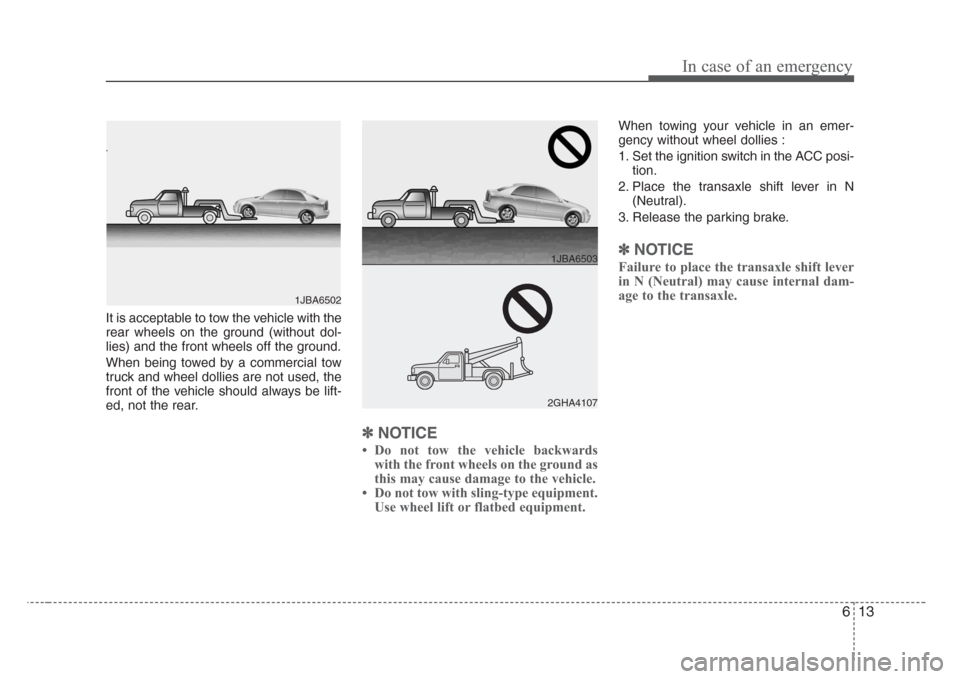
It is acceptable to tow the vehicle with the
rear wheels on the ground (without dol-
lies) and the front wheels off the ground.
When being towed by a commercial tow
truck and wheel dollies are not used, the
front of the vehicle should always be lift-
ed, not the rear.
✽
NOTICE
• Do not tow the vehicle backwards
with the front wheels on the ground as
this may cause damage to the vehicle.
• Do not tow with sling-type equipment.
Use wheel lift or flatbed equipment.
When towing your vehicle in an emer-
gency without wheel dollies :
1. Set the ignition switch in the ACC posi-
tion.
2. Place the transaxle shift lever in N
(Neutral).
3. Release the parking brake.
✽
NOTICE
Failure to place the transaxle shift lever
in N (Neutral) may cause internal dam-
age to the transaxle.
2GHA41071JBA6503
1JBA6502
Page 168 of 219
In case of an emergency
14 6
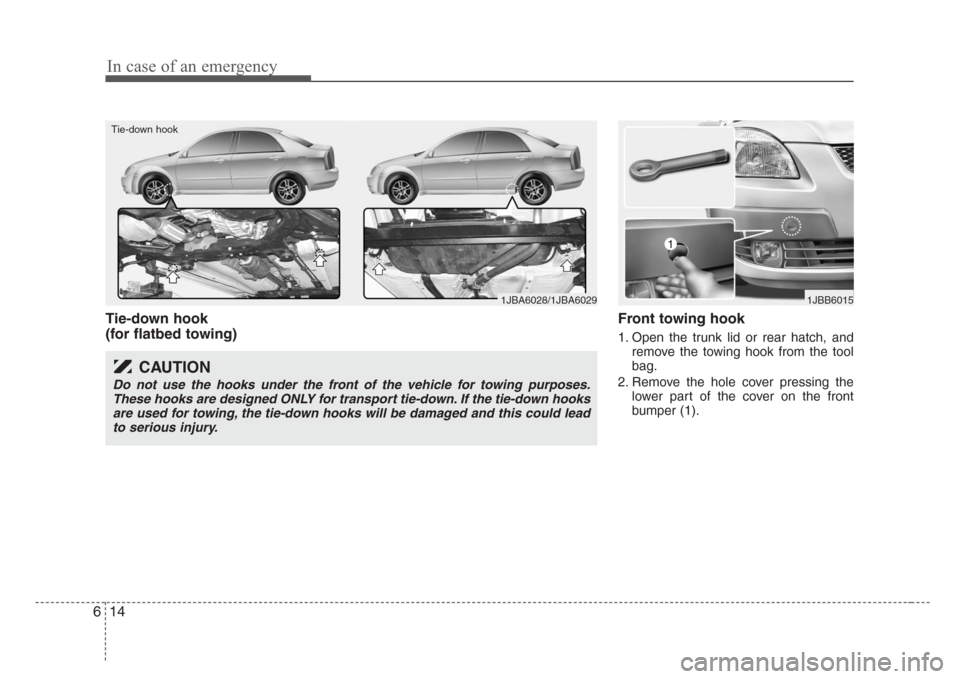
Tie-down hook
(for flatbed towing)Front towing hook
1. Open the trunk lid or rear hatch, and
remove the towing hook from the tool
bag.
2. Remove the hole cover pressing the
lower part of the cover on the front
bumper (1).
Tie-down hook
1JBA6028/1JBA6029
CAUTION
Do not use the hooks under the front of the vehicle for towing purposes.
These hooks are designed ONLY for transport tie-down. If the tie-down hooks
are used for towing, the tie-down hooks will be damaged and this could lead
to serious injury.
1JBB6015
1
Page 171 of 219
617
In case of an emergency
✽
NOTICE
To prevent internal damage to the
transaxle, never tow your vehicle from
the rear (backwards) with all four tires
in contact with the surface.
Tips for towing a stuck vehicle
The following methods are effective
when your vehicle is stuck in mud, sand
or similar substances that prevent the
vehicle from being driven out under its
own power.
• Remove the soil and sand, etc. from
the front and the back of the tires.
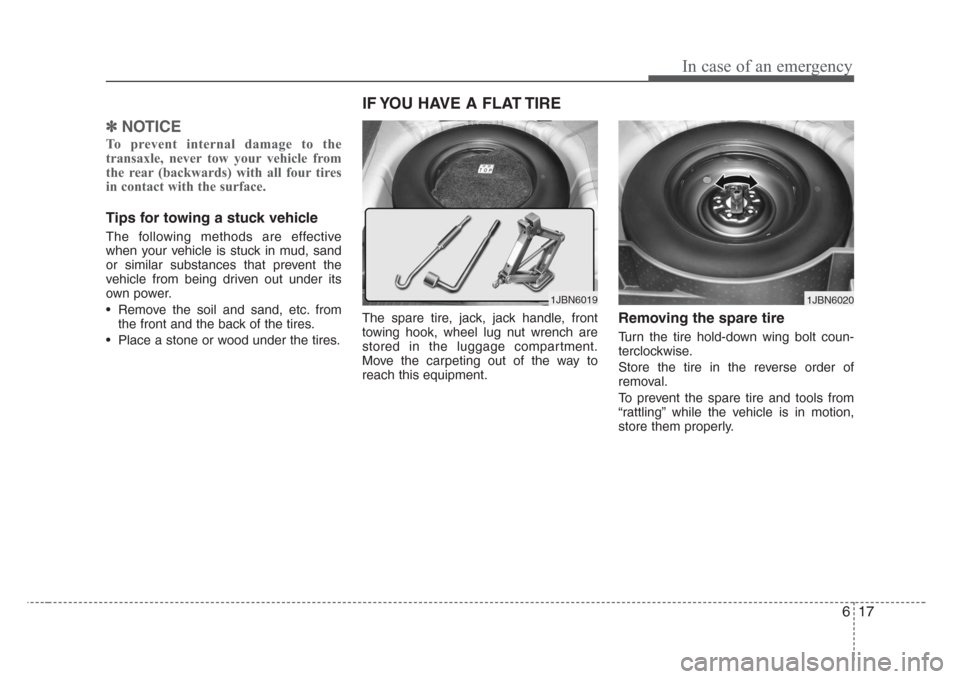
• Place a stone or wood under the tires.The spare tire, jack, jack handle, front
towing hook, wheel lug nut wrench are
stored in the luggage compartment.
Move the carpeting out of the way to
reach this equipment.
Removing the spare tire
Turn the tire hold-down wing bolt coun-
terclockwise.
Store the tire in the reverse order of
removal.
To prevent the spare tire and tools from
“rattling” while the vehicle is in motion,
store them properly.
IF YOU HAVE A FLAT TIRE
1JBN60191JBN6020
Page 172 of 219
In case of an emergency
18 6
Important - use of compact spare
tire
your vehicle is equipped with a compact
spare tire. This compact spare tire takes
up less space than a regular-size tire.
This tire is smaller than a conventional
tire and is designed for temporary use
only.
The compact spare should be inflated to
60 psi (420 kPa).
✽
NOTICE
Check the inflation pressure after
installing the spare tire. Adjust it to the
specified pressure, as necessary.
When using a compact spare tire,
observe the following precautions:
• Under no circumstances should you
exceed 80 km/h (50 mph); a higher
speed could damage the tire.
• Ensure that you drive slowly enough
for the road conditions to avoid all haz-
ards. Any road hazard, such as a pot-
hole or debris, could seriously damage
the compact spare.
• Any continuous road use of this tire
could result in tire failure, loss of vehi-
cle control, and possible personal
injury.
• Do not exceed the vehicle’s maximum
load rating or the load-carrying capaci-
ty shown on the sidewall of the com-
pact spare tire.
• Avoid driving over obstacles. The com-
pact spare tire diameter is smaller than
the diameter of a conventional tire and
reduces the ground clearance approxi-
mately 25 mm (1 inch), which could
result in damage to the vehicle.• Do not take this vehicle through an
automatic car wash.
• Do not use tire chains on this tire.
Because of the smaller size, a tire
chain will not fit properly. This could
damage the vehicle and result in loss
of the chain.
• This tire should not be installed on the
front axle if the vehicle must be driven
in snow or on ice.
• Do not use the compact spare tire on
any other vehicle because this tire has
been designed especially for your vehi-
cle.
• The compact spare tire’s tread life is
shorter than a regular tire. Inspect your
compact spare tire regularly and
replace worn compact spare tires with
the same size and design, mounted on
the same wheel.
CAUTION
• You should drive carefully when
the compact spare is in use. The
compact spare should be
replaced by the proper conven-
tional tire and rim at the first
opportunity.
• The operation of this vehicle is
not recommended with more than
one compact spare tire in use at
the same time.
CAUTION
This spare tire should be used only
for VERY short distances. Compact
spares should NEVER be used for
long drives or extended distances.