Page 170 of 219

In case of an emergency
16 6
• Before emergency towing, check that
the hook is not broken or damaged.
• Fasten the towing cable or chain
securely to the hook.
• Do not jerk the hook. Apply steady and
even force.
• To avoid damaging the hook, do not
pull from the side or at a vertical angle.
Always pull straight ahead.
• Use a towing strap less than 5m (16
feet) long. Attach a white or red cloth
(about 30cm (12 inches) wide) in the
middle of the strap for easy visibility.
• Drive carefully so that the towing strap
is not loosened during towing.When your vehicle is being towed
by another vehicle other than a tow
truck (in case of an emergency)
• Turn the ignition switch to ACC so the
steering wheel isn’t locked.
• Place the transaxle shift lever in N
(Neutral).
• Release the parking bake.
• Vehicles equipped with automatic
transaxles should not exceed 45 km/h
(28 mph) and should not be towed
more than 80 km (50 miles).
• Vehicles equipped with manual
transaxle should not be towed in
excess of 88 km/h (55 mph) and
should not be towed more than 645 km
(400 miles).
• Press the brake pedal with more force
than normal since you will have
reduced brake performance.
• More steering effort will be required
because the power steering system
will be disabled.
• If you are driving down a long hill, the
brakes may overheat and brake per-
formance will be reduced. Stop often
and let the brakes cool off.
CAUTION
Use extreme caution when towing
the vehicle.
• Avoid sudden starts or erratic
driving maneuvers which would
place excessive stress on the
emergency towing hook and tow-
ing cable or chain. The hook and
towing cable or chain may break
and cause serious injury or dam-
age.
• If the towing vehicle does not move
easily, do not forcibly continue the
towing. Contact an authorized Kia
dealer or a commercial tow truck
service for assistance.
• Tow the vehicle as straight ahead
as possible.
• Keep away from the vehicle dur-
ing towing.1JBA4124
Page 177 of 219
7
Maintenance services / 7-2
Maintenance schedule / 7-3
Owner maintenance / 7-7
Engine compartment / 7-9
Engine oil / 7-10
Engine cooling system / 7-11
Brake fluid / 7-13
Drive belts / 7-14
Power steering / 7-14
Automatic transaxle / 7-15
Lubricants and fluids / 7-16
Air cleaner / 7-17
Climate control air filter / 7-18
Wiper blades / 7-19
Battery / 7-21
Tires and wheels / 7-23
Lubricant specifications / 7-32
Exterior care / 7-33
Interior care / 7-35
Maintenance
Page 181 of 219
75
Maintenance
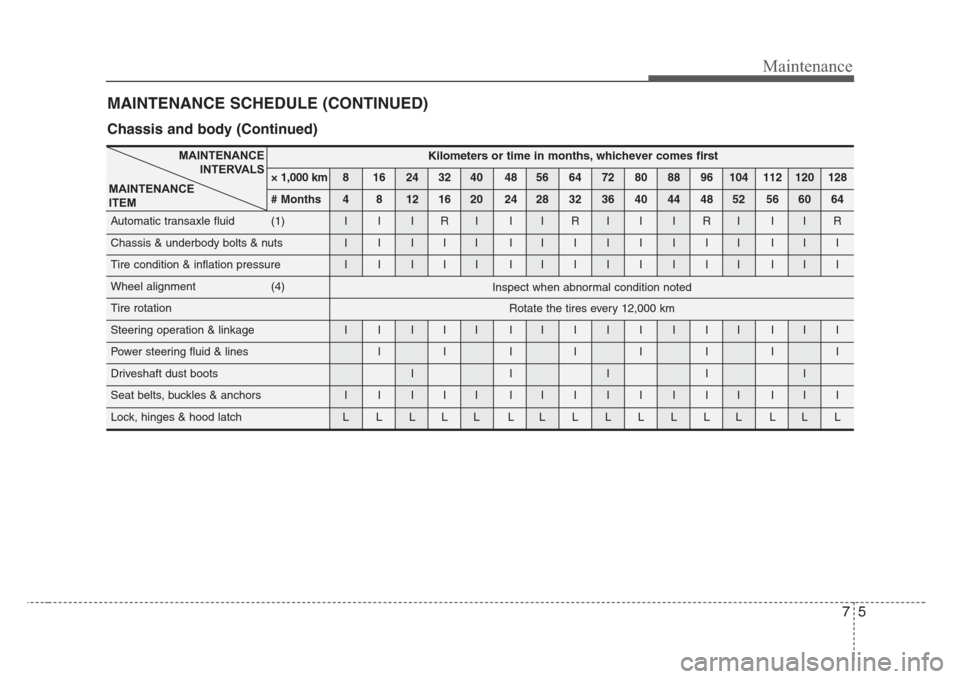
MAINTENANCE SCHEDULE (CONTINUED)
Chassis and body (Continued)
Kilometers or time in months, whichever comes first
× 1,000 km 8 16 24 32 40 48 56 64 72 80 88 96 104 112 120 128
# Months4 8 12 16 20 24 28 32 36 40 44 48 52 56 60 64
Automatic transaxle fluid (1) I I I R I I I R I I I R I I I R
Chassis & underbody bolts & nuts I I I I I IIIIIIII III
Tire condition & inflation pressure I I I I I IIIIIIII III
Wheel alignment (4)
Tire rotation
Steering operation & linkage I I I I I IIIIIIII III
Power steering fluid & lines I I IIIIII
Driveshaft dust boots I I I I I
Seat belts, buckles & anchors I I I I I IIIIIIII III
Lock, hinges & hood latch L L L L L LLLLLLLL LLL
MAINTENANCE
INTERVALS
MAINTENANCE
ITEM
Inspect when abnormal condition noted
Rotate the tires every 12,000 km
Page 184 of 219

Maintenance
8 7
At least once a year :
• Clean body and door drain holes.
• Lubricate door hinges and checks, and
hood hinges.
• Lubricate door and hood locks and
latches.
• Lubricate door rubber weatherstrips.
• Check the air conditioning system
before the warm weather season.
• Check the power steering fluid level.
• Inspect and lubricate automatic
transaxle linkage and controls.
• Clean battery and terminals.
• Check the brake fluid level.
Owner maintenance precautions
Improper or incomplete service may
result in problems. This section gives
instructions only for the maintenance
items that are easy to perform.
As explained earlier in this section, sev-
eral procedures can be done only by an
authorized Kia dealer with special tools.
Improper owner maintenance during
the warranty period may affect war-
ranty coverage. For details, read the
separate Kia Warranty & Consumer
Information Manual provided with the
vehicle. If you're unsure about any
servicing or maintenance procedure,
have it done by an Authorized Kia
Dealer.WARNING- Maintenance
work
• Performing maintenance work on
a vehicle can be dangerous.You
can be seriously injured while per-
forming some maintenance pro-
cedures. If you lack sufficient
knowledge and experience or the
proper tools and equipment to do
the work, have it done by an
Authorized Kia Dealer.
• Working under the hood with the
engine running is dangerous.It
becomes even more dangerous
when you wear jewelry or loose
clothing. These can become
entangled in moving parts and
result in injury. Always remove all
loose or hanging clothing and all
jewelry before working on the
engine.
Page 185 of 219
79
Maintenance
ENGINE COMPARTMENT
OJB058004
1. Engine coolant reservoir
2. Engine oil filler cap
3. Brake fluid reservoir
4. Air cleaner
5. Fuse box
6. Negative battery terminal
7. Positive battery terminal
8. Auto transaxle oil dipstick
(if equipped)
9. Radiator cap
10. Engine oil dipstick
11. Power steering fluid reservoir
(if equipped)
12. Windshield washer fluid
reservoir
Page 190 of 219

Maintenance
14 7
DRIVE BELTS
Drive belts should be checked periodical-
ly for proper tension and adjusted if nec-
essary. At the same time, belts should be
examined for cracks, wear, fraying or
other evidence of deterioration and
replaced if necessary.
Belt routing should also be checked to be
sure there is no interference between the
belts and other parts of the engine. After
a belt is replaced, the new belt should be
adjusted again after two or three weeks
to eliminate slack resulting from initial
stretching after use.
Checking the compressor drive
belt
Have the drive belts checked in accor-
dance with the maintenance schedule.
Checking the power steering fluid
level
With the vehicle on level ground, check
the fluid level in the power steering reser-
voir periodically. The fluid should be
between MAX and MIN marks on the
side of the reservoir at the normal tem-
perature.
Before adding power steering fluid, thor-
oughly clean the area around the reser-
voir cap to prevent power steering fluid
contamination.
If the level is low, add fluid to the MAX
level.In the event the power steering system
requires frequent addition of fluid, the
vehicle should be inspected by an
authorized Kia dealer.
✽
NOTICE
• To avoid damage to the power steer-
ing pump, do not operate the vehicle
for prolonged periods with a low
power steering fluid level.
• Never start the engine when the reser-
voir tank is empty.
• When adding fluid, be careful that
dirt does not get into the tank.
• Insufficient fluid can result in
increased steering effort; excessive
noise may also be present as the steer-
ing wheel is turned.
• The use of the non-specified fluid
could reduce the effectiveness of the
power steering wheel and cause dam-
age to it.
Use only the specified power steering
fluid. (Refer to "Recommended
Lubricants" later in this section.)
Power steering hose
Check the hoses and hose connections
for leaks or damage before driving the
vehicle.
1JBA7005
POWER STEERING (IF EQUIPPED)
Page 208 of 219

Maintenance
32 7
LUBRICANT SPECIFICATIONS
Recommended lubricants
To help achieve proper engine and powertrain performance and
durability, use only lubricants of the proper quality. The correct
lubricants also help promote engine efficiency that results in
improved fuel economy.
Engine oils labeled Energy Conserving Oil are now available.
Along with other additional benefits, they contribute to fuel
economy by reducing the amount of fuel necessary to over-
come engine friction. Often, these improvements are difficult to
measure in everyday driving, but in a year’s time, they can offer
significant cost and energy savings.
Recommended SAE viscosity number
✽
NOTICE
Always be sure to clean the area around any filler plug, drain
plug, or dipstick before checking or draining any lubricant.
This is especially important in dusty or sandy areas and when
the vehicle is used on unpaved roads. Cleaning the plug and
dipstick areas will prevent dirt and grit from entering the
engine and other mechanisms that could be damaged.
Engine oil viscosity (thickness) has an effect on fuel economy
and cold weather operating (starting and oil flow). Lower vis-
cosity engine oils can provide better fuel economy and cold
weather performance, however, higher viscosity engine oils are
required for satisfactory lubrication in hot weather. Using oils of
any viscosity other than those recommended could result in
engine damage.
When choosing an oil, consider the range of temperature your
vehicle will be operated in before the next oil change. Proceed
to select the recommended oil viscosity from the chart.
*¹ Refer to the recommended SAE viscosity numbers.
These lubricants and fluids are recommended for use in your
vehicle.
Lubricant Classification
API Service SJ, SL or above,
ILSAC GF-3 or above
Manual transaxle fluidAPI Service GL-4
(SAE 75W-85, fill-for-life)
DIAMOND ATF SP-III, SK ATF SP-III
Power steering fluid PSF-III
Brake/Clutch fluid FMVSS116 DOT-3 or DOT-4
Engine oil *¹
Automatic transaxle fluidTemperature Range for SAE Viscosity Numbers
Temperature
Engine Oil *
1
°C
(°F)-30 -20 -10 0 10 20 30 40 50
-10 0 20 40 60 80 100 120
1. For better fuel economy, it is recommended to use the engine oil of a viscosity
grade SAE 5W-20,5W-30 (API SJ, SL / ILSAC GF-3).
10W-30
5W-20, 5W-30
Page 216 of 219

Specifications
4 8
Light BulbsCapacities
Light Bulb 4 Door 5 Door
Headlights (Low/High) 55/60 55/60
Front turn signal lights 27 27
Position lights 5 5
Front fog lights (if equipped) 27 27
Front side mark light 5 5
Stop and tail lights 27/8 28/8
Rear turn signal lights 27 27
Back-up lights 18 18
High mounted stop light 18 18
License plate lights 5 5
Front map lamp 10 10
Center dome lamp 10 10
Trunk room (cargo area) lamp 5 5
Wattage
Lubricant Volume Classification
Engine oil
*13.3lAPI service SJ, SL or above
(with filter change) (3.5 US qt.) ILSAC GF-3 or above
Manual transaxle fluid1.9lAPIserviceGL-4
(2.0 US qt.) SAE 75W-85 (fill-for-life)
Automatic transaxle 6.1 l
fluid (6.5 US qt.)
Power steering0.8l
PSF-III
(0.8 US qt.)
Coolant5.5~5.8lEthylene glycol base for
(5.8~6.1 US qt.)aluminum radiator
Brake fluid0.7~0.8lFMVSS116 DOT-3
(0.7~0.8 US qt.) o r D OT- 4
Fuel45lUnleaded gasoline with
(11.9 US gal.)AKI 87 or higher
*¹Refer to the recommended SAE viscosity numbers on the page 7-32.
DIAMOND ATF SP-III,
SK ATF SP-III