2008 KIA PICANTO flat tire
[x] Cancel search: flat tirePage 236 of 335

613
What to do in an emergency
F070301ASA
Important - use of compact spare tire(if equipped)
Your vehicle is equipped with a com-
pact spare tire. This compact spare
tire takes up less space than a regu-
lar-size tire. This tire is smaller than a
conventional tire and is designed for
temporary use only.
The compact spare should be inflat-
ed to 420 kPa (60 psi).
✽✽NOTICE
Check the inflation pressure after
installing the spare tire. Adjust it to
the specified pressure, as necessary.
When using a compact spare tire,
observe the following precautions:
Under no circumstances should you exceed 80 km/h (50 mph); a higher speed could damage the
tire.
Ensure that you drive slowly enough to avoid all hazards. Anyroad hazard, such as a pothole or
debris, could seriously damage the
compact spare.
Any continuous road use of this tire could result in tire failure, loss of
vehicle control, and possible per-
sonal injury.
Do not exceed the vehicle’s maxi- mum load rating or the load-carry-
ing capacity shown on the sidewall
of the compact spare tire.
Avoid driving over obstacles. The compact spare tire diameter issmaller than the diameter of a con-
ventional tire and reduces the
ground clearance approximately25 mm (1 inch), which could result
in damage to the vehicle.
CAUTION
You should drive carefully
when the compact spare is inuse. The compact spareshould be replaced by the proper conventional tire andrim at the first opportunity.
The operation of this vehicle is not recommended withmore than one compact spare tire in use at the same time.
WARNING
The compact spare tire is for
emergency use only. Do not
operate your vehicle on thiscompact spare at the speed
over 80 km/h (50 mph). Theoriginal tire should be repaired
or replaced as soon as possible
to avoid failure of the spare
possibly leading to personal
injury or death.
Page 238 of 335
615
What to do in an emergency
IF YOU HAVE A FLAT TIRE (WITH TIREMOBILITYKIT, IF EQUIPPED)
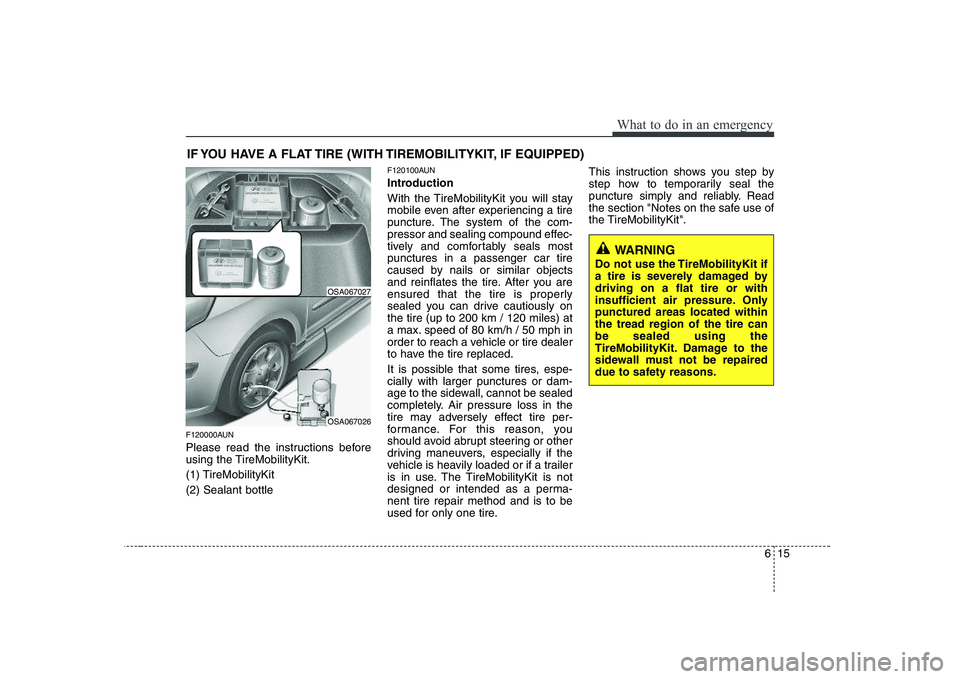
F120000AUN
Please read the instructions before
using the TireMobilityKit. (1) TireMobilityKit(2) Sealant bottle F120100AUN
Introduction
With the TireMobilityKit you will stay
mobile even after experiencing a tire
puncture. The system of the com-
pressor and sealing compound effec-
tively and comfortably seals mostpunctures in a passenger car tire
caused by nails or similar objects
and reinflates the tire. After you are
ensured that the tire is properly
sealed you can drive cautiously onthe tire (up to 200 km / 120 miles) at
a max. speed of 80 km/h / 50 mph in
order to reach a vehicle or tire dealer
to have the tire replaced.
It is possible that some tires, espe- cially with larger punctures or dam-
age to the sidewall, cannot be sealed
completely. Air pressure loss in the
tire may adversely effect tire per-
formance. For this reason, you
should avoid abrupt steering or other
driving maneuvers, especially if the
vehicle is heavily loaded or if a trailer
is in use. The TireMobilityKit is not
designed or intended as a perma-nent tire repair method and is to be
used for only one tire.This instruction shows you step by
step how to temporarily seal the
puncture simply and reliably. Read
the section "Notes on the safe use ofthe TireMobilityKit".
WARNING
Do not use the TireMobilityKit if
a tire is severely damaged bydriving on a flat tire or with
insufficient air pressure. Onlypunctured areas located withinthe tread region of the tire canbe sealed using the
TireMobilityKit. Damage to the
sidewall must not be repaired
due to safety reasons.
OSA067026
OSA067027
Page 239 of 335

What to do in an emergency
16
6
F120200AUN What to do when a tire is punc- tured
A punctured tire is repaired in two
stages. In the 1st stage, sealing com-pound and air is inflated into the tire
and the vehicle driven a short dis-tance (3 km / 2 miles) to spread the
compound inside the tire. In the 2nd
stage, the inflation pressure is
checked and, if necessary, more air
is added into the tire. It is then possi-
ble to drive cautiously with the tire up
to 200 km (120 miles) at a maximumspeed of 80 km/h (50 mph) in order
to reach a vehicle or tire dealer to
have the tire replaced. If so inform
other drivers that the TireMobilityKit
has been used and provide advice
and warnings about changed driving
behaviour. F120201ASA
1st Stage: Pump sealing compound
and air into the tire
1. Open the lid and remove the
speed label (1) from the TireMobilityKit and place it in the
car, within clear view of the driver. 2. Remove the hose (2) and the
power cable (3) from theTireMobilityKit.
OUN066100LOUN066101L
Page 241 of 335

What to do in an emergency
18
6
10. Switch the On/Off switch (8) to
the "I"-position.
Please note: When the sealing compound is added through the
tire valve the pressure gauge
could increase from approxi-
mately 4-6 bar (60-90 psi), but itwill drop again after about 30
seconds. 11. Inflate the tire to at least 1.8 bar
(26 psi) and at most 3.5 bar (51
psi) within 7 minutes. Switch off
the compressor briefly by press-
ing "O" so you are be able to readthe actual tire inflation pressure
on the gauge.
CAUTION
During the tire inflation opera-
tion do not stand next to thedamaged tire. Check the side-wall of the tire for unusual bulges or deformations.Discontinue the inflation opera-tion and deflate the tire by using the pressure release (10), if anyunusual appearance is noticed.
CAUTION
If a tire inflation pressure of 1.8 bar (26 psi) is not achievablewithin 7 minutes, the tire is tooseverely damaged and you must not drive on the tire. Call forroad side service or towing.
OUN066103L
Page 242 of 335

619
What to do in an emergency
12. If a tire inflation pressure of 1.8bar (26 psi) is reached, turn the
On/Off switch to the "O"-position,
quickly unscrew the hose from
the tire. Unplug the cable from
the cigarette lighter. Do not
unscrew the bottle. Stow theTireMobilityKit, the bottle cap and
the bottle holder cap safely in the
vehicle in an easily accessible
place, as it will be needed again
to check tire pressure.
13. Drive immediately and cautiously for about 3 km (2 miles) so thatthe sealing compound can seal
the puncture. Do not exceed 80
km/h (50 mph). While driving, if
you experience any unusual
vibration, ride disturbance or
noise, reduce your speed and
drive with caution until you can
safely pull off to the side of the
road. Call for road side service or
towing. F120202ASA
2nd Stage: Check tire pressure
14. Stop after driving for about 3 km
(2 miles) and check the pressure
of the punctured tire as follows:
a) Ensure that the On/Off switch (8) of the compressor is in the"O"-position.
b) Screw the hose onto the valve of the punctured tire.
c) Plug the power cable into the cigarette lighter (12 volt socket).
d) Read the inflation pressure on the gauge of the TireMobilityKit.
CAUTION
If the inflation pressure is below
1.3 bar (19 psi), do not continueto drive. Call for road side serv- ice or towing.
OUN066103L
Page 243 of 335

What to do in an emergency
20
6
15. If the inflation pressure is 1.3 bar
(19 psi) or more, turn the On/Off
switch to the "I"-position andadjust the inflation pressure tothe recommended inflation pres-
sure (Refer to “Tires and wheels”
in section 9). Reduce any exces-
sive pressure by using the pres-
sure release valve (10).
16. Turn the kit off by pressing "O". Unscrew the hose from the tire
valve and unplug the electric plug
from the socket. 17. Do not unscrew the bottle. Stow
the TireMobilityKit safely in the
vehicle. 18. Drive to the next vehicle or tire
dealer to replace the tire.
19. After using the TireMobilityKit to seal your tire, replace the hose,the sealing compound and con-
nected parts. See the last page
of this instruction. When replac-
ing the damaged tire inform thetire mechanic that a sealing com-
pound was used before the tire isdemounted!
WARNING
After the sealing compound has
been used, the max. permissiblespeed is 80 km/h (50 mph) and
the damaged tire is to be
replaced promptly, at least with-in a distance of 200 km (120
miles). While driving, if you
experience any unusual vibra-
tion, ride disturbance or noise,
reduce your speed and drive
with caution until you can safe-
ly pull off to the side of the road.
Call for road side service or
towing.WARNING
After a long period without driv-
ing, the inflation pressure must
be checked before driving.
OUN066103L
Page 244 of 335

621
What to do in an emergency
F120203APA
3rd stage: What to do when checkingthe tire inflation pressure
1. Open the lid from the
TireMobilityKit.
2. Remove the hose (2) and the elec- tric lead (3).
3. Unscrew the valve cap from the defective tire. 4. Screw the hose (7) tightly onto the
tire valve.
5. Now you can read the tire pres- sure. If it needs to be increased,
move on to step 6.
6. Make sure that the On/Off switch (8) is in the "O"-position.
7. Place the electric plug (9) into the socket of the cigarette lighter (12
volt).
8. Start the engine (only if the car is outdoors.) 9. Switch the On/Off switch (8) to the
"I"-position and inflate the tire tothe recommended inflation pres-
sure.
10. Switch off the TireMobilityKit and check the tire pressure again.
11. After you have inflated the tire, unscrew the hose, unplug the
electric plug and stow the
TireMobilityKit safely in your
vehicle.
OUN066103LOUN066101L
Page 245 of 335

What to do in an emergency
22
6
F120300ASA
Notes on the safe use of the TireMobilityKit
Park your car at the side of the
road so that you can work with the
TireMobilityKit away from moving
traffic. Place your warning triangle
in a prominent place to make pass-
ing vehicles aware of your location.
To be sure your vehicle won't move, even when you're on a fairly
level ground, always set your park-
ing brake.
Only use the TireMobilityKit for sealing/inflation passenger car
tires. Do not use on motorcycles,
bicycles or any other type of tires.
Do not remove any foreign objects - such as nails or screws - that
have penetrated the tire. Before using the TireMobilityKit
read the precautionary advice
printed on the sealant bottle!
Provided the car is outdoors, leave the engine running. Otherwise
operating the compressor may
eventually drain the car battery.
Never leave the TireMobilityKit unattended while it is being used.
Do not leave the compressor run- ning for more than 10 min. at a time
or it may overheat.
Do not use the TireMobilityKit if the ambient temperature is below -30°C (-20°F).
Do not use the sealing compound after its expiration date which can
be found on the label of the bottle.
Keep away from children.
CAUTION
Do not use the TireMobilityKit if the tire is severely damaged bydriving with insufficient airpressure (e.g. if the tire has bulges, cuts, cracks or similardefects). Only seal puncturedareas located within the tread region of the tire. Damage to thesidewall should not be sealedfor safety reasons.