Page 225 of 289
67
In case of an emergency
Driver-side panel bolster1. Turn the ignition switch and all other
switches off.
2. Open the cover.3. Pull the suspected fuse straight out.
Use the removal tool (1) provided in
the engine compartment fuse/relay
box.
4. Check the removed fuse; replace it if it
is blown.
Spare fuses are provided in the fuse
panel.
5. Push in a new fuse of the same rating,
and make sure it fits tightly in the clips.
If it fits loosely, consult an authorized Kia
dealer.
If you do not have a spare, use a fuse of
the same rating from a circuit you may
not need for operating the vehicle, such
as the audio fuse.If the headlights or other electrical com-
ponents do not work and the fuses are
OK, check the fuse block in the engine
compartment. If a fuse is blown, it must
be replaced.
OMG065003
OMG065004
Page 227 of 289
69
In case of an emergency
Engine compartment
OMG065006
Fuse/Relay panel descriptionInside the fuse/relay box covers, you can find the fuse/relay
label describing fuse/relay name and capacity.
Engine compartment
Description Fuse rating Protected component
I/P B+ 2 50A In panel B+
ABS 2 40A ABS
DRL 15A Daytime running light
HORN 15A Horn
H/LP LOW 15A Headlight (low)
F/PUMP 20A Fuel pump
H/LP HI 15A Headlight (high)
ECU 10A Engine control unit
ABS 1 40A ABS
ALT 125A (150A)* Alternator
SPARE 10A Spare fuse
SPARE 15A Spare fuse
SPARE 20A Spare fuse
FRT FOG 15A Front fog light
ECU RELAY 30A Engine control unit
POWER AMP 20A Amplifier
SPARE 15A Spare fuse
SPARE 20A Spare fuse
P/OUTLET 25A Power outlet
RAD FAN 30A (40A)* Radiator fan
PCU 10A Power train control system sen-
sors, TCU
ABS 10A ABS
S/WARMER 25A Seat warmer
ATM 20A Automatic transaxle control
S/ROOF 20A Sunroof
SPARE 20A Spare fuse
Page 228 of 289
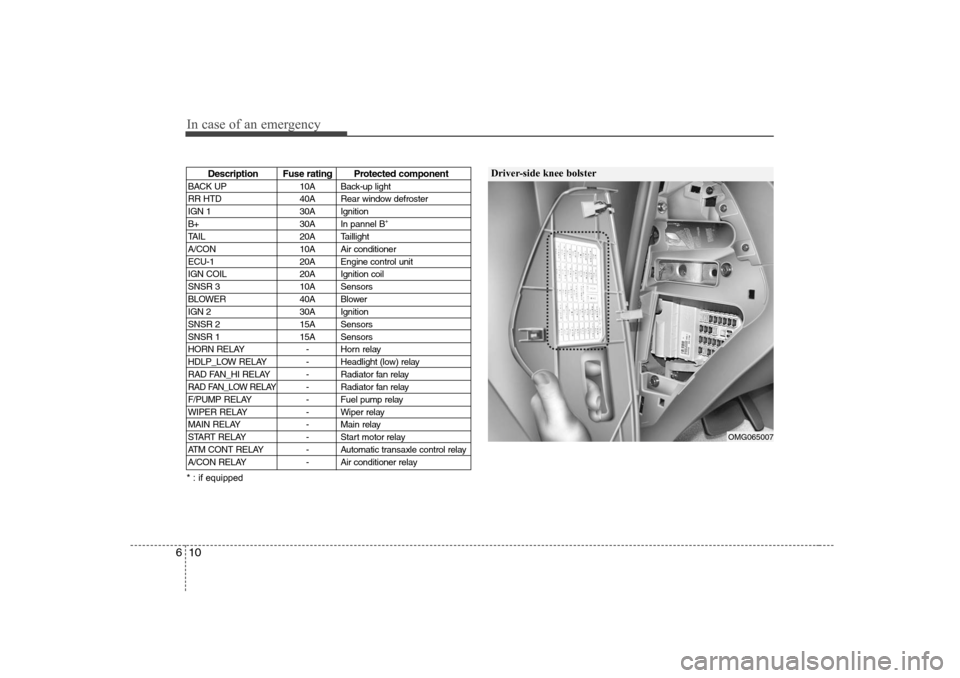
In case of an emergency10 6
OMG065007
Driver-side knee bolster
Description Fuse rating Protected component
BACK UP 10A Back-up light
RR HTD 40A Rear window defroster
IGN 1 30A Ignition
B+ 30A In pannel B
+
TAIL 20A Taillight
A/CON 10A Air conditioner
ECU-1 20A Engine control unit
IGN COIL 20A Ignition coil
SNSR 3 10A Sensors
BLOWER 40A Blower
IGN 2 30A Ignition
SNSR 2 15A Sensors
SNSR 1 15A Sensors
HORN RELAY - Horn relay
HDLP_LOW RELAY - Headlight (low) relay
RAD FAN_HI RELAY - Radiator fan relayRAD FAN_LOW RELAY
- Radiator fan relay
F/PUMP RELAY - Fuel pump relay
WIPER RELAY - Wiper relay
MAIN RELAY - Main relay
START RELAY - Start motor relay
ATM CONT RELAY - Automatic transaxle control relay
A/CON RELAY - Air conditioner relay
* : if equipped
Page 229 of 289

611
In case of an emergency
Driver-side knee bolster
Description Fuse rating Protected component
H/LP 10A Headlight
A/CON SW 10A Air conditioner
START 10A Start motor
P/SEAT RH 30A Power seat (right)
P/WDW RH 25A Power window (right)
WIPER 25A Front wiper
MIRR HTD 10A Outside rearview mirror defroster
RR FOG 15A Rear fog light
P/SEAT LH 30A Power seat (left)
P/WDW LH 25A Power window (left)
SPARE 10A Spare fuse
MODULE-2 10A Cluster
W/DEICER 15A Deicer
TAIL RH 10A Taillight (right)
TAIL LH 10A Taillight (left)
EPS 10A Power steering wheel
A/CON 10A Air conditioner
SAFETY PWR 20A Safety power window
A/BAG IND 10A Airbag warning
A/BAG 15A Airbag
DR LOCK 25A Central door lock
SPARE 10A Spare fuse
CLUSTER 10A Cluster
MODULE-1 10A BWS buzzer, ESP switch
Description Fuse rating Protected component
HAZARD 15A Hazard warning light
STOP LP 15A Stop light
SPARE 15A Spare fuse
TELL TALE 10A Clock
T/LID OPEN 15A Trunk lid opener
ADJ PEDAL 10A Adjust pedal relay
SPARE 15A Spare fuse
T/SIG 10A Turn signal light
TPMS 10A TPMS
BLOWER MTR 10A Blower, Air conditioner
MEMORY 15A Cluster, ETACS, A/C, Clock,
Room lamp
AUDIO 15A Audio
C/LIGHTER 25A Cigar lighter
D/CLOCK 10A Clock
Page 230 of 289
In case of an emergency12 6Memory fuseYour vehicle is equipped with memory
fuses to prevent battery discharge if your
vehicle is parked without being operated
for prolonged periods. Use the following
procedures before parking the vehicle for
prolonged period.
1. Turn off the engine.
2. Turn off the headlights and tail lights.
3. Open the driver-side knee bolster
cover and pull up the “MEMORY 15A /
AUDIO 15A”.
✽ ✽
NOTICE• If the memory fuses are pulled up
from the fuse panel, the warning
chime, audio, clock and interior
lamps, etc., will not operate. Some
items must be reset after replacement.
• Even though the memory fuses are
pulled up, the battery can still be dis-
charged by operation of the head-
lights or other electrical devices.
OMG065008
Page 248 of 289

77
Maintenance
OWNER MAINTENANCE Owner maintenance schedule The following lists are vehicle checks and
inspections that should be performed by
the owner or an authorized Kia dealer at
the frequencies indicated to help ensure
safe, dependable operation of your vehi-
cle.
Any adverse conditions should be
brought to the attention of your dealer as
soon as possible.
These Owner Maintenance Checks are
generally not covered by warranties and
you may be charged for labor, parts and
lubricants used.When you stop for fuel: Check the engine oil level.
Check coolant level in coolant reser-
voir.
Check the windshield washer fluid
level.
Look for low or under-inflated tires.
While operating your vehicle: Note any changes in the sound of the
exhaust or any smell of exhaust fumes
in the vehicle.
Check for vibrations in the steering
wheel. Notice any increased steering
effort or looseness in the steering
wheel, or change in its straight-ahead
position.
Notice if your vehicle constantly turns
slightly or “pulls” to one side when trav-
eling on smooth, level road.
When stopping, listen and check for
strange sounds, pulling to one side,
increased brake pedal travel or “hard-
to-push” brake pedal.
If any slipping or changes in the oper-
ation of your transaxle occurs, check
the transaxle fluid level.
Check automatic transaxle P (Park)
function.
Check parking brake.
Check for fluid leaks under your vehicle
(water dripping from the air condition-
ing system during or after use is nor-
mal).
At least monthly: Check coolant level in the coolant
recovery reservoir.
Check the operation of all exterior
lights, including the stoplights, turn sig-
nals and hazard warning flashers.
Check the inflation pressures of all
tires including the spare.At least twice a year
(i.e., every Spring and Fall) : Check radiator, heater and air condi-
tioning hoses for leaks or damage.
Check windshield washer spray and
wiper operation. Clean wiper blades
with clean cloth dampened with wash-
er fluid.
Check headlight alignment.
Check muffler, exhaust pipes, shields
and clamps.
Check the lap/shoulder belts for wear
and function.
Check for worn tires and loose wheel
lug nuts.
WARNING
- Radiation
coolant
Be careful when checking your
engine coolant level when the
engine is hot. Scalding hot coolant
and steam may blow out under
pressure. This could cause burns or
other serious injury.
Page 263 of 289

Maintenance22 7
For best battery service : Keep the battery securely mounted.
Keep the top of the battery clean and
dry.
Keep the terminals and connections
clean, tight, and coated with petroleum
jelly or terminal grease.
Rinse any spilled electrolyte from the
battery immediately with a solution of
water and baking soda.
If the vehicle is not going to be used for
an extended time, disconnect the bat-
tery cables.
Battery recharging Your vehicle has a maintenance-free,
calcium-based battery.
If the battery becomes discharged in a
short time (because, for example, the
headlights or interior lights were left on
while the vehicle was not in use),
recharge it by slow charging (trickle)
for 10 hours.
If the battery gradually discharges
because of high electric load while the
vehicle is being used, recharge it at 20-
30A for two hours.Items to be reset after the battery has
been discharged or the battery has
been disconnected. Clock (See Chapter 3)
Climate control system
(See Chapter 4)
Audio (See Chapter 3)
Sunroof (See Chapter 3)
(Continued)
When lifting a plastic-cased bat-
tery, excessive pressure on the
case may cause battery acid to
leak, resulting in personal injury.
Lift with a battery carrier or with
your hands on opposite corners.
Never attempt to charge the bat-
tery when the battery cables are
connected.
The electrical ignition system
works with high voltage. Never
touch these components with the
engine running or the ignition
switched on.
Failure to follow the above warn-
ings can result in serious bodily
injury or death.
OMG075021
Page 269 of 289

Maintenance28 7
Wheel replacement When replacing the metal wheels for
any reason, make sure the new
wheels are equivalent to the original
factory units in diameter, rim width
and offset.
WARNING -
Replacing
tires
Driving on worn-out tires is
very hazardous and will
reduce braking effectiveness,
steering accuracy, and trac-
tion.
Your vehicle is equipped with
tires designed to provide for
safe ride and handling capa-
bility. Do not use a size and
type of tire and wheel that is
different from the one that is
originally installed on your
vehicle. It can affect the safety
and performance of your vehi-
cle, which could lead to han-
dling failure or rollover and
serious injury. When replacing
the tires, be sure to equip all
four tires with the tire and
wheel of the same size, type,
tread, brand and load-carrying
capacity.
(Continued)
(Continued)
If you nevertheless decide to
equip your vehicle with any
tire/wheel combination not
recommended by Kia for off
road driving, you should not
use these tires for highway
driving.
The use of any other tire size
or type may seriously affect
ride, handling, ground clear-
ance, stopping distance, body
to tire clearance, snow tire
clearance, and speedometer
reliability.
It is best to replace all four
tires at the same time. If that is
not possible, or necessary,
then replace the two front or
two rear tires as a pair.
Replacing just one tire can
seriously affect your vehicle’s
handling.
WARNING
A wheel that is not the correct
size may adversely affect wheel
and bearing life, braking and
stopping abilities, handling char-
acteristics, ground clearance,
body-to-tire clearance, snow
chain clearance, speedometer
calibration, headlight aim and
bumper height.