Page 246 of 283
711
Maintenance
ENGINE OIL AND OIL FILTER
Checking the engine oil level
1. Be sure the vehicle is on level ground.
2. Start the engine and allow it to reachnormal operating temperature.
3. Turn the engine off and wait for a few minutes (about 5 minutes) for the oil to
return to the oil pan.
4. Pull the dipstick out, wipe it clean, and re-insert it fully.
5. Pull the dipstick out again and check the level. The level should be between
F and L.
If it is near or at L, add enough oil to bring
the level to F. Do not overfill.
Use only the specified engine oil. (Refer
to “Recommended Lubricants” later inthis section.)Changing the engine oil and filter
Change engine oil and filter according to
the Scheduled Maintenance at the begin-
ning of this section.
OGH057003OGH057005
Page 249 of 283

Maintenance
147
BRAKES
Checking brake fluid level
Check the fluid level in the reservoir peri-
odically. The fluid level should be
between MAX and MIN marks on the
side of the reservoir.
Before removing the reservoir cap and
adding brake fluid, clean the area around
the reservoir cap thoroughly to prevent
brake fluid contamination.If the level is low, add fluid to the MAX
level. The level will fall with accumulated
mileage. This is a normal condition asso-
ciated with the wear of the brake pads. If
the fluid level is excessively low, have the
brake system checked by an Authorized
Kia Dealer.
Use only the specified brake fluid. (Refer
to “Recommended Lubricants” later inthis section.)
Never mix different types of fluid.
WARNING
When changing and adding brake
fluid, handle it carefully. Do not let it
come in contact with your eye s.If
brake fluid should come in contact
with your eyes, immediately flush
them with a large quantity of fre sh
tap water. Have your eye s examined
by a doctor as soon as possible.
WARNING
In the event the brake s ystem
requires frequent additions of fluid,
the vehicle should be inspected by
an Authorized Kia Dealer.
CAUTION
Do not allow brake fluid to contact the vehicle' s body paint, a s paint
damage will res ult. Brake fluid,
which has been exposed to open air for an extended time should never
be used as its quality cannot be guaranteed. It should be thrown
out. Don't put in the wrong kind of fluid. For example, just a few dropsof mineral-bas ed oil,such as
engine oil, in your brake system can damage brake system parts.
OGH057013
Page 250 of 283

715
Maintenance
POWER STEERING
Checking the power steering fluid
level
With the vehicle on level ground, check
the fluid level in the power steering reser-
voir periodically. The fluid should be
between MAX and MIN marks on the
level gauge attached to the cap.
Before adding power steering fluid, thor-
oughly clean the area around the reser-
voir cap to prevent power steering fluid
contamination.
If the level is low, add fluid to the MAX
level. In the event the power steering system
requires frequent addition of fluid, the
vehicle should be inspected by an
Authorized Kia Dealer.
✽
NOTICE
To avoid damage to the power steer-
ing pump, do not operate the vehicle
for prolonged periods with a low
power steering fluid level.
Never start the engine when the reser- voir tank is empty.
When adding fluid, be careful that dirt does not get into the tank.
Too little fluid can make the steering wheel heavier or strange noise can be
generated.
The use of the non-specified fluid could reduce the effectiveness of the
power steering wheel and cause dam-
age to it.
Use only the specified power steering
fluid. (Refer to "RecommendedLubricants" later in this section.)
Power steering hose
Check the connections for oil leaks,
severe damage and the twists in the
power steering hose before driving.
OGH076421N
Page 252 of 283

717
Maintenance
✽NOTICE
“COLD” scale is for reference only and
should NOT be used to determine
transaxle fluid level.
New automatic transaxle fluid should be
red. The red dye is added so the assem-
bly plant can identify it as automatic
transaxle fluid and distinguish it from
engine oil or antifreeze. The red dye,
which is not an indicator of fluid quality, is
not permanent. As the vehicle is driven,
the automatic transaxle fluid will begin to
look darker. The color may eventually
appear light brown.
✽NOTICE
Have an Authorized Kia dealer change
the automatic transaxle fluid according
to the Scheduled Maintenance at the
beginning of this section.CAUTION
• Low fluid level causes transaxle
slippage. Overfilling can caus e
foaming, loss of fluid and transaxle malfunction.
• The use of a non- specified fluid
could result in transaxle malfunc- tion.
WARNING- Parking brake
To avoid sudden movement of the
vehicle, apply parking brake and
depress the brake pedal before
moving the shift lever.
WARNING - Transaxle fluid
The transaxle fluid level should be
checked when the engine i s at nor-
mal operating temperature. This
means that the engine, radiator,
radiator hose and exhaust system
etc., are very hot. Exercise great
care not to burn your self during this
procedure.
Page 253 of 283

Maintenance
187
LUBRICANTS AND FLUIDS
Checking the washer fluid level
The reservoir is translucent so that you
can check the level with a quick visual
inspection.
Check the fluid level in the washer fluid
reservoir and add fluid if necessary. Plain
water may be used if washer fluid is not
available. However, use washer solvent
with antifreeze characteristics in cold cli-
mates to prevent freezing.
Body lubrication
All moving points of the body, such as
door hinges, hood hinges, and locks,
should be lubricated each time the
engine oil is changed. Use a non-freez-
ing lubricant on locks during cold weath-
er.
Make sure the engine hood secondary
latch keeps the hood from opening when
the primary latch is released.WARNING
• Do not use radiator coolant or
antifreeze in the was her fluid
reservoir.
• Radiator coolant can s everely
obscure visibility when sprayed
on the wind shield and may cau se
loss of vehicle control or damage
to paint and body trim.
•Wind shield Washer fluid agents
contain some amounts of alcohol
and can be flammable under cer-
tain circumstances. Do not allow
sparks or flame to contact the
washer fluid or the wa sher fluid
reservoir. Damage to the vehicle
or it's occupants could occur.
•Wind shield washer fluid is poi-
sonous to humans and animals.
Do not drink and avoid contacting
windshield washer fluid. Seriou s
injury or death could occur.
OGH057500
Page 259 of 283

Maintenance
247
✽NOTICE
Before performing maintenance or
recharging the battery, turn off all
accessories and stop the engine.
The negative battery cable must be removed first and installed last when
the battery is disconnected.
WARNING- Recharging
battery
When recharging the battery,
observe the following precaution s:
• The battery mus t be removed
from the vehicle and placed in an
area with good ventilation.
• Do not allow cigarette s,sparks,or
flame near the battery.
• Watch the battery during charg- ing, and stop or reduce the charg-
ing rate if the battery cells begin
gassing (boiling) violently or if
the temperature of the electrolyte
of any cell exceeds 49°C (120°F).
• Wear eye protection when check- ing the battery during charging.
(Continued)
(Continued)
•Disconnect the battery charger in
the following order.
1. Turn off the battery charger main switch.
2. Unhook the negative clamp from the negative battery terminal.
3. Unhook the positive clamp from the positive battery terminal.
Page 269 of 283
Maintenance
347
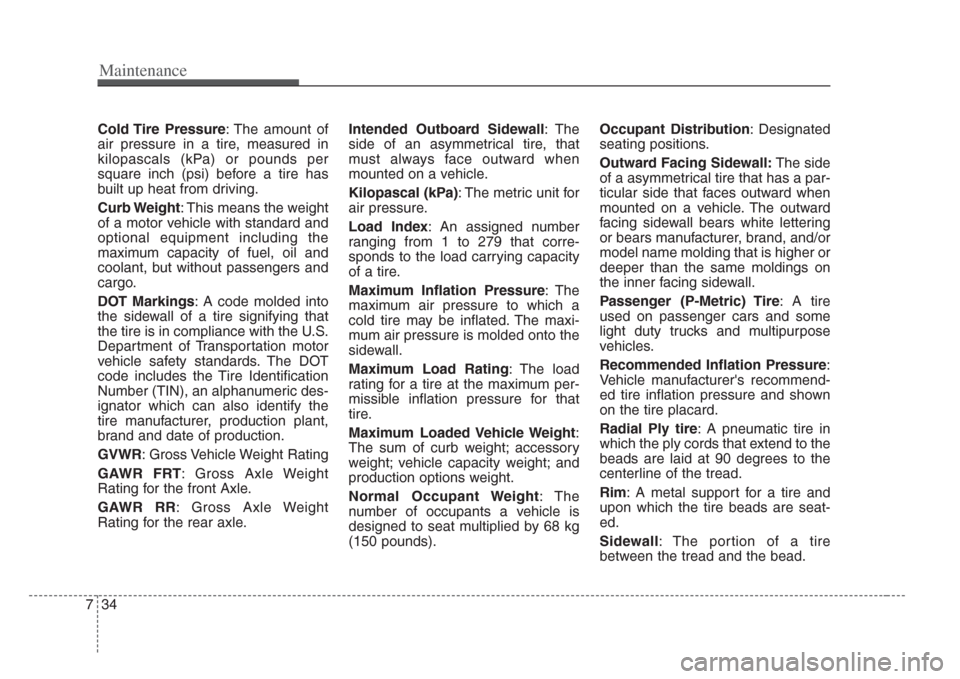
Cold Tire Pressure: The amount of
air pressure in a tire, measured in
kilopascals (kPa) or pounds per
square inch (psi) before a tire has
built up heat from driving.
Curb Weight : This means the weight
of a motor vehicle with standard and
optional equipment including the
maximum capacity of fuel, oil and
coolant, but without passengers and
cargo.
DOT Markings : A code molded into
the sidewall of a tire signifying that
the tire is in compliance with the U.S.
Department of Transportation motor
vehicle safety standards. The DOT
code includes the Tire Identification
Number (TIN), an alphanumeric des-
ignator which can also identify the
tire manufacturer, production plant,
brand and date of production.
GVWR: Gross Vehicle Weight Rating
GAWR FRT: Gross Axle Weight
Rating for the front Axle.
GAWR RR: Gross Axle Weight
Rating for the rear axle. Intended Outboard Sidewall
: The
side of an asymmetrical tire, that
must always face outward when
mounted on a vehicle.
Kilopascal (kPa) : The metric unit for
air pressure.
Load Index : An assigned number
ranging from 1 to 279 that corre-
sponds to the load carrying capacity
of a tire.
Maximum Inflation Pressure : The
maximum air pressure to which a
cold tire may be inflated. The maxi-
mum air pressure is molded onto the
sidewall.
Maximum Load Rating : The load
rating for a tire at the maximum per-
missible inflation pressure for that
tire.
Maximum Loaded Vehicle Weight :
The sum of curb weight; accessory
weight; vehicle capacity weight; and
production options weight.
Normal Occupant Weight:The
number of occupants a vehicle is
designed to seat multiplied by 68 kg
(150 pounds). Occupant Distribution
: Designated
seating positions.
Outward Facing Sidewall: The side
of a asymmetrical tire that has a par-
ticular side that faces outward when
mounted on a vehicle. The outward
facing sidewall bears white lettering
or bears manufacturer, brand, and/or
model name molding that is higher or
deeper than the same moldings on
the inner facing sidewall.
Pa ssenger (P-Metric) Tire : A tire
used on passenger cars and some
light duty trucks and multipurpose
vehicles.
Recommended Inflation Pressure :
Vehicle manufacturer's recommend-
ed tire inflation pressure and shown
on the tire placard.
Radial Ply tire : A pneumatic tire in
which the ply cords that extend to the
beads are laid at 90 degrees to the
centerline of the tread.
Rim: A metal support for a tire and
upon which the tire beads are seat-
ed.
Sidewall: The portion of a tire
between the tread and the bead.
Page 271 of 283
Maintenance
367
LUBRICANT SPECIFICATIONS
Recommended lubricants
To help achieve proper engine and pow-
ertrain performance and durability, use
only lubricants of the proper quality. The
correct lubricants also help promote
engine efficiency that results in improved
fuel economy.
Engine oils labeled Energy Conserving
Oil are now available. Along with other
additional benefits, they contribute to fuel
economy by reducing the amount of fuel
necessary to overcome engine friction.
Often, these improvements are difficult to
measure in everyday driving, but in a
year’s time, they can offer significant cost
and energy savings.
*¹ Refer to the recommended SAE viscosity numbers on the next page.
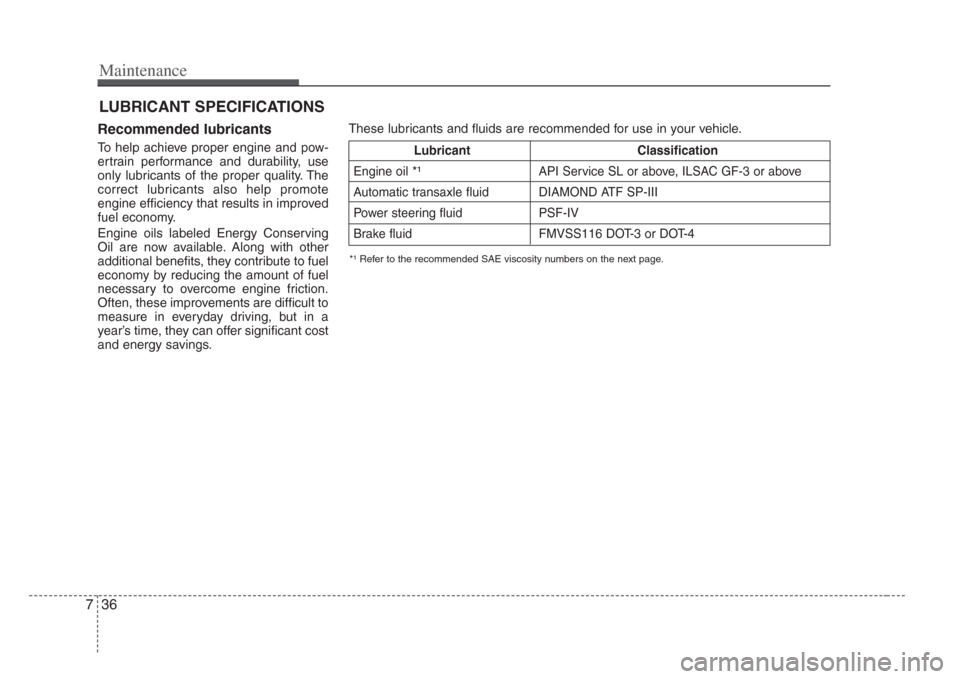
These lubricants and fluids are recommended for use in your vehicle.
LubricantClassification
Engine oil
*¹API Service SL or above, ILSAC GF-3 or above
Automatic transaxle fluid DIAMOND ATF SP-III
Power steering fluid PSF-IV
Brake fluid FMVSS116 DOT-3 or DOT-4