Page 401 of 466

Brake and Power Steering System Hoses
When servicing the vehicle for scheduled maintenance,
inspect surface of hoses for evidence of heat and me-
chanical damage. Hard and brittle rubber, cracking, tears,
cuts, abrasion, and excessive swelling suggest deteriora-
tion of the rubber. Particular attention should be made to
examining those hose surfaces nearest to high heat
sources, such as the exhaust manifold.
Inspect all hose clamps and couplings to make sure they
are secure and no leaks are present.
NOTE:Inspection of brake hoses should be done when-
ever the brake system is serviced and every engine oil
change.WARNING!
Worn brake hoses can burst and cause brake failure.
You could have an accident. If you see any signs of
cracking, scuffing, or worn spots, have the brake
hoses replaced immediately.
Brake Master Cylinder — Brake Fluid Level Check
Refer to Fluids, Lubricants, and Genuine Parts in this
section for the correct fluid type.
WARNING!
Use of a brake fluid that may have a lower initial
boiling point, or is unidentified as to specification,
may result in sudden brake failure during hard
prolonged braking. You could have an accident.
400 MAINTAINING YOUR VEHICLE
Page 407 of 466

Following off-road usage, completely inspect the under-
body of your vehicle. Check tires, body structure, steer-
ing, suspension and exhaust system for damage. Check
threaded fasteners for looseness, particularly on the
chassis, drivetrain components, steering and suspension.
Retighten, if required, to torque values specified in the
Service Manual. Also check for accumulations of vegeta-
tion or brush that could become a fire hazard, or conceal
damage to fuel lines, brake hoses, axle pinion seals, and
propeller shafts. Check air conditioning drain tube on the
lower dash wall in the engine compartment for mud or
debris, and clean as required. A plugged tube will
adversely affect air conditioning performance.CAUTION!
Under frequent heavy-duty driving conditions,
change all lubricants, and lubricate body compo-
nents more often than in normal service to prevent
excessive wear.
Appearance Care And Protection From Corrosion
Protection Of Body And Paint From Corrosion
Vehicle body care requirements vary according to geo-
graphic locations and usage. Chemicals that make roads
passable in snow and ice, and those that are sprayed on
trees and road surfaces during other seasons, are highly
corrosive to the metal in your vehicle. Outside parking,
which exposes your vehicle to airborne contaminants,
road surfaces on which the vehicle is operated, extreme
406 MAINTAINING YOUR VEHICLE
Page 420 of 466

CAUTION!
•When installing the Integrated Power Module
cover, it is important to ensure the cover is prop-
erly positioned and fully latched. Failure to do so
may allow water to get into the Integrated Power
Module, and possibly result in an electrical system
failure.
•When replacing a blown fuse, it is important to
use only a fuse having the correct amperage rating.
The use of a fuse with a rating other than indicated
may result in a dangerous electrical system over-
load. If a properly rated fuse continues to blow, it
indicates a problem in the circuit that must be
corrected.
VEHICLE STORAGE
If you are leaving your vehicle dormant for more than 21
days you may want to take steps to protect your battery.
You may:
•Remove Cartridge fuse #15 in the Power Distribution
Center labeled Ignition-Off Draw (IOD).
•Store the removed IOD fuse in the Power Distribution
Center location #11 labeled “IOD Storage.”
•Or, disconnect the negative cable from the battery.
•Anytime you store your vehicle, or keep it out of
service (i.e., vacation) for two weeks or more, run the
air conditioning system at idle for about five minutes
in the fresh air and high blower setting. This will
ensure adequate system lubrication to minimize the
possibility of compressor damage when the system is
started again.
MAINTAINING YOUR VEHICLE 419
7
Page 421 of 466

REPLACEMENT BULBS — IF EQUIPPED
Interior LightsBulb Type
Auto. Trans. Indicator Light ................. 658
Courtesy Lights, Under Dash (1) .............. 906
Heater Control Lights (2) ................... 194
Rocker Switch Indicator Light (Rear Window
Defogger, and Rear Wash/Wipe) ............... **
Soundbar Dome Light ..................... 912
** Bulbs only available from authorized dealer.
Exterior Lights Bulb Type
Backup Lights (2) ........................ 3157
Center High-Mounted Stop Light (1) .........L.E.D.
Fog Lights ............................. 9145
Front Park/Turn Lights (2) .................3157
Front Side Marker Lights (2) ................. 168
Headlights (2) .......................... H13
Stop/Tail/Turn Lights (2) ..................3157
Underhood Light ......................... 561
License Light ........................... 194 NOTE:
Numbers refer to commercial bulb types that
can be purchased from your local authorized dealer.
If a bulb needs to be replaced, visit your authorized
dealer or refer to the applicable Service Manual.
BULB REPLACEMENT
NOTE: Lens fogging can occur under certain atmo-
spheric conditions. This will usually clear as atmospheric
conditions change to allow the condensation to change
back into a vapor. Turning the lamps on will usually
accelerate the clearing process.
Head Light
1. Open hood and support using prop rod.
2. Remove the front grille. Turn the retainers along the
top 1/4 turn counterclockwise and remove.
3. Pull the bottom of the grille away starting at one side
and working toward the other.
420 MAINTAINING YOUR VEHICLE
Page 424 of 466
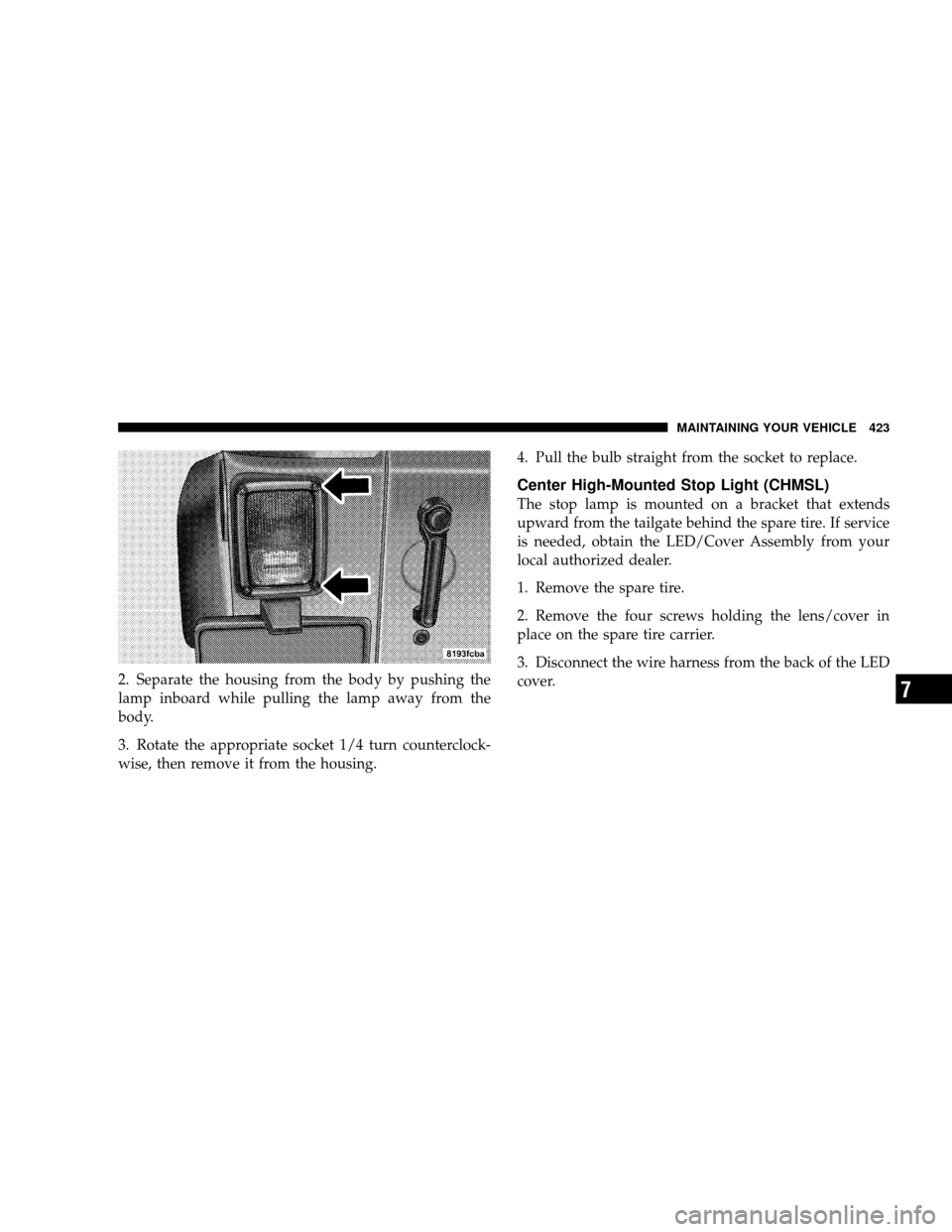
2. Separate the housing from the body by pushing the
lamp inboard while pulling the lamp away from the
body.
3. Rotate the appropriate socket 1/4 turn counterclock-
wise, then remove it from the housing.4. Pull the bulb straight from the socket to replace.
Center High-Mounted Stop Light (CHMSL)
The stop lamp is mounted on a bracket that extends
upward from the tailgate behind the spare tire. If service
is needed, obtain the LED/Cover Assembly from your
local authorized dealer.
1. Remove the spare tire.
2. Remove the four screws holding the lens/cover in
place on the spare tire carrier.
3. Disconnect the wire harness from the back of the LED
cover.
MAINTAINING YOUR VEHICLE 423
7
Page 429 of 466

EMISSIONS CONTROL SYSTEM MAINTENANCE
The Scheduled Maintenance services listed inbold type
must be done at the times or mileages specified to ensure
the continued proper functioning of the emission control
system. These, and all other maintenance services in-
cluded in this manual, should be done to provide best
vehicle performance and reliability. More frequent main-
tenance may be needed for vehicles in severe operating
conditions, such as dusty areas and very short trip
driving.
Inspection and service should also be done any time a
malfunction is suspected.
NOTE: Maintenance, replacement, or repair of the emis-
sions control devices and systems on your vehicle may be
performed by any automotive repair establishment or
individual using any automotive part that has been
certified pursuant to U.S. EPA or, in the State of Califor-
nia, California Air Resources Board regulations.
MAINTENANCE SCHEDULE
The oil change indicator system will remind you that it is
time to take your vehicle in for scheduled maintenance.
On Non-EVIC equipped vehicles “CHANgE OIL” will
flash in the instrument cluster odometer and a single
chime will sound, indicating that an oil change is neces-
sary.
Based on engine operation conditions the oil change
indicator message will illuminate, this means that service
is required for your vehicle. Have your vehicle serviced
as soon as possible, within the next 500 mi (805 km).
NOTE:
•The oil change indicator message will not monitor the
time since the last oil change. Change your vehicles oil
if it has been 6 months since your last oil change even
if the oil change indicator message is NOT illumi-
nated.
428 MAINTENANCE SCHEDULES
8
M A I
N T
E
N A
N CE
S
C
H E
D
U L
E
S
Page 433 of 466
Perform Maintenance Every(Where time and mileage
are listed, follow the interval that occurs first.)
Maintenance Items MilesKilometers or Months
Inspect the front suspension, tie rod ends and boot
seals, replace if necessary. 24,000
40 000 24
Replace the engine air cleaner filter. 30,00050 000 30
Change the manual transmission fluid if using your
vehicle for any of the following: trailer towing, snow
plowing, heavy loading, taxi, police, delivery service
(commercial service), off-road, desert operation or
more then 50% of your driving is at sustained high
speeds during hot weather, above 90°F (32°C). 30,000
50 000 30
Inspect the transfer case fluid. 30,00050 000 30
Change the automatic transmission fluid and main
sump filter if using your vehicle for any of the follow-
ing: police, taxi, fleet or frequent trailer towing. 60,000
100 000 60
432 MAINTENANCE SCHEDULES
8
M
A I
N T
E
N A
N CE
S
C
H E
D
U L
E
S
Page 435 of 466
WARNING!
You can be badly injured working on or around a
motor vehicle. Do only that service work for which
you have the knowledge and the right equipment. If
you have any doubt about your ability to perform a
service job, take your vehicle to a competent
mechanic.
434 MAINTENANCE SCHEDULES
8
MA I
N T
E
N A
N CE
S
C
H E
D
U L
E
S