Page 112 of 466

required to gain traction. To turn ESP on again, momen-
tarily depress the ESP OFF switch. This will restore the
normal “ESP On” mode of operation.
NOTE:To improve the vehicle’s traction when driving
with snow chains, or starting off in deep snow, sand, or
gravel, it may be desirable to switch to the “Partial Off” mode by pressing the ESP OFF switch. Once the situation
requiring ESP to be switched to the “Partial Off” mode is
overcome, turn ESP back on by momentarily depressing
the ESP OFF switch. This may be done while the vehicle
is in motion.
ESP Off (4H Range Only)
This mode is intended for off-highway or off-road use
when ESP stability features could inhibit vehicle maneu-
verability due to trail conditions. This mode is entered by
depressing and holding the ESP OFF switch for five
seconds when the vehicle is stopped and the engine is
running. In this mode, all ESP and TCS stability features
are turned off except for the “limited slip” feature de-
scribed in the TCS section. After five seconds, a chime
will sound, the ESP/TCS Indicator Light will illuminate,
and the “ESP OFF�
message will appear in the odometer.
Refer to “Compass and Mini-Trip Computer — If
Equipped” in Section 4 of this manual. To turn ESP on
ESP OFF Switch
UNDERSTANDING THE FEATURES OF YOUR VEHICLE 111
3
Page 114 of 466

40 mph (48 km/h), the normal ESP stability function
returns but TCS remains off. When the vehicle speed
drops below 35 mph (40 km/h), the ESP system shuts off.
ESP is off at low vehicle speeds in 4L range so that it will
not interfere with off-road driving, but the ESP function
returns to provide the stability feature at speeds above 40
mph (48 km/h). The ESP/TCS Indicator Light will al-
ways be illuminated in 4L range when ESP is off.
NOTE:The “ESP OFF” message will display and the
audible chime will sound when the shift lever is placed in
the PARK position from any position other than PARK,
and then moved out of the PARK position. This will
occur even if the message was previously cleared.WARNING!
With the ESP switched off, the enhanced vehicle
stability offered by ESP and ERM are unavailable. In
an emergency evasive maneuver, the ESP and ERM
systems will not engage to assist in maintaining
stability. The “Full Off” mode is intended for off-
road use only.
Disabling ESP for Modified Vehicles (4WD Models
Only)
Vehicles modified with larger tires and/or suspension
lifts may experience early ESP activations as compared to
a non-modified production vehicle depending on lift
size, tire size, suspension changes and/or driving habits.
If early ESP activations are experienced while driving a
modified vehicle, the additional ability to permanently
turn off ESP is available. A steering wheel/ESP button
UNDERSTANDING THE FEATURES OF YOUR VEHICLE 113
3
Page 116 of 466

9. Turn the steering wheel back to center.
10. Press and hold the ESP OFF button for seven seconds.
11. Cycle the ignition key to OFF.
After performing the ESP disable procedure correctly,
“ESP OFF” will be displayed in the odometer for approxi-
mately 12 seconds each time the ignition is moved to ON.
Repeating the ESP disable procedure will re-enable nor-
mal ESP operation.
ESP/BAS Warning Light
The malfunction indicator lamp for the ESP is
combined with the BAS indicator. The ESP/
BAS Warning Light in the instrument cluster
comes on when the ignition switch is turned to
the “ON” position. It should go out with the engine
running. If the ESP/BAS Warning Light comes on continuously
with the engine running, a malfunction has been detected
in either the ESP or the BAS system, or both. If this light
remains on after several ignition cycles, and the vehicle
has been driven several miles at speeds greater than 30
mph (48 km/h), see your authorized dealer as soon as
possible to have the problem diagnosed and corrected.
NOTE:
•�The ESP/BAS Warning Light comes on momentarily
each time the ignition switch is turned ON.
•Each time the ignition is turned ON, the ESP System
will be ON even if it was previously turned off.
•The ESP Control System will make buzzing or clicking
sounds when it is active. This is normal; the sounds
will stop when ESP becomes inactive following the
maneuver that caused the ESP activation.
UNDERSTANDING THE FEATURES OF YOUR VEHICLE 115
3
Page 117 of 466

ELECTRICAL POWER OUTLETThis vehicle has two auxiliary power outlets that can
provide up to 20 Amps of current for accessories de-
signed for use with the standard power outlet adapters.
The outlet located in the lower portion of the instrument
panel has a snap-on plastic cap so that it can be covered
when not in use. As a safety precaution, the outlet in the
instrument panel only operates with the ignition switch
ON. When the optional cigar lighter heating element is
used, it heats when pushed in and pops out automati-
cally when ready for use.To preserve the heating
element, do not hold the lighter in the heating position.
The right side outlet is powered directly from the battery
(power available at all times). Items plugged into this
outlet may discharge the battery and/or prevent engine
starting. The left side outlet has power available only when the
ignition is on. This outlet will also operate a conventional
cigar lighter unit.
Power Outlets
116 UNDERSTANDING THE FEATURES OF YOUR VEHICLE
Page 118 of 466
Electrical Outlet Use With Engine Off
WARNING!
•Many accessories that can be plugged in draw power
from the vehicle’s battery, even when not in use (i.e.,
cellular phones, etc.). Eventually, if plugged in long
enough, the vehicle’s battery will discharge suffi-
ciently to degrade battery life and/or prevent engine
starting.
• Accessories that draw higher power (i.e., coolers,
vacuum cleaners, lights, etc.), will degrade the battery
even more quickly. Only use these intermittently and
with greater caution.
• After the use of high-power draw accessories, or long
periods of the vehicle not being started (with acces-
sories still plugged in), the vehicle must be driven a
sufficient length of time to allow the alternator to
recharge the vehicle’s battery.
• Power outlets are designed for accessory plugs only.
Do not hang any type of accessory or accessory
bracket from the plug.
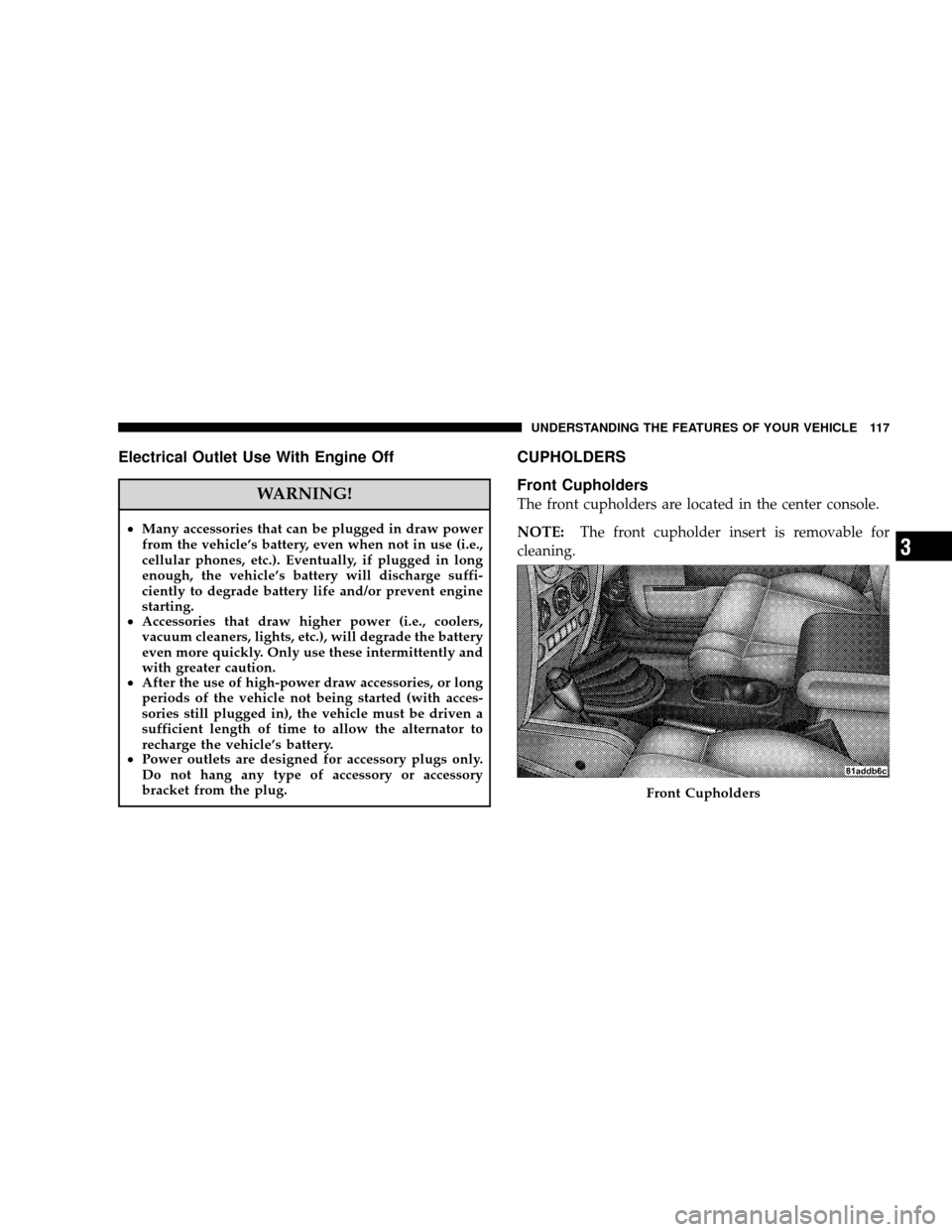
CUPHOLDERS
Front Cupholders
The front cupholders are located in the center console.
NOTE: The front cupholder insert is removable for
cleaning.
Front Cupholders
UNDERSTANDING THE FEATURES OF YOUR VEHICLE 117
3
Page 199 of 466
If the rear wiper is operating when the ignition is turned
OFF, the wiper will automatically return to the “Park”
position. When the vehicle is restarted, the wiper will
resume function at whichever position the switch is set
at.
Adding Washer Fluid
The fluid reservoir for the windshield washers and the
rear window washer is shared. It is located in the front of
the engine compartment, and should be checked for fluid
level at regular intervals. Fill the reservoir with wind-
shield washer solvent (not radiator antifreeze) and oper-
ate the system for a few seconds to flush out the residual
water.
Rear Window Defroster — If Equipped
The pushbutton is located on
the bottom right side of the
blower control knob. Press
this button to turn on the rear
window defroster. An amber
light shows that the defroster
is on.
Windshield Wiper/Washer Switch
198 UNDERSTANDING THE FEATURES OF YOUR VEHICLE
Page 207 of 466

INSTRUMENT CLUSTER DESCRIPTION
Your vehicle is equipped with the instrument cluster
described on the following pages.
1. Fuel Gauge
The pointer shows the level of fuel in the fuel tank.
NOTE:When the ignition switch is turned to OFF, the
fuel gauge, voltmeter, oil pressure and temperature
gauges may not show accurate readings. When the
engine is not running, turn the ignition switch to ON to
obtain accurate readings.
2. Charging System Warning Light This light shows the status of the electrical charg-
ing system. The light should come on for three
seconds when the ignition is first turned ON. If the light
comes back on immediately or comes on while driving, it
means that there is a problem with the charging system
or the battery is low. Also, a chime will sound if the light
comes back on. See your authorized dealer immediately. 3. Front Fog Light Indicator Light — If Equipped
This light shows when the front fog lights are on.
4. Low Fuel Warning Light When the fuel level reaches approximately 2.8 gal
(10.6L) this light will turn on and a single chime
will sound.
5. Speedometer
Indicates vehicle speed.
6. Front Axle Lock Indicator Light — If Equipped Indicates when the front axle lock has been
activated.
206 UNDERSTANDING YOUR INSTRUMENT PANEL
Page 208 of 466

7. Seat Belt Indicator LightA warning chime and an indicator light will alert
you to buckle the seat belts. When the belt is
buckled, the chime will stop, but the light will stay
on until it times out (about six seconds).
8. Turn Signal Indicator Lights The arrows will flash with the exterior turn signals
when the turn signal lever is operated. A tone will
chime if the turn signals are left on for more than 1 mi (2
km).
9. Oil Pressure Warning Light Shows low engine oil pressure. The light will come
on and remain on when the ignition switch is
turned from the OFF to the ON position, and the light
will turn off after the engine is started. If the bulb does
not come on, have the system checked by your autho-
rized dealer. If the warning light comes on and remains on while
driving, stop the vehicle and shut off the engine. DO
NOT OPERATE THE VEHICLE UNTIL THE CAUSE IS
CORRECTED. Also, a single chime will sound.
10. High Beam Indicator Light
This light shows that the headlights are on high
beam. Push the multifunction control lever away
from you to switch the headlights to high beam. Pull the
lever towards you to switch the headlights back to low
beam. If the driver’s door is open, and the headlights or
park lights are left on, the High Beam Indicator Light will
remain illuminated and a chime will sound.
11. Brake Warning Light After the ignition is turned on, this light illumi-
nates to indicate function check at vehicle start-
up. It also indicates if the parking brake is
applied. If the light stays on when the parking brake is
UNDERSTANDING YOUR INSTRUMENT PANEL 207
4
