Page 371 of 466

WARNING!
Raising the vehicle higher than necessary can make
the vehicle less stable and cause an accident. It could
slip off the jack and hurt someone near it. Raise the
vehicle only enough to remove the tire.
6. Remove the lug nuts and wheel.
7. Position spare wheel/tire on vehicle and install lug
nuts with cone-shaped end toward wheel. Lightly tighten
nuts clockwise. To avoid the risk of forcing the vehicle off
the jack, do not tighten the nuts fully until the vehicle has
been lowered.
8. Lower the vehicle by turning the jack screw to the left,
and remove the jack and wheel blocks. 9. Finish tightening the lug nuts. Push down on the
wrench while tightening for increased leverage. Alternate
nuts until each nut has been tightened twice. Correct
wheel nut tightness is 95 ft lbs (130 N·m). If in doubt
about the correct tightness, have them checked with a
torque wrench by your authorized dealer or at a service
station.
10. Remove jack assembly and wheel blocks.
WARNING!
A loose tire or jack, thrown forward in a collision or
hard stop, could endanger the occupants of the ve-
hicle. Always stow the jack parts and the spare tire in
the places provided.
11. Secure the tire, jack, and tools in their proper loca-
tions.
370 WHAT TO DO IN EMERGENCIES
Page 377 of 466

▫Driveline And Steering Component
Lubrication ..........................392
▫ Body Lubrication .....................392
▫ Windshield Wiper Blades ................392
▫ Windshield And Rear Window Washers .....393
▫ Exhaust System ......................393
▫ Cooling System .......................394
▫ Hoses And Vacuum/Vapor Harnesses .......399
▫ Brake System ........................399
▫ Automatic Transmission ................401
▫ Hydraulic Clutch Fluid — Manual
Transmission ........................403
▫ Manual Transmission ..................403
▫ Transfer Case ........................404 ▫
Front/Rear Axle Fluid ..................405
▫ Maintenance After Off-Road Driving ........405
▫ Appearance Care And Protection From
Corrosion ...........................406
� Fuses (Totally Integrated Power Module) ......413
� Vehicle Storage ........................419
� Replacement Bulbs — If Equipped ...........420
� Bulb Replacement ......................420
▫ Head Light ..........................420
▫ Front Park/Turn Signal .................421
▫ Front Side Marker .....................422
▫ Front Fog Light ......................422
▫ Rear Tail, Stop, Turn Signal, And Backup
Lights .............................422
376 MAINTAINING YOUR VEHICLE
Page 378 of 466
▫Center High-Mounted Stop Light (CHMSL) . . . 423
� Fluid Capacities ........................424
� Fluids, Lubricants And Genuine Parts ........424▫
Engine .............................424
▫ Chassis ............................425
MAINTAINING YOUR VEHICLE 377
7
Page 380 of 466

ONBOARD DIAGNOSTIC SYSTEM — OBD II
Your vehicle is equipped with a sophisticated onboard
diagnostic system called OBD II. This system monitors
the performance of the emissions, engine, and automatic
transmission control systems. When these systems are
operating properly, your vehicle will provide excellent
performance and fuel economy, as well as engine emis-
sions well within current government regulations.
If any of these systems require service, the OBD II system
will turn on the “Malfunction Indicator Light.” It will
also store diagnostic codes and other information to
assist your service technician in making repairs. Al-
though your vehicle will usually be drivable and not
need towing, see your authorized dealer for service as
soon as possible.CAUTION!
•Prolonged driving with the “Malfunction Indica-
tor Light” on could cause further damage to the
emission control system. It could also affect fuel
economy and drivability. The vehicle must be
serviced before any emissions tests can be per-
formed.
•If the “Malfunction Indicator Light” is flashing
while the engine is running, severe catalytic con-
verter damage and power loss will soon occur.
Immediate service is required.
MAINTAINING YOUR VEHICLE 379
7
Page 381 of 466

Loose Fuel Filler Cap Message
After fuel is added, the vehicle diagnostic system can
determine if the fuel filler cap is possibly loose, improp-
erly installed, or damaged. A “gASCAP” message will be
displayed in the odometer. Tighten the gas cap until a
�clicking�sound is heard. This is an indication that the
gas cap is properly tightened. Press the odometer reset
button to turn the message off. If the problem persists,
the message will appear the next time the vehicle is
started. This might indicate a damaged cap. If the prob-
lem is detected twice in a row, the system will turn on the
“Malfunction Indicator Light.” Resolving the problem
will turn the “Malfunction Indicator Light.” off.
EMISSIONS INSPECTION AND MAINTENANCE
PROGRAMS
In some localities, it may be a legal requirement to pass
an inspection of your vehicle’s emissions control system.
Failure to pass could prevent vehicle registration.
For states that require an Inspection and Mainte-
nance (I/M), this check verifies the Malfunction
Indicator Light (MIL) is functioning and is not on
when the engine is running, and that the OBD II system
is ready for testing.
Normally, the OBD II system will be ready. The OBD II
system may notbe ready if your vehicle was recently
serviced, recently had a dead battery, or a battery replace-
ment. If the OBD II system should be determined not
ready for the I/M test, your vehicle may fail the test.
380 MAINTAINING YOUR VEHICLE
Page 404 of 466

CAUTION!
Be aware that if the fluid temperature is below 50° F
(10° C), it may not register on the dipstick. Do not add
fluid until the temperature is elevated enough to
produce an accurate reading.
7. Check for leaks. Release the parking brake.
NOTE: To prevent dirt and water from entering the
transmission after checking or replenishing fluid, make
certain that the dipstick cap is properly reseated. It is
normal for the dipstick cap to spring back slightly from
its fully seated positions, as long as its seal remains
engaged in the dipstick tube.
Special Additives
Automatic Transmission Fluid (ATF) is an engineered
product and its performance may be impaired by supple-
mental additives. Therefore, do not add any fluid addi-
tives to the transmission. The only exception to this
policy is the use of special dyes to aid in detecting fluid
leaks. In addition, avoid using transmission sealers as
they may adversely affect seals.
Hydraulic Clutch Fluid — Manual Transmission
The clutch hydraulic system is a sealed maintenance free
system. In the event of leakage or other malfunction, the
system must be replaced.
Manual Transmission
Selection of Lubricant
Use only manufacturer’s recommended manual trans-
mission fluid. Refer to Fluids, Lubricants, and Genuine
Parts in this section for the correct fluid type.
MAINTAINING YOUR VEHICLE 403
7
Page 413 of 466

RINSING —Be sure to remove all trace of cleaner by
rinsing the top thoroughly with clean water. Remember
to allow the top to dry before lowering it.
Care Of Fabric Top Windows
CAUTION!
Your vehicle’s fabric top has pliable plastic windows
which can be scratched unless special care is taken by
following these directions:
1. Never use a dry cloth to remove dust. Instead, use a
microfiber towel or soft cotton cloth moistened with
cold or warm, clean water, and wipe across the window,
not up and down. MOPAR�Jeep Soft Glass Window
Cleaner will safely clean all plastic windows without
scratching. Removes fine scratches to improve visibility
and provide UV protection to help prevent yellowing. 2. When washing,
never use hot water or anything
stronger than a mild soap. Never use solvents such as
alcohol or harsh cleaning agents.
3. Always rinse thoroughly with cold water, then wipe
with a soft and slightly moist, clean cloth.
4. When removing frost, snow or ice, never use a scraper
or de-icing chemicals. Use warm water only if you must
clean the window quickly.
5. Debris (sand, mud/dirt, dust, or salt) from off-road
driving will have a major impact on zipper operation.
Even normal on-road driving and vehicle washing will
eventually impact window zipper operation. To maintain
ease of use of the window zippers, each window zipper
should be cleaned and lubricated regularly. Use MO-
PA R �Soft Top Zipper Cleaner and Lubricant to ease
zipper operation. Before applying, make sure the zipper
teeth are clear of sand, mud, and other materials. Clean
both sides of the zipper, not just one side. Rinse both
412 MAINTAINING YOUR VEHICLE
Page 416 of 466
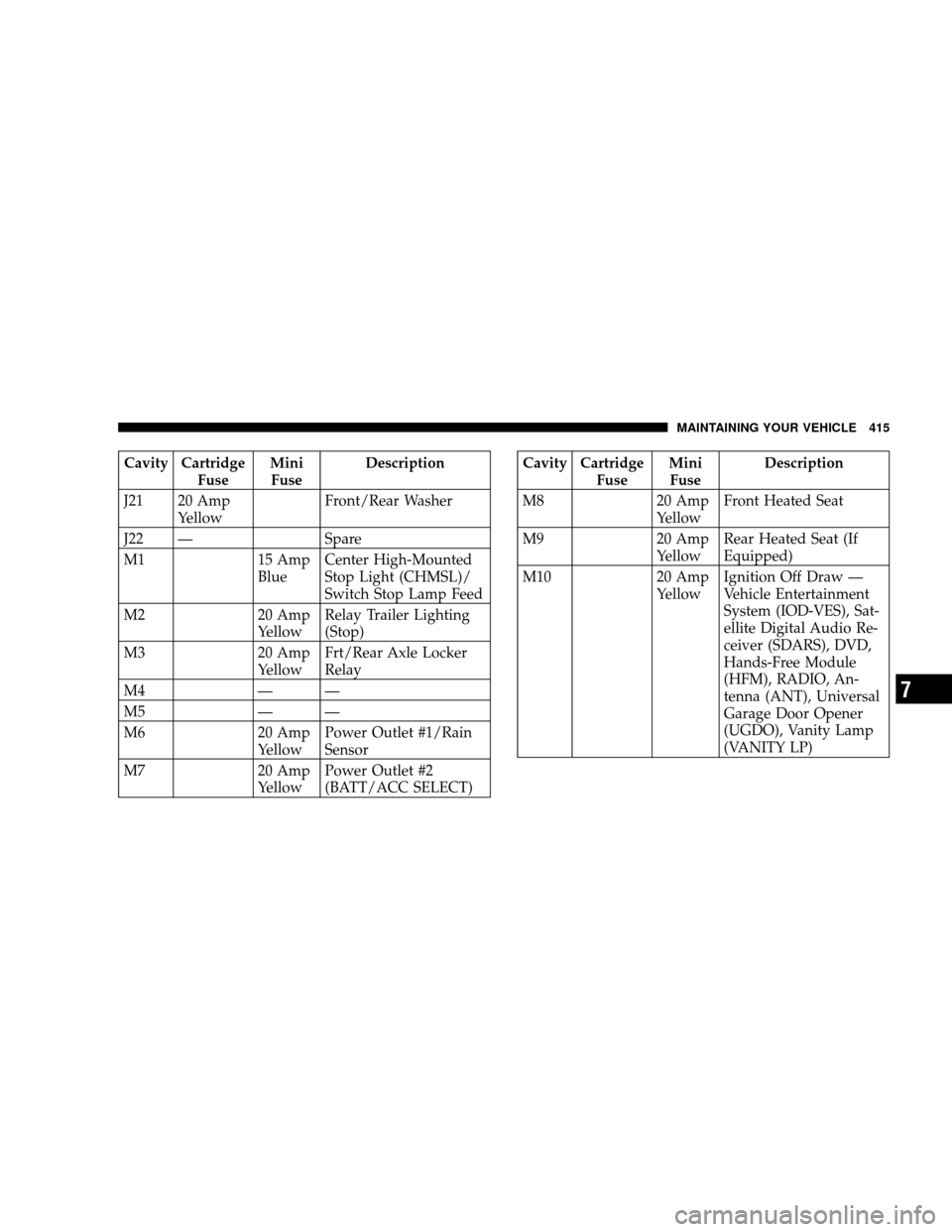
Cavity CartridgeFuseMini
Fuse Description
J21 20 Amp Yellow Front/Rear Washer
J22 — Spare
M1 15 Amp
Blue Center High-Mounted
Stop Light (CHMSL)/
Switch Stop Lamp Feed
M2 20 Amp
Yellow Relay Trailer Lighting
(Stop)
M3 20 Amp
Yellow Frt/Rear Axle Locker
Relay
M4 — —
M5 — —
M6 20 Amp
Yellow Power Outlet #1/Rain
Sensor
M7 20 Amp
Yellow Power Outlet #2
(BATT/ACC SELECT)Cavity Cartridge
FuseMini
Fuse Description
M8 20 Amp
Yellow Front Heated Seat
M9 20 Amp
Yellow Rear Heated Seat (If
Equipped)
M10 20 Amp
Yellow Ignition Off Draw —
Vehicle Entertainment
System (IOD-VES), Sat-
ellite Digital Audio Re-
ceiver (SDARS), DVD,
Hands-Free Module
(HFM), RADIO, An-
tenna (ANT), Universal
Garage Door Opener
(UGDO), Vanity Lamp
(VANITY LP)
MAINTAINING YOUR VEHICLE 415
7