2008 JEEP PATRIOT check engine light
[x] Cancel search: check engine lightPage 183 of 438
26. Malfunction Indicator Light (MIL)
This light is part of an Onboard Diagnostic
system called OBD II that monitors emissions,
engine, and automatic transmission control sys-
tems. The light will illuminate when the key is in the
ON/RUN position before engine start. If the light does
not come on when turning the key from OFF to ON/
RUN, have the condition checked promptly.
Certain conditions such as a loose or missing gas cap,
poor fuel quality, etc., may illuminate the light after
engine start. The vehicle should be serviced if the light
stays on through several of your typical driving cycles. In
most situations the vehicle will drive normally and will
not require towing.
If the MIL flashes when the engine is running, serious
conditions may exist that could lead to immediate loss of
power or severe catalytic converter damage. The vehicle
should be serviced as soon as possible if this occurs.27. Hill Descent Indicator Light — If Equipped
The symbol illuminates (is armed) when the
4WD Lock switch is activated and the trans-
mission range indicator is in LOW or REVERSE
position (Off-Road Mode).
28. Front Fog Light Indicator Light — If Equipped
This light shows when the front fog lights are on.
29. Electronic Stability Program (ESP) Indicator
Light/Traction Control System (TCS) Indicator Light —
If Equipped
If this indicator light flashes during accelera-
tion, apply as little throttle as possible. While
driving, ease up on the accelerator. Adapt your
speed and driving to the prevailing road con-
ditions, and do not switch off the ESP, or TCS — if
equipped.
UNDERSTANDING YOUR INSTRUMENT PANEL 181
4
Page 184 of 438

30. Electronic Stability Program (ESP) Indicator Light
The malfunction light for the ESP is combined
with BAS. The yellow “ESP/BAS Warning
Light” comes on when the ignition switch is
turned to the ON position. They should go out
with the engine running. If the “ESP/BAS Warning
Light” comes on continuously with the engine running, a
malfunction has been detected in either the ESP or the
BAS system. If this light remains on after several ignition
cycles, and the vehicle has been driven several miles/
kilometers at speeds greater than 30 mph (48 km/h), see
your authorized dealer as soon as possible.
31. 4WD! Warning Light
This light monitors the 4-Wheel Drive (4WD)
system. The light will come on, for a bulb
check, when the ignition key is turned to the
ON position and may stay on for as long as
three seconds.When lit solid:There is an 4WD system fault. 4WD
performance will be at a reduced level. Service the 4WD
system soon.
When blinking:The 4WD system is temporarily dis-
abled due to overload condition.
32. Electronic Vehicle Information Center Display — If
Equipped
When the appropriate conditions exist, this display
shows the Electronic Vehicle Information Center (EVIC)
messages.
33. Electronic Vehicle Information Center (EVIC)
Button — If Equipped
Pushing this button, will change the display to the
choices available for EVIC.
182 UNDERSTANDING YOUR INSTRUMENT PANEL
Page 186 of 438

•Right Front Turn Signal Light Out (with a single
chime)
•Right Rear Turn Signal Light Out (with a single chime)
•RKE Battery Low (with a single chime)
•Personal Settings Not Available – Vehicle not in PARK
(automatic transmissions) or vehicle is in motion
(manual transmissions).
•Left/Right Front Door Ajar (one or more, with a single
chime if speed is above 1 mph (1 km/h)
•Left/Right Rear Door Ajar (one or more, with a single
chime if speed is above 1 mph (1 km/h)
•Door(s) Ajar (with a single chime if vehicle is in
motion)
•Gate Ajar (with a single chime)
•Headlights On
•Key In Ignition
•Check TPM System
Engine Oil Change Indicator System
Oil Change Required
Your vehicle is equipped with an engine oil change
indicator system. The “Oil Change Required” message
will flash in the EVIC display for approximately 10
seconds after a single chime has sounded, to indicate the
next scheduled oil change interval. The engine oil change
indicator system is duty-cycle based, which means the
engine oil change interval may fluctuate dependent upon
your personal driving style.
Unless reset, this message will continue to display each
time you turn the ignition switch to the ON/RUN
position. To turn off the message temporarily, press and
release the Trip Odometer button on the instrument
184 UNDERSTANDING YOUR INSTRUMENT PANEL
Page 330 of 438
Towing Tips — Automatic Transmission
The automatic transmission fluid and filter should be
changed if you REGULARLY tow a trailer for more than
45 minutes of continuous operation. Refer to the “Main-
tenance Schedule” in Section 8 for transmission fluid
change intervals.
NOTE:Check the automatic transmission fluid level
before towing.
Towing Tips — Electronic Speed Control (If
Equipped)
Don’t use in hilly terrain or with heavy loads.
When using the speed control, if you experience speed
drops greater than 10 mph (16 km/h), disengage until
you can get back to cruising speed.
Use speed control in flat terrain and with light loads to
maximize fuel efficiency.
Towing Tips — Cooling System
To reduce the potential for engine and transmission
overheating, take the following actions:
City Driving
When stopped for short periods of time, put transmission
in NEUTRAL but do not increase engine idle speed.
Highway Driving
Reduce speed.
Air Conditioning
Turn off temporarily.
refer to Cooling System Operating information in the
Maintenance section of this manual for more informa-
tion.
328 STARTING AND OPERATING
Page 352 of 438
RESET button to turn off the message. If the problem
persists, the message will appear the next time the
vehicle is started. This might indicate a damaged cap. If
the problem is detected twice in a row, the system will
turn on the MIL. Resolving the problem will turn the MIL
light off.
EMISSIONS INSPECTION AND MAINTENANCE
PROGRAMS
In some localities, it may be a legal requirement to pass
an inspection of this vehicle’s emissions control system.
Failure to pass could prevent vehicle registration.
For states that require an Inspection and Mainte-
nance (I/M), this check verifies the Malfunction
Indicator Light (MIL) is functioning and is not on
when the engine is running, and that the OBD II system
is ready for testing.Normally, the OBD II system will be ready. The OBD II
system maynotbe ready if the vehicle was recently
serviced, recently had a dead battery, or a battery replace-
ment. If the OBD II system should be determined not
ready for the I/M test, the vehicle may fail the test.
This vehicle has a simple ignition key-actuated test,
which you can use prior to going to the test station. To
check if this vehicle’s OBD II system is ready, you must
do the following:
1. Insert the ignition key into the ignition switch.
2. Turn the ignition to the ON position, but do not crank
or start the engine.
3. If you crank or start the engine, you will have to start
this test over.
4. As soon as you turn the ignition key to the ON
position, you will see the MIL symbol come on as part of
a normal bulb check.
350 MAINTAINING YOUR VEHICLE
Page 374 of 438
NOTE:Inspection of brake hoses should be done when-
ever the brake system is serviced and at every engine oil
change.
WARNING!
Worn brake hoses can burst and cause brake failure.
You could have an accident. If you see any signs of
cracking, scuffing, or worn spots, have the brake
hoses replaced immediately.
Brake Master Cylinder
The fluid level in the master cylinder should be checked
when performing under hood services, or immediately if
the brake system warning light is on.
Be sure to clean the top of the master cylinder area before
removing the cap. If necessary, add fluid to bring the
fluid level up to the requirements described on the brakefluid reservoir. Fluid level can be expected to fall as the
brake pads wear. The brake fluid level should be checked
when the pads are replaced. However, low fluid level
may be caused by a leak and a checkup may be needed.
NOTE:If your vehicle is equipped with amanual
transaxle, the brake fluid reservoir supplies fluid to both
the brake system and the clutch release system. The two
systems are separated in the reservoir, and a leak in one
system will not affect the other system. Themanual
transaxleclutch release system should not require fluid
replacement during the life of the vehicle. If the brake
fluid reservoir is low and the brake system does not
indicate any leaks or other problems, it may be a result of
a leak in the hydraulic clutch release system. See your
local authorized dealer for service.
Use only manufacturer’s recommended brake fluid. Re-
fer to “Fluids, Lubricants, and Genuine Parts” under
Section 8.
372 MAINTAINING YOUR VEHICLE
Page 404 of 438

Once a Month
•Check the tire pressure and look for unusual wear or
damage.
•Inspect the battery and clean and tighten the terminals
as required.
•Check the fluid levels of coolant reservoir, brake
master cylinder, power steering and transmission and
add as needed.
•Check all lights and other electrical items for correct
operation.At Each Oil Change
•Change the engine oil filter.
•Inspect the brake hoses and lines.
•Check the manual transmission fluid level.
CAUTION!
Failure to perform the required maintenance items
may result in damage to the vehicle.
402 MAINTENANCE SCHEDULES
8
M
A
I
N
T
E
N
A
N
C
E
S
C
H
E
D
U
L
E
S
Page 420 of 438
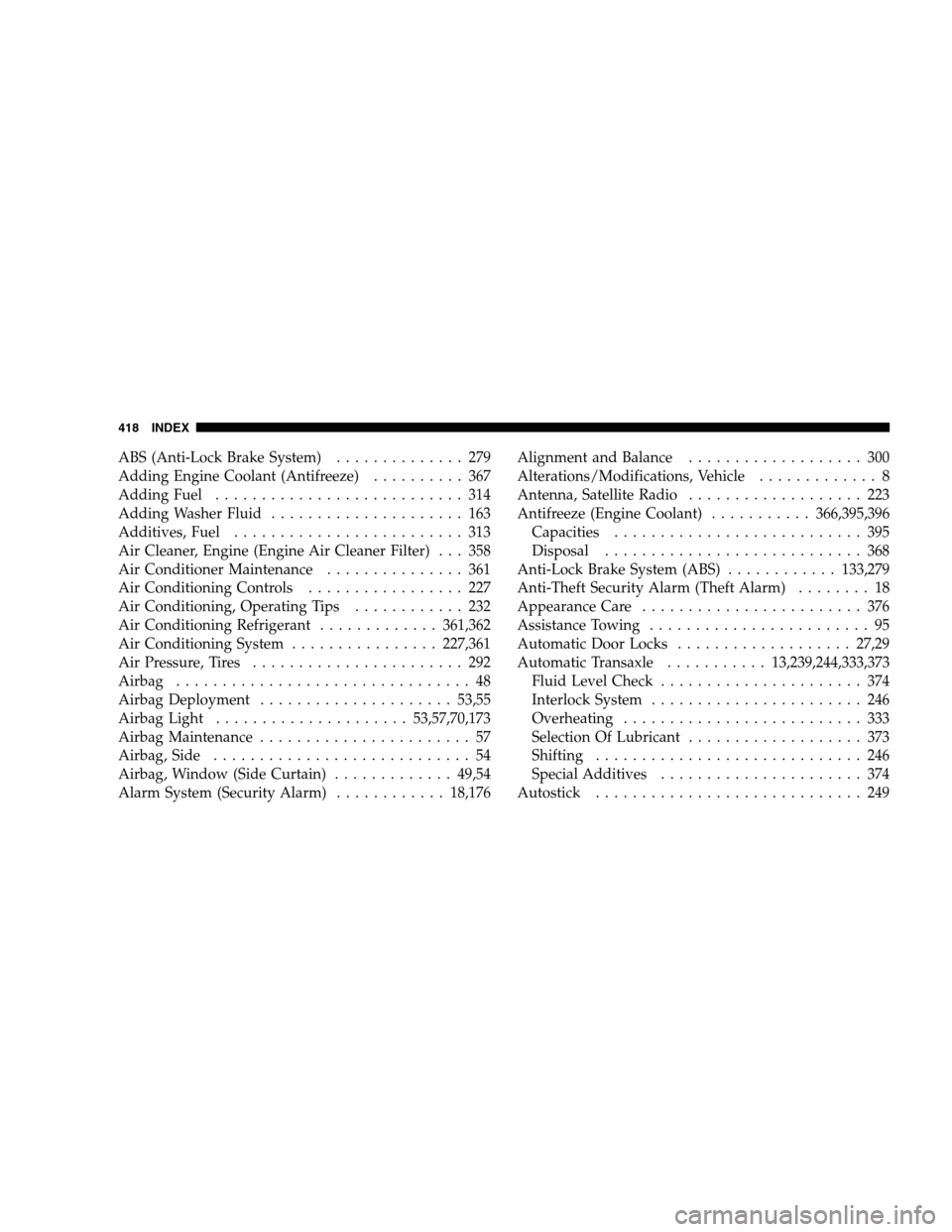
ABS (Anti-Lock Brake System).............. 279
Adding Engine Coolant (Antifreeze).......... 367
Adding Fuel........................... 314
Adding Washer Fluid..................... 163
Additives, Fuel......................... 313
Air Cleaner, Engine (Engine Air Cleaner Filter) . . . 358
Air Conditioner Maintenance............... 361
Air Conditioning Controls................. 227
Air Conditioning, Operating Tips............ 232
Air Conditioning Refrigerant.............361,362
Air Conditioning System................227,361
Air Pressure, Tires....................... 292
Airbag................................ 48
Airbag Deployment..................... 53,55
Airbag Light..................... 53,57,70,173
Airbag Maintenance....................... 57
Airbag, Side............................ 54
Airbag, Window (Side Curtain)............. 49,54
Alarm System (Security Alarm)............ 18,176Alignment and Balance................... 300
Alterations/Modifications, Vehicle............. 8
Antenna, Satellite Radio................... 223
Antifreeze (Engine Coolant)...........366,395,396
Capacities........................... 395
Disposal............................ 368
Anti-Lock Brake System (ABS)............133,279
Anti-Theft Security Alarm (Theft Alarm)........ 18
Appearance Care........................ 376
Assistance Towing........................ 95
Automatic Door Locks................... 27,29
Automatic Transaxle........... 13,239,244,333,373
Fluid Level Check...................... 374
Interlock System....................... 246
Overheating.......................... 333
Selection Of Lubricant................... 373
Shifting ............................. 246
Special Additives...................... 374
Autostick ............................. 249
418 INDEX