Page 343 of 393
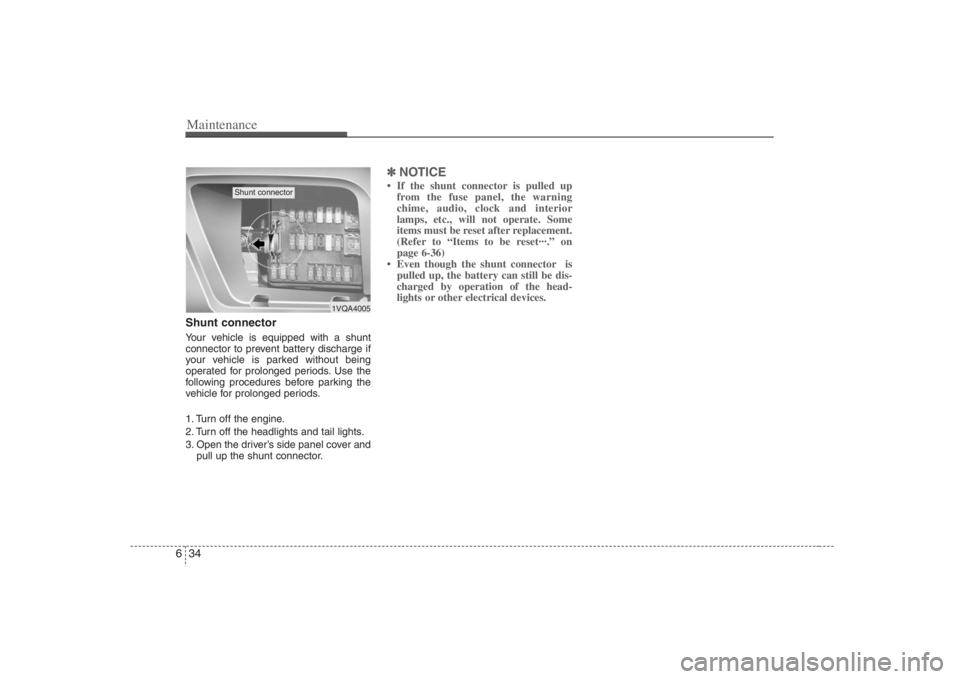
Maintenance34 6Shunt connector Your vehicle is equipped with a shunt
connector to prevent battery discharge if
your vehicle is parked without being
operated for prolonged periods. Use the
following procedures before parking the
vehicle for prolonged periods.
1. Turn off the engine.
2. Turn off the headlights and tail lights.
3. Open the driver’s side panel cover and
pull up the shunt connector.
✽ ✽
NOTICE• If the shunt connector is pulled up
from the fuse panel, the warning
chime, audio, clock and interior
lamps, etc., will not operate. Some
items must be reset after replacement.
(Refer to “Items to be reset···.” on
page 6-36)
• Even though the shunt connector is
pulled up, the battery can still be dis-
charged by operation of the head-
lights or other electrical devices.
1VQA4005
Shunt connector
Page 345 of 393
Maintenance36 6For best battery service: Keep the battery securely mounted.
Keep the battery top clean and dry.
Keep the terminals and connections
clean, tight, and coated with petroleum
jelly or terminal grease.
Rinse any spilled electrolyte from the
battery immediately with a solution of
water and baking soda.
If the vehicle is not going to be used for
an extended time, disconnect the bat-
tery cables.Battery recharging Your vehicle has a maintenance-free,
calcium-based battery.
If the battery becomes discharged in a
short time (because, for example, the
headlights or interior lights were left on
while the vehicle was not in use),
recharge it by slow charging (trickle)
for 10 hours.
If the battery gradually discharges
because of high electric load while the
vehicle is being used, recharge it at 20-
30A for two hours.
Items to be reset after the battery
has been discharged or the bat-
tery has been disconnected. Clock (See Chapter 3)
Sunroof (See Chapter 3)
Trip computer (See Chapter 3)
Climate control system (See Chapter
3)
Audio (See Chapter 3)
Power sliding door and power tailgate
(See Chapter 3)
CAUTION
Before performing maintenance
or recharging the battery, turn off
all accessories and stop the
engine.
The negative battery cable must
be removed first and installed last
when the battery is disconnected.
WARNING
- Recharging
battery
When recharging the battery,
observe the following precautions:
The battery must be removed
from the vehicle and placed in an
area with good ventilation.
Do not allow cigarettes, sparks, or
flame near the battery.
Watch the battery during charg-
ing, and stop or reduce the charg-
ing rate if the battery cells begin
gassing (boiling) violently or if
the temperature of the electrolyte
of any cell exceeds 120°F (49°C).
(Continued)
(Continued)
Wear eye protection when check-
ing the battery during charging.
Disconnect the battery charger in
the following order.
1. Turn off the battery charger main
switch.
2. Unhook the negative clamp from
the negative battery terminal.
3. Unhook the positive clamp from
the positive battery terminal.
Page 360 of 393

651
Maintenance
LIGHT BULBS REPLACEMENT Use only the bulbs of the specified
wattage.
✽ ✽
NOTICEAfter driving in heavy rain or washing,
headlight and taillight lenses could
appear frosty. This condition is caused by
the temperature difference between the
lamp inside and outside. This is similar
to the condensation on your windows
inside your vehicle during the rain and
doesn’t indicate a problem with your
vehicle. If the water leaks into the lamp
bulb circuitry, have the vehicle checked
by an Authorized Hyundai Dealer.
WARNING
- Working on
the lights
Prior to working on the light, firmly
apply the parking brake, ensure that
the ignition switch is turned to the
“LOCK” position and turn off the
lights to avoid sudden movement of
the vehicle and burning your fin-
gers or receiving an electric shock.
CAUTION
Be sure to replace the burned-out
bulb with one of the same wattage
rating. Otherwise, it may cause
damage to the fuse or electric
wiring system.
CAUTION
If you don’t have necessary tools,
the correct bulbs and the expertise,
consult an Authorized Hyundai
Dealer. In many cases, it is difficult
to replace vehicle light bulbs
because other parts of the vehicle
must be removed before you can
get to the bulb. This is especially
true if you have to remove the head-
light assembly to
get to the bulb(s).
Removing/installing
the headlight
assembly can result in damage to
the vehicle.
Page 364 of 393
655
Maintenance
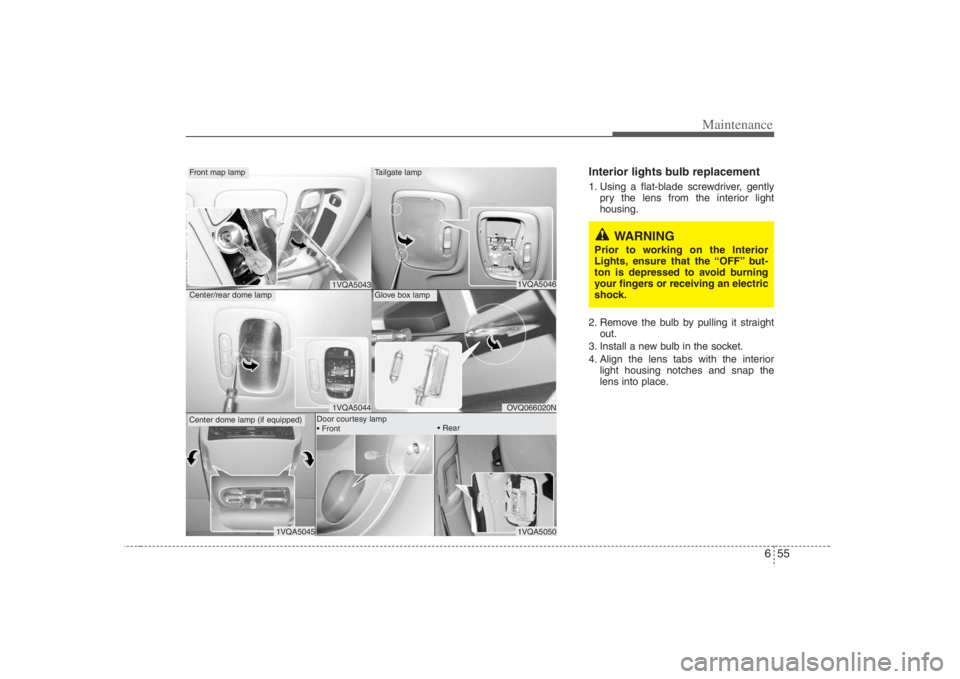
Interior lights bulb replacement1. Using a flat-blade screwdriver, gently
pry the lens from the interior light
housing.
2. Remove the bulb by pulling it straight
out.
3. Install a new bulb in the socket.
4. Align the lens tabs with the interior
light housing notches and snap the
lens into place.
1VQA5046OVQ066020N
Tailgate lampGlove box lamp
1VQA50431VQA5044
Front map lampCenter/rear dome lampCenter dome lamp (if equipped)
1VQA5050
1VQA5045
Door courtesy lamp
WARNING
Prior to working on the Interior
Lights, ensure that the “OFF” but-
ton is depressed to avoid burning
your fingers or receiving an electric
shock.
Page 389 of 393
Index4 9
Power outlet ··························································· 3-177
Shopping bag holder ·············································· 3-175
Sunvisor ·································································· 3-176
Interior lights ····························································· 3-125
Interior overview ··························································· 2-2
Key positions ································································· 4-5
Illuminated ignition switch ········································ 4-5
Keys ··············································································· 3-3
Label information ·························································· 7-2
Light bulbs replacement ·············································· 6-51
Lighting ····································································· 3-128
Lubricant ······································································ 6-59
Lubricants and fluids ··················································· 6-20
Luggage net holder ···················································· 3-165
Maintenance services ····················································· 6-2
Manual climate control system ································· 3-138
Air conditioning button ·········································· 3-143
Heating and ventilation (front) ······························· 3-139
Heating and ventilation (rear) ································ 3-144
Mirrors ······································································· 3-104Owner maintenance ······················································· 6-9
Power adjustable pedals ·············································· 3-59
Power sliding door and power tailgate ························ 3-17
Power ON/OFF button ············································· 3-20
Power sliding door operation ··································· 3-21
Power tailgate operation ··········································· 3-24
Power steering ····························································· 6-21
Rear parking assist system·············································4-25
Rear seat entertainment system / DVD player ·········· 3-206
Headphones ···························································· 3-207
Audio via vehicle speakers ···································· 3-208
Connecting other devices to the RSE ···················· 3-209
Using the DVD player ··········································· 3-210
Using the CD player ··············································· 3-214
Using the remote control ········································ 3-219
Remote keyless entry ····················································· 3-4
Reporting safety defects ················································ 7-5
Road warning ································································· 5-2
Roof rack ··································································· 3-166
Scheduled maintenance service ····································· 6-2M
SOPR
KL