2008 HYUNDAI ENTOURAGE engine overheat
[x] Cancel search: engine overheatPage 277 of 393
437
Driving your vehicle
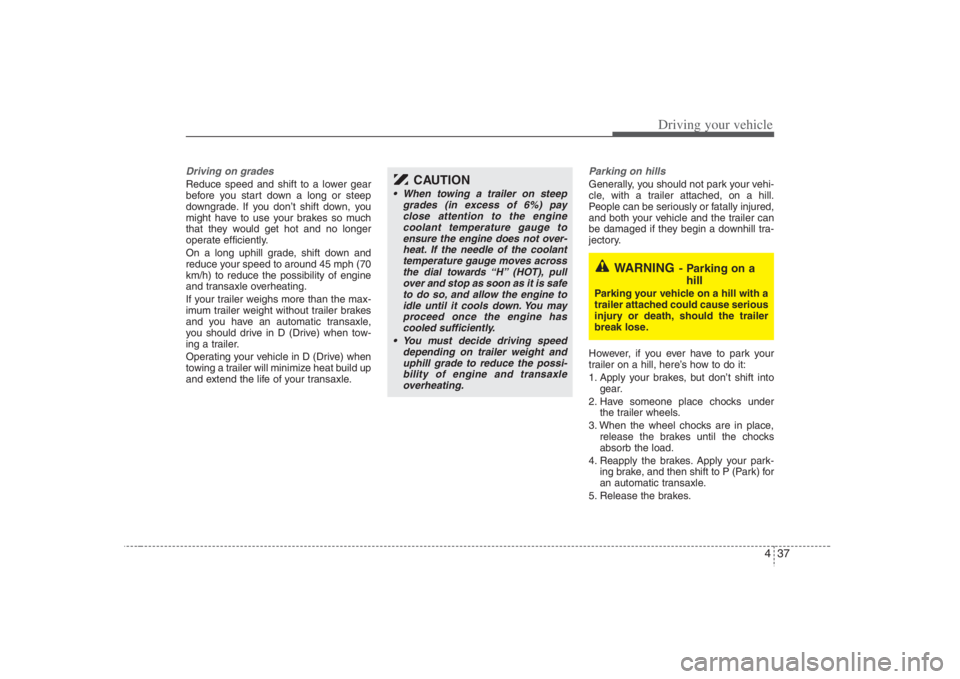
Driving on grades Reduce speed and shift to a lower gear
before you start down a long or steep
downgrade. If you don’t shift down, you
might have to use your brakes so much
that they would get hot and no longer
operate efficiently.
On a long uphill grade, shift down and
reduce your speed to around 45 mph (70
km/h) to reduce the possibility of engine
and transaxle overheating.
If your trailer weighs more than the max-
imum trailer weight without trailer brakes
and you have an automatic transaxle,
you should drive in D (Drive) when tow-
ing a trailer.
Operating your vehicle in D (Drive) when
towing a trailer will minimize heat build up
and extend the life of your transaxle.
Parking on hills Generally, you should not park your vehi-
cle, with a trailer attached, on a hill.
People can be seriously or fatally injured,
and both your vehicle and the trailer can
be damaged if they begin a downhill tra-
jectory.
However, if you ever have to park your
trailer on a hill, here’s how to do it:
1. Apply your brakes, but don’t shift into
gear.
2. Have someone place chocks under
the trailer wheels.
3. When the wheel chocks are in place,
release the brakes until the chocks
absorb the load.
4. Reapply the brakes. Apply your park-
ing brake, and then shift to P (Park) for
an automatic transaxle.
5. Release the brakes.
CAUTION
When towing a trailer on steep
grades (in excess of 6%) pay
close attention to the engine
coolant temperature gauge to
ensure the engine does not over-
heat. If the needle of the coolant
temperature gauge moves across
the dial towards “H” (HOT), pull
over and stop as soon as it is safe
to do so, and allow the engine to
idle until it cools down. You may
proceed once the engine has
cooled sufficiently.
You must decide driving speed
depending on trailer weight and
uphill grade to reduce the possi-
bility of engine and transaxle
overheating.
WARNING
- Parking on a
hill
Parking your vehicle on a hill with a
trailer attached could cause serious
injury or death, should the trailer
break lose.
Page 278 of 393
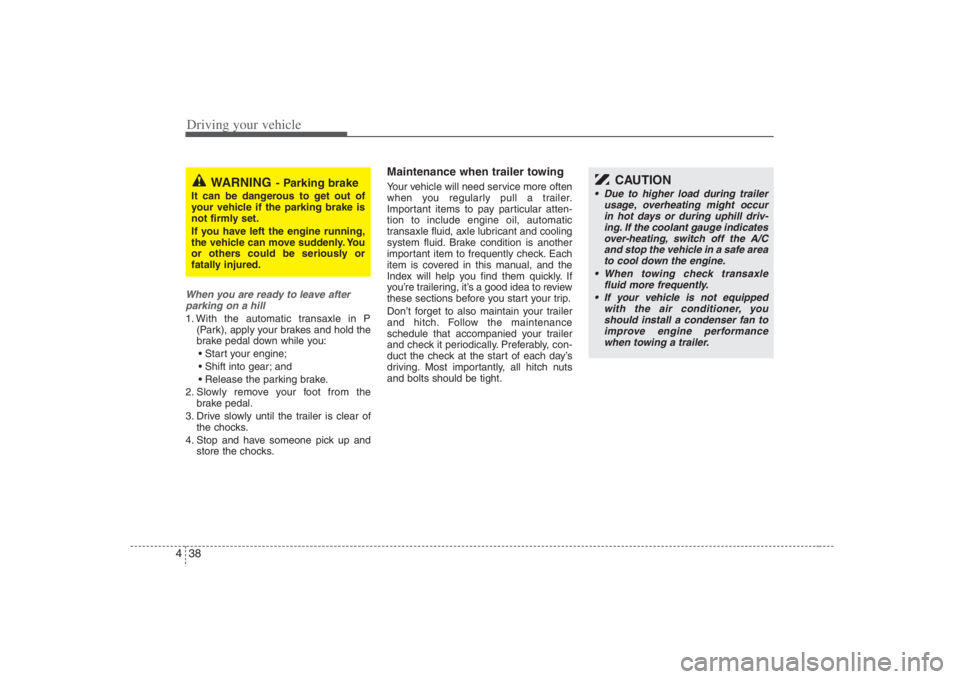
Driving your vehicle38 4When you are ready to leave after
parking on a hill 1. With the automatic transaxle in P
(Park), apply your brakes and hold the
brake pedal down while you:
and
2. Slowly remove your foot from the
brake pedal.
3. Drive slowly until the trailer is clear of
the chocks.
4. Stop and have someone pick up and
store the chocks.
Maintenance when trailer towing Your vehicle will need service more often
when you regularly pull a trailer.
Important items to pay particular atten-
tion to include engine oil, automatic
transaxle fluid, axle lubricant and cooling
system fluid. Brake condition is another
important item to frequently check. Each
item is covered in this manual, and the
Index will help you find them quickly. If
you’re trailering, it’s a good idea to review
these sections before you start your trip.
Don’t forget to also maintain your trailer
and hitch. Follow the maintenance
schedule that accompanied your trailer
and check it periodically. Preferably, con-
duct the check at the start of each day’s
driving. Most importantly, all hitch nuts
and bolts should be tight.
WARNING
- Parking brake
It can be dangerous to get out of
your vehicle if the parking brake is
not firmly set.
If you have left the engine running,
the vehicle can move suddenly. You
or others could be seriously or
fatally injured.
CAUTION
Due to higher load during trailer
usage, overheating might occur
in hot days or during uphill driv-
ing. If the coolant gauge indicates
over-heating, switch off the A/C
and stop the vehicle in a safe area
to cool down the engine.
When towing check transaxle
fluid more frequently.
If your vehicle is not equipped
with the air conditioner, you
should install a condenser fan to
improve engine performance
when towing a trailer.
Page 287 of 393
5
Road warning / 5-2
If the engine will not start / 5-2
Emergency starting / 5-3
If the engine overheats / 5-5
Tire pressure monitoring system (TPMS) / 5-6
If you have a flat tire / 5-11
Towing / 5-20
What to do in an emergency
Page 291 of 393

55
What to do in an emergency
5. Start the engine of the vehicle with the
booster battery and let it run at 2,000
rpm, then start the engine of the vehi-
cle with the discharged battery.If the cause of your battery discharging is
not apparent, you should have your vehi-
cle checked by an Authorized Hyundai
Dealer.Push-starting Vehicles equipped with automatic
transaxle cannot be push-started.
Follow the directions in this section for
jump-starting.If your temperature gauge indicates over-
heating, if you experience a loss of
power, or if you hear a loud knocking or
pinging noise, the engine has probably
overheated. Should any of these symp-
toms occur, use the following procedure:
1. Turn on the hazard warning flasher,
then drive to the nearest safe location
and stop your vehicle; set the auto-
matic transaxle in P (Park) and apply
the parking brake.
2. Make sure the air conditioner is off.
3. If coolant or steam is boiling out of the
radiator, stop the engine and call an
Authorized Hyundai Dealer for assis-
tance.
If coolant is not boiling out, allow the
engine to idle and open the hood to
permit the engine to cool gradually.
If the temperature does not go down
with the engine idling, stop the engine
and allow sufficient time for it to cool.4. The coolant level should then be
checked. If the level in the reservoir is
low, look for leaks at the radiator
hoses and connections, heater hoses
and connections, radiator, and water
pump. If you find a major leak or
another problem that may have
caused the engine to overheat, do not
operate the engine until it has been
corrected. Call an Authorized Hyundai
Dealer for assistance. If you do not
find a leak or other problem, carefully
add coolant to the reservoir.
If the engine frequently overheats, have
the cooling system checked and repaired
by an Authorized Hyundai Dealer.
CAUTION
Never tow a vehicle to start it
because the sudden surge forward
when the engine starts could cause
a collision with the tow vehicle.
CAUTION
- Battery cables
Do not connect the jumper cable
from the negative terminal of the
booster battery to the negative ter-
minal of the discharged battery.
This can cause the discharged bat-
tery to overheat and crack, releas-
ing battery acid.
IF THE ENGINE OVERHEATS
WARNING
- Removing
radiator cap
Do not remove the radiator cap
when the engine and radiator are
hot. Scalding hot coolant and steam
may blow out under pressure. This
could cause serious injury.
Page 388 of 393
93
Index
Door locks ···································································· 3-11
Central door lock switch ·········································· 3-13
Child-protector rear door lock ································· 3-15
Tailgate ····································································· 3-15
Driver position memory system ·································· 3-57
Economical operation ·················································· 4-29
Electronic stability control (ESC) ······························· 4-22
Emergency starting ························································ 5-3
Emission control system ·············································· 6-66
Engine compartment ···················································· 6-11
Engine coolant ····························································· 6-13
Engine exhaust can be dangerous! ································ 4-2
Engine oil ····································································· 6-12
Explanation of scheduled maintenance items ··············· 6-7
Fuel filler lid ································································ 3-30
Fuel requirements ·························································· 1-2
Fuses ············································································ 6-26
Gauges ······································································· 3-110
Engine temperature gauge ······································ 3-109
Fuel gauge ······························································ 3-112
Instrument panel illumination ································ 3-112
Odometer/Trip odometer ········································ 3-110Speedometer ··························································· 3-110
Tachometer ····························································· 3-111
Good braking practices ················································ 4-28
Hazard warning flasher ············································· 3-137
Homelink® wireless control system ························· 3-167
Hood ············································································ 3-29
Horn ··········································································· 3-135
How to use this manual ················································· 1-2
If the engine overheats ·················································· 5-5
If the engine will not start ············································· 5-2
If you have a flat tire ··················································· 5-11
Carrying a flat tire ···················································· 5-18
Changing tires ·························································· 5-14
Removing the spare tire ··········································· 5-11
Storing the spare tire ················································ 5-12
Important - use of compact spare tire ······················ 5-13
Immobilizer system ······················································· 3-9
Instrument cluster ······················································ 3-109
Instrument panel overview ············································ 2-3
Interior features ························································· 3-173
Ashtray ··································································· 3-174
Cigarette lighter ······················································ 3-173
Clothes hanger ························································ 3-176
Cup holder ······························································ 3-174
Digital clock ··························································· 3-178EFG
HI