2008 HYUNDAI ENTOURAGE ESP
[x] Cancel search: ESPPage 55 of 393
339
Features of your vehicle
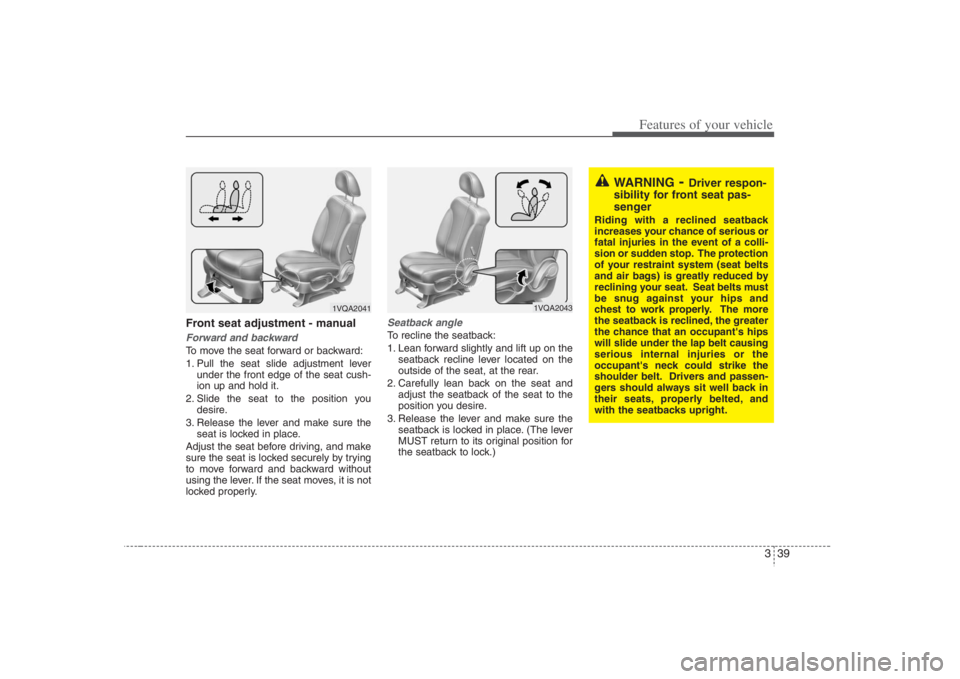
Front seat adjustment - manualForward and backwardTo move the seat forward or backward:
1. Pull the seat slide adjustment lever
under the front edge of the seat cush-
ion up and hold it.
2. Slide the seat to the position you
desire.
3. Release the lever and make sure the
seat is locked in place.
Adjust the seat before driving, and make
sure the seat is locked securely by trying
to move forward and backward without
using the lever. If the seat moves, it is not
locked properly.
Seatback angleTo recline the seatback:
1. Lean forward slightly and lift up on the
seatback recline lever located on the
outside of the seat, at the rear.
2. Carefully lean back on the seat and
adjust the seatback of the seat to the
position you desire.
3. Release the lever and make sure the
seatback is locked in place. (The lever
MUST return to its original position for
the seatback to lock.)
1VQA2041
1VQA2043
WARNING
- Driver respon-
sibility for front seat pas-
senger
Riding with a reclined seatback
increases your chance of serious or
fatal injuries in the event of a colli-
sion or sudden stop. The protection
of your restraint system (seat belts
and air bags) is greatly reduced by
reclining your seat. Seat belts must
be snug against your hips and
chest to work properly. The more
the seatback is reclined, the greater
the chance that an occupant's hips
will slide under the lap belt causing
serious internal injuries or the
occupant's neck could strike the
shoulder belt. Drivers and passen-
gers should always sit well back in
their seats, properly belted, and
with the seatbacks upright.
Page 57 of 393
341
Features of your vehicle
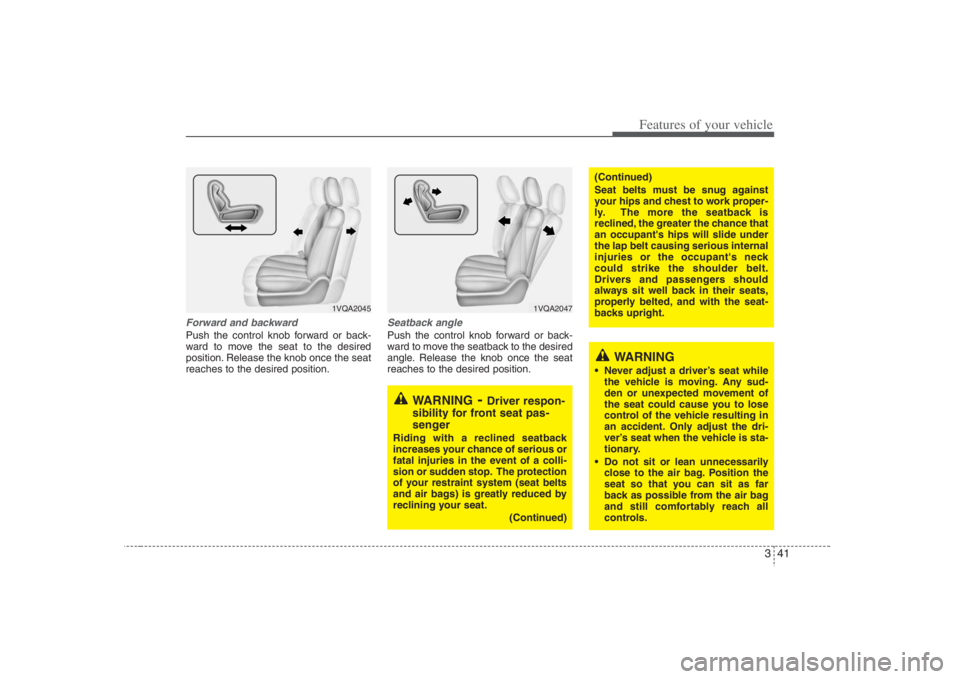
Forward and backward Push the control knob forward or back-
ward to move the seat to the desired
position. Release the knob once the seat
reaches to the desired position.
Seatback anglePush the control knob forward or back-
ward to move the seatback to the desired
angle. Release the knob once the seat
reaches to the desired position.
1VQA2045
1VQA2047
WARNING
- Driver respon-
sibility for front seat pas-
senger
Riding with a reclined seatback
increases your chance of serious or
fatal injuries in the event of a colli-
sion or sudden stop. The protection
of your restraint system (seat belts
and air bags) is greatly reduced by
reclining your seat.
(Continued)
(Continued)
Seat belts must be snug against
your hips and chest to work proper-
ly. The more the seatback is
reclined, the greater the chance that
an occupant's hips will slide under
the lap belt causing serious internal
injuries or the occupant's neck
could strike the shoulder belt.
Drivers and passengers should
always sit well back in their seats,
properly belted, and with the seat-
backs upright.
WARNING
Never adjust a driver’s seat while
the vehicle is moving. Any sud-
den or unexpected movement of
the seat could cause you to lose
control of the vehicle resulting in
an accident. Only adjust the dri-
ver’s seat when the vehicle is sta-
tionary.
Do not sit or lean unnecessarily
close to the air bag. Position the
seat so that you can sit as far
back as possible from the air bag
and still comfortably reach all
controls.
Page 88 of 393
Features of your vehicle72 3
Using a child restraint systemFor small children and babies, the use of
a child seat or infant seat is required. This
child seat or infant seat should be of
appropriate size for the child and should
be installed in accordance with the man-
ufacturer's instructions. It is further
required that the seat be placed in the
vehicle's rear seat.
(Continued)
Never leave children unattended
in a vehicle – not even for a short
time. The car can heat up very
quickly, resulting in serious
injuries to children inside. Even
very young children may inadver-
tently cause the vehicle to move,
entangle themselves in the win-
dows, or lock themselves or oth-
ers inside the vehicle.
Never allow two children, or any
two persons, to use the same seat
belt.
Children often squirm and reposi-
tion themselves improperly.
Never let a child ride with the
shoulder belt under their arm or
behind their back. Always prop-
erly position and secure children
in rear seat.
Never allow a child to stand-up or
kneel on the seat or floorboard of
a moving vehicle. During a colli-
sion or sudden stop, the child can
be violently thrown against the
vehicles interior, resulting in seri-
ous injury.
(Continued)
(Continued)
Never use an infant carrier or a
child safety seat that "hooks"
over a seatback, it may not pro-
vide adequate security in an acci-
dent.
Seat belts can become very hot,
especially when the car is parked
in direct sunlight. Always check
seat belt buckles before fastening
them over a child.
Always store or secure a child
seat, even when it is not in use.
During a collision or sudden stop,
the child seat could be thrown
inside the vehicle.
Page 121 of 393

3 105
Features of your vehicle
Outside rearview mirror heater
(if equipped) The outside rearview mirror heater is
actuated in connection with the rear win-
dow defroster. To heat the outside
rearview mirror glass, push the button for
the rear window defroster.
The rearview mirror heater (and rear win-
dow defroster) will not operate unless the
engine is running.
The outside rearview mirror glass will be
heated for defrosting or defogging and
will give you improved rear vision in
inclement weather conditions. Push the
button again to turn the heater off. The
outside rearview mirror heater automati-
cally turns off after 20 minutes.
Electric remote control The electric remote control mirror switch
allows you to adjust the position of the
left and right outside rearview mirrors. To
adjust the position of either mirror, move
the selection switch lever (1) to R or L to
select the right side mirror or the left side
mirror, then press a corresponding point
( ) on the mirror adjustment control to
position the selected mirror up, down, left
or right.
After adjustment, put the selection switch
lever into neutral position to prevent the
inadvertent adjustment.
CAUTION
The mirrors stop moving when
they reach the maximum adjust-
ing angles, but the motor contin-
ues to operate while the switch is
depressed. Do not depress the
switch longer than necessary, the
motor may be damaged.
Do not attempt to adjust the out-
side rearview mirror by hand.
Doing so may damage the mirror.
1VQA2108
Page 140 of 393
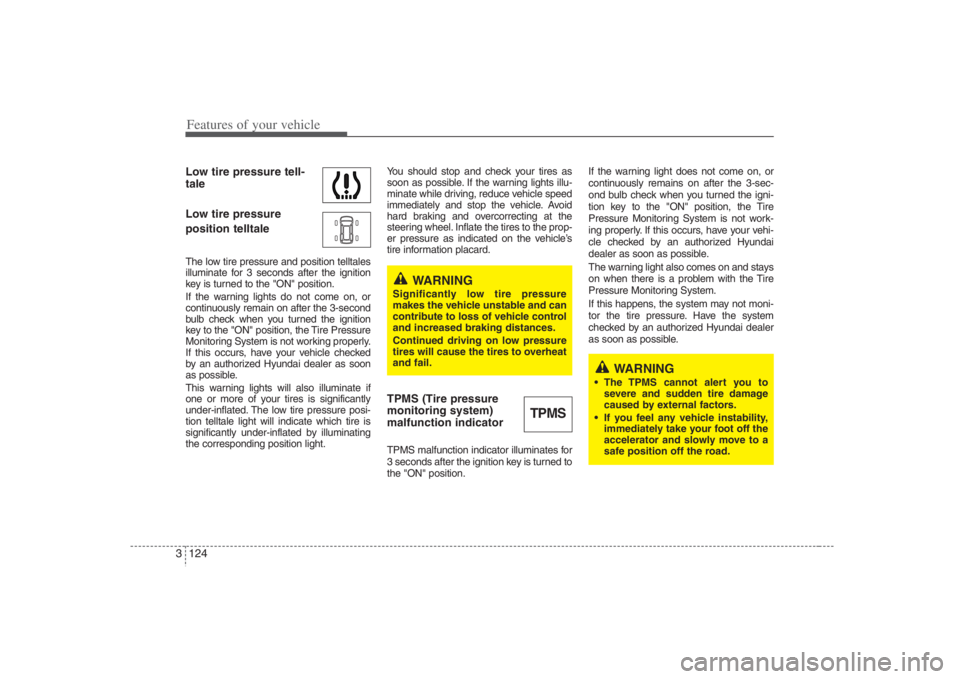
Features of your vehicle124 3Low tire pressure tell-
tale
Low tire pressure
position telltaleThe low tire pressure and position telltales
illuminate for 3 seconds after the ignition
key is turned to the "ON" position.
If the warning lights do not come on, or
continuously remain on after the 3-second
bulb check when you turned the ignition
key to the "ON" position, the Tire Pressure
Monitoring System is not working properly.
If this occurs, have your vehicle checked
by an authorized Hyundai dealer as soon
as possible.
This warning lights will also illuminate if
one or more of your tires is significantly
under-inflated. The low tire pressure posi-
tion telltale light will indicate which tire is
significantly under-inflated by illuminating
the corresponding position light.You should stop and check your tires as
soon as possible. If the warning lights illu-
minate while driving, reduce vehicle speed
immediately and stop the vehicle. Avoid
hard braking and overcorrecting at the
steering wheel. Inflate the tires to the prop-
er pressure as indicated on the vehicle’s
tire information placard.
TPMS (Tire pressure
monitoring system)
malfunction indicatorTPMS malfunction indicator illuminates for
3 seconds after the ignition key is turned to
the "ON" position.If the warning light does not come on, or
continuously remains on after the 3-sec-
ond bulb check when you turned the igni-
tion key to the "ON" position, the Tire
Pressure Monitoring System is not work-
ing properly. If this occurs, have your vehi-
cle checked by an authorized Hyundai
dealer as soon as possible.
The warning light also comes on and stays
on when there is a problem with the Tire
Pressure Monitoring System.
If this happens, the system may not moni-
tor the tire pressure. Have the system
checked by an authorized Hyundai dealer
as soon as possible.
TPMS
WARNING
Significantly low tire pressure
makes the vehicle unstable and can
contribute to loss of vehicle control
and increased braking distances.
Continued driving on low pressure
tires will cause the tires to overheat
and fail.
WARNING
The TPMS cannot alert you to
severe and sudden tire damage
caused by external factors.
If you feel any vehicle instability,
immediately take your foot off the
accelerator and slowly move to a
safe position off the road.
Page 141 of 393
3 125
Features of your vehicle
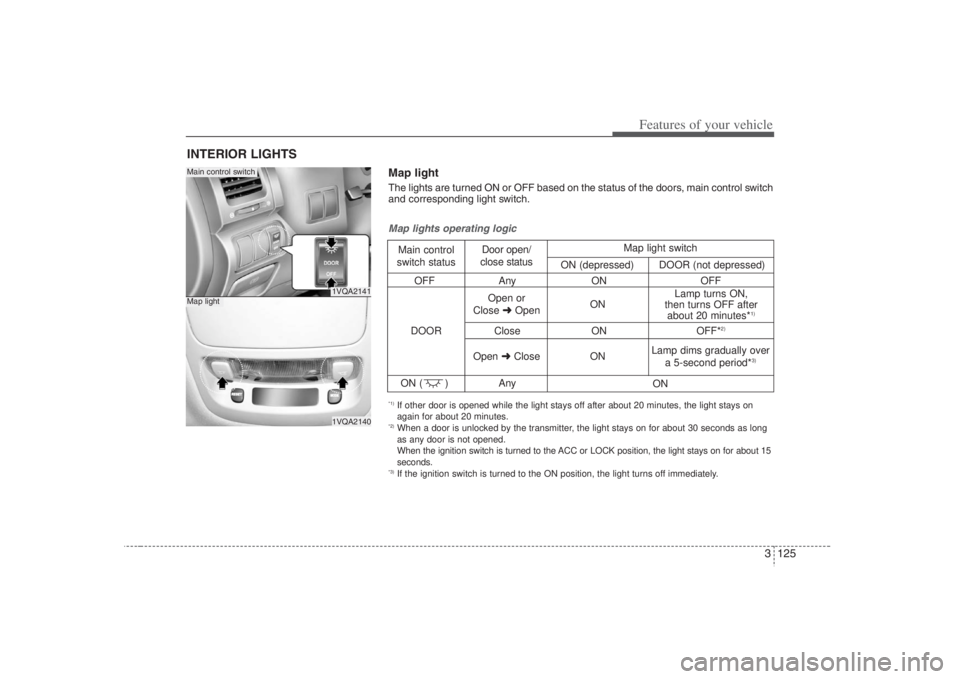
INTERIOR LIGHTS
1VQA21411VQA2140
Main control switchMap light
OFF Any ON OFF
Close ON OFF*
2)
ON ( ) Any
Map lights operating logicMain control
switch statusDoor open/
close status
DOOROpen or
Close ➜OpenONLamp turns ON,
then turns OFF after
about 20 minutes*
1)
Open ➜Close
ON
ON Lamp dims gradually over
a 5-second period*
3)
Map light switch
ON (depressed)DOOR (not depressed)
*1) If other door is opened while the light stays off after about 20 minutes, the light stays on
again for about 20 minutes.*2) When a door is unlocked by the transmitter, the light stays on for about 30 seconds as long
as any door is not opened.
When the ignition switch is turned to the ACC or LOCK position, the light stays on for about 15
seconds.*3) If the ignition switch is turned to the ON position, the light turns off immediately.Map lightThe lights are turned ON or OFF based on the status of the doors, main control switch
and corresponding light switch.
Page 142 of 393

Features of your vehicle126 3
1VQA2141
1VQA2142/OUN026245
1VQA2333
Main control switchDome light - center (if equipped)
OFF Any
Close ON OFF*
2)
OFF
ON ( ) Any
Dome lights operating logicMain control
switch statusDoor open/
close status
DOOROpen or
Close ➜OpenON
ONOFF
OFF Lamp turns ON,
then turns OFF
after about 20
minutes*
1)
Lamp dims
gradually over
a 5-second
period*
3)
Open ➜CloseOFF
ON Dome light switch
ON
DOOR OFF
*1) If other door is opened while the light stays off after about 20 minutes, the light stays on
again for about 20 minutes.*2) When a door is unlocked by the transmitter, the light stays on for about 30 seconds as long
as any door is not opened.
When the ignition switch is turned to the ACC or LOCK position, the light stays on for about 15
seconds.*3) If the ignition switch is turned to the ON position, the light turns off immediately.Dome lightThe lights are turned ON or OFF based on the status of the doors, main control switch
and corresponding light switch.
Dome light - center/rear (if equipped)
Page 143 of 393
3 127
Features of your vehicle
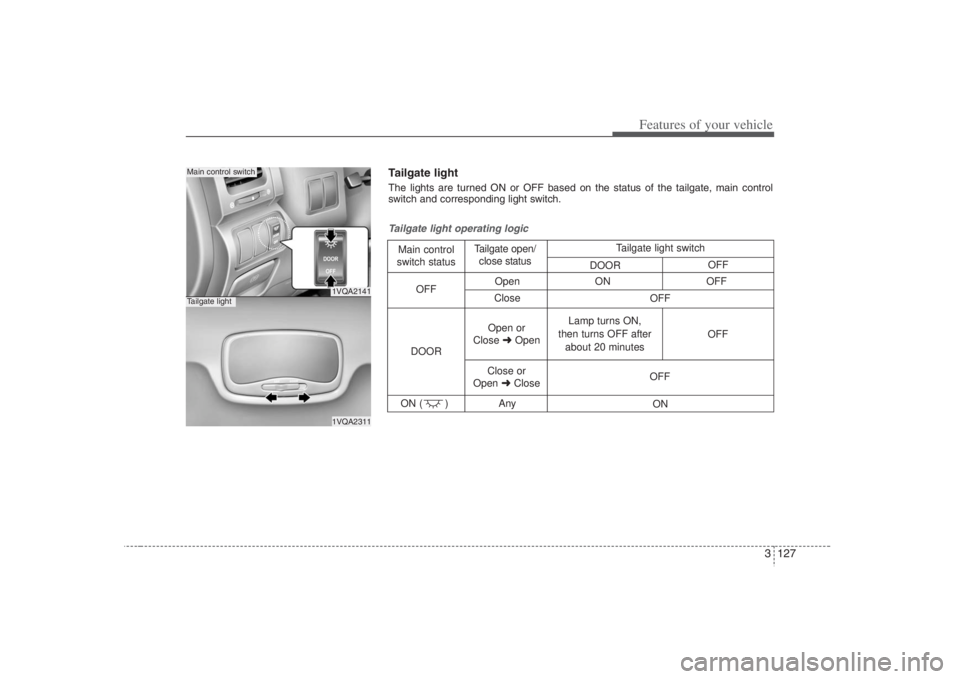
1VQA21411VQA2311
Main control switchTailgate light
Open ON OFF
Close
ON ( ) Any
Tailgate light operating logicMain control
switch statusTailgate open/
close status
DOOROFF
Open or
Close ➜OpenLamp turns ON,
then turns OFF after
about 20 minutesOFF
Close or
Open ➜CloseOFF
ON OFF Tailgate light switch
DOOROFFTailgate light The lights are turned ON or OFF based on the status of the tailgate, main control
switch and corresponding light switch.