2008 Hyundai Azera engine
[x] Cancel search: enginePage 315 of 345
7
EMISSION CONTROL SYSTEMS2
EMISSION CONTROL
SYSTEMS
H010B01A-AAT1. Crankcase Emission Control Sys-
temThe positive crankcase ventilation system
is employed to prevent air pollution caused
by blow-by gases being emitted from the
crankcase. This system supplies fresh fil-
tered air to the crankcase through the air
intake hose. Inside the crankcase, the fresh
air mixes with blow-by gases, which then
pass through the PCV valve into the induc-
tion system.
CanisterFuel vapors generated inside the fuel tank
are absorbed and stored in the onboard
canister. When the engine is running, the
fuel vapors absorbed in the canister are
drawn into the surge tank through the
purge control solenoid valve.Purge Control Solenoid Valve (PCSV)The purge control solenoid valve is con-
trolled by the Engine Control Module
(ECM); when the engine coolant tempera-
ture is low during idling, the PCSV closes
so that evaporated fuel is not taken into the
engine. After the engine warms-up during
ordinary driving, the PCSV opens to intro-
duce evaporated fuel to the engine.H010D01A-AAT3. Exhaust Emission Control
SystemThe Exhaust Emission Control System is a
highly effective system which controls ex-
haust emissions while maintaining good
vehicle performance.
H010A01NF-AATYour Hyundai is equipped with an emis-
sion control system to meet all emission
regulations.
There are three emission control systems
which are as follows.
(1) Crankcase emission control system
(2) Evaporative emission control system
(3) Exhaust emission control system
In order to assure the proper function of the
emission control systems, it is recom-
mended that you have your car inspected
and maintained by an authorized Hyundai
dealer in accordance with the maintenance
schedule in this manual.
Caution for the Inspection and Mainte-
nance Test (With Electronic Stability
Control (ESC) system)
o To prevent the vehicle from misfiring
during dynamometer testing, turn the
Electronic Stability Control (ESC) sys-
tem off by pressing the ESC switch.
o After dynamometer testing is com-
pleted, turn the ESC system back on
by pressing the ESC switch again.
H010C01S-AAT2. Evaporative Emission Control (In-
cluding ORVR: Onboard Refuel-
ing Vapor Recovery) SystemThe Evaporative Emission Control Sys-
tem is designed to prevent fuel vapors from
escaping into the atmosphere.
(The ORVR system is designed to allow
the vapors from the fuel tank to be loaded
into a canister while refueling at the gas
station, preventing the escape of fuel va-
pors into the atmosphere.)
TGhma-7.p658/25/2005, 5:35 PM 2
Page 316 of 345
7
EMISSION CONTROL SYSTEMS
3
!
!
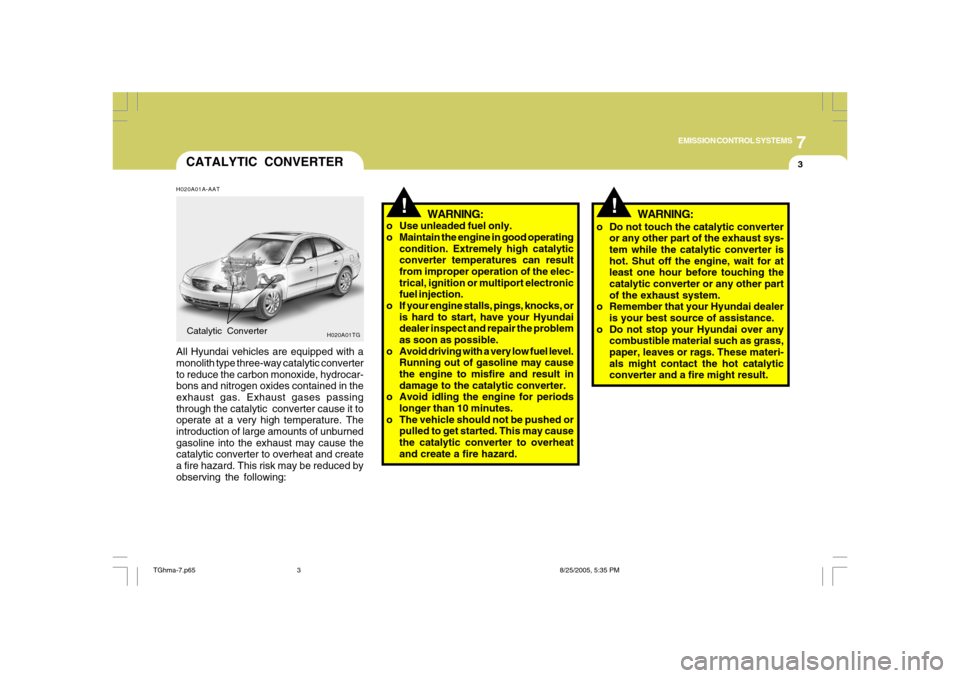
CATALYTIC CONVERTERH020A01A-AATAll Hyundai vehicles are equipped with a
monolith type three-way catalytic converter
to reduce the carbon monoxide, hydrocar-
bons and nitrogen oxides contained in the
exhaust gas. Exhaust gases passing
through the catalytic converter cause it to
operate at a very high temperature. The
introduction of large amounts of unburned
gasoline into the exhaust may cause the
catalytic converter to overheat and create
a fire hazard. This risk may be reduced by
observing the following:Catalytic Converter
WARNING:
o Use unleaded fuel only.
o Maintain the engine in good operating
condition. Extremely high catalytic
converter temperatures can result
from improper operation of the elec-
trical, ignition or multiport electronic
fuel injection.
o If your engine stalls, pings, knocks, or
is hard to start, have your Hyundai
dealer inspect and repair the problem
as soon as possible.
o Avoid driving with a very low fuel level.
Running out of gasoline may cause
the engine to misfire and result in
damage to the catalytic converter.
o Avoid idling the engine for periods
longer than 10 minutes.
o The vehicle should not be pushed or
pulled to get started. This may cause
the catalytic converter to overheat
and create a fire hazard.
H020A01TG
o Do not touch the catalytic converter
or any other part of the exhaust sys-
tem while the catalytic converter is
hot. Shut off the engine, wait for at
least one hour before touching the
catalytic converter or any other part
of the exhaust system.
o Remember that your Hyundai dealer
is your best source of assistance.
o Do not stop your Hyundai over any
combustible material such as grass,
paper, leaves or rags. These materi-
als might contact the hot catalytic
converter and a fire might result.
WARNING:
TGhma-7.p658/25/2005, 5:35 PM 3
Page 317 of 345
Vehicle Identification Number (VIN) .............................. 8-2
Engine Number ............................................................. 8-2
Tire Information ............................................................. 8-2
Recommended Cold Tire Inflation Pressures ............... 8-3
Checking Tire Inflation Pressure ................................... 8-5
Tire Sidewall Labeling ................................................... 8-5
Tire Terminology and Definitions ................................... 8-7
All Season Tires ............................................................ 8-9
Snow Tires .................................................................... 8-9
Tire Chains ..................................................................8-10
Tire Rotation................................................................8-10
Tire Balancing.............................................................8-11
Tire Traction................................................................8-11
When to Replace Tires ...............................................8-11
Tire Maintenance........................................................8-12
Spare Tire and Tools ...................................................8-13
Warranties for Your Hyundai Vehicle..........................8-13
Consumer Information.................................................8-14
Reporting Safety Defects............................................8-16
Binding Arbitration of Warranty Claims.......................8-17
8
8
CONSUMER INFORMATION, REPORTING
SAFETY DEFECTS & BINDING
ARBITRATION OF WARRANTY CLAIMS
Page 318 of 345
8
CONSUMER INFORMATION, REPORTING SAFETY DEFECTS & BINDING ARBITRATION OF WARRANTY CLAIMS2
ENGINE NUMBER
VEHICLE IDENTIFICATION
NUMBER (VIN)
I010B01A-AAT I010A01O-AAT
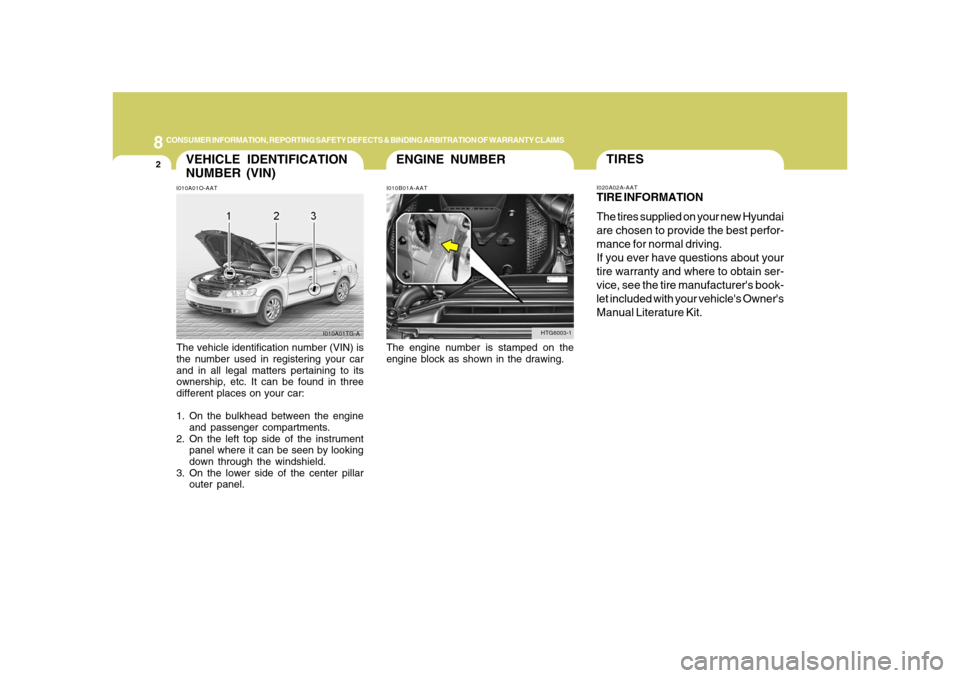
The vehicle identification number (VIN) is
the number used in registering your car
and in all legal matters pertaining to its
ownership, etc. It can be found in three
different places on your car:
1. On the bulkhead between the engine
and passenger compartments.
2. On the left top side of the instrument
panel where it can be seen by looking
down through the windshield.
3. On the lower side of the center pillar
outer panel.The engine number is stamped on the
engine block as shown in the drawing.
TIRESI020A02A-AATTIRE INFORMATION
The tires supplied on your new Hyundai
are chosen to provide the best perfor-
mance for normal driving.
If you ever have questions about your
tire warranty and where to obtain ser-
vice, see the tire manufacturer's book-
let included with your vehicle's Owner's
Manual Literature Kit.
I010A01TG-AHTG6003-1
Page 334 of 345
9
Measurement ................................................................ 9-2
Engine...........................................................................9-3
Lubrication Chart ........................................................... 9-4
VEHICLE SPECIFICATIONS
9
Page 336 of 345
9
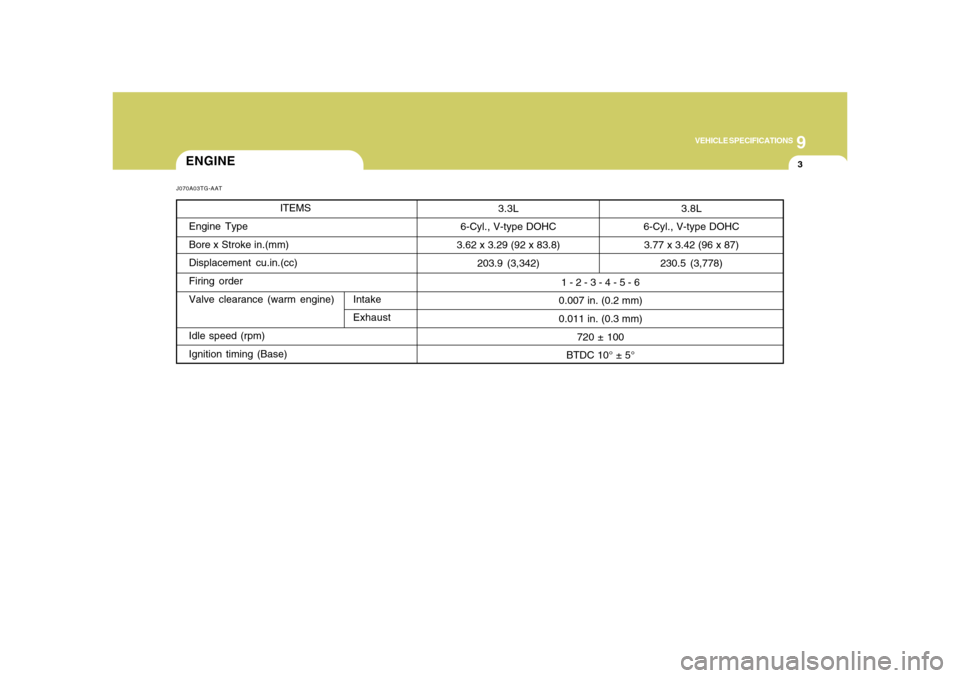
VEHICLE SPECIFICATIONS
3
3.8L
6-Cyl., V-type DOHC
3.77 x 3.42 (96 x 87)
230.5 (3,778)
1 - 2 - 3 - 4 - 5 - 6
0.007 in. (0.2 mm)
0.011 in. (0.3 mm)
720 ± 100
BTDC 10° ± 5°
ENGINEJ070A03TG-AAT
ITEMS
Engine Type
Bore x Stroke in.(mm)
Displacement cu.in.(cc)
Firing order
Valve clearance (warm engine) Intake
Exhaust
Idle speed (rpm)
Ignition timing (Base)
3.3L
6-Cyl., V-type DOHC
3.62 x 3.29 (92 x 83.8)
203.9 (3,342)
Page 337 of 345
9
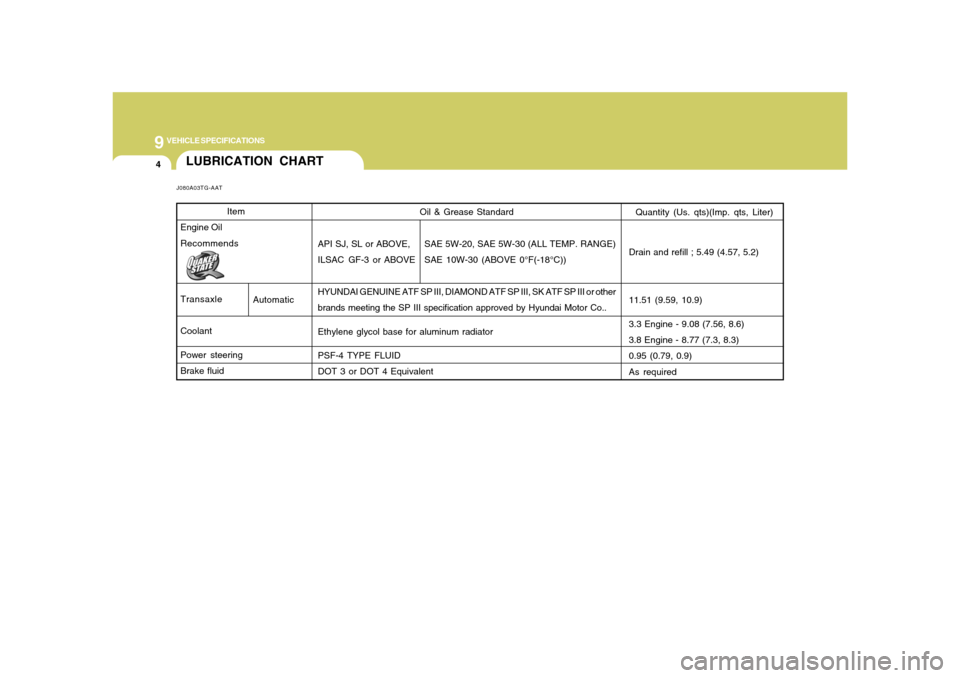
VEHICLE SPECIFICATIONS4
Oil & Grease Standard
API SJ, SL or ABOVE, SAE 5W-20, SAE 5W-30 (ALL TEMP. RANGE)
ILSAC GF-3 or ABOVE SAE 10W-30 (ABOVE 0°F(-18°C))
HYUNDAI GENUINE ATF SP III, DIAMOND ATF SP III, SK ATF SP III or other
brands meeting the SP III specification approved by Hyundai Motor Co..
Ethylene glycol base for aluminum radiator
PSF-4 TYPE FLUID
DOT 3 or DOT 4 Equivalent
LUBRICATION CHARTJ080A03TG-AAT
Quantity (Us. qts)(Imp. qts, Liter)
Drain and refill ; 5.49 (4.57, 5.2)
11.51 (9.59, 10.9)
3.3 Engine - 9.08 (7.56, 8.6)
3.8 Engine - 8.77 (7.3, 8.3)
0.95 (0.79, 0.9)
As required Item
Engine Oil
Recommends
Transaxle
Coolant
Power steering
Brake fluid
Automatic
Page 340 of 345

10
INDEX
3
Console Box .......................................................................1-98
Consumer Information .......................................................8-14
Cooling Fans ......................................................................6-23
Corrosion Protection
Cleaning the interior ......................................................... 4-6
Protecting your Hyundai from corrosion .......................... 4-2
Washing and waxing ........................................................ 4-4
Cruise Control ..................................................................1-119
D
Defrosting/Defogging.......................................................1-133
Door
Central door locks ............................................................ 1-9
Door locks ......................................................................... 1-7
Door warning light ........................................................1-117
Locking and unlocking front door with a key .................. 1-7
Drink Holder .......................................................................1-90
Driving
Economical driving .........................................................2-15
Smooth cornering ...........................................................2-16
Winter driving ..................................................................2-16
E
Electronic Stability Control (ESC) System ........................2-11
Emission Control System ..................................................... 7-2Engine
Before starting the engine ................................................ 2-3
Compartment.................................................................... 6-2
Coolant.............................................................................. 6-6
Coolant temperature gauge ...........................................1-73
If the engine overheats ..................................................... 3-4
Number............................................................................. 8-2
Oil ...................................................................................... 6-4
Starting.............................................................................. 2-5
Engine Exhaust Can Be Dangerous! .................................. 2-2
F
Fan Speed Control Switch ...............................................1-127
Fog Light
Front ................................................................................1-82
Front Seats .........................................................................1-19
Active headrests .............................................................1-21
Adjustable headrests ......................................................1-20
Adjusting seat forward and rearward ............................1-19
Adjusting seatback angle ...............................................1-19
Seat cushion height adjustment ................................... 1-22
Seat warmer ....................................................................1-24
Fuel
Capacity............................................................................ 9-2
Gauge..............................................................................1-73
Recommendations............................................................ 1-2