Page 15 of 268

Position the lap part of the belt as
low as possible across your hips,
then pull up on the shoulder part of
the belt so the lap part f its snugly.
This lets your strong pelvic bones
take the force of a crash and reduces
the chance of internal injuries.
Insert the latch plate into the buckle,
then tug on the belt to make sure the
belt is securely latched. Check that
the belt is not twisted, because a
twisted belt can cause serious
injuries in a crash.
Reclining a seat-back so that the
shoulder part of the belt no longer
rests against the occupant’s chest
reduces the protective capability of
the belt. It also increases the chance
of sliding under the belt in a crash
and being seriously injured. The
farther a seat-back is reclined, the
greater the risk of injury.
See page f or how to adjust the
seat-backs.
69
Protecting A dults and Teens
Fasten and Position the Seat
Belts
4.
12
Reclining the seat-back too far
can result in serious injury or
death in a crash.
Adjust the seat-back to an
upright position, and sit well
back in the seat.
�\f���—�\f���—�����y�
���������
�
�y���
�(���������\f�y�\f�\f�
���y
2008 S2000
Page 16 of 268

Sitting improperly can increase the
chance of injury during a crash. For
example, if an occupant slouches,
lies down, turns sideways, sits
forward, leans forward or sideways,
or puts one or both f eet up, the
chance of injury during a crash is
greatly increased.
After occupants have adjusted their
seats and put on seat belts, it is very
important that they continue to sit
upright, well back in their seats, with
their feet on the floor, until the
vehicle is parked and the engine is
off.
See page f or additional
inf ormation about your seat belts
and how to take care of them. Using a seat
belt that is not working properly can
result in serious injury or death.
Have your dealer check the belt as
soon as possible.
If a seat belt does not seem to work
properly, it may not protect the
occupant in a crash. This could cause
very serious injuries in a crash.
If necessary, pull up on the shoulder
belt again to remove any slack, then
check that the belt rests across the
center of your chest and over your
shoulder. This spreads the f orces of
a crash over the strongest bones in
your upper body.
16
CONT INUED
Protecting A dults and Teens
Maintain a Proper Sitting
Position
5.
No one should sit in a seat wit h an
inoperat ive seat belt .
Never place t he shoulder port ion of a
lap/shoulder belt under your arm orbehind your back.
Driver and Passenger Saf ety
13
Improperly positioning the seat
belts can cause serious injury
or death in a crash.
Make sure all seat belts are
properly positioned before
driving.
�\f���—�\f���—�����y�
���������
���y���
�(���������\f�y�\f�\f�
���y
2008 S2000
Page 17 of 268
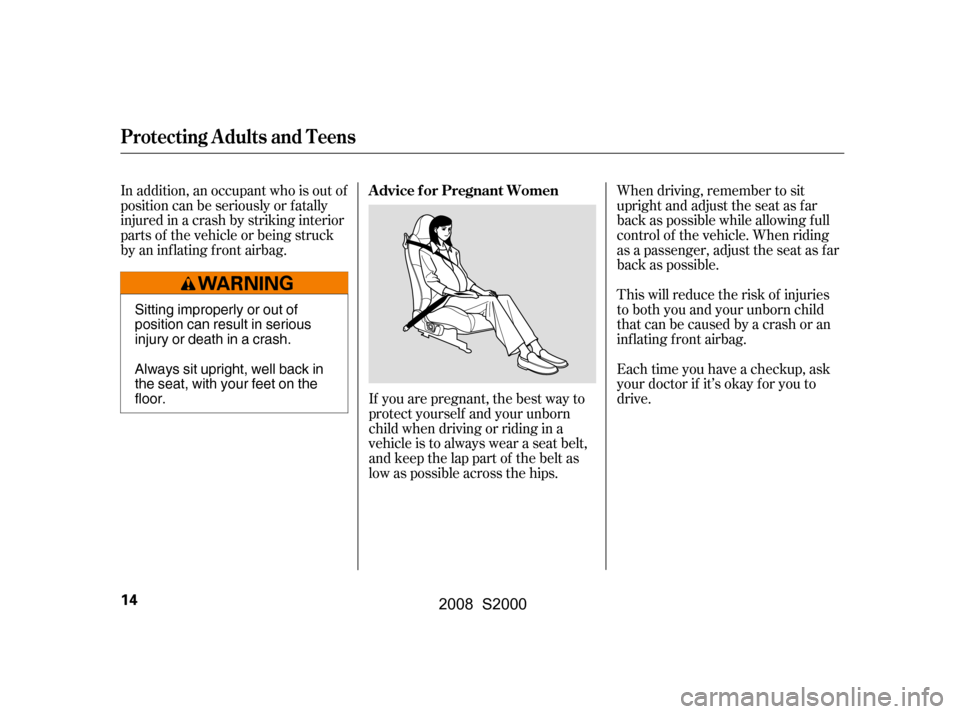
When driving, remember to sit
upright and adjust the seat as f ar
back as possible while allowing f ull
control of the vehicle. When riding
as a passenger, adjust the seat as far
back as possible.
This will reduce the risk of injuries
to both you and your unborn child
that can be caused by a crash or an
inflating front airbag.
Each time you have a checkup, ask
your doctor if it’s okay f or you to
drive.
If you are pregnant, the best way to
protect yourself and your unborn
child when driving or riding in a
vehicle is to always wear a seat belt,
and keep the lap part of the belt as
low as possible across the hips.
In addition, an occupant who is out of
position can be seriously or f atally
injured in a crash by striking interior
parts of the vehicle or being struck
by an inflating front airbag.
Protecting A dults and Teens
Advice f or Pregnant Women
14
Sitting improperly or out of
position can result in serious
injury or death in a crash.
Always sit upright, well back in
the seat, with your feet on the
floor.
�\f���—�\f���—�����y�
�������������y���
�(���������\f�y�\f�\f�
���y
2008 S2000
Page 18 of 268

If they do, they
could be very seriously injured in a
crash.
Devices intended to improve
occupant comf ort or reposition the
shoulder part of a seat belt can
reduce the protective capability of
thebeltandincreasethechanceof
serious injury in a crash. If your
hands or arms are close to an
airbag cover, they could be injured
if the airbag inf lates.
Carrying hard or sharp
objects on your lap, or driving with
a pipe or other sharp object in
your mouth, can result in injuries
if your f ront airbag inf lates.
Objects on the
covers marked ‘‘SRS AIRBAG’’
could interf ere with the proper
operation of the airbags or be
propelled inside the vehicle and
hurt someone if the airbags inf late.
Additional Saf ety Precautions
T wo people should never use t he
same seat belt .
Do not put any accessories on seatbelts. K eep your hands and arms away
f rom t he airbag covers.
Do not place hard or sharp object s
bet ween yourself and a f rontairbag.
Do not at t ach or place object s onthe airbag covers.
Protecting A dults and Teens
Driver and Passenger Saf ety
15
�\f���—�\f���—�����y�
�������������y���
�(���������\f�y�\f�\f���\f�y
2008 S2000
Page 19 of 268

Your seat belt system includes lap/
shoulder belts in both seating
positions. The seat belts are also
equipped with automatic seat belt
tensioners.
This system uses the same sensors
as the front airbags to monitor
whether the seat belts are latched or
unlatched, and how much weight is
on the passenger’s seat (see page).
The seat belt system
includes an indicator on the
instrument panel and a beeper to
remind you and your passenger to
f asten your seat belts.
This system monitors the seat belts.
If you turn the ignition switch to the
ON (II) position bef ore your seat
belt is f astened, the beeper will
sound and the indicator will f lash. If
your seat belt is not f astened bef ore the beeper stops, the indicator will
stop f lashing but remain on.
If a passenger does not f asten their
seat belt, the indicator will come on
about 6 seconds af ter the ignition
switch is turned to the ON (II)
position.
If eitherthedriverorpassengerdoes
not f asten their seat belt, the beeper
will sound and the indicator will f lash
again at regular intervals.
When no one is sitting in the
passenger’s seat, or a child or small
adult is riding there, the indicator
should not come on and the beeper
should not sound.
If the indicator comes on or the
beeper sounds when the driver’s seat
belt is latched and there is no
passenger and no items on the
passenger’s seat, something may be
interf ering with the monitoring
system. Look f or and remove:
If no obstructions are found, have
your vehicle checked by a dealer.
Any object(s) touching the rear of
the seat-back.
Any objects hanging on the seat.
Any items under the passenger’s
seat.
24
Additional Inf ormation About Your Seat Belts
Seat Belt System Components
16
�\f���—�\f���—�����y�
�������������y���
�(���������\f�y�\f�\f���
�y
2008 S2000
Page 20 of 268

The lap and shoulder belt goes over
your shoulder, across your chest,
and across your hips.
To fasten the belt, insert the latch
plate into the buckle, then tug on the
belt to make sure the buckle is
latched (see page f or how to
properly position the belt).
To unlock the belt, press the red
PRESSbuttononthebuckle.Guide
the belt across your body so that it
retracts completely. Af ter exiting the
vehicle, be sure the belt is out of the
way and will not get closed in the
door.Both seat belts have an emergency
retractor. In normal driving, the
retractor lets you move f reely in your
seat while it keeps some tension on
the belt. During a collision or sudden
stop, the retractor automatically
locks the belt to help restrain your
body.
The passenger’s seat belt has a
lockable retractor that must be
activated to secure a forward-facing
child seat (see page ).
If the shoulder part of the belt is
pulled all the way out, the lockable
retractor will activate. The belt will
retract, but it will not allow the
passenger to move f reely.
To deactivate the lockable retractor,
unlatch the buckle and let the seat
belt fully retract. To refasten the
seat belt, pull it out only as f ar as
needed.
12
34
Additional Inf ormation About Your Seat Belts
L ap/Shoulder Belt
Driver and Passenger Saf ety
17
�\f���—�\f���—�����y�
�������������y���
�(���������\f�y�\f�\f�����y
2008 S2000
Page 21 of 268

For saf ety, you should check the
condition of your seat belts regularly.
For added protection, the seat belts
are equipped with automatic seat
belt tensioners. When activated, the
tensioners immediately tighten the
beltstohelpholdthedriveranda
passenger in place. Pull each belt out f ully and look f or
f rays, cuts, burns, and wear. Check
that the latches work smoothly and
the belts retract easily. If a belt does
not retract easily, cleaning it may
correct the problem (see page ).
Any belt that is not in good condition
or not working properly will not
provide good protection and should
be replaced as soon as possible.
If a seat belt is worn during a crash,
it must be replaced by your dealer. A
belt that has been worn during a
crash may not provide the same level
of protection in a subsequent crash.
Honda provides a limited warranty
on seat belts. See your
booklet f or
details.
The tensioners are designed to
activate in any collision severe
enough to cause the f ront airbags to
deploy.
However, the tensioners can be
activated during a collision in which
the airbags do not deploy. In this
case, the airbags would not be
needed, but the additional restraint
could be helpf ul.
When the tensioners are activated,
the seat belts will remain tight until
they are unbuckled.
184
Honda
Warranty Inf ormation
Seat Belt Maintenance
A utomatic Seat Belt T ensioners
Additional Inf ormation About Your Seat Belts
18
�\f���—�\f���—�����y�
�������������y���
�(���������\f�y�\f�\f�����y
2008 S2000
Page 22 of 268
The dealer should also inspect the
anchors f or damage and replace
them if needed. If the automatic seat
belt tensioners activate during a
crash, they must be replaced.
Additional Inf ormation About Your Seat Belts
Driver and Passenger Saf ety
19
Not checking or maintaining
seat belts can result in serious
injury or death if the seat belts
do not work properly when
needed.
Check your seat belts regularly
and have any problem
corrected as soon as possible.
�\f���—�\f���—�����y�
������\f��\f���y���
�(���������\f�y�\f�\f�����y
2008 S2000