Page 220 of 341

In certain unusual conditions when
your vehicle gets stuck in shallow
mud or f resh snow, it may be easier
to free it with the VSA temporarily
switched of f . When the VSA system
is of f , the traction control system is
alsooff.Youshouldonlyattemptto
f ree your vehicle with the VSA of f if
you are not able to f ree it when the
VSA is on.Driving with varying tire or wheel
sizes may cause the VSA to
malf unction. When replacing tires,
make sure they are of the same size
and type as your original tires (see
page ).
If you install winter tires, make sure
they are the same size as those that
were originally supplied with your
vehicle. Exercise the same caution
during winter driving as you would if
your vehicle was not equipped with
VSA.
This switch is above the parking
brake release handle. Press it to turn
the VSA system on and of f .
When VSA is off, the VSA activation
indicator comes on as a reminder.
VSA is turned on every time you
start the engine, even if you turned it
off the last time you drove the
vehicle.
Immediately af ter f reeing your
vehicle, be sure to switch the VSA on
again. We do not recommend driving
your vehicle with the VSA and
traction control systems switched off.
271
VSA Of f Switch VSA and Tire Sizes
Vehicle Stability Assist (VSA) System
216
�\f���—�\f���—�����y�
����\f��������y���
�(���������\f�y�\f�����
�y
2008 Ridgeline
Page 226 of 341

There are two common types of
trailer brakes: surge and electric.
Surge brakes are common f or boat
trailers, since the brakes will get wet.
If you choose electric brakes, be
sure they are electronically actuated.
Do not attempt to tap into your
vehicle’s hydraulic system. No
matter how successf ul it may seem,
any attempt to attach trailer brakes
to your vehicle’s hydraulic system
will lower braking ef f ectiveness and
create a potential hazard.
Seeyourtrailermanufacturerfor
more inf ormation on installing
electric brakes.
Honda requires that any trailer with
a total trailer weight of 1,000 lbs (455
kg) or more have its own brakes.A f actory installed, 4-pin gray
connector is located under the
instrument panel near the top of the
parking brake pedal. This connector
has all of the circuits required to
install most electric trailer brake
controllers. A jumper harness to
adapt your electric trailer brake
controller to the vehicle is included
with the optional Genuine Honda
trailer hitch kit. To obtain a trailer
hitch kit, see your dealer.
Have a qualif ied mechanic install
your trailer brake controller
f ollowing the trailer brake controller
manuf acturer’s instructions. Failure
to properly install the trailer brake
controller may increase the distance
it takes f or you to stop your vehicle
when towing a trailer.Use this illustration to identif y each
terminal in the trailer brake
controller connector.
Trailer Brakes
Towing a Trailer
222
BRAKE
(20A)
(BLUE)
GROUND
(BLACK)
ELECTRIC BRAKE
(BROWN/WHITE)
STOP
(WHITE/BLACK)
�\f���—�\f���—�����y�
����
�\f������y���
�(���������\f�y�\f�������y
2008 Ridgeline
Page 228 of 341

�´
Trailer lights and equipment must
comply with f ederal, state, province,
and local regulations. Check trailer
light requirements f or the areas
where you plan to tow, and use only
equipment designed f or your vehicle.We recommend that you have your
dealer install a Honda wiring harness
and converter. This harness has
been designed f or your vehicle.
Ref er to the above illustration f or
wiring information.
Your vehicle is equipped with a
connector to install an optional trailer
lighting connector that mates with
your vehicle. Since lighting and wiring vary with
trailer type and brand, you should
also have a qualif ied mechanic install
a suitable connector between the
vehicle and the trailer.
Trailer Lights
Towing a Trailer
224
GROUND
(BLACK)
LEFT TURN SIGNAL
AND BRAKE LIGHTS
(GREEN/WHITE)
TAILLIGHTS
(GREEN/BLACK)
ELECTRIC BRAKE
(BROWN/WHITE) RIGHT TURN SIGNAL
AND BRAKE LIGHTS
(GREEN/RED)
BACK-UP LIGHTS
(BLUE)
GROUND
(BLACK)
B CHARGE
(GREEN)
�\f���—�\f���—�����y�
����
�
��\f�\f�y���
�(���������\f�y�\f�������y
2008 Ridgeline
Page 232 of 341
�´
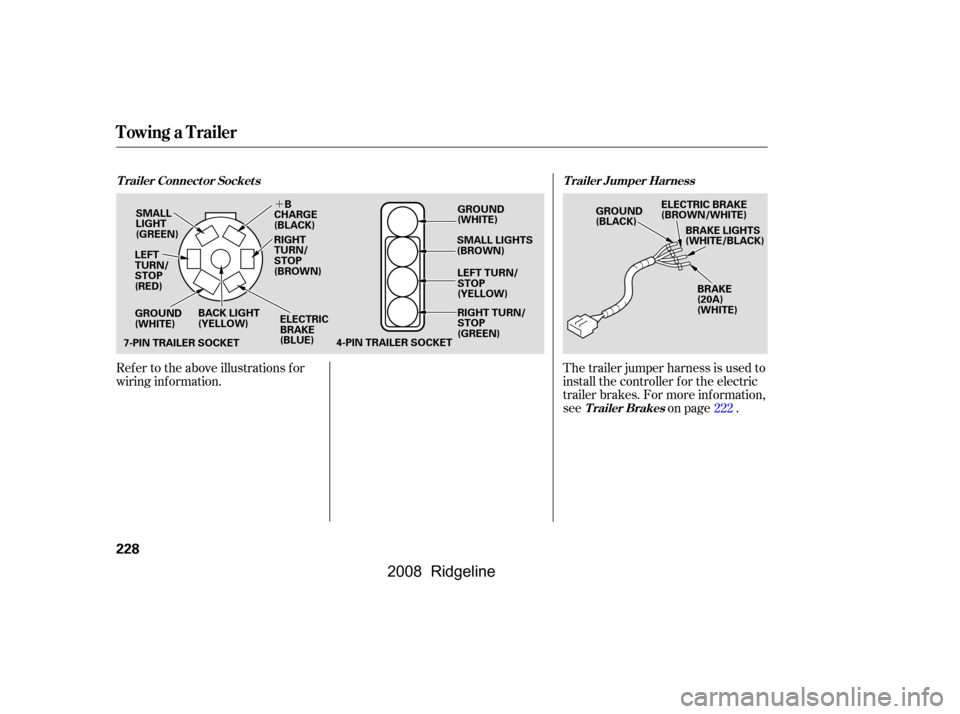
The trailer jumper harness is used to
install the controller f or the electric
trailer brakes. For more inf ormation,
see on page .
Ref er to the above illustrations f or
wiring information.
222
T railer Connect or Socket s
Trailer Brakes
T railer Jumper Harness
Towing a Trailer
228
7-PIN TRAILER SOCKET
ELECTRIC
BRAKE
(BLUE)
SMALL
LIGHT
(GREEN)
B
CHARGE
(BLACK)
BACK LIGHT
(YELLOW)
GROUND
(WHITE) GROUND
(WHITE)
GROUND
(BLACK)ELECTRIC BRAKE
(BROWN/WHITE)
BRAKE
(20A)
(WHITE)
LEFT TURN/
STOP
(YELLOW)
RIGHT TURN/
STOP
(GREEN)
SMALL LIGHTS
(BROWN)
LEFT
TURN/
STOP
(RED)
4-PIN TRAILER SOCKET BRAKE LIGHTS
(WHITE/BLACK)
RIGHT
TURN/
STOP
(BROWN)
�\f���—�\f���—�����y�
����
�
������y���
�(���������\f�y�\f�������y
2008 Ridgeline
Page 233 of 341

The added weight, length, and
height of a trailer will af f ect your
vehicle’s handling and perf ormance,
so driving with a trailer requires
some special driving skills and
techniques.
Your vehicle tires and spare are in
good condition and properly
inf lated.
The trailer tires and spare are in
good condition and inf lated as
recommended by the trailer
maker.
The vehicle has been properly
serviced, and the tires, brakes,
suspension, cooling system, and
lights are in good operating
condition.
The trailer has been properly
serviced and is in good condition.
All weights and loads are within
limits.
Thehitch,safetychains,andany
other attachments are secure.
Allitemsonandinthetrailerare
properly secured and cannot shif t
while you drive. Towing perf ormance can be
af f ected by high altitude, high
temperature, or when climbing
steep grades. Theref ore, premium
f uel (premium unleaded gasoline
with pump octane number of 91 or
higher) is recommended when
towing more than 3,500 lbs (1,590
kg).
Foryoursafetyandthesafetyof
others,taketimetopracticedriving
maneuvers bef ore heading f or the
open road, and f ollow the guidelines
below.
Avoid towing a trailer during your
vehicle’s f irst 600 miles (1,000 km).
When preparing to tow, and bef ore
driving away, be sure to check the
f ollowing:
CONT INUED
Driving Saf ely With a T railer
Pre-T ow Checklist
Break-In Period
Towing a Trailer
Driving
229
�\f���—�\f���—�����y�
����
�
������y���
�(���������\f�y�\f�������y
2008 Ridgeline
Page 234 of 341

If youmuststopwhenfacinguphill,
use the f oot brake or parking brake.
Do not try to hold the vehicle in
place by pressing on the accelerator,
as this can cause the automatic
transmission to overheat.
When driving down hills, reduce
your speed, and use D3. Do not
‘‘ride’’ the brakes.
Drive slower than normal in all
driving situations, and obey posted
speed limits f or vehicles with trailers.
When towing a f ixed-sided trailer
(e.g., camper), do not exceed 55 mph
(88 km/h). At higher speeds, the
trailer may sway or affect vehicle
handling.
Crosswinds and air turbulence
caused by passing trucks can disrupt
your steering and cause the trailer to
sway. When being passed by a large
vehicle, keep a constant speed, and
steer straight ahead. Do not try to
make quick steering or braking
corrections.
When towing a trailer on level roads
under normal driving conditions, do
not use D3. This will increase the
automatic transmission fluid
temperature and may cause
overheating. Maketurnsmoreslowlyandwider
than normal. The trailer tracks a
smaller arc than your vehicle, and it
canhitorrunoversomethingthe
vehicle misses.
Allow more time and distance f or
braking. Do not brake or turn
suddenly as this could cause the
trailer to jackknif e or turn over.
When climbing hills, closely watch
your temperature gauge. If it nears
the red (Hot) mark, turn the air
conditioning of f , reduce speed and, if
necessary, pull to the side of the
road to let the engine cool.
With heavy cargo on the pickup bed,
your vehicle has a higher center of
gravity. Drive slowly and cautiously,
and allow more time and distance f or
braking. Loading heavy cargo could
af f ect your vehicle’s handling and
perf ormance. Remember, it
takes longer to slow down and
stop when towing a trailer.T owing Speeds and Gears
Handling Crosswinds and Buf f et ing
Making T urns and Braking
Driving on Hills
Towing a Trailer
230
�\f���—�\f���—�����y�
����
�
������y���
�(���������\f�y�\f�������y
2008 Ridgeline
Page 235 of 341

Always drive slowly and have
someone guide you when backing up.
Grip the of the steering wheel,
then turn the wheel to the left to get
the trailer to move to the lef t. Turn
the wheel to the right to move the
trailer to the right.
Do not park on an incline unless it is
unavoidable. If you must park on an
incline, f ollow the steps below to
help prevent the vehicle and trailer
f rom rolling and possibly injuring
someone.Turn the f ront wheels toward the
curb on a downhill, and away f rom
the curb on an uphill.
With the f oot brake f ully pressed,
have someone place wheel chocks
on the downhill side of the vehicle
and trailer wheels.
Firmly apply the parking brake
bef ore you put the transmission in
Park. This keeps the vehicle f rom
putting pressure on the parking
mechanism in the transmission. It
also makes it easier to move the
shif t lever out of Park when you
want to drive away.
When parking on level ground,
f ollow all normal precautions (see
page ) including putting the
transmission in Park, and f irmly
setting the parking brake. If the vehicle’s tires slip when
retrieving a boat f rom the water,
shif t to f irst gear, and turn on VTM-4
lock (see page ). Disengage
VTM-4 lock as soon as the boat is
out of the water to prevent damage
to the VTM-4 system.
1.
2.
3.
211 206
bottom
Backing Up
Parking Ret rieving a Boat
Towing a Trailer
Driving
231
�����—�����—�����y�
����
��������y���
�(�����������y���������y
2008 Ridgeline
Page 238 of 341

Forbettertractiononallsurfaces,
accelerate slowly and gradually build
up speed. If you try to start too fast
on wet soil, mud, snow, or ice, you
might not have enough traction to
get underway, and you may dig
yourself a hole. Starting with the
shif t lever in second (2) gear will
help you have a smoother start on
snow or ice.
Keep in mind that you will usually
need more time and distance to
brake to a stop on unpaved surf aces.
Avoid hard braking. Do not ‘‘pump’’
the brakes; let the anti-lock braking
system pump them f or you.Your vehicle is not equipped with
undercarriage guards to protect key
components, so take care to avoid
rocks, tree stumps, and other
obstacles in your path.
Because your vehicle has a higher
center of gravity than a conventional
passenger vehicle, driving a wheel
over a tall object, or allowing a wheel
to drop into a deep hole, can cause
your vehicle to tip or roll over.
If you can’t clearly see all conditions
or obstacles on a slope, walk the
slope bef ore you drive on it. If you
have any doubt whether or not you
can saf ely drive on the slope, don’t
do it. Find another route.
If you are driving up a hill and f ind
that you cannot continue,
. Your vehicle could roll
over. Slowly back down the hill,
f ollowing the same route you took up
the hill.
do not try to
turn around
A ccelerating and Braking A voiding Obstacles Driving on Slopes
Of f -Highway Driving Guidelines
234
�\f���—�\f���—�����y�
����
��������y���
�(���������\f�y�\f�������y
2008 Ridgeline